“ By 2025, robots will be out of the blue.
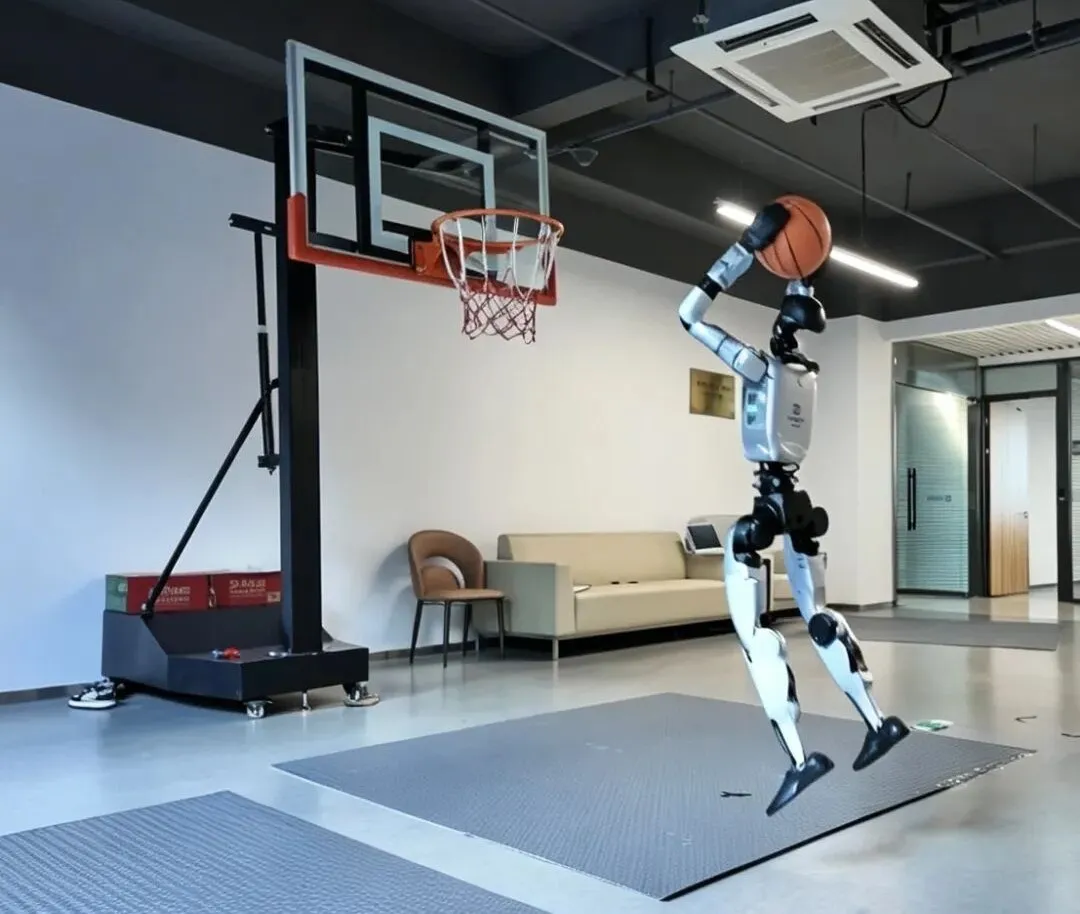
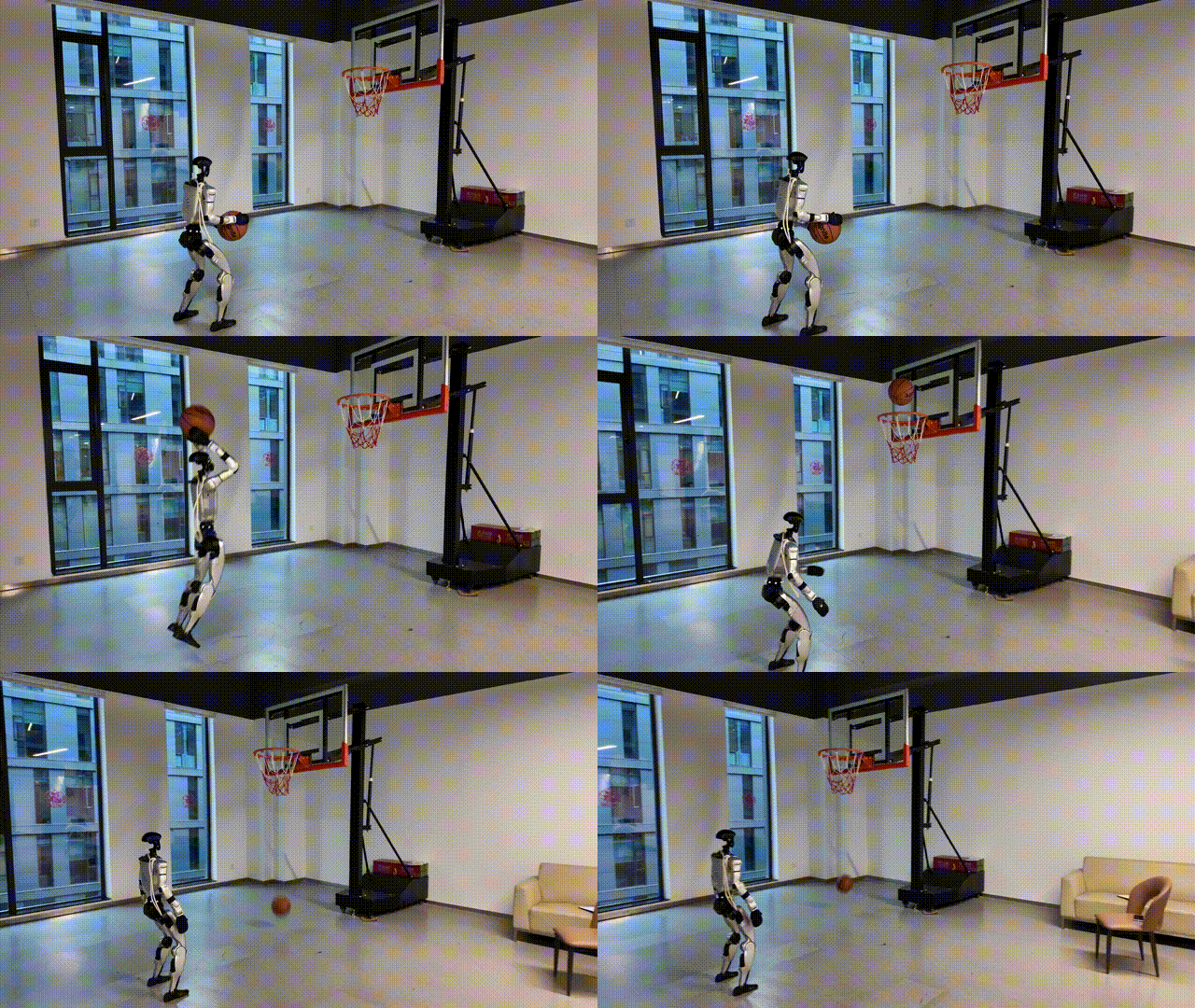
A human-shaped robot stands in front of a standard basket. It kneels down, weighs heavily, both legs are bent, the body bounces upwards; at the same time, the robot completes posture adjustment, the arm pushes the ball forward, the basket passes through the basket, and the robot then completes landing and buffering.
The next time, it didn't stand on its own shot, but went off empty-handed.
This is the world's first publicly realized humanoid robot to perform multiple full-body shooting movements.
If you look at the results, it's just that the robot has learned a few basketball moves. But if you pull the lens away, the Robotics Conference believes that it doesn't mean basketball.
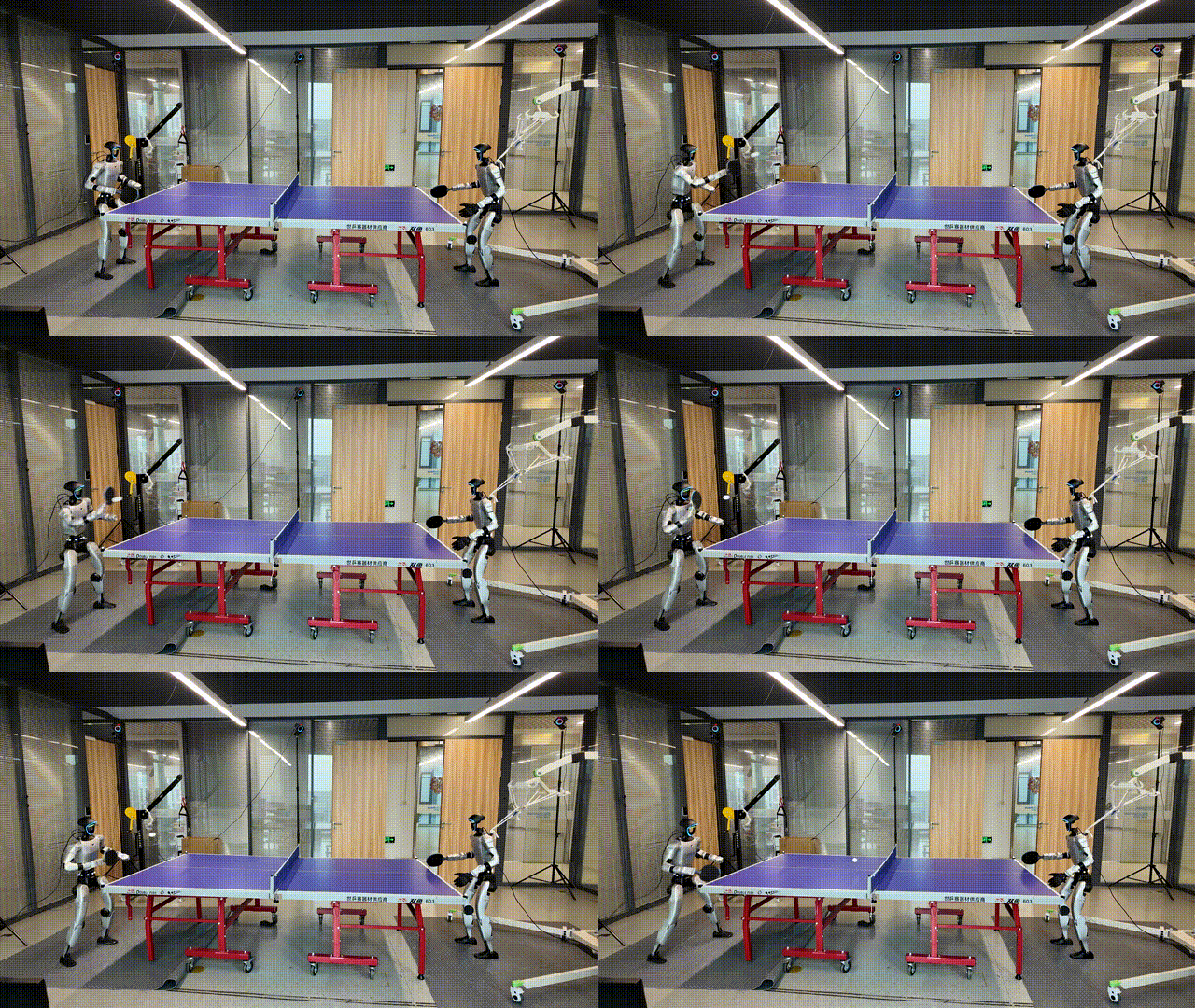
In places like the WRC, robots play ping-pong as well. Because if shooting tests are full-body explosions, aerial gestures and landing buffers, then ping-pong testing is another limit: continuous perception, step adjustment, swing control and millisecond closure under high-speed balls. One biased to full-body dynamic projections, one biased to high-speed interactions, they together constitute two test stones in physical intelligence in athletics.

Over the past two years, the hottest discussions in the robotics industry have focused on big models, world models, and general intelligence. When did robots become the industry's most frequently asked question, when did they have a chip like GPT? But in the real physical world, there is a more troubling question.
Because language can make mistakes, and robots can't. A model can tell a robot to throw a three-point shot, but to actually execute this sentence, it needs to address simultaneous visual positioning, jump time, body weight, leg strength, dry posture, arm trajectory, wrist release, and landing buffers. Any link with tens of milliseconds or even smaller deviations, the last basketball may fly past the basket.
This is why athletics may be a special window to observe the evolution of physical intelligence. Sport is as complex without family services, but it limits robots' core capabilities of high-speed perception, dynamic decision-making, full-body coordination and physical interaction.
The robot industry has been waiting for decades, and this time, it has finally brought robots to the sports arena.
The company learned that, starting with sports such as basketball and table tennis, they are currently trying to answer another deeper question: Is it really possible for a humanoid robot to have a set of skills that can learn and evolve continuously?
01.
The GPT era is just around the corner, and people are starting to look for AlphaGo moments.
Over the past two years, the technological narrative in the robotics industry has become increasingly focused on the brain of a robot. Whoever has a bigger model, a stronger world model, more rich data, is likely to be closer to a general robot.
But the feedback from the real world is very straightforward. Because robots are not smart because they know what they're doing, but because they can do what they're doing and they actually have the ability to land.
Taking a shot is more than just lifting a hand and throwing the ball. To complete a complete jump, the system needs to sense the positioning of the basket and the ball in real time, precise control of the jump time, dynamic adjustment of the whole body's weight, coordination of leg strength, dry posture, arm movement trajectory, arm release strength.
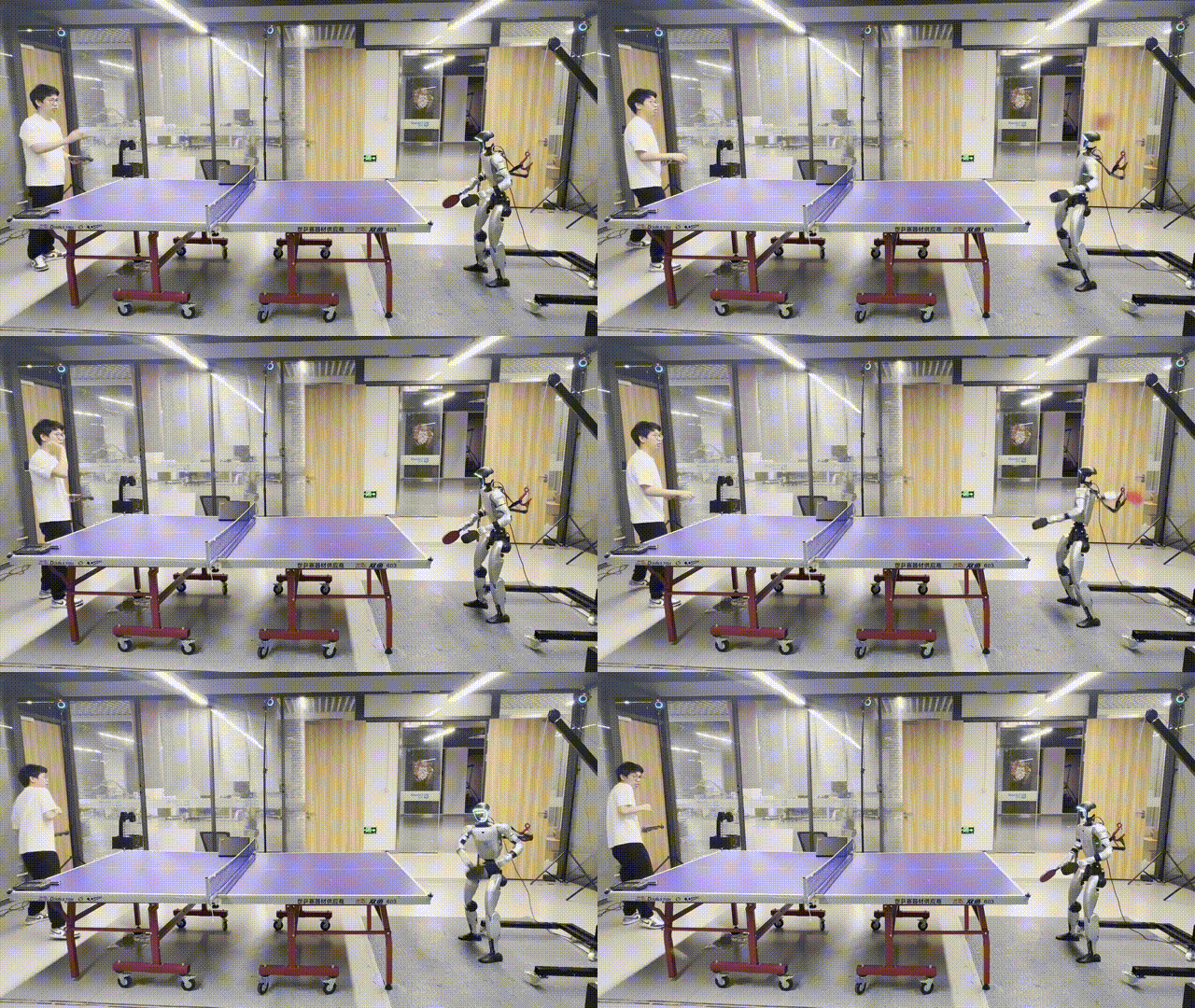
The challenges of table tennis are equally challenging. As demonstrated in the WRC, robots face the ball continuously, with constantly changing speed, rotation, and drop points, to complete identification, movement, pulling, hitting, and returning. It has no fixed trajectory, and every lap is a re-decision. This is the value of table tennis as a testing ground for physical intelligence: the rules are clear, but the process is highly uncertain; the results are direct, but the execution window is extremely short.
Industrial robots are good at determination scenarios, fixed positions, fixed trajectories, everything can be predicted beforehand. But ball movement is exactly the opposite, the environmental rules are clear but full of dynamic uncertainty: the position of the ball changes at a moment's notice, the robot's own physical state changes continuously, and all movements require a high-speed response.
Whether the goal is scored, whether the ball is returned, the results are direct, feedback quantified. This also makes the basketball court, the table tennis court, an excellent physical testing ground with physical intelligence. It compresses these core capabilities of high-speed perception, dynamic decision-making, full-body coordination, physical interaction in a very short time, forcing robots to become real sports decision-makers instead of mechanical replicators.
AlphaGo shook the industry not because it played the game of Go, but because it evolved autonomously beyond human experience in a clear and quantifiable environment of rules and feedback. Today, basketball and table tennis courts are becoming the chessboard for humanoid robots.
Unlike pure virtual chess games, robots must face the inertia of the real world, collisions, friction, sensor delays and uncertainty of all kinds. The problem here is not how many beautiful words a model can produce, but whether it can convert abstract instructions into stable and reliable real actions in the physical world.
If these events are put together, what they really constitute is not a bunch of robotic sports performances, but a gradually clear technical pathway. From single action to dynamic action; from fixed trajectory to complete coordination; from one success to continuous evolution of skills.
There is an interesting flaw in this with the GPT, which has chased the industry in the past. GPT proves that machines are able to understand and generate information. But with physical intelligence it must ultimately prove that machines can turn information into action and gain new experience after action.
The output of the former is Token. The output of the latter is skill.
What Intelligent Infinity is trying to do is to deepen this skill into the ability to learn, reproduce and migrate. This is closer to what the intelligent industry really wants, rather than a continuous evolution of skills.
02.
Disconnect and reconnect to understand and physically execute the scene
One of the pathways that is worth the industry's attention is the mind-boggling blur of technology.
On one side of the technological pathway is the Agentic brain, and on the other side is a system of basic models of the robot's physical abilities, including full-body operational base models and precision operating models.
From a technical architecture point of view, what it's trying to solve is an increasingly important problem in the corporate intelligence industry: how to connect high-scenic intelligence with lower corporate capabilities.
This actually corresponds to two long-standing but often confused questions in the process of physically intelligent landings. The first is what robots should do in the current scenario and the second is how exactly do robots do this?
The Agentic brain is closer to the former. It needs to understand the specific environment, organize perception, planning, decision making, and execution, and break down a complex task into a skill that the robot can call. For example, in a sports scenario, the robot is faced not with simple shots and shots, but with a series of state judgments: where the target is, what is the body's current state, when to jump, what actions to take, and how to restore balance the next step.
The basic model of full-body operation solves another problem: it requires robots to have language control, real-time motion generation and dynamic motion control capabilities to further transform human instructions into actions that the body can perform.
The relationship between the two is that the Agentic brain actually decides what a mouse does, and the basic model is responsible for making the body mouse do it.

In fact, this is an increasingly important architectural change after the intelligent move towards industrial landfill engineering.
Because a robot is not a blank piece of hardware. It has its own dynamic characteristics, sensor latency, executor response, and mechanical structure. A truly efficient, physically intelligent system must understand the relationship between the model and the body at the same time and enable it to actually execute this landing instruction.
Brain companies are often good at algorithmic models, but have limited understanding of the dynamics of robotic entities and the properties of the executors; traditional robotic enterprises are deeply engaged in mechanical hardware, data-driven AI capabilities are short-lived. Human robots are entering the engineering landing stage, and deep integration of mechanics, electrical control, dynamics, perceptual planning and AI algorithms is lacking.
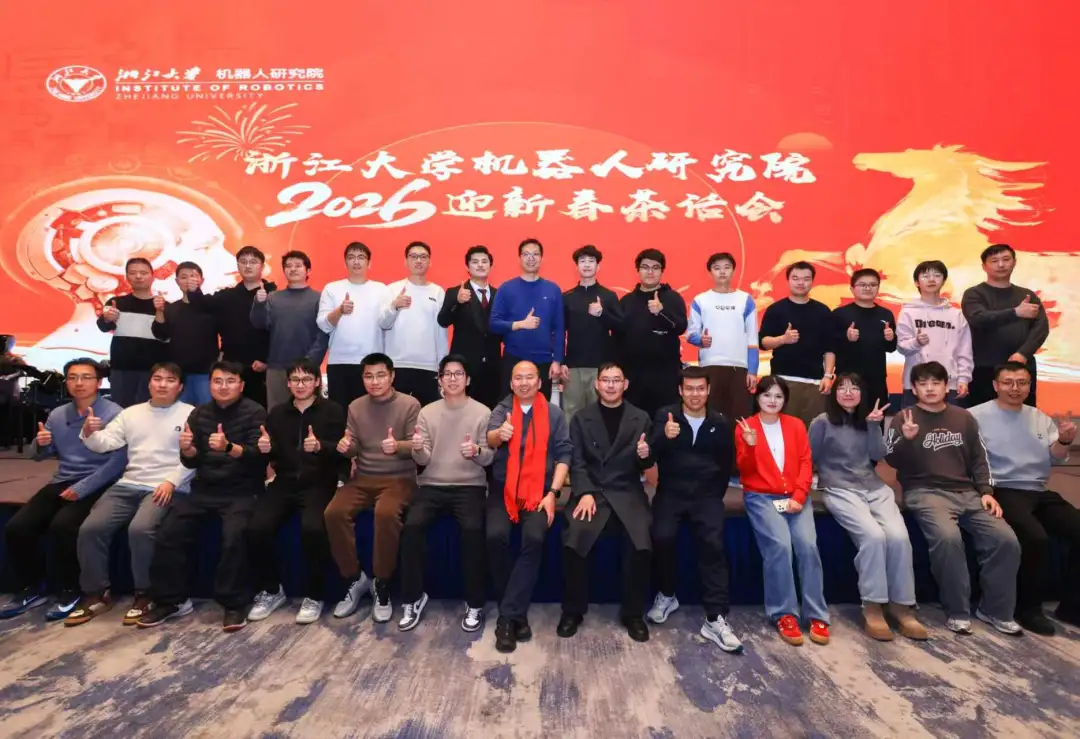
The team itself presents a more special combination: the team's concentration at Zhejiang University is extremely high, the company's name is derived from Zhejiang University's Cognitive Biology, Zhejiang University's Zhejiang Institute of Robotics, and was created and engineered by a team of small brains at Zhejiang University of Robotics. The company's founder and chief consultant is the former vice-secretary of the Zhejiang University Party Committee, Professor Zhejiang University of Robotics, founder and CEO of Zhejiang University of Robotics, and the former deputy executive director of the Zhejiang University of Robotics Research (Hangzhou Hefei Center for New Robotics Design).
The company's core technological backbone consists of several faculties such as Zhejiang University's School of Control, the School of Computer Science, the School of Artificial Intelligence, the School of Telecommunications and the School of Mechanics, while the company has also absorbed the R&D power of academia, the University of Hong Kong, and industries such as Ali, Netie, to form a short-lived interdisciplinary team of Robotics+AI+Control+Mechanical, which enables its technological path to proceed from systems engineering, to integrate mechanical, control perception, sports planning and models into the same system. This multidisciplinary interdisciplinary capability will become increasingly important after physical intelligence enters the engineering ground stage.
03.
Sports are just an entry point, and the real industry value is in the evolution of skills in cooking.
Athletics is not the ultimate market to enter. It is more like a technical verification ground. It verifies the speed at which this core asset is realized.
Intelligent business logic, not as an athletic sports company, but hoping to realize the AlphaGo moment in the athletic sports scene and then migrate to other scenes, eventually becoming a physically intelligent skills infrastructure company.
What is a Skill Evolution System? Simply put, it's the ability to develop, train and continually upgrade the real world for robots, like Appstore for mobile apps. But it's time-consuming not just to develop individual robot projects for customers, but to product the real world's workforce into replicable, deployable, sustainable robot skills. Through standardized skills development, training, deployment and evaluation processes, and authentically executing data-driven autonomous optimization locks, continuous production and evolution of robot skills.
Once this capability is deployed, there is an opportunity to migrate to other scenarios.
Because the real business imagination isn't about how many demos a robot can make, it's about how many robots, how many scenarios and how many industries a skill that has been trained can be copied into.
If the answer is only one, then it is still a project capability. If the answer can be a hundred, a thousand, or even more, then it begins to have infrastructure properties.
This is also a new division of labor that is emerging in the robotics industry. In the past, the industrial chain has largely revolved around mechanical structures, motors, decelerators, controllers, and integrated circuits; with the development of physical intelligence, a new layer of infrastructure around models, data, skills, and development platforms may emerge in the future.
Some people build bodies. Some people provide a general model. Some people are responsible for giving the body some kind of professional ability. Some people are responsible for organizing these capabilities to form a skill ecosystem that developers can use.
From this point of view, the positioning of the evolutionary system of artificial intelligence is that it hopes to solve a structural problem that has existed for a long time in the robotics industry: how to develop expensive, discrete, expert experience-based robotic skills into standardized, portable, and replicable production processes that quickly bring all sorts of robots to the real world.
04.
The real need for the robotics industry is to learn to grow faster and continue to evolve
From 2026 onwards, in fact, in the last few years, the human-robot industry has made a significant leap in capability.
Robots have moved from standing up, walking up, to grabbing, operating and complex movements; the arrival of large models has given them the ability to understand language, understand the environment, and understand tasks.
But from the lab to the industry, down to the ground, what really determines the limit may be how long it takes for a robot to learn a new skill, whether it will continue to evolve after learning this skill?
Because true universality is never about writing all the tasks in the system in advance, but about having the ability to learn and evolve at a lower cost when faced with unknown tasks.
A robot that can shoot doesn't mean it's a general robot. But if it can learn new ways of shooting in a shorter amount of time and transfer its full-body coordination capabilities to other dynamic tasks; if it can continue to work across different robot bodies, then what we're seeing is no longer just a demo, but a new way of producing robot capabilities.
Basketball is just a testing ground. Full-body shooting under the basket demonstrates the ability of a robot to perceive, make decisions, operate, and operate in highly dynamic, high-physical interaction scenarios. It does not verify the ability of a robot to put a ball in the basket, but the ability of a robot to take one successful move and immerse it in the starting point for next learning.
If the robotics industry in the past was trying to figure out how to make robots, then the next competition is likely to be gradually shifted to robots that can learn to work faster in the real world after they are created.
And this time, the answer may not be in the larger model.
It may lie between models, bodies, data, skills, and real physical environments, a link that has never been actually opened before.