The monthly production exceeds 90,000 units, but demand is starting to shift?
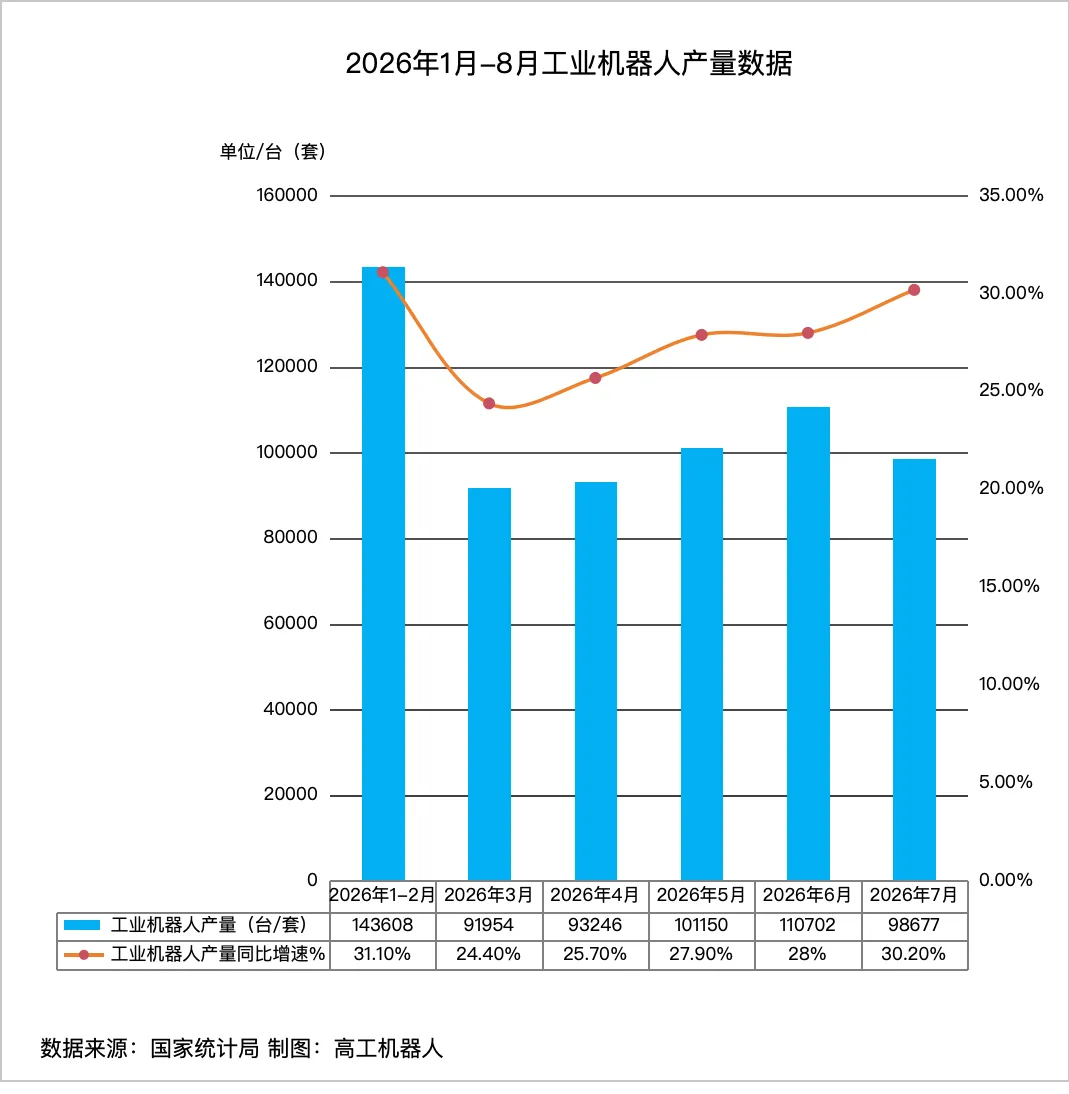
During the whole year, the total production for 1 August reached 91,000 units per month, and in 9 December alone, about 68,000 units per month were produced, which was the first time that the annual production of industrial robots exceeded 1 million units.
Production maintains a high position and is dependent on downstream demand. However, in contrast to traditional logics that rely on the procurement of newly-built capacity traction equipment, this year's demand for industrial robots is supported more by the upgrading of inventory production lines, and the expansion of a few high-tech industries such as lithium-ion, semiconductors. This feature is evident in both investment data and downstream industry production data, which also determines the main source of order growth for industrial robot enterprises this year.
From an industrial perspective, the main users of robots are expanding rapidly. In August, the increase in the value of large-scale equipment manufacturing grew by 12.1%, accounting for 38.3% of the total installed industry, an increase of 2.2%, and 8 equipment industries all achieved growth; the increase in the value of high-tech manufacturing grew by 16.7%, the cumulative growth in August was 14.2%, significantly faster than the growth of 5.3% of the conventional industry.
In terms of investments, the country's fixed-asset investments declined by 7.2% in August, while manufacturing investments declined by 2.3% in August. However, due to the continued impact of the two-tier policy, the contraction in equipment and equipment purchases grew by 9.3% and the share of total investments rose to 19.5%, reflecting the tendency of enterprise investments to focus on upgrading equipment and transforming production lines, which is an important scenario for releasing the demand for industrial robots.
Sectorally, electronics and semiconductors are one of the most concentrated areas of current expansion and investment in equipment. In August, the electronics industry increased in value by 17.2%, and the contribution to the growth of conventional industry reached 35.4%; in high-tech manufacturing, the manufacture of integrated circuits, the manufacture of electronic industrial special equipment increased in value by 101.5% and 31.2% respectively.
In August, the production of electric vehicles and new energy vehicles grew 31.0% and 21.9%, respectively, and overhead storage demand was booming, lithium-ion battery production grew 57.2%; in August, investment in lithium-ion battery manufacturing increased 20.6%, and the automotive industry increased in value by 7.4%.
In comparison, the demand for equipment in some new energy and consumer electronics industries remains weak, such as low visibility in the photovoltaic and smart phone industries, limited growth in demand for industrial robots, which means that the increase in orders for robotic enterprises this year is more due to the deep cultivation of high visibility segmentation races.
Export growth declined, high-end demand for imports warmedChina's exports of industrial robots grew by 48.7% in 2025, surpassing imports for the first time, and officially became a net exporter of industrial robots; into 2026, exports continued to grow on a high basis, with products sold to 141 countries and regions around the world in the first half of the year, but the growth is undergoing a significant shift.
Customs data shows that exports of industrial robots in the first quarter amounted to 316 million yuan, an increase of 42%; exports of 62.9 million yuan in the first half of the year, a decrease of 18.6%; growth in the first seven and eight months further decreased to 13.2% and 13% respectively.
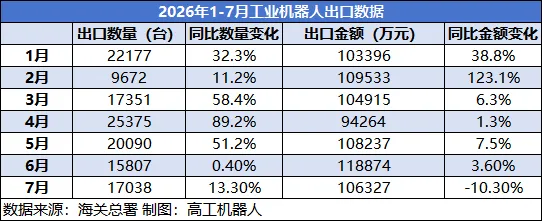
Product structure is the number one factor. According to statistics from the Digital Economy Laboratory of the University of Foreign Economy and Trade, in July, ordinary industrial robots exported $332 million, accounting for 31.3% of exports, but the growth rate decreased from 10.1% in the first quarter to 5.2%. Although collaboration robots and spraying robots exports grew at a high rate of 47.5% and 112.3% respectively, their share accounted for only 13.9% overall.
The second major factor was the cooling of the main market, with ASEAN and the European Union as China's main exports of industrial robots, accounting for nearly 50% of the volume of exports in the previous seven months, but fell by 24.6% and 37.2% respectively in July. Vietnam, while still the country's top market for industrial robot exports, declined by 8.4% in 1 July, while Brazil, Germany and Malaysia grew by 429.3%, 65.1% and 103.0%, respectively.
At the same time as exports and exchanges, imports have warmed significantly over the course of the year. Industrial robot imports amounted to $917 million in January and July, an increase of 11.2%, of which 16.4% and 12.9% in June and July respectively.
In terms of class, the gap is mainly reflected in the price and scale of the high-end product category. In the first half of the year, the single import price of collaborative robots was about 118,000 yuan, which is 2.5 times the single export price, and the single import price of resistor welding robots was about 1.6 times that of exports.
Changes in import data, on the one hand, reflect the expanded demand for high-end equipment in domestic manufacturing such as semiconductors, precision electronics, and on the other hand, suggest that there is still a long way to go to replace the high-added-value domestic applications of industrial robots.
Signs of change in decelerator production, new growth in industrial equipment
Overall, in the first eight months, the industrial robot industry has been operating at a high birth rate, export growth has shifted pace, import demand has warmed, and the pace of domestic and foreign demand growth has been markedly differentiated. From a year-round perspective, downtrends in the industrial chain are two signals worth continuing tracking, which will affect the trend of the industry in the fourth quarter and even next year, as well as the capacity planning and market layout judgement of the whole and parts enterprises.
Thanks to the accelerated landing of new technologies such as physical intelligence, human-machine collaboration, the production of robot accelerators grew by 63.9% in 2025, up 57.3% in the first half of this year, significantly faster than the production of industrial robots of 28.0% in the same period.
However, in July and August, the production of robot accelerators fell to 22.7% and 11.4%, respectively, while industrial robot production increased from 30.2% to 34.6% over the same period. Despite the impact of the elimination of the baseline, the production of robot accelerators in August grew at an average rate of about 19.7% over two years, still below the average growth rate of 24.1% for industrial robots.
At the same time, the decelerator head enterprises are still accelerating the expansion of production, and whether downstream demand can digest new capacity, will also affect the subsequent production movement. Currently, the deviation from the decelerator and the overall increase in speed, whether it is a phase reserve adjustment or a change in the pace of demand, remains to be verified by subsequent data.
Second is the growth space brought by the emerging categories. Compared to industrial robots, humanoid robots, four-legged robots are still small in size, but have also entered the mass production stage and have begun to penetrate rapidly into the industrial sector. The National Bureau of Statistics revealed that China's human robot shipments have increased to 97% worldwide; the Ministry of Industry and Communications expects the total production of humanoid robots to break 100,000 units this year.
At the current pace, the annual production of industrial robots is expected to exceed one million units for the first time. After crossing this threshold, the scale of industrial competitiveness is also changing. For example, exports are seen not only as growth, but also as price, brands and localized service capabilities; production is seen not only as turnover, but also as profitable quality; new categories are seen not only as shipments, but as operational capabilities in real production lines. These changes will determine whether Chinese industrial robots can enter a new growth curve.
(Note: The text quotes data from the National Bureau of Statistics, General Administration of Customs of the People's Republic of China; the cover is an AI mapping.)
In the midst of a surge of real progress, hundreds of millions of B rounds of financing have been secured, why is this domestic manufacturer of six-dimensional sensors being chased by capital?