Recently, more and more AI companies have taken a similar path: training their own models with the expertise and business experience they have accumulated.
In August, legal AI firm Harvey released its first open-weight model, Tenet, which was based on the Kimi K3 and has a 19.7 percent overall pass rate on the legal AI benchmark LAB, significantly higher than closed-source models such as Fable 5 (~11.5%) and GPT-5.6 Sol (~2.5%). The cost per single mission is $5.92, which is lower than the two closed-source models above.
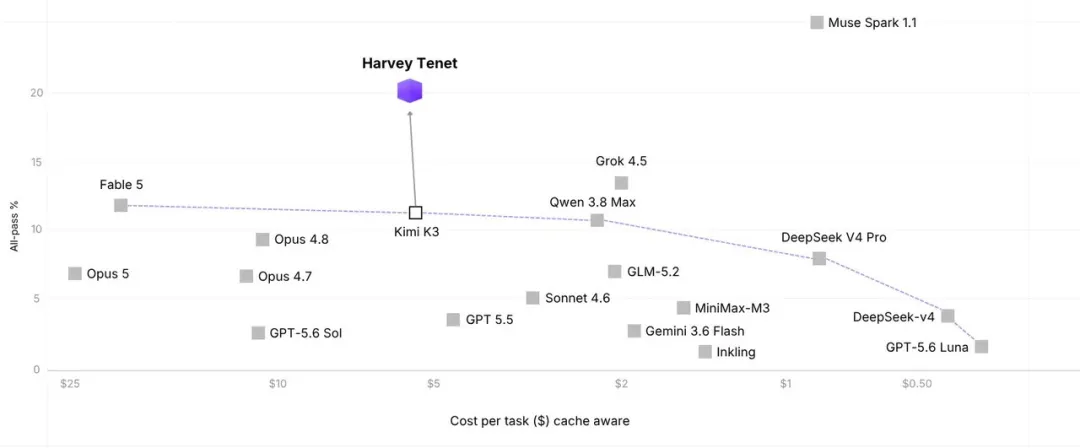
On the LAB release mission, Harvey Tenet achieved a 19.7% overall pass rate at a single mission cost of about $5.92, which was higher than Fable 5 and GPT-5.6 Sol, with significantly lower costs.
This has also prompted some netizens to exclaim: "Are even companies investing in OpenAI starting to train their own models?"
Mercor co-founder and CEO Brendan Foody describes Harvey as the pioneer of "mastering autonomous intelligence" in the application-level AI enterprise.
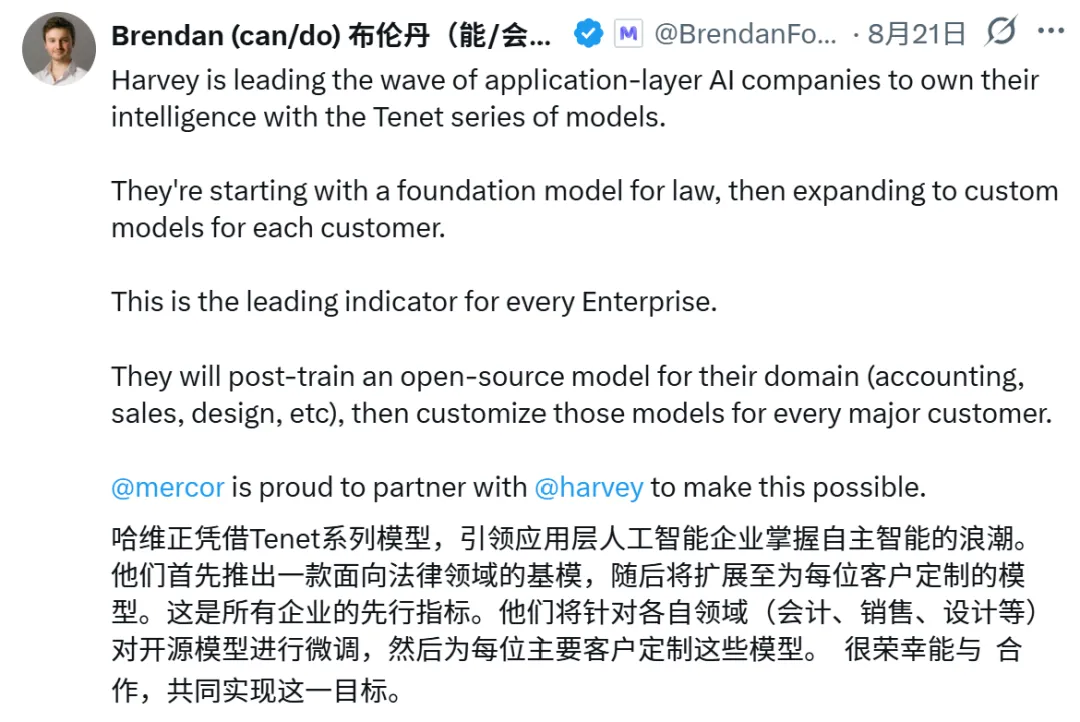
Brendan Foody believes that enterprises in the future may first train open models for specific areas such as accounting, sales, and design, and then provide further customization for important customers.
Closed-source model APIs reduce the barrier to the use of AI by enterprises, but if core capabilities depend on external models in the long run, products are also affected by the terms of service, model updates, price and supply stability. It is difficult for enterprises to determine how models are generated, and it is difficult for enterprises to judge the accumulated data and business to be truly dependent on their assets.
But at the same time, model training is becoming increasingly difficult. As open models move from 10 billion parameters to 100 billion parameters, the arithmetic and engineering complexity required to train is also increasing.
This puts companies under similar pressure to AI labs, with no dedicated Infra teams, and difficulty in building and maintaining large-scale training clusters independently; even with Infra teams, continuous adaptation to different models and algorithms, maintenance of training environments and scheduling resources requires significant human resources.
The open model reduces the threshold for weight gain without simultaneously lowering the threshold for the training model.
Now, there is a new solution to this threshold.
Emotion machines introduced a large model training platform called PyTRIO, which encapsulates the computing and underlying engineering required for training into the Training API. Users control data, Loss, Reward, and training logic locally, requiring GPU computation to be sent to the cloud via the API; underlying tasks such as environmental configuration, distributed training, and cluster maintenance are handled by the platform.
PyTRIO's official website:
The official document:
As a result, training capabilities also become a resource that can be accessed on demand through APIs. PyTRIO is presented as a TaaS training as a service paradigm: like calling a reasoning API, calling for large model training capabilities.
For enterprises, this means that models can no longer just be generalised from external leases, but can continue to shape model capabilities with their own data and really take control of models in their own hands.
From professional data to exclusive models,
Self-training as a new river
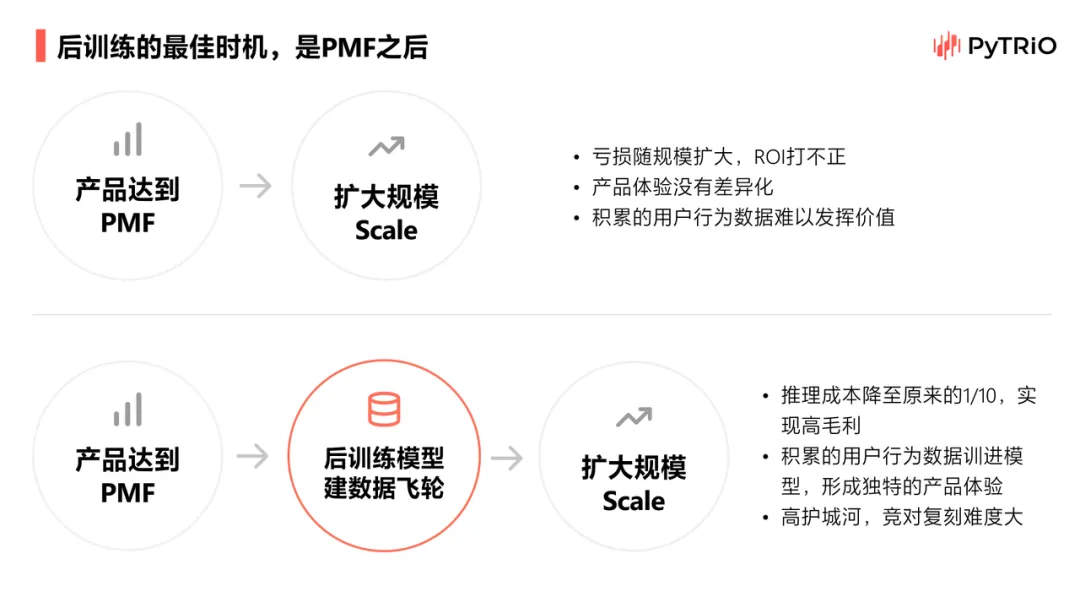
When an AI company is just starting out, the most pressing challenge is usually to verify that the product is in real need, i.e. to find the PMF (Product-Market Fit, product market fit).
At an uncertain stage of market feedback, teams need to make products as quickly as possible, reach out to users and adjust directions. In this case, directly calling the front-end model API is often more efficient, not only saving the cost of autonomous training and engineering inputs, but also facilitating the team to replace the underlying model at any time according to product needs.
As the PMF became clearer, product thinking began to change.
As users increase and products begin to accumulate real data, teams will gradually form a set of judgments of their own. At this point, it is difficult to convert these accumulations into the core capabilities of the product.
Post-training provides a place for these accumulations. Industry knowledge, business experience, and even the team's "taste" of the product can be entered into the model. Application interfaces and workflows are easily imitated, while long-term accumulated high-quality data, and the model behaviour that shapes these data, is difficult to replicate by competitors.
Moreover, in the future, companies will have more than one model - legal, customer, sales, R&D, face-to-face data, mission objectives and evaluation standards - which may vary from department to department, from scenarios to important customers, training a set of proprietary models of different sizes and capabilities and constantly updating them with new data.
Recent cases have confirmed the feasibility of this route.
Cursor's approach is representative. Composer 2 is based on Kimi K2.5, which uses both continuous pre-training and large-scale reinforcement learning in the training process, and also absorbs the feedback Cursor has accumulated from real products.
According to data released by Fireworks AI, Composer 2 is in the first tier on multiple programming benchmarks, and the cost of reasoning is only about 1/6 to 1/10 of the cost of the same front-end programming model. Those programming tasks, user feedback and evaluation standards that were originally scattered throughout the product's use have also begun to be directly involved in shaping model capabilities.
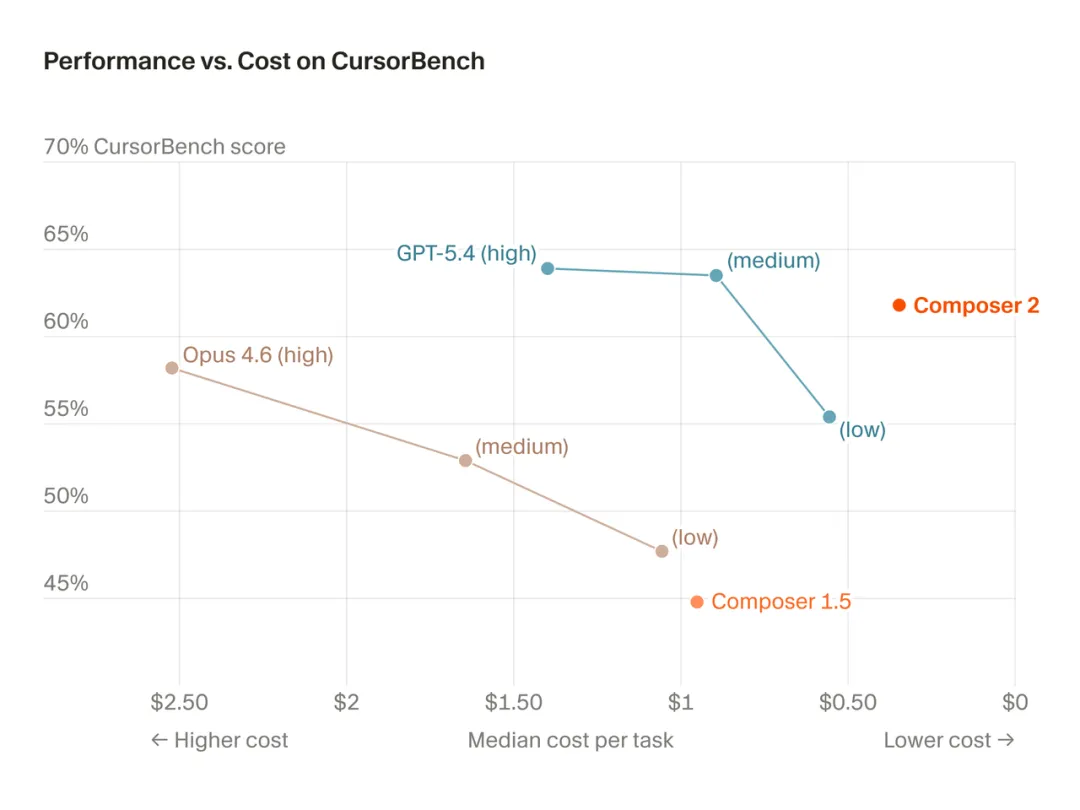
On the CursorBench, the cost of single-task reasoning is significantly lower while Composer 2 maintains the front-end model level. Source: Cursor
On the other hand, the accumulation of professional judgments can also transform into the core competitiveness of a product.
Bridgewater Fund and Thinking Machines Lab selected six categories of financial information screening tasks to conduct training based on Qwen3-235B and engage financial experts in data marking.
The results were straightforward: the model accuracy rate reached 84.7%, higher than the best front-end generic model in the test (78.2%). In return for the number of errors, the decrease was 29.8%; the cost of single-task reasoning was also reduced by 13.8 times.
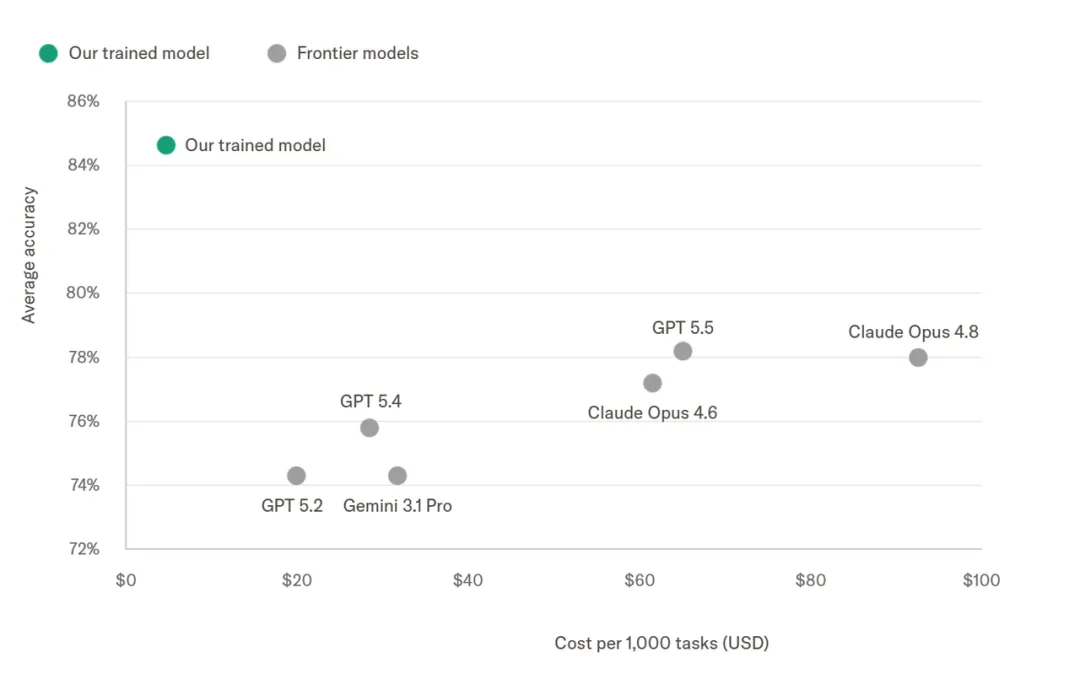
The Qwen3-235B, trained in expert data, achieved an average accuracy of 84.7% on six types of financial information screening missions, outperforming the front-end model, while calculating costs of about 1/13.8 of the latter. Source: Thinking Machines Lab, Bridgewater AIA Labs
For AI labs, the value of self-training is different.
As the focus of research expands from small model modeling to large model reinforcement learning, distillation, and Agentic RL, experiments envision increasing reliance on large-scale training conditions. Researchers can design Loss, Reward, and training cycles, but actual progress is often limited by a series of constraints such as CUDA environments, parallel strategies, and cluster modeling.
Mastering the capability of autonomous training means that the laboratory can proactively decide how models are learned and quickly validate new methods on larger open models. This gives researchers more full experimental space and more energy to return to algorithm design and results analysis, allowing the study to envision a faster conversion into verifiable model capabilities.
Whether it's embedding professional data into enterprise models or turning new approaches into verifiable modeling capabilities, the two kinds of demands ultimately address the same question: How can self-training be done more "consciously"?
PyTRIO: Making Big Model Training a Capacity for Calling
PyTRIO's idea is to break down the training process into user-controlled algorithmic layers and computational layers responsible for the platform.
The user installs the PyTRIO SDK in the local Python environment and continues to write data processing, loss, reward and training cycles; the batch required for each round of training is sent to the cloud via the API and computed by GPUs such as forward_backward, optim_step and sample.
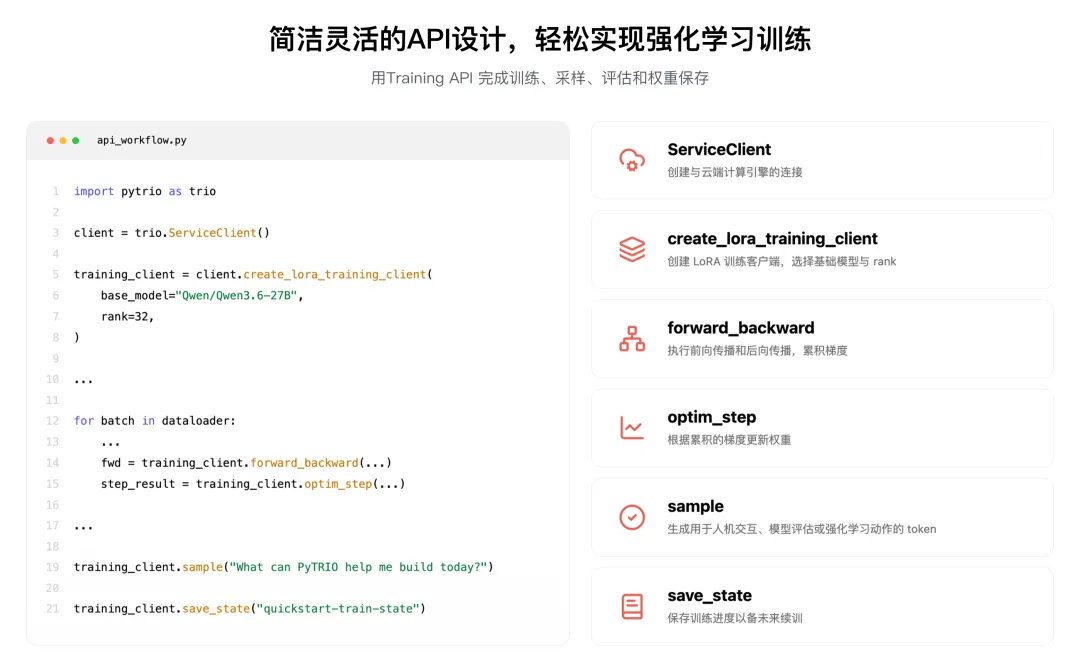
PyTRIO offers open training, sampling, evaluation and weight conservation capabilities through a set of programmable Training APIs.
This means that users retain control over algorithms and experimental processes without having to directly operate GPU clusters that carry computation. As long as they have a connected Python environment, MacBook, lightweight books, CPU workstations and even tree stumps, robots can start training tasks. The devices are only responsible for organizing experiments, and the real heavy computation is done remotely.
Compared to direct-lease GPUs, PyTRIO saves cluster environment building and Infra operation; compared to a "black box tuning" platform that uses only fixed data formats, algorithms, and parameters, the way the data is organized, algorithms, and training logic are still user-determined. It takes into account the convenience of hosting platforms and the algorithmic flexibility of direct-lease GPUs.
This programmable, on-demand training service constitutes a specific definition of TaaS by PyTRIO.
This model has been implemented in a variety of post-training scenarios.
It's about $13.30, about the price of a cup of tea. Can you believe this could be a training bill for a multi-round search for reinforcement learning experiments?
In PyTRIO's open-source Search-R1 experiment, developers used Qwen 3.5-4B and knowledgeable search backend to enable the model to master multiple search capabilities through reinforcement learning: the model needs to repeatedly query, read search results, and complete responses based on the information received. Such tasks require continuous interaction with external tools, a typical scenario for Agentic RL.
The whole experiment started from a connected CPU device. After 50 steps of training, the model's Macro EM (maximum accuracy matching) on the 70-way problem increased from 28.57% to 45.71%, and the format accuracy increased from 58.57% to 94.29%.
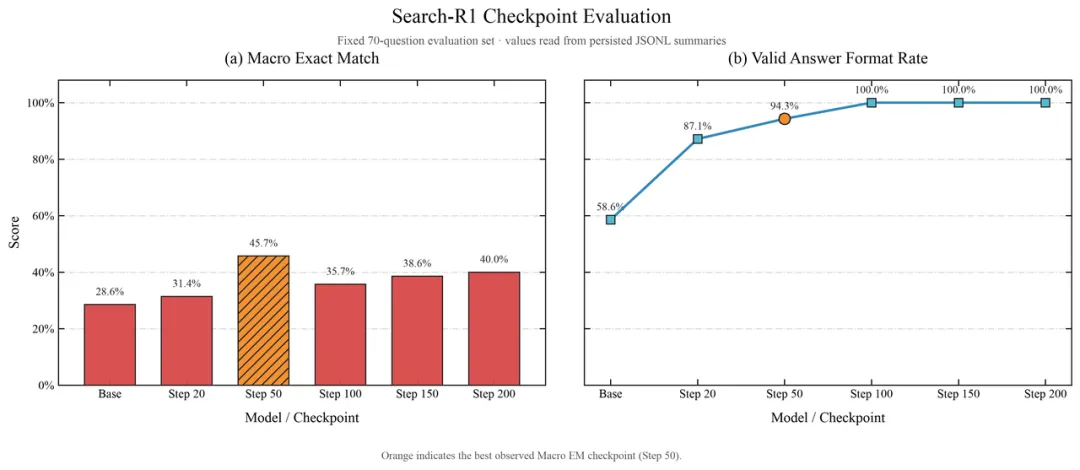
In the assessment of fixed 70 path problems, when the model trained to step 50, the macro EM increased from 28.57% to 45.71%, and the format correction rate increased from 58.57% to 94.29%.
If Search-R1 demonstrates how the Agent interacts with the external environment, the focus of the Medical OPD is on another common problem: how to avoid the degradation of the original general capabilities when the model gains professional competence.
Researchers first used Qwen3.5-4B for general medical SFTs. MedQA-zh scores in the model increased from 72.17% to 79%, while non-medical C-Eval scores dropped from 81.67% to 69.33%.
Subsequently, the researchers adopted the SAR-OPD scheme: first, let the medical model guide the student model's professional learning ability, and then use the original basic model as a "focus" to help it restore general competence. Following this process, the model scored 84.33% and 84.67% respectively on MedQA-zh and non-medical C-Eval, both indicators exceeding the original Qwen3.5-4B.
This group of experiments demonstrated how the Training API can support a multi-stage distillation process, allowing researchers to continue to look for ways to retain general competence while enhancing their professional competence.
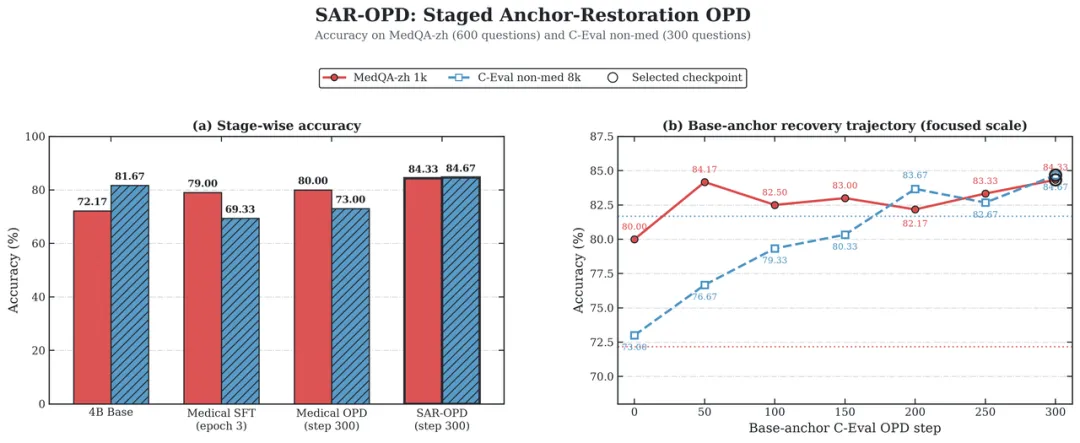
Normal medical SFTs improved MedQA-zh scores, but led to a decrease in non-medical C-Eval scores; after SAR-OPD training, the two indicators ended up at 84.33% and 84.67% respectively.
Images can also be entered into the same training process. Vision GRPO provides visual input for the model and trains it to answer geometrical questions through reinforcement learning. Qwen 3.5-4B increases accuracy from 71% to 87%, and format accuracy from 75% to 91% on 100 test subjects fixed to GeoQA.
Further dismantling finds that this improvement is largely due to the improvement in answering the format: in a sample that is already correct in the format, the model's conditional accuracy has increased from only 94.7% to 95.6%. The researchers can therefore continue to analyze which models specifically changed Reward's behavior rather than just getting a final score.
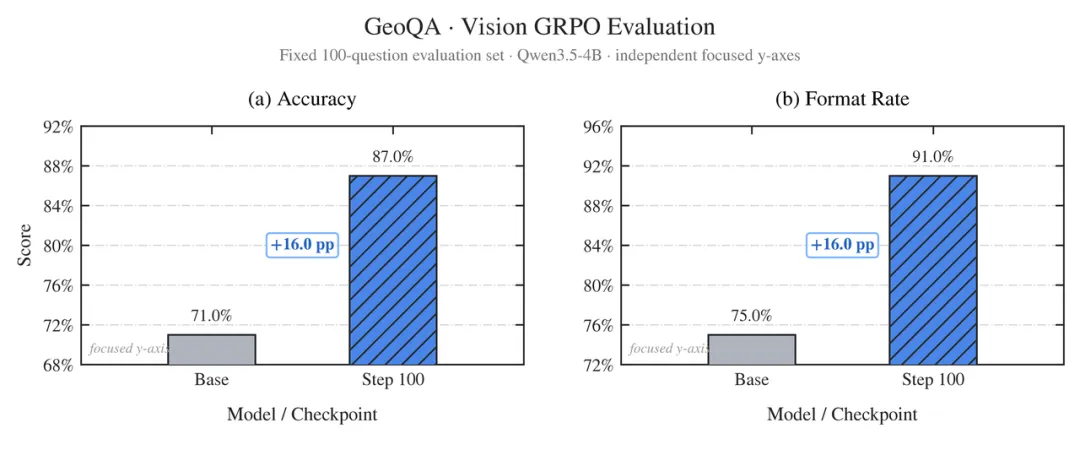
Following Vision GRPO training, Qwen 3.5-4B improved accuracy and formatting accuracy on the 100 fixed path questions in GeoQA by 16 percentage points.
From multiple searches, medical distilling to visual reinforcement learning, the three sets of experiments used different data, rewards, and training processes, all organized through the same set of Training APIs.
However, under the same interface, the pace of computing power consumption for different tasks is not the same.
In Search-R1, for example, a rollout involves the complete process of generating a model, calling a search tool and waiting for results, in which not every link is continuously occupied by a GPU for intensive computation.
For this type of long Rollout, with relatively small amounts of data, PyTRIO's shared clusters are billed as Token on demand, with teams paying only for the actual processed Token. Researchers can try different Reward and training paths at a lower cost without having to lease entire GPUs in advance.
Tasks such as SFT and data synthesis typically have a more continuous, stable computing load. For these types of training, as well as for enterprise teams with long-term use needs, the exclusive Training API is GPU-based and provides relatively fixed training resources.
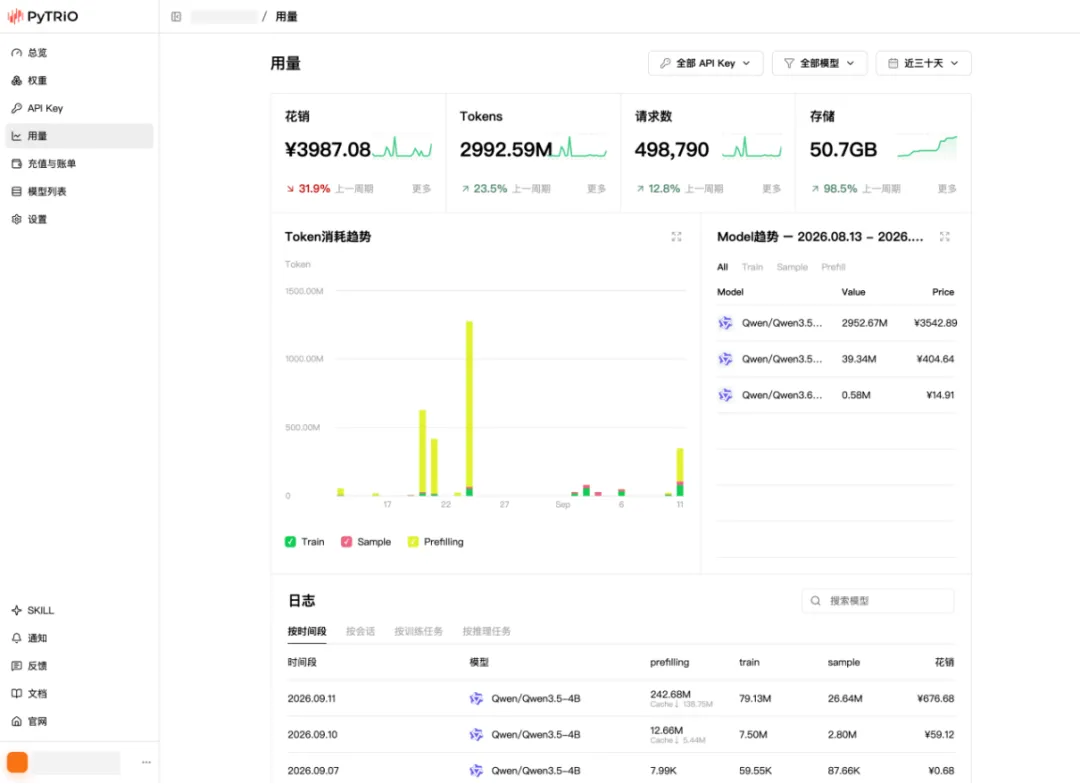
PyTRIO controllers can view Token consumption, number of requests, storage and spending by model and API Key.
The two models correspond to the demands of experimental resilience and stable production loads respectively. Teams can choose the method of billing based on the proportion of tasks generated, waited and intensive computation, so that the computational costs are more in line with the actual operation of the task.
More than a Training API!
Connecting computing, tool chains and continuous learning
The training API unifies not only training inputs, but also the way developers use different underlying algorithms.
Behind a chip is often a software ecosystem.
For example, when using different software packages, arithmetic libraries and communication programs, and when migrating training tasks, environments, arithmetic and distributed programs often have to be re-adapted, and underlying engineering almost needs to be done over and over again.
PyTRIO attempts to make the operation of replacing the chip more "smooth". Developers can be trained through the same set of Training API organizations, whether the task is run on Invidia or on elevation computing, the corresponding environmental configuration and adaptation work is done by the platform, and the upper training code can be as consistent as possible.
Currently, PyTRIO has completed adaptations to lifting models such as the 950PR, 910B and is capable of supporting large-scale training missions.
For domestic computing, this is equivalent to lowering the migration threshold for real training tasks. The algorithm team does not have to spend a lot of energy first to become familiar with the new underlying tools, and experiments have also made it easier to move to domestic chips, and the focus of migration work can go back to the model effect and the algorithmic efficiency itself.
From the point of view of the entire AI research and development process, PyTRIO is also an important step in improving the toolkit layout of the emotional machine.
Previously launched, SwanLab has covered experimental observation and management, helping researchers complete training visualization, experimental recording, version comparison and team collaboration; PyTRIO continues to enter the training execution linkage. The two are thus linked to research and development such as experiment initiation, execution, observation and completion.
SwanLab helps teams continue to track and analyze the model training process through training visualization, experimental recording and multi-experimental comparison.
In the continuous learning path envisioned by the emotional machine, the data generated by the application's interaction with the user can be re-introduced into the evaluation and training process. Which responses are effective or where the model fails may be the next round of optimization signals. Data drives model updates after being screened and processed, and updated models return to the application to receive new feedback.
If automation were to go forward, AI could also be involved in proposing research hypotheses, modifying experiment configurations, starting training and analyzing results, and then planning the next round of experiments accordingly.
These concepts are evolving gradually with the implementation of the training capability API. From chip adaptation to experimental management, to continuous learning with AutoResearch, as directed by PyTRIO, Training API is gradually becoming an infrastructure that connects application data, research logic and computational resources.
From calling for intelligence to controlling intelligence
Today, open weight allows more and more teams of different sizes to have the opportunity to shape models for the first time. However, there is still a small distance between downloading models and actually completing training.
For enterprises and laboratories, it's also the distance from "0" to "1". More valuable industry data, more research-intensive concepts that if they can't get into the training process, will ultimately stay in place.
PyTRIO is trying to shorten this distance as much as possible.
For AI startups, the Training API provides an opportunity to transform product data into differentiation capabilities; transition companies can further leverage industry knowledge and business experience; and AI labs can reduce underlying engineering's barriers to research efficiency.
In the long run, it may not be a one-size-fits-all model that a company needs to master, but a set of exclusive models that are tailored to different departments, business scenarios and customer needs that can be continuously updated.
If the reasoning API allows more teams to call on intelligence, then TaaS (Training as a Service) is aiming to make shaping intelligence a callable capability. PyTRIO hopes that through the Training API, more teams will be able to take a step closer to truly mastering their models.
When the model is truly controlled by the team, the boundaries of intelligence will be opened up.