In 2026, there was a significant change in the collaborative robot market: 30 kg and above loaded products began to enter the product matrix of mainstream enterprises. According to high-tech robots not complete statistics, since this year alone, companies such as ABB, Gambling Smart, China alongside robots, saving card robots, Anaka Motors, Taida, Kawasaki robots have successively launched new collaborative robot products weighing more than 30 kg.
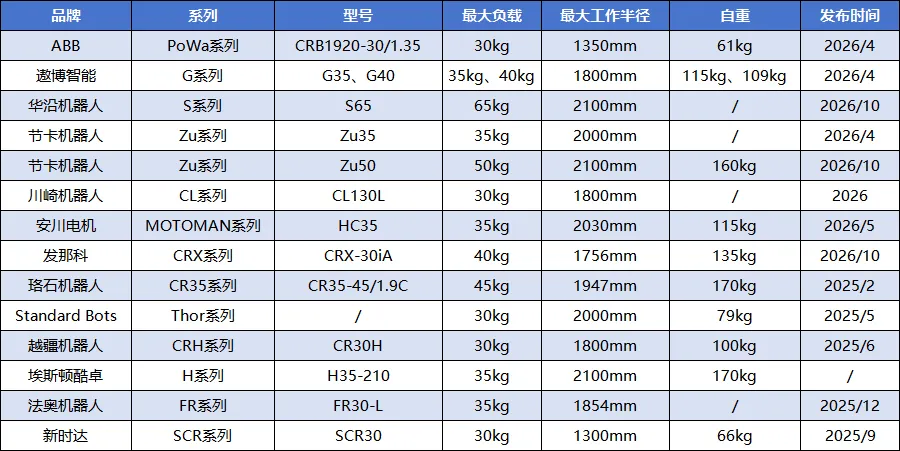
From the supply side, competition in the mid-low-load market is intensifying, pushing enterprises to expand into higher-load areas. In applications such as detection, assembly, screw locking and simple offloading, the basic functionality of different brands of products has gradually become the same, and price competition continues to increase.
On the application side, the direct force behind product-centric release comes from coding. Coding seems to be highly standardized, but in real life there are many traditional automation projects that are difficult to cover. For example, warehouse logistics companies often face frequent changes in SKU, limited production line space, coding location adjustment, and low seasonal capacity fluctuations.
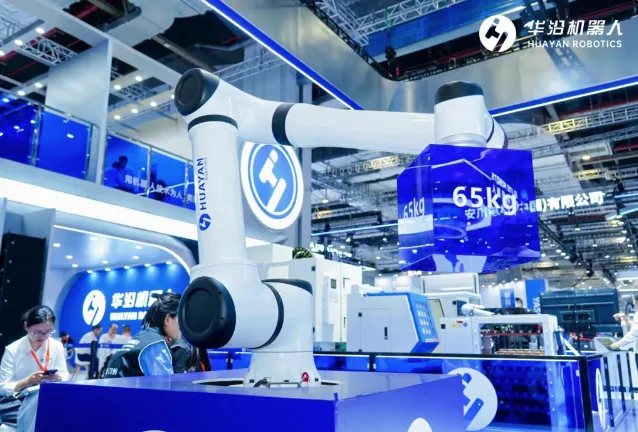
Image source: China alongside robots
Specifically, a carton loaded with 15-20 kg of items, combined with large-sized vacuum suction plates and terminal tools such as claw claw, the weight the robot needs to carry easily exceeds 25 kg, leaving a reduction in speed and safety surplus, 30 kg of load is the initial configuration. Therefore, only loads exceeding 30 kg are eligible for entry to the medium-size coding market, which can further cover applications such as food, beverages and chemical raw materials.
Another reason for the acceleration of the release of heavy-duty collaboration robots is the development of the corporate body business. Many large collaboration robotics companies have released human-powered control arms and intelligent robot products, and in the trend of embedded body-to-factory activation, they have begun to roll single-arm loads. Because after entering the factory, most of the body-to-body intelligent robots are taken over by heavy-duty vehicles such as container transfers, disassembly lines, and supply lines, the size of single-arm loads directly determines whether they can handle these tasks.
Collaborative robotics enterprises accumulate on loading joints, driving and safety controls, which can be balanced into physical products; after the volume of physical products, they will in turn mitigate the R&D and manufacturing costs of loading joints. The two business lines are mutually supportive and make manufacturers more willing to continue investing in loading collaborative robots.
I was able to get up and run fast from the elephant to the elephant.
Simultaneous advancement of lightening and acceleration
On the path to high loads, some companies have chosen the design direction of industrial collaboration robots, using structural design of industrial robots to make the load higher, such as the HX6 series of collaboration robots controlled by Washington to the maximum load of 80 kg, and the CR-35iB collaboration robots of the Genko family to the maximum load of 50 kg and so on.
Some companies continue to take advantage of the ease of deployment of collaborative robots and the flexibility of switching products, choosing to promote collaborative robot lightweighting.
For example, Bloomberg Smart has previously launched the 35kg collaboration robot iS35, but this year's G35 has reduced its weight by 1/3 compared to the iS35 under the assumption of 35kg load, and the arm span is still maintained at 2100mm.
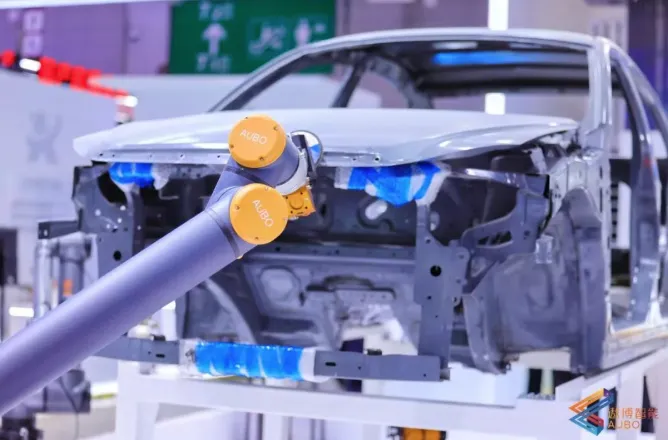
Image source: Gambling intelligence
On the one hand, companies are reducing redundant weights by optimizing the topology of joints, using high-strength alloys or composite materials to ensure structural rigidity. On the other hand, motors, accelerators, brakes and drivers are evolving towards higher torque densities and higher integration. High-voltage servo platforms, high-power density drivers and improved thermal dissipation designs can improve the output of joints without significantly increasing volume.
The CR30H uses topology-optimized joint structure and high-strength materials to reduce weight and thermal load by increasing the power density of the servo drive and reducing the number of parts; the Bloomberg G series uses 48V, 96V drive platforms and permanent magnetic braking to find a balance between high load, joint speed and weight.
In addition to weight reduction, the second apparent trend for overloaded collaborative robots is an increase in speed.
The CR30H reaches a maximum joint speed of 300°/s, with a maximum TCP speed of 6m/s, and in conjunction with the HyperMove motion control algorithm, the CR30H can achieve 10 boxes of beats per minute under specific coding conditions. This year's release, the Bloomberg G35, further increases the maximum joint speed to 336°/s, with a maximum TCP speed of 6.4m/s.
From the supply chain perspective, the seriesed supply of large-sized, large-torque coil accelerators also provides more choice space for the development of overloaded collaborative robots.
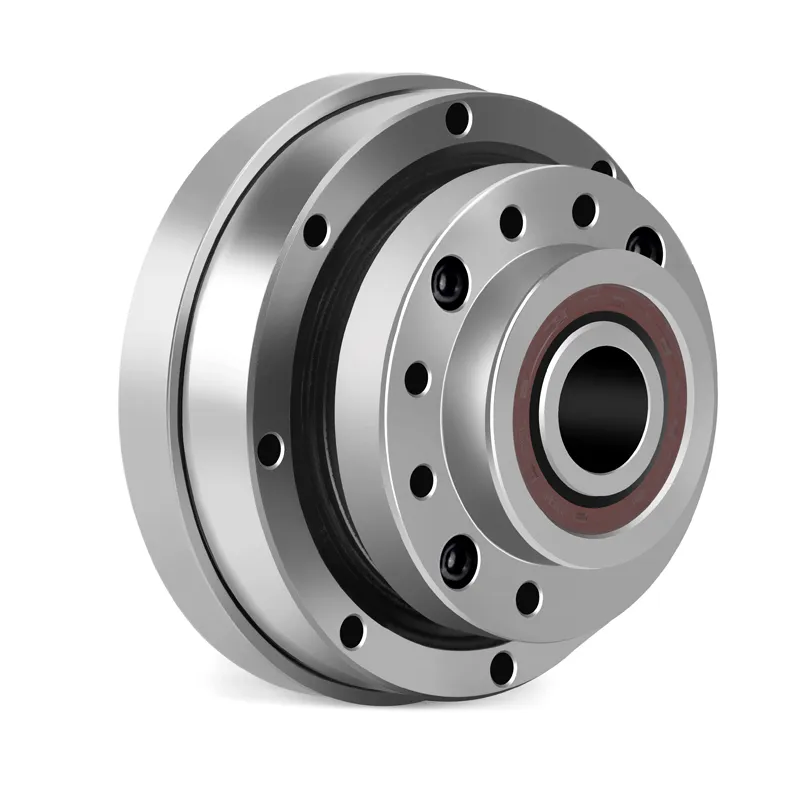
Image source: Foo Foo Fighters
In the past, industrial robots were the main customer group for these large torque reducers, while overloaded collaborative robots brought new growth.
The higher the load and the higher the speed
The more safe you can be, the more you can't stop just by hitting.
The nearer the load and speed range of conventional industrial robots, the higher the safety risks associated with human-to-machine collaboration. When a collaborative robot carries a load of 30 kg and a few kilograms of end-to-end tools running at high speeds, even if the mechanical arm is capable of collision detection and stops after contact, it is not necessarily able to control damage within acceptable limits.
For example, Bloomberg Smart emphasizes that uncontrolled movement with a load of more than 20 kg can cause serious damage, and in practical applications, it is still based on risk assessment to configure safety fences, shutters, or other protective measures. ABB's PoWa series opts for collision detection using current ring feedback, while using solutions such as SafeMove to achieve virtual barriers.
In overloaded high-speed applications, the mere reliance on power and power constraints is often not enough, often requiring multiple sensor integration technologies to ensure safe operation. For example, large-load collaboration robots along the S-series of robots in China, multiple safety sensing modules such as laser radars, electronic skin, can be actively lowered to stop when people or objects enter the robot's work area.
Therefore, even if this type of rechargeable robot is still defined as a rubber-collaborative robot barrel, it does not mean that the safety fence can be removed in any scenario, but that the entire application system, including end-tools, workpieces and surrounding equipment, needs to be verified. For collaborative robots weighing more than 30 kg, the combination of contactless safety sensing and collision detection makes more sense than simply improving collision sensitivity.
Written at the end
Reloaded collaboration robots are not simply a scaled-up version of traditional collaboration robots, but are shaping a clearer product evolutionary direction: with higher loads covering codes, food transportation and heavy loading, to minimize the flexibility of deployment, to narrow the pace gap with traditional industrial robots at higher end speeds, and to control security risks through force control, spatial perception and functional security systems.
As more and more manufacturers cross the 30kg threshold, market competition will shift away from whether or not they have a loaded product barrier, to whether or not they can run at higher speeds, maintain a reasonable load-to-weight ratio, and build improved safety solutions in real-world conditions. The threshold for loaded collaborative robots lies not only in the size of the rated load, but also in whether or not they can continue to meet real-world requirements for pace, stability, and deployment efficiency within clear safety limits.
These questions need to be addressed jointly by individual companies, core component suppliers, integrators and end users.
Around the technological breakthroughs and application practices of robots entering the real production line, from 15 to 16 December, high-tech robots invited industry chain peers to engage in an in-depth on-site exchange, starting from factory demand, to explore the path of upgrading of physical capabilities, the combination of high-tech technology and process scenarios, so that technology inputs can be transformed into customer measurable production value.
* Article cover for AI mapping