Big language model smart bodies are increasingly entering the scene of long-term companion chats where they no longer answer a question, but have a long-term relationship with the user.
This relationship poses a specific requirement for memory: the user will not repeat the same thing year after year with the same words, and the memory system will still have to retrieve the memory of the year when the wording, topic or context changes.
But today almost all long-term memory programs, whether underlying with vector libraries, graph databases, or other storage forms, share the same assumption in retrieval links: as long as queries and memories are "like" enough, memory can be recalled. This assumption is only created when memory and conversation have a literal or semantic similarity. However, in real conversations, the wording changes, the scene changes, and the memory still needs to be recalled.
T-Mem's solution is to reverse this hypothesis: instead of trying to find similarities while recovering, instead of saving the default scene that can trigger this memory as a bridge at the moment it is written, so that critical memories can still be recalled through scene memory and completely without semantic dialogue, allowing AI to learn how to use memory memory. This work has been received by the EMNLP 2026 main conference, with code data and open source.
T-Mem: Memory that Anticipates, Not Archives
Code and data:https://github.com/Sherlockwz/T-Mem
The paper:
One example is the Connected Blind Zone.
A few months ago, you said something to your regular AI assistant:
She is allergic to seafood and has been in the hospital for the past week.
You're going to have a dinner party next week, and you're going to have a hot discussion with your colleagues in the group, and you're going to go back and ask them:
Where are we going next week?
There is no semantic and literal similarity between the two phrases. But the organizers should of course think about this: team building should choose a restaurant, and, of course, considering everyone's preferences and taboos, the memory of "small seafood allergy" is precisely the key to the decision to "make a team and not just eat seafood".
A person who knows your AI should do this: When a query comes to "Where are we going", they automatically recall that "little piece of seafood allergy" a few months ago, and then give you a suggestion: "Don't go to the beach?
Similarity can't be reconciled: it only recognizes the literal image, the line between the memory of this example and the current dialogue, which is naturally invisible in its depths.
It's not that the system isn't working well, it's the structural blind sphere of the entire technological pathway. In the paper, we call this ability to "remember the past based on potential semantic associations" associative recall.
T-Mem: Memory is not for archiving, it is for being remembered
What T-Mem wants to do, one word makes it clear: make the memory of the moment it was written ready for "how it will be remembered in the future".
This is behind a classic concept in cognitive science: episodic future thinking: people remember the past, often not to archive, but to preview the future. The phrase "small seafood allergy" deserves to be remembered because it will be used in the future scenario of "Where are we going next week".
T-Mem engineered this mechanism: When writing memories, a set of "link clues" are pre-written for each memory, called triggers. With these clues, a memory can be found as "superficially similar" and remembered as "semantically relevant".
Returning to the recent example, the moment the phrase "small allergy to seafood" is written in memory, T-Mem asks a question: What is the future use of this information?
Maybe it's time to discuss what to eat.
It could also be a time for unitary medical examinations, unified statistical allergy histories.
These scenes are pre-recorded by T-Mem at the time of writing. You may be concerned that each memory is so paved that it will cost out of control.
And after a while, when T-Mem built us where we're going next week, "this scene really came, T-Mem flashed a pre-planned link to recall the clue (like the scene where the group set up a dinner to eat), and then it used that clue to recall the fact that it was allergic to seafood and pulled it from the depths of the memory and put it in front of AI.
One sentence: Similarity retrieval is waiting for you to open your mouth and T-Mem paves the way for your connection in advance.
A 2×2 square map with all the memory questions
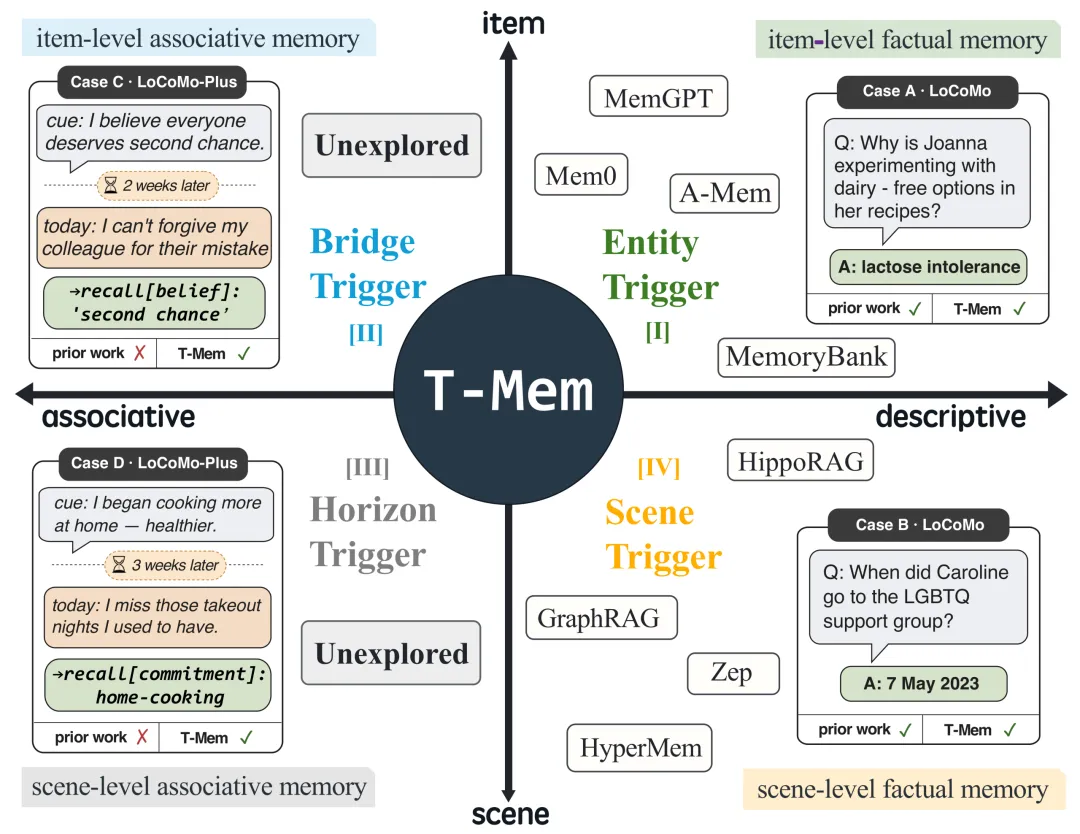
T-Mem model overview, showing the four-dimensional space of "memory particles (facts/scenes) x retrieval directions (descriptions/thinking) "
The idea of T-Mem modeling can be explained by a picture. Memory has two intersecting axes:
Directional axis: descriptive memory (based on similarity on the surface) vs relational memory (based on potential associations)
Axis of Granularity: Single Facts vs. Full Scenes
The mainstream memory system, divided into 2×2 quadrants, is almost entirely crammed into "description" on one side, and "link" on the other. The reason is that whether memory is stored as a vector or a graph, the last jump in the mainstream system retrieval is the same: take the current user query, select the "most like" item in the memory.
The practice of T-Mem is to fill this sequence of coordinates: each square has a trigger family, numbered QIQIV corresponds to the quadratic graph one-by-one. The two-dimensional description of QI entity triggering QIV scene triggering) is the strengthening of fact memory, the entity triggering a single fact labeling generalization of the scene triggering to write the whole scene into a multi-dimensional file, enhancing similar retrieval capacity. The real innovation is connected to two dimensions: bridge contacting QII) in fact particles predicting "what situation this fact will be used in", a small sea of sensitive memories, connected to the trigger line of the establishment of the dining room selection; front-end triggering QIII, such as in the pre-scene conversations, how many people would want to talk to you in a hospital in the near future, so that you don't have to go to the hospital for more than a few nights, so that you don't have to be intimidated about it.
One sentence summarizes the idea: similarity responds to "what you're like", and the trigger responds to "how you'll be remembered".
How to run a T-Mem: Write one and read two links
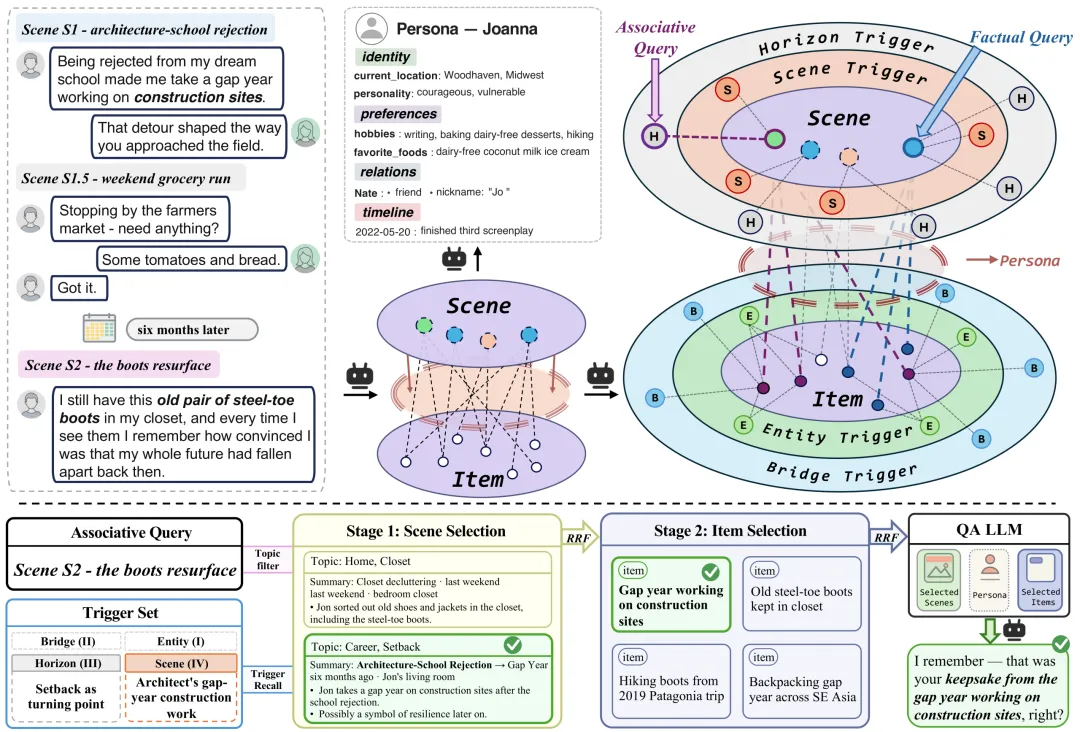
T-Mem then cuts the conversation into a single standalone scene with a full story, then puts multiple scenes under the same theme, then extracts the atomized fact entries from the scene, and connects the fact entries and constructs a scene. Finally, the Trigger, which combines the facts with each scene, triggers the memory to think about "what will be remembered in the future".
After receiving a question, T-Mem retrieves it step by step: first determine which topic the problem falls on, then select the relevant scenario under that topic, and finally extract the specific facts and give the model an answer. The key difference from the traditional scheme is that link threads are involved in the retrieval at the beginning: even if a problem has no superficial resemblance to a memory, as long as it literally "steps in the middle" of the memory thread, the memory will not be taken directly into the candidate, but by the subject through the gateway outside.
Once you have written one, it is good to correspond to the following two passages in the chart: all the preparations made when writing, all the preparations performed when reading.
Performance performance: two benchmarks, double refresh SOTA
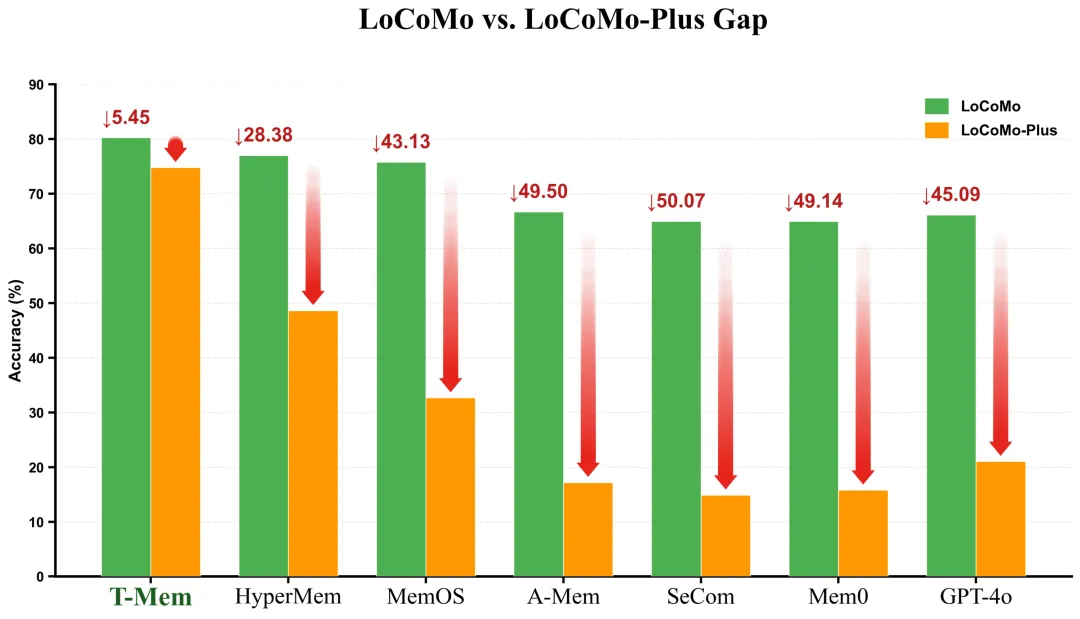
T-Mem scored double SOTAs on two memory benchmarks
On LoCoMo, the overall accuracy of T-Mem is 80.26%, updating SOTA;
It reached 74.81% on LoCoMo-Plus and also refreshed SOTA.
LoCoMo is the mainstream long-conversation fact-memory benchmark, but its theme is essentially similar: querying and memory-sharing are keywords, entities can hit, and there is not a single topic in the whole set that requires connectivity. T-Mem refreshes SOTA here, explaining its basic memory capabilities without losing any mainstream system.
The real test is LoCoMo-Plus. It deliberately adds a "cognitive subset" based on LoCoMo: it erases the semantic similarity between every question, clue, and answer in this subset, and connects to each other only by narrative or causal clues. Any system that relies on similarity retrieval here will fail directly. As far as we know, it is also the only public benchmark that can independently test "linked memory".
T-Mem's more prominent data is the cross-domain gap: the mainstream system dropped from LoCoMo to LoCoMo-Plus, dropping 28 to 50 percentage points on average, while T-Mem dropped only 5.45 percentage points.
This figure is precisely what T-Mem is trying to prove: memory is not an addition to the memory, but a half-sided capability that the similarity pathway lacks from the structure.
What is the meaning of this verse?
At the end of the paper, we cite a long-standing judgment in cognitive science, which is also the pinnacle of T-Mem design:
"A long-term memory system earns its adaptive value not by archiving the dialogue stream faithfully, but by anticipating, at write time, the future cues under which its contents will need to be reached".
What T-Mem wants to do is make this statement a reality: that memory is no longer an archive, but an answer prepared in advance for the future.
Researchers and engineers interested in conversational AI, intelligence, and long-term memory are welcome to pay attention, reproduce, and communicate.
Introduction by the author
The team of authors from Tencent PCG, whose main contributors include: Guo Wei-dong, Wang Da-kai, Liu Xiaobo, Liu Xiaobo and Xu Han, published work in EMNLP 2026. The team has long focused on research in the field of role-playing, and has published several papers in the fields of instructional follow-up, memory, and more.