It's the first time in the history of the world.
Last week, we were surprised by something.
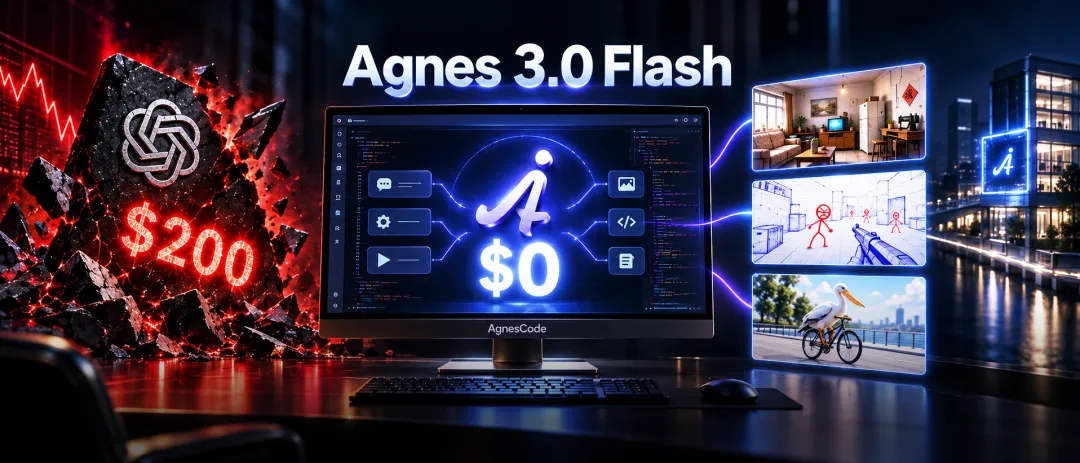
OpenAI announced on Thursday that it would shut down its $200 ChatGPT Pro suite entirely because the demand for computing from Astra was too high and OpenAI could not afford it.
Indeed, many developers have had the experience of looking at the wildly burning backdrop of Token and feeling that the wallet is costing too much to drop the blood!
Today, the execution capacity of the model and the cost of use together affect the ultimate experience, and what we need is AI to deliver a complete task.
The good news is that today, a massive upgrade and the perfect combination of all of the aforementioned "king fries" from the Agnes 3.0 Flash supermodel + AgnesCode desktop has arrived!
In the latest international authority list, its comprehensive intelligence level directly squeezed into the first tier; but most incredibly, its API calls, all! department! free! free!
Moreover, it's not just a web-based dialog box, it's actually "let AI help you complete the task" by embedding it in the desktop's AgnesCode.
Today, the question that concerns everyone most is: When AI really gets involved, will free models help users get the job done?
So let's take a look at how much zero-cost AI can help us improve our work efficiency.
One person, one computer, one free engineer
Currently, the free Agnes 3.0 Flash model is built into AgnesCode.
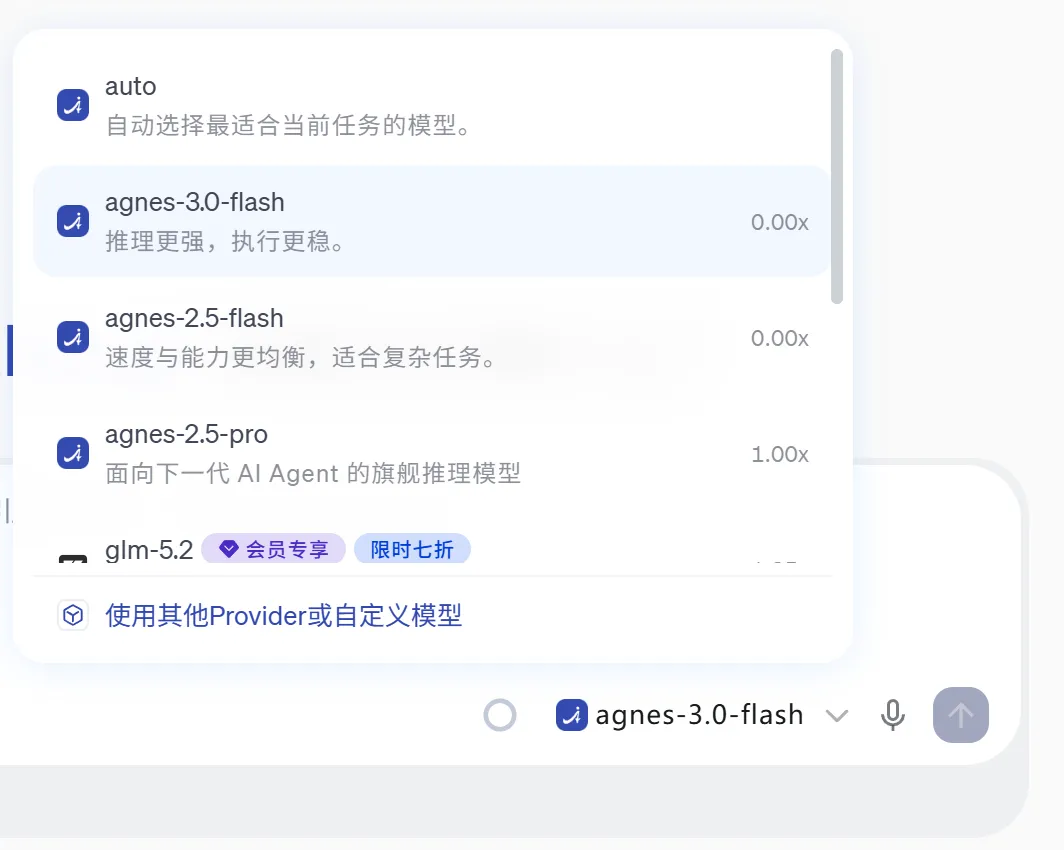
What is AgnesCode?
It's not just an editor, it's a desktop AI workstation introduced by Agnes AI.
It can integrate your local projects, model capabilities, Skills expansion and MCP into a single workspace. What's more, it supports real-world development directly through CLI in natural language.
We're going to test one below.
First, let it take a picture and make it an old house that you can walk into.
Note that the photo below is a copy of what we used to paint the Agnes model with its own image generating capabilities: "The living room of ordinary people in northern Chinese cities after 1997".
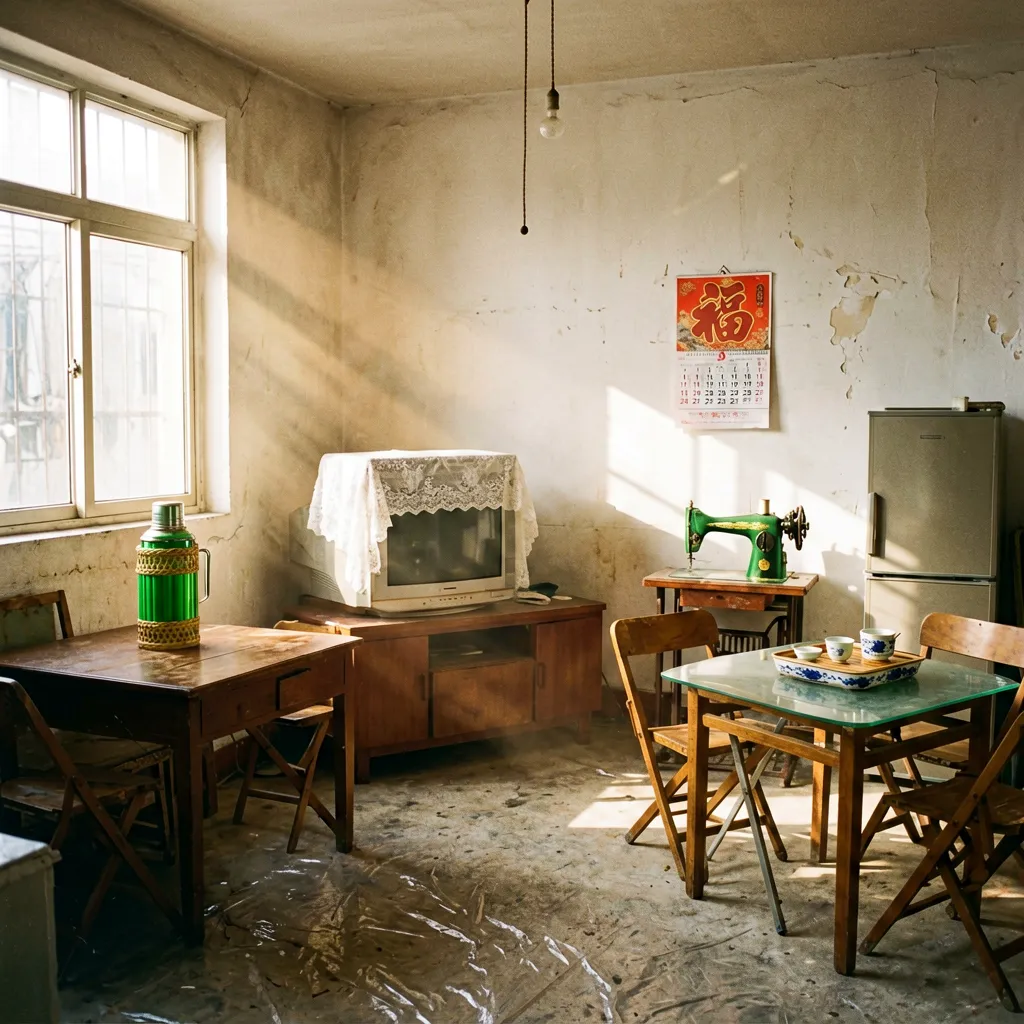
We then inserted the photo and let it replicate a 3D room based on the spatial relationships and furniture layout in the photo.
As a result, the output of AgnesCode was a surprise.
It's basically a first-person shooter game: with WASD, you can skate around the house, and then you can skate around with your mouse.


Scroll down and see
We tried to press "E" on the half-empty cords, and the lights were really bright, and the light bulbs would even blink like old light bulbs.
Then press E before going to the lightning bolt, and the screen instantly bursts full of snowflakes; and when you get to the fridge, the door can be pulled out.
The table and chairs in the house are flat, and you can move the whole house up and down, where you want to put it, where you want to put it, and play around with the R key, and you can put it all back in one key.
In the end, it did fit the whole set of sounds in the room: a crisp "shriek" of pulling the rope, the sound of the old TV piercing the snowflakes, the thick ringing sound when the refrigerator door was pulled.

Then we bring the difficulty up and make it a really playable game.
When I was in high school, who hadn't painted a mattress fight on the drawing paper of a math book?
This time, let's make it a first-person shooter game:
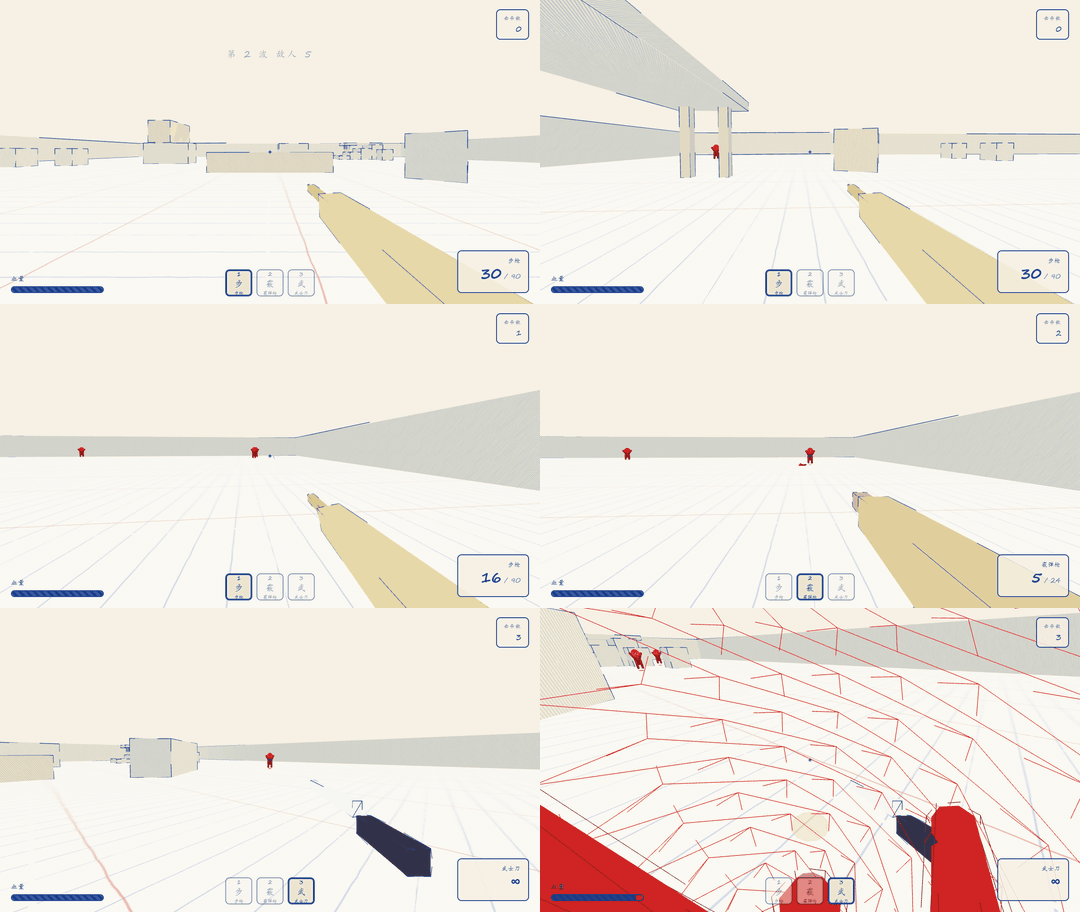
Use Vite + Three.js to create a playable first-person shooter game. The entire world is pictured on Yogurt's notebook: white paper, blue circle pencil outlines and line shadows, the enemy is a red mattress. WASD moves, mouse-pointing, left-key shooting, R-balls; provides rifles, shotguns and samurai knives, with a clear distinction.
In the first look, it was a Yogurt paper.
The containers in the distance are square pieces of circular pencils, similar to those painted on a laptop while attending class that year.
Finally, we made it a cycling cartoon with HTML and SVG.
This is something that everyone in the circle knows about. The famous developer, Simon Willison, has a crush on him: every time a new big model comes out, he tries to code for a picture of a bicycle rider.
Because of his short-legged face and the complex mechanical structure of his bicycle, he is simply a "ghost mirror" that tests AI's ability to understand space.
This time, we had a bit of a problem with Agnes' new model: getting it moving.
Using a single sheet of paper to write a circular animation, he could sit steadily on the wheelchair, with his wings hanging from the handlebars, and his two feet on the pedals; most importantly, the legs had to be naturally curved and stretched along with the pedal, not detached.
We were a little surprised by the web page that turned it in.

In the picture, the wheels are breathing, the ankles are stepping up, and the legs are perfectly matched to the rhythm of the mechanical movement.
Moreover, what makes this model feel more common sense is a small feature that it cuts off itself.
In the process, it realized that it was wrong: this contradicted the requirement of the title "Wings support the car handle".
Without any artificial intervention, it was entirely its brain that filled in the physical picture, blocking the logical loophole itself.
In summary, the experience after testing was that with AgnesCode + Agnes 3.0 Flash, the free model also started moving from "talking robots" to "full-fledged engineers who can actually work".
It's free and affordable.Agnes 3.0 Flash is breaking with computational anxiety
After testing the desktop, go back and see today's protagonist Agnes 3.0 Flash. It is fully available in AgnesCode and API.
In today's e-commerce, office, and development where AI is fully penetrating, a task often involves multiple steps, and the current upgrade of Agnes 3.0 Flash is the rush of AI coding, Agent and complex task work.
Official prices are still surprising, with the current price of all three token inputs, inputs and outputs in the cache life of the current API being $0, at zero cost.

The answer is, it will definitely surprise you!
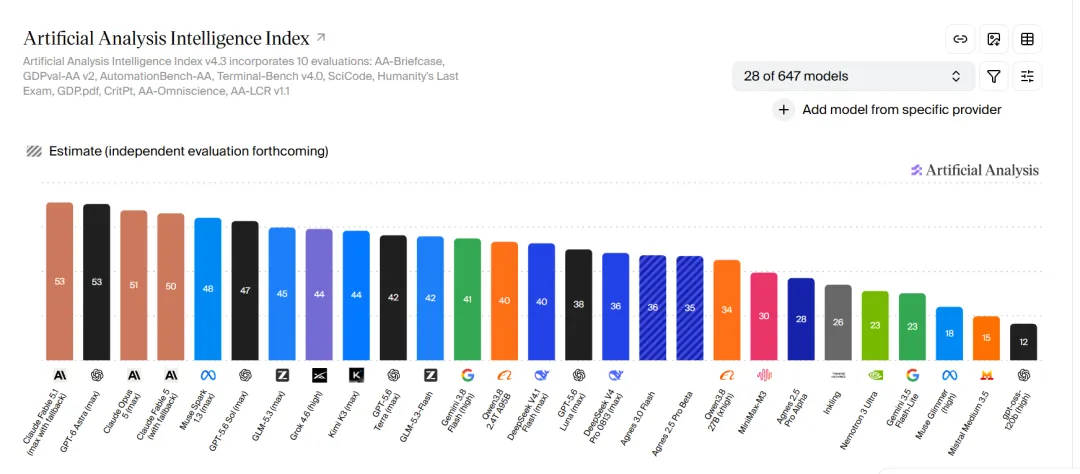
Let's take a look at the recently released Artificial Analysis authority rating list. In this comprehensive review that emphasizes real work tasks, tool execution, programming and complex reasoning, the results of Agnes 3.0 Flash stand out.
In Artificial Analysis Index v4.3, Agnes 3.0 Flash scored 36 points, and integrated intelligence performance has entered the current mainstream model ladder.
In Artificial Analysis's Smart Performance × Token price comparison, Agnes 3.0 Flash entered the most attractive range at around $0.03/million Token and is located at the forefront of Pareto.
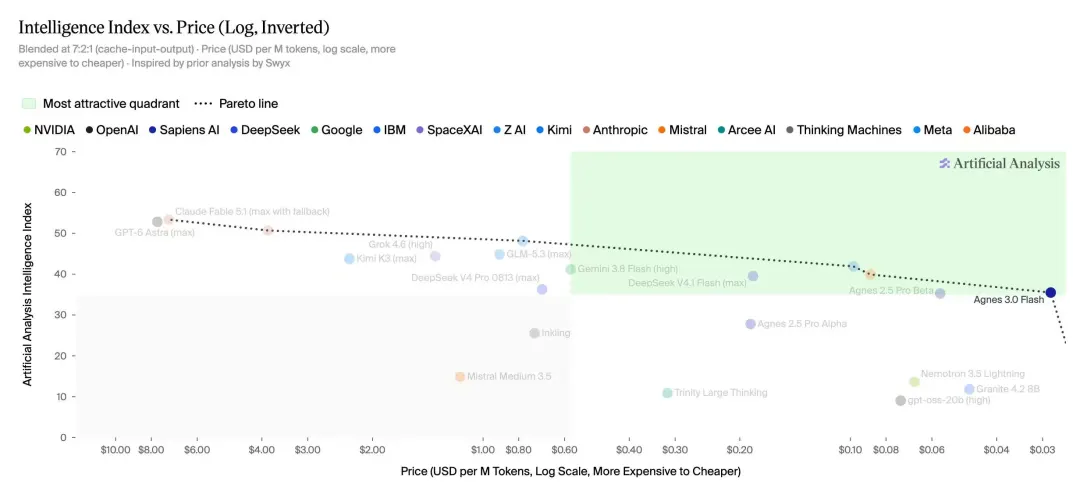
In developing and executing complex Agent tasks, we no longer have to worry about repeatedly modifying and consuming the tokens of crazy Debug.
You can do your best to let it try and make mistakes until it delivers the perfect results.
From the desktop to the physical world, AGH is on its way
If you think that the free model and AgnesCode are enough, then Agnes AI is putting in place a big picture that might make you even more excited.
Currently, AgnesCode primarily addresses the "super workstation" problem of developers on desktop computers.
But what about the complex business at the corporate level, how do you get Agent to really integrate into the company's approval flows, knowledge bases, and even the devices that control the physical world?
Agnes AI is exploring a brand new Agent Infrastructure product called Agnes Harness (AGH) and is slated for open source release in late September!
AGH's ambition is to provide an open Agent operating environment.
The worst part is its "public to exclusive" architecture: the underlying runtime is unified, but businesses can package their own private knowledge bases, databases, working codes, and verification rules into plugins by introducing the Agnes Package (FDE).
This means that in the future, not just code editors, your business systems, Ai-for-Science research scenes, and even programmable hardware will be able to interact with Agnes 3.0 Flash in a unified way.
AI capabilities will continue to perform complex tasks steadily in increasingly real-world scenarios.
The era of free AI is really coming.
Looking back on these two years of AI development, we have witnessed countless "parameter rallies".
But for those of you who really need AI, what touches me the most is this: "It's done, and no money!"
With 36 points on the AA list, Agnes 3.0 Flash demonstrates its "intelligence" and highest integrity at zero token cost.
When trying to make mistakes no longer requires cost and limits your creativity, all you have left is your imagination.
Start your free AI journey right now.
It's a great way to get your hands on the workstation of AgnesCode (instant experience built-in 3.0 Flash):