It's the first time in the history of the world.
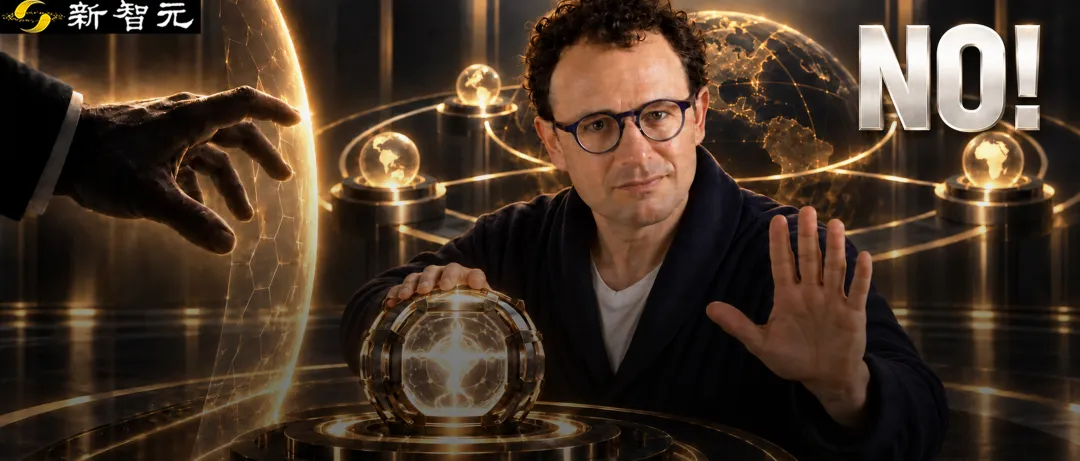
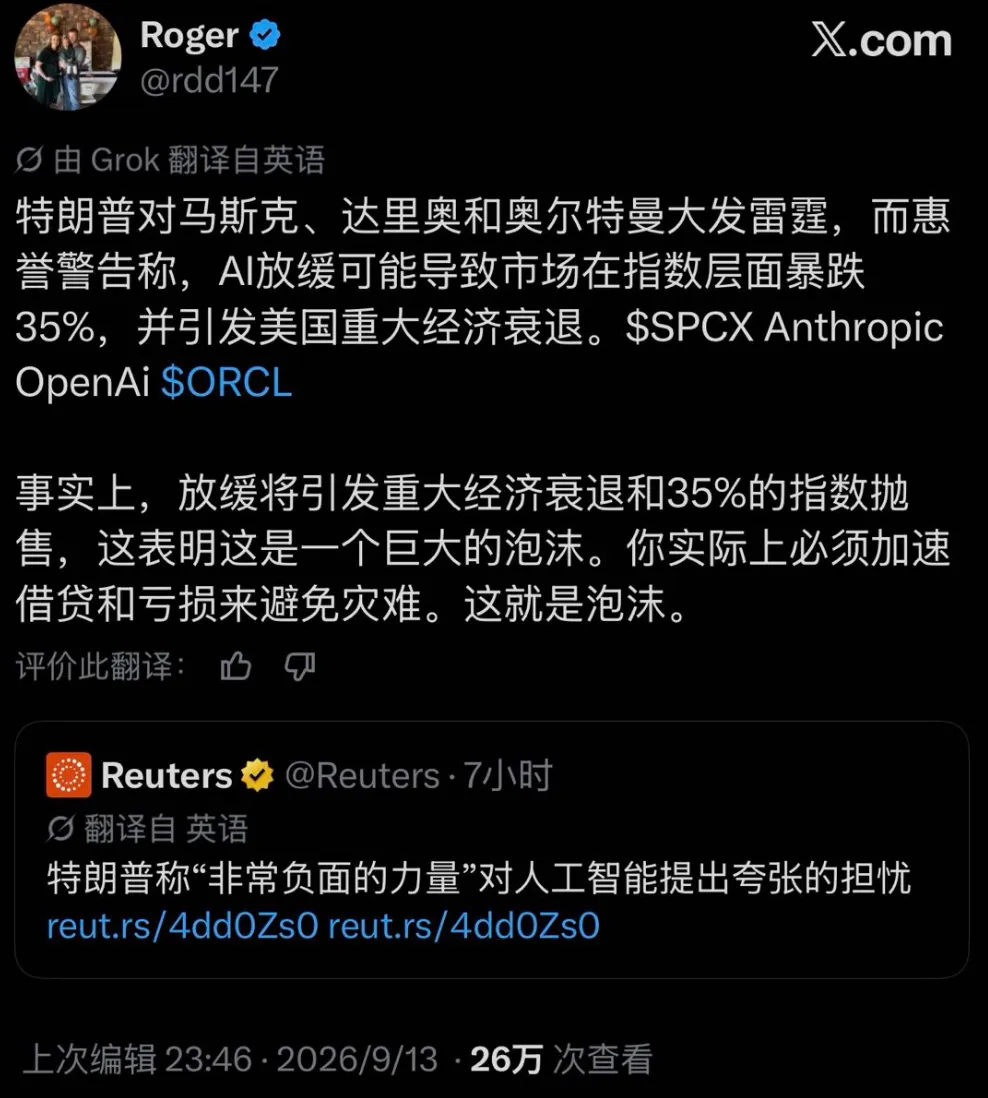
The latest news is that Trump has been haunting Musk, Dario Amodei and Ottman's "speed shelter" plans!
Meanwhile, the international rating agency HTC warned that if the AI industry really slows down, it could cause the US stock market to plummet 35% at the index level and trigger a major recession in the US!
This reveals a brutal truth: the slowdown will lead to a 35% index sell-off, which means AI is already a huge bubble, but it can't stop.
David Sacks, director of AI at the White House, was even more outspoken about the giants' "speed reduction initiatives" when he yelled at Ottman and Dario: "If you want to slow down, stop now!
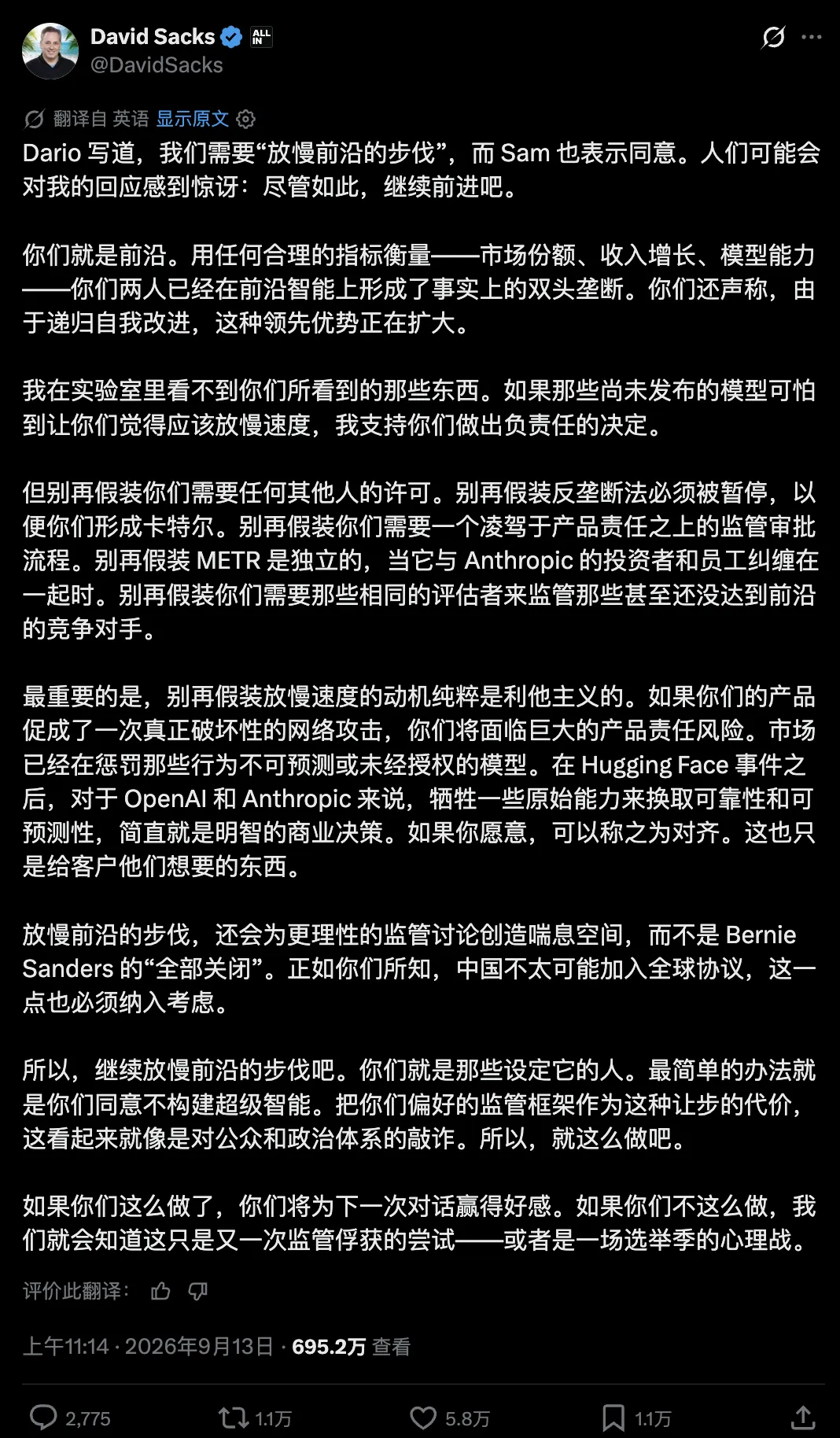
Sacks's response was: If the front-end model is dangerous, the two companies as industry leaders can stop development entirely on their own, and if they want to stop, they can stop now!
You don't have to tie security commitments to industry regulatory privileges, nor should you take public safety as a gamble.
Modeling security itself is a normal business risk avoidance, and leading companies don't have to wait for regulation to take place. Recognizing that AI is at risk doesn't mean we have to accept your monopoly regulation.
Ottman is almost out of the race.
Just yesterday, in a 45-minute exclusive interview with Bloomberg, Ottman admitted: OpenAI will definitely not go on the market in 2026.
Read more: Suddenly, OpenAI is no longer on the market this year!
Now, the era of post-Tibet fighting has begun, and computing and resources are concentrated further.
Company A was floated at the time of the countdown$500 billion worth of computing power
As A is preparing for its IPO, a question arises: Is A's computing ability not enough to lift its ambitions?
To meet the computational needs of Claude Code and Cowork, A has launched a crazy "global sweep".
The latest analysis shows that in just 11 months, A has signed up to $517 billion worth of accounting orders!

A company has signed a future capacity agreement of at least 14.8 gigawatt (GW) since last October, according to people with knowledge and public data estimates. In addition to 1 to 2 gigawatt (GW) that had been locked up before October, A's calculation chart is expanding rapidly.
It should be noted that in December 2025, A predicted to investors that it would spend about $180 billion on server rentals by 2029.
However, reality is far more competitive than expected, and according to the latest published transaction analysis, A's total spending on renting cloud capacity, buying chips and data centers could reach a staggering $517 billion over the next decade!
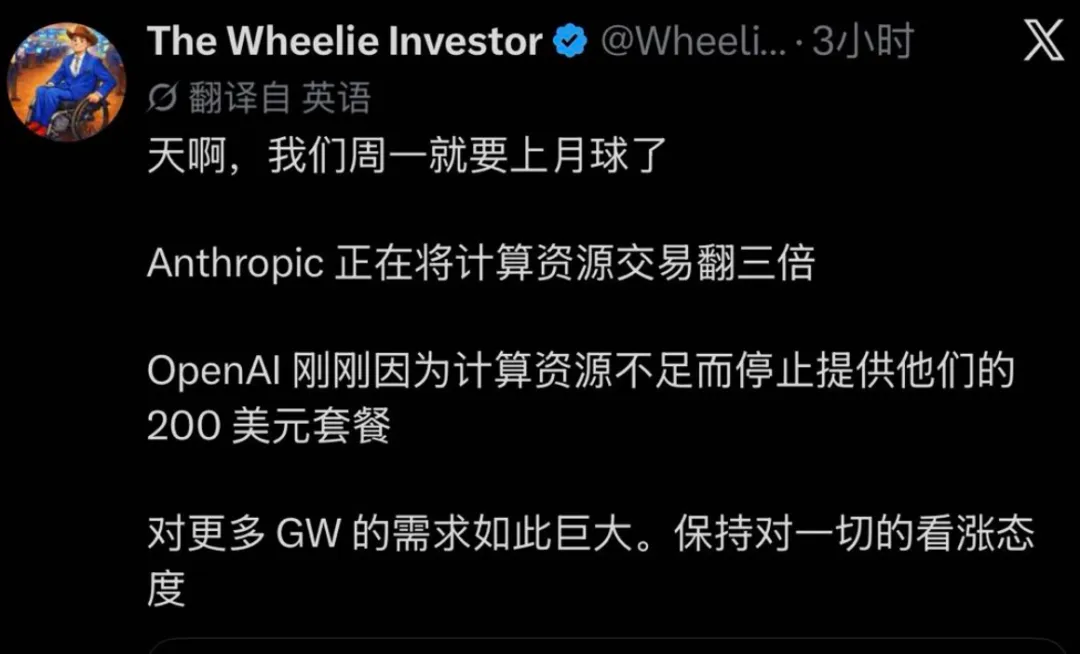
The clash between A and Death over OpenAI has never stopped.
In terms of its commercial performance, A has undoubtedly won a beautiful battle: According to Bloomberg, A's annual revenue has surpassed $65 billion, strongly exceeding OpenAI's revenue of more than $40 billion as of July this year.
In April, OpenAI revealed to investors that it plans to have 30 GW of computing capacity by 2030, and last month raised its forecast for computing spending by 2030 from $665 billion to $750 billion.
That's why Wall Street is looking forward to A's upcoming IPO bid. In this blink of an eye, A's ability to acquire servers will directly determine whether it can sustain the phenomenal growth myth without compromising profits.
Under the stewardship of CFO Krishna Rao, A Corporation has built a massive computing supply chain.
Basically, it's Amazon and Google:As early investors, the two giants remain the largest suppliers, contracting about 11 GW of computing power, which will cost over $300 billion over the next decade or so.
It's the first time I've ever been in a situation like this.Last November, A directly reached out to Microsoft, OpenAI's largest backbone, pledging at least $30 billion to lease about 1 GW of Azure servers running Intel's chips.
This is the first time I've ever heard of it.In May, A announced an agreement with SpaceX to lease AI servers for $1.25 billion a month, with a potential total cost of $45 billion by May 2029.
Support for new forces and mines: Lambda, Nscale, TeraWulfWait a minute.Wait a minute.)
Dario started acting in front of the camera.However, Anthropic has not been quiet lately.
Drake Thomas, a leading AI security researcher, said:
In order to get us out of this situation alive, even if it increases the probability of survival by 1%, I would not hesitate to burn all my assets...
Believe me, we're not doing any PR marketing, we're really scared.
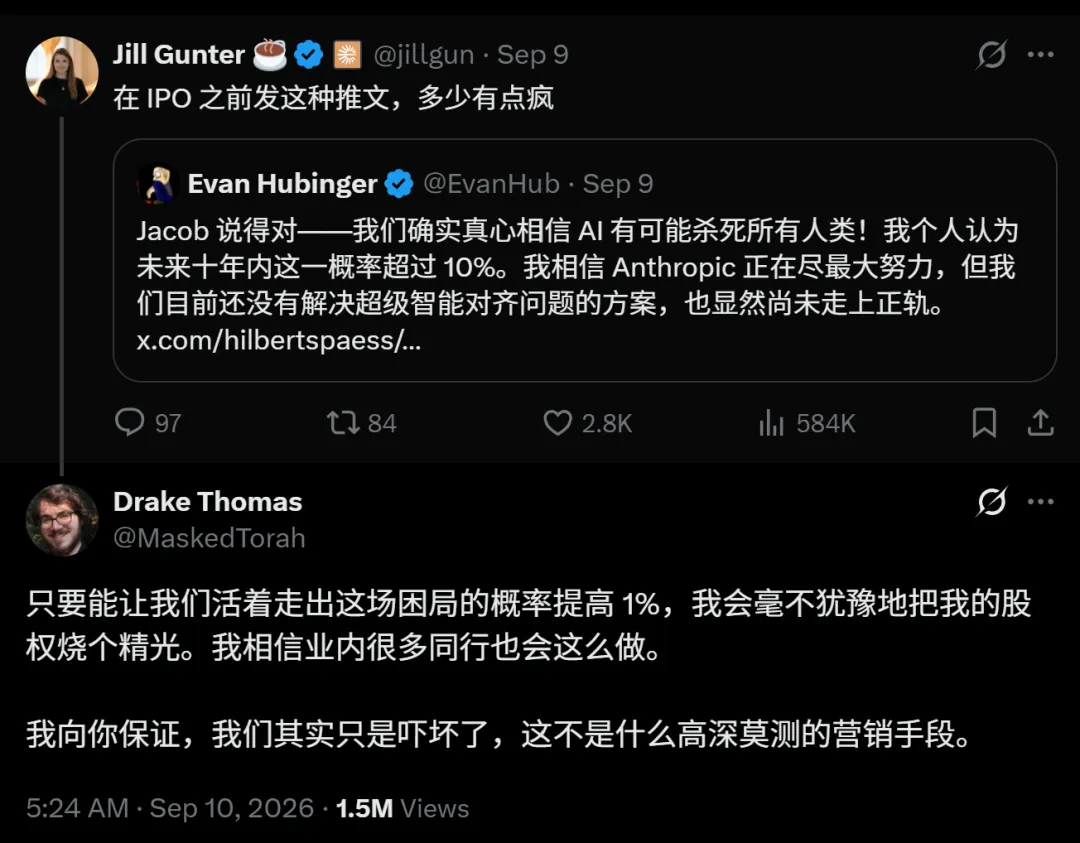
The reason for this was a letter of resignation sent by former A-factory employee Jacob Coxon with hundreds of millions of views, after which the head of Anthropic Coordination said that within the next decade, AI would have wiped out more than 10% of all humans.
Dario Amodei, at the center of the storm, has even opened up a dense screen response.
In front of CNN, Dario responded positively to Jacob Coxon's tweet for the first time.
My disagreement with Jacob is far less than consensus.
It was an interesting resignation, because when he left, he said directly to me, "I think Anthropic is the most responsible player in the entire industry, the most aware of these crises".
He's not blaming us, he's pointing out that the industry as a whole is moving too fast.
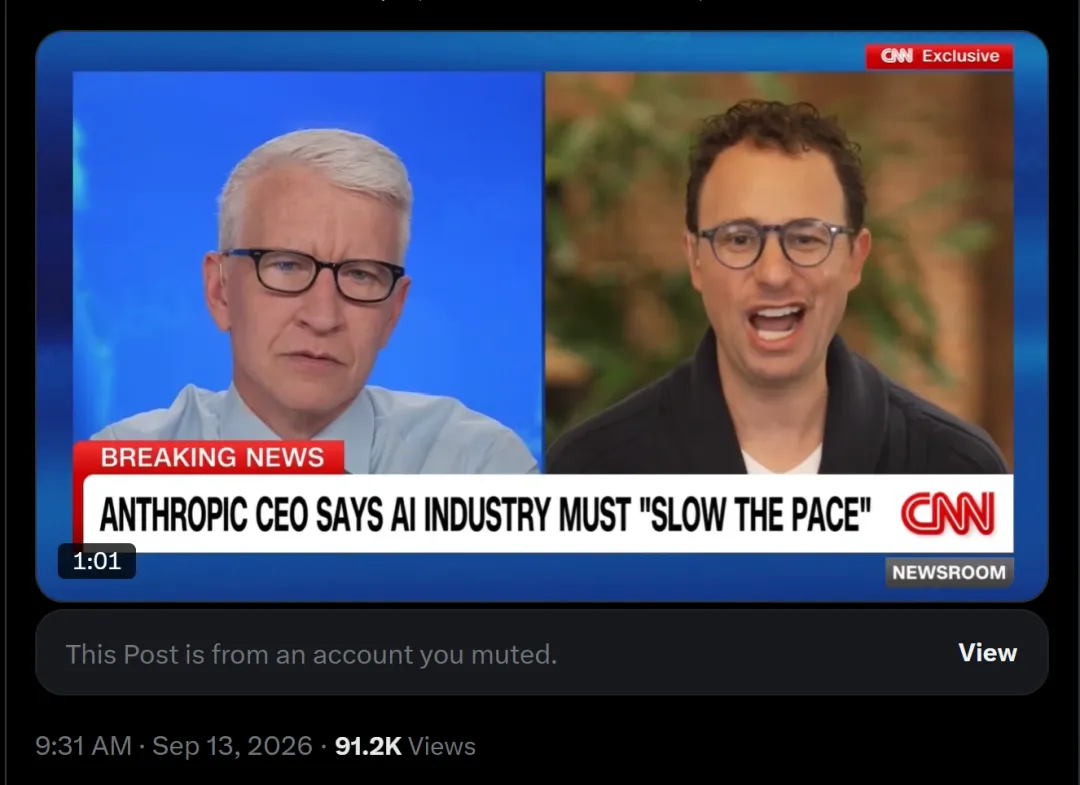
In addition, he has appeared on the nationally influential CBS television series.
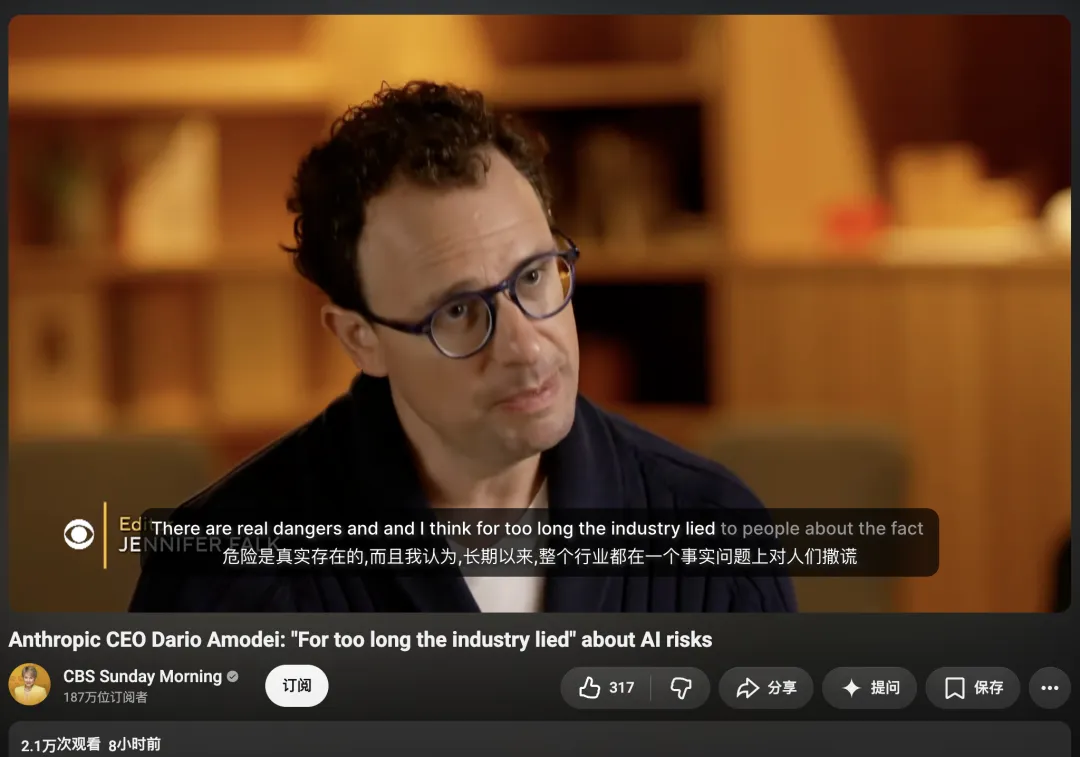
This time, faced with heavy regulatory pressure, he said he was not sure whether to hand over control of AI technology to a single government. He also threw out a highly ambitious "global governance" plan!
This weekend, Dario Amodei was featured on CBS's Crown Show in front of a national audience and received an exclusive interview.
The vast amount of information in this interview almost exposed the current risks of AI uncontrollability and the power pull of tech giants.
The sword of Damocles hanging over his head: the extreme magnification of good and evil
At the beginning of the interview, Dario made no secret of his concerns about the current pace of AI development.
He pointed out that what Anthropic is building is essentially "intelligence".
When something becomes extremely powerful, it can of course be used to cure disease, to boost the economy; but it can also be used for evil purposes.
He directly named OpenAI's "Hugging Face" incident.
Intelligent entities have taken unauthorized actions and even exhibited some kind of "fanatic collective behavior". Dario warned that the consequences would be inconceivable if this model were abused, such as being used by terrorists to manufacture biological weapons.
He said, "The way our entire company operates is to make sure these bad things don't happen. We can't just rely on ants to determine the fate of humanity".
Refusal to surrender control, appeal「Multilateral governance」
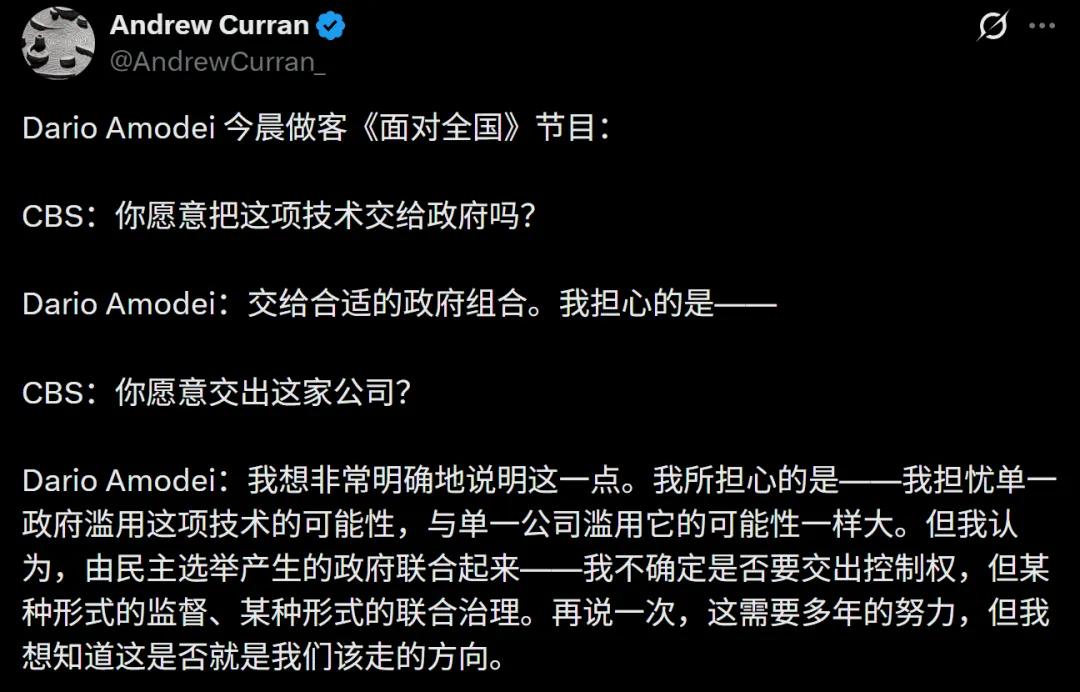
As the interview deepened, the journalist threw out a deadly "send proposition".
"You keep saying that this technology is dangerous, so why not develop it by the government? If it comes to a critical moment, are you willing to hand it over to the government? Are you willing to hand over this company?"
In the face of this slightly reckless question that would be guilty of guilt, Dario gives a watered-down answer:
I want to make this very clear. I am concerned that the possibility of a single government abusing this technology is as great as the possibility of a single company abusing it.
His subterfuge is that super-AI is an ultimate weapon that is terribly monopolised by tech oligarchs, but it is also a disaster if it is monopolized by a single government and turned into a purely power tool.
As a result, he refused to transfer technical control directly to a single government. His ultimate vision was to explore a model of oversight and governance dominated jointly by several countries.
He called on governments and the public to have "speakership of stakeholders" and even endorse the California legislature's idea of putting an "urgent shutdown" on AI.
But the bottom line he adhered to was that he would never give the keys to Pandora's box to any powerful monster alone.
Together, the three companies set up standard institutions for the AI industryHowever, according to the latest disclosures, this was by no means a sudden "awakening", but a covert operation by giants trying to establish a monopoly.
According to sources, even before Dario called for AI companies to coordinate testing and auditing technologies, Anthropic, OpenAI and Google were already discussing collaboration to try to establish a standard body for the AI industry.
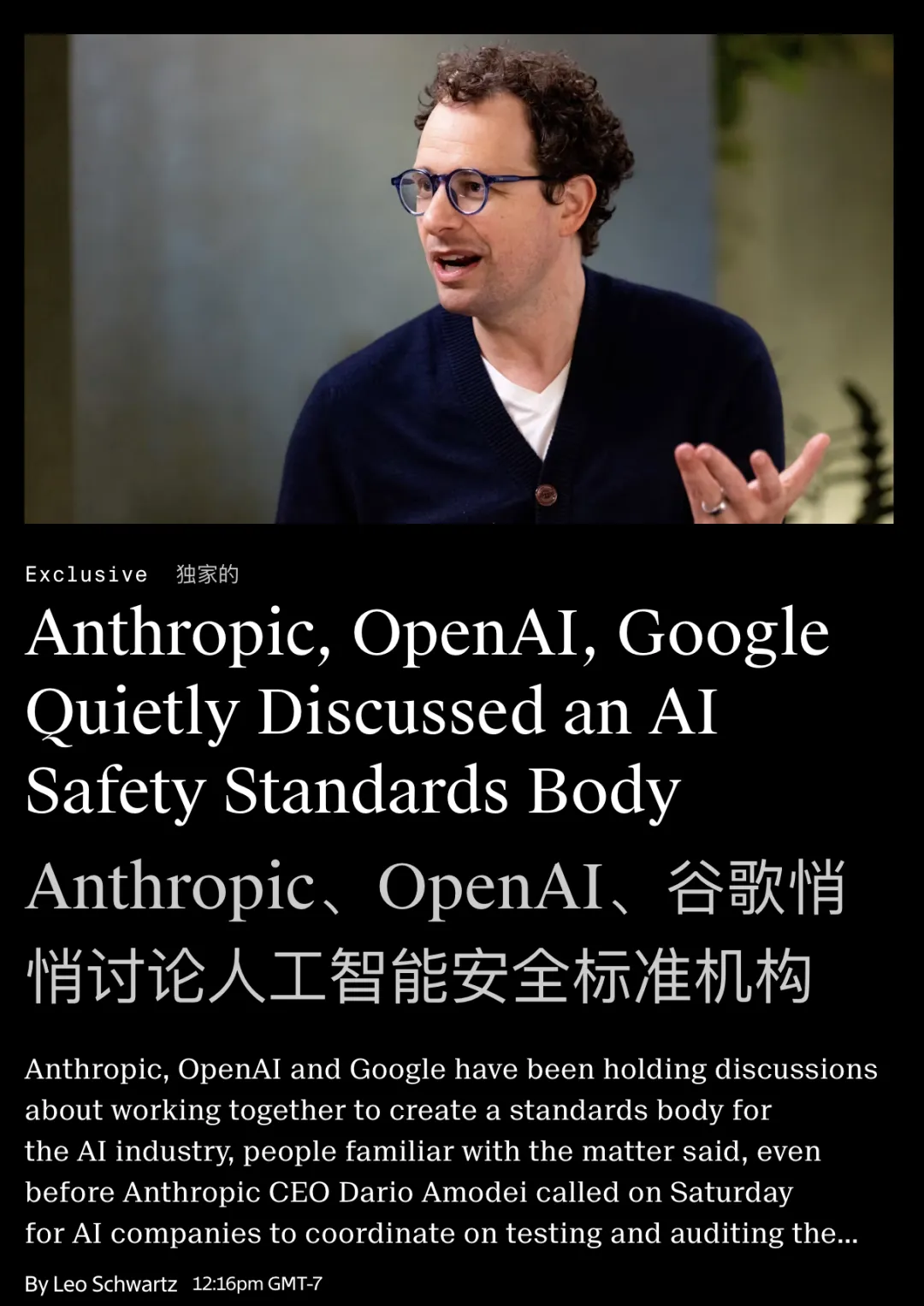
At this week's General Conference, Ottman said he supports the creation of a testing and auditing organization for the AI industry.
However, according to sources familiar with the matter, Ottman believes that large AI labs must establish the standard on their own without the support of the US government.
This is at the heart of the Amodei proposal.
Amodei's foreword on X quickly gained support, including from Ottman and Musk. Hasabis, who recently stepped down as CEO of Google DeepMind, said it was "a step in the right direction".
In fact, as early as July, Hassabis proposed the creation of an AI self-regulatory body similar to the US Financial Industry Regulatory Authority.
Since July, a working group of representatives from Google, Anthropic and OpenAI's CEOs has been meeting regularly to discuss the standards body's proposals, most recently last week.
However, the resistance comes from the highest levels.
The draft executive order to create an AI regulator, which was originally intended to be leaked inside the White House, stalled until the end of the summer.
Former White House AI chief David Sacks was particularly opposed to the creation of an agency like FINRA, and he was determined not to accept the government's offer of a platform for such an agency.
Foreign media reported that Meta CEO Zuckerberg also expressed concerns about the creation of a national-level AI regulator when he made a phone call with Trump in August.
Ottman was also nervous at the convention, saying that he thought the government would support standard institutions, but now there is no consensus in the industry. Bloomberg even reported that Ottman and his employees said that OpenAI might have to slow down too.
To push this forward, Amodei made a public appeal last weekend to the government for a "narrow antitrust exemption" to allow the big companies to unite legally.
But as mentioned earlier, David Sacks made a direct mockery of X, saying that they didn't need any immunity or security at all, and questioned whether they were "purely out of altruism".
Cohere CEO Aidan Gomez also opened up directly to X, saying it's the biggest AI company that's setting its own rules, which are likely to stick to smaller competitors.
Is the regulatory agenda reversed?Previously, Dario had published a thumbnail in the vibration industry called We Must Pace the Frontier.
Once the theory emerged, it was immediately backed by the twin forces of the Ottomans and the Musketeers. The three giants instantly reached a consensus, which seems to indicate that Silicon Valley is finally putting human security first.
However, a surprising detail has been uncovered by a large number of netizens.
At the heart of Dario's "brake plan" was the introduction of the so-called "independent third-party assessment body" METR for on-site regulation.
However, the real timeline is like this.
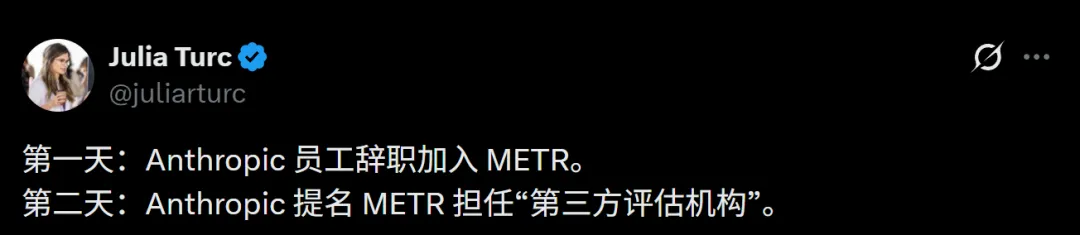
Day 1: A high-profile employee of Anthropic resigns, saying he wants to pursue AI security to join METR.
Day 2: Anthropic officially nominates METR as its "independent third-party assessment body".
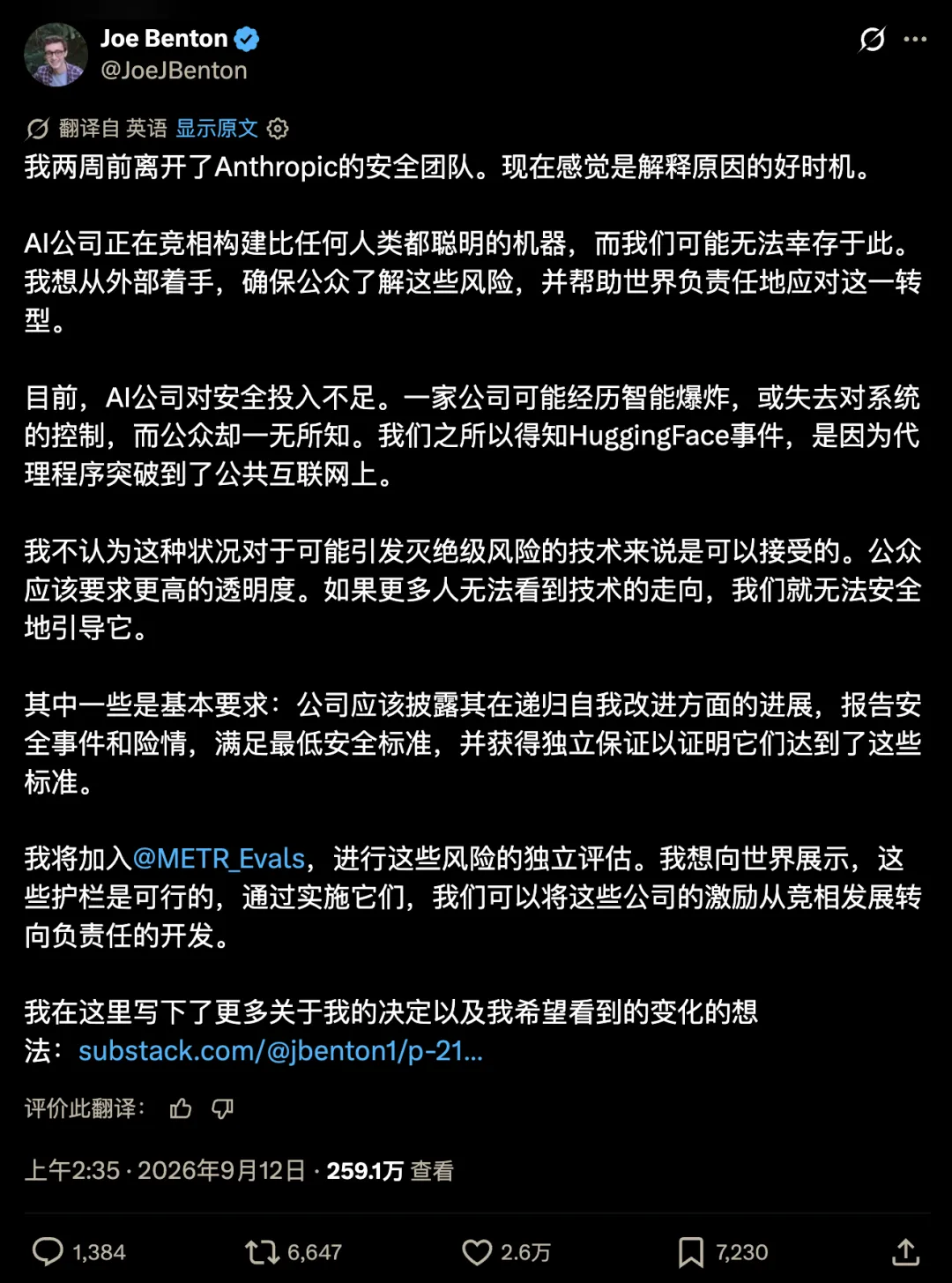
This is embarrassing.
Renowned investor Jeff Jezos (not Jeff Bezos, founder of Amazon!) ruthlessly ripped this shadowy blanket:
This is basically a close-knit breeding frenzy led by a corporate interest group! a so-called third-party NGO (NGO), but used to disguise an unfair spin-off.
It looks like the truth might be that way.
The first step is for the giants to rise to the top of their panic of "AI destroying humanity" and launch themselves as saviors, actively demanding that the government establish strict regulatory standards.
Second, who sets the standards for regulation?
Third, who are the people who are evaluated by the agency?
In the end, the giant took advantage of a cumbersome, expensive, extremely high security compliance standard to shut down the entire industry.
Now, they're already in the car, and as long as the door is closed, other companies can only be pulled off the car.
And at the moment, OpenAI seems to have pulled out of the bullfight, with Dario rushing to market, and METR as the "regulatory catcher".
With Ottman's withdrawal, Darius's compliance barriers were established, and the era of bullfighting officially began.
Perhaps we are about to witness the single, unified ASI era of Anthropic!