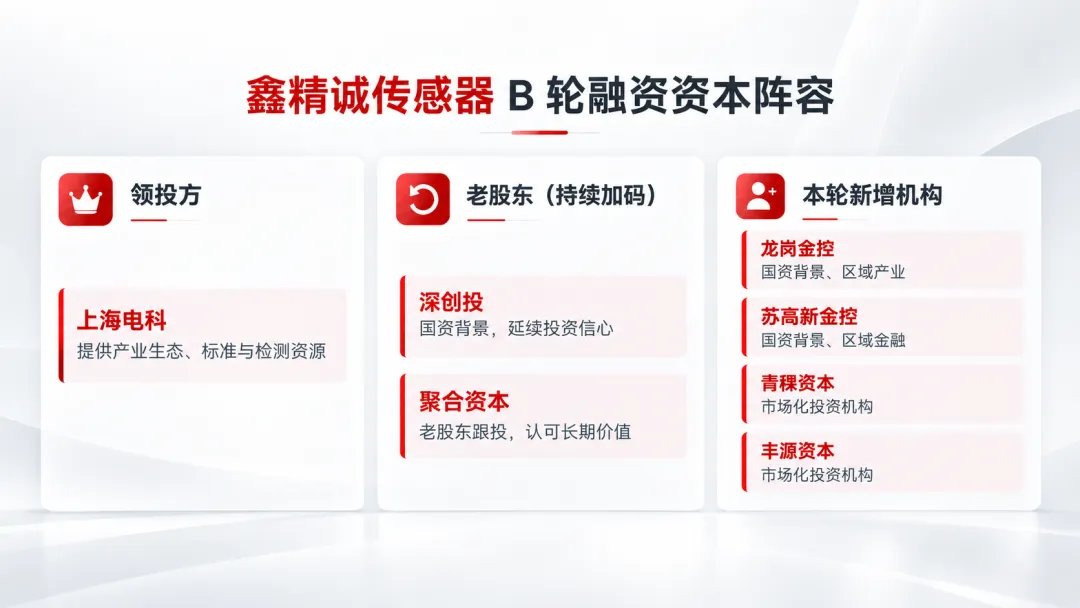
 The expression of the ETF is straightforward: for more than two decades, ETFs have been fully self-developed in applications ranging from sensitive components, elastic body structures, signal processing, labeling decomposition and power control, occupying a key role in the robotics industry chain, highlighting the value of industrial collaboration.
The reason for this round is two words: confidence. An investment institution with a state-funded background continues to bet after round A, which is uncommon on the hard-tech circuit.
Among the newly added investors, Longchamp Gold Control and Suzhou Gold Control are both local state-owned platforms, and there are also industrial resources available in the form of preferred equity capital and venture capital. These investment institutions will be developed separately from industrial resources, regional co-operation and other dimensional sensors.
In this regard, the investment structure of this round of financing is clear: investors provide an industrial ecosystem, old shareholders provide long-term confidence, new growth capital provides regional and industrial resources. To some extent, the essence of this round of financing is the bet of industrial capital and state capital on the large-scale supply of torque-controlled sensors.
What is guaranteed by capital?Established in 2009, Intelligent Sensors is a national specialty small giant, specializing in six-dimensional sensors, MEMS sensors, joint torque sensors, micro-power sensors, and power control instruments and power control software.
These are the basics. Two things are really worth mentioning: focus and pragmatism.
Liu always insisted on the theory of well drilling: one meter wide, one meter deep. At the beginning of his career, he didn't know when the robotics industry would explode, and he wasn't sure how deep he would find water, but his judgment was that as long as he kept digging down the direction of multidimensional force measurement technology, water would always come out.
The time of entry into the field of robotics was in 2018, and the official launch of the product in 2020, when the time node was really hot ahead of the humanoid robot circuit. This meant that the sensor was not coming in through the wind, but was digging wells into that depth, naturally touching the water.
As for practicality, Liu has shared a case: the company and the domestic Power Battery System pipeline have collaborated to develop a six-dimensional collision-resistant sensor, mainly because industrial arms are prone to collision at the movement transport link, and the gaps in the power supply are very small, and forced embedding can cause fire.
Customers don't need high-end products, but a solution that solves specific problems. Intelligent sensors can make these products because they are deep enough in the 3C and new energy industries to understand the pain points of the terminal scenario.
In his interview with high-tech robotics, Liu said that the product must be accurate to meet the real needs of the customer and solve the customer's application pain points, rather than simply pursuing technological advancements.
This pragmatic approach has enabled Intelligent Sensors to capture more than 50 percent of the market share in both 3C and New Energy sectors. But what's really interesting is that the accumulated power control experience in these two industries coincides with the power sensing capabilities required by physically intelligent robots, which are the same underlying technology.
Technology has accumulated to a certain extent, and entering the robot track is a natural extension. The question is how much it has done specifically on this track.
What has been done in the field of physically intelligent robots?With decades of power control experience in the 3C and new energy industries, the Intelligent Sensor has come a long way in product layout.
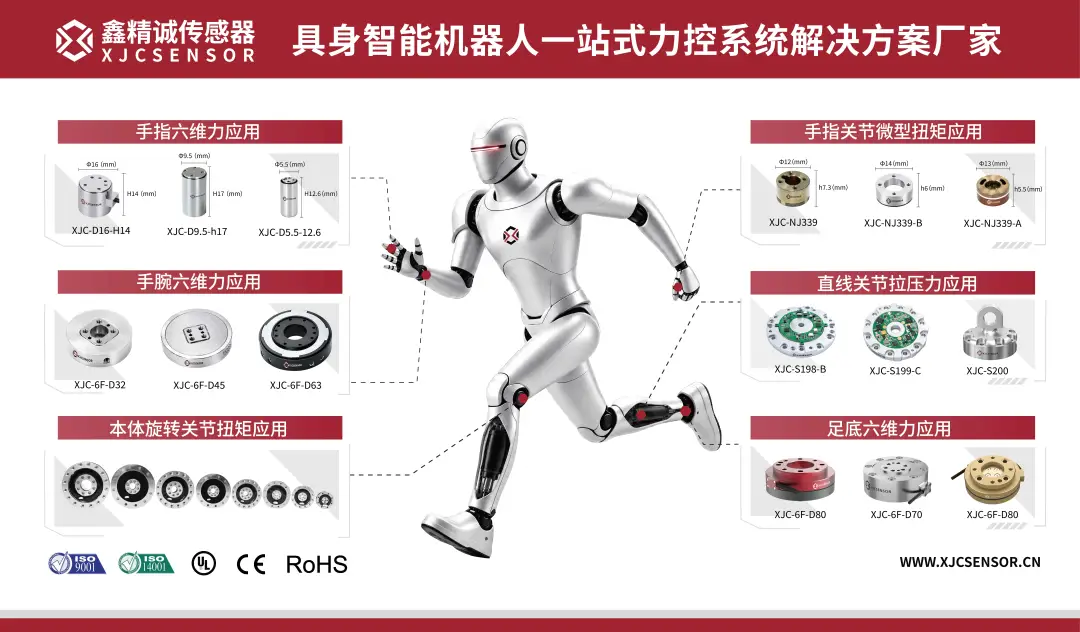
First of all, the most demanding pointing fingers of a robotic sensors are the fingertips, although the pointing space is very small, but the perception of force is very high.
At the 2026 WRC, Shenzhen Intelligent Sensors featured its world's smallest resistance-stressed six-dimensional sensor, 5.5mm in diameter and 12.6mm in height. At the same time, it also showed two micro-six-dimensional sensors, 6.5mm and 9.5mm, which have been used in brilliant projects.
Finger joint position, micro joint torque sensors cover a range of 10mm in diameter (6mm in mid-air) to 14mm, of which 10mm is the smallest globally.
The position of the wrist and body, the 6F series six-dimensional sensors accurately match the space, installation interface and load requirements of the wrist of the manufacturer's humanoid robot.
From the fingers to the joints to the wrist and the body, where a robot needs power, there are corresponding products. This is not a single breakthrough, but a systematic layout.
The product is made, and the energy needs to be produced.
Traditional six-dimensional sensor labeling often faces problems such as cycle length, high equipment inputs, and the difficulty of solving matrix consistency controls, and the practice of high-strength sensors is to combine single load + multi-dimensional verification. Based on this idea, it has self-developed fully automated testing equipment, which has been put online in batches. This equipment has achieved 10 times the labeling efficiency based on the cost of 1/6 of the existing similar programs on the market.
As of April 2026, its six-dimensional sensor automation test labeling platform has formed the capacity to handle about 50,000 units per year, covering testing, labeling, decoding and results testing. This number is critical, as the six-dimensional sensor moves from the laboratory to large-scale applications.Market data is also validating the feasibility of the system.
In the first quarter of 2026, Intelligent Sensors achieved key breakthroughs in the field of intelligent robots: combined shipments of robotic power sensors exceeded 100,000. To date, it has entered the supply chain system of more than 200 customers, covering joint module manufacturers, agile hand manufacturers, human robot body manufacturers, and collaborative robot body manufacturers.
In July of this year, it was listed on the Hong Kong Stock Exchange as the first stock in the Hong Kong Stock Exchange's entire range of intelligent robots, and the demand for upstream suppliers will only increase after the listing.
As to why customers chose aluminum sensors, Liu summarized: one is the traditional metal aluminum stress meter and glass micro-aluminum MEMS stress chip bi-technical route, which can cover different needs; two is the stable performance of the product in the client; three is the capacity of bulk delivery, which can respond quickly to large-scale orders.
These three points, put together, are actually: technology has a choice, products are reliable, satisfy large customer volumes and stable delivery.
What's next?With more than 100,000 shipments in a quarter, the meaning is clearer in the context of the human-robot industry.
Data from the Institute of Advanced Robotics Industry (GGII) shows that around 18,000 human robots were shipped domestically in 2025, an increase of more than 650%, and are expected to reach 625,000 by 2026. As human robots move from machine verification to small-scale and large-scale applications, power-controlled sensors are gradually shifting from selectable configurations of silicon to the just-needed silicon core.
Based on this industry trend, Liu set a more challenging annual goal: the company's full-year shipments of body-smart robots are expected to exceed 500,000 in 2026.
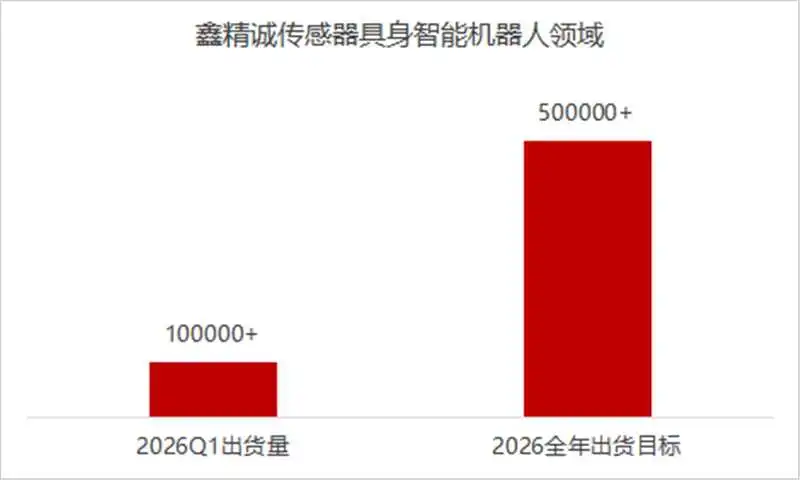
This goal is not for the faint of heart. More than 100,000 units have been delivered in a quarter, and the capacity and automation production lines are still expanding. According to Shenzhen Sensor CEO Shenzhen Shenzhen, the daily production of pure artificial production sensors is only 100 percent, and there are high problems with welding accuracy and difficulty in controlling the decommissioning rate, while the production of automation production lines can reach 3,000 units per day, the efficiency improves several times, and subsequently, depending on the demand of the market, the demand for automation equipment is increased to meet the needs of customers.
Funds are also in the pipeline. In 2026, the ZTE Intelligent Sensors program invests about 30 million yuan to develop and automate manufacturing capabilities. The product line will add more than 80 six-dimensional sensor models, more than 300 connector torque sensor models, and continue to increase the product matrix from the current 680+ models.
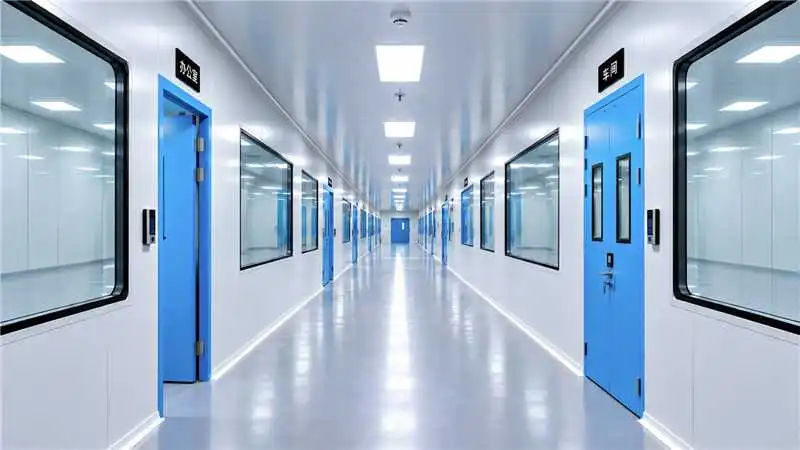
Based on these moves, Intelligent Sensors have a clear sense of their position in the industry. As in the new energy and 3C industry, Intelligent Robotics continues to be at the forefront of the field of power-control sensors.
If this goal can be achieved, it depends on a more fundamental problem: six-dimensional sensors can be used to measure efficiency, automate production lines, and customers can verify that they can't continue to be robust.
The completion of round B financing is in part a confirmation of this judgment by the capital markets.