On 10 September, on the sidelines of the congress, the co-founder, CEO and CEO of Biosynchronous Technologies, announced the official launch of a new model.Motus 2, an evolutionary universal model of the world geared towards robotic maneuvers。
If you know a little bit about physical intelligence, you should know how hot the term "world model mouse" has been lately. But what Motos 2 wants to do is go further than just predict the future of mouse:
Robots don't just do what they do, they also know what happens when they do it, and it doesn't work, and they continue to learn from it.
Translate it this way: the robot that used to teach you how to cook chicken is chicken, and now the Motos 2 is trying to teach itself how to cook chicken.
01.
A conflagration without borders
The body world model is becoming a crowded track.
Currently, there are more than 55 companies in the country that publicly claim to be making the world's smartest models. 12 companies have entered the unicorn ranking. In the first half of the year alone, smartest racetrack disclosed over 46 billion yuan in funding, seven of which went to the top 20 companies.
But underneath the excitement, there is one more remarkable question:Most of the world's models in fluorescent physics follow the performance of fluorescent lights and fluorescent controlled lights, far behind their ability to produce realistic images.The WorldArena Track1 assessment of 2026 by CVPR, which assessed world models from dimensions such as visual quality, motion quality, content consistency, physical consistency, 3D spatial accuracy, and controllability, unexpectedly exposed a fragmented silicon model that could generate imagery of a fictitious real future, but could not guarantee that the future would be physically executable.
This is the core contradiction of the first half:Everyone makes a fool of predicting the future, but predicting accurately is not the same as using it well.
Whether it's going along real-time routes, integrating VLA with the world model, or cutting off logical efficiency, the answer is basically the same: given the current state and movement, what will the world be like next?
This is a mythical prediction problem. What happens after the prediction? Is the result better? Is the distance from the mission closer or further away?
The industry has not been able to systematically answer this question.
02.
A disregarded fracture: from prediction of hydrogen to evaluation of hydrogen
In addition to the world model, the robot can answer how the robot will do the job. But between the two questions, there is a lack of ability:Assessment of the results themselves。
Without this path, predictive models are merely information gains that cannot be converted into strategic improvement signals. Models can generate 100 possible futures, but don't know which one is worth pursuing.
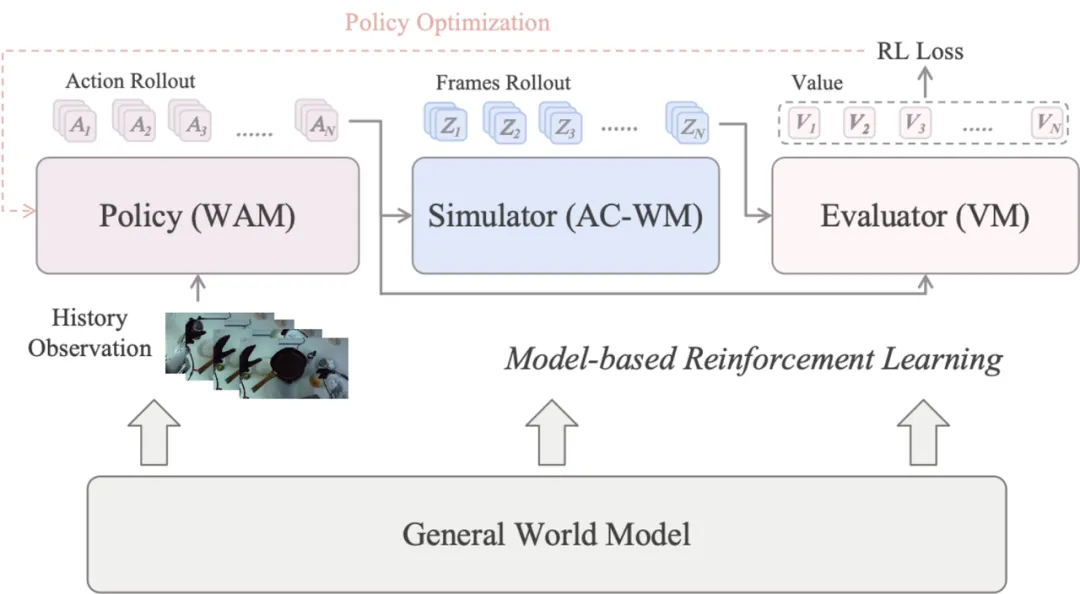
Motus2 wants to add Evaluation and Feedback. It tries to move the world model from a closed loop to a predictive loop:
Action→ Forecasting→ Evaluation→ Feedback→ Further learning
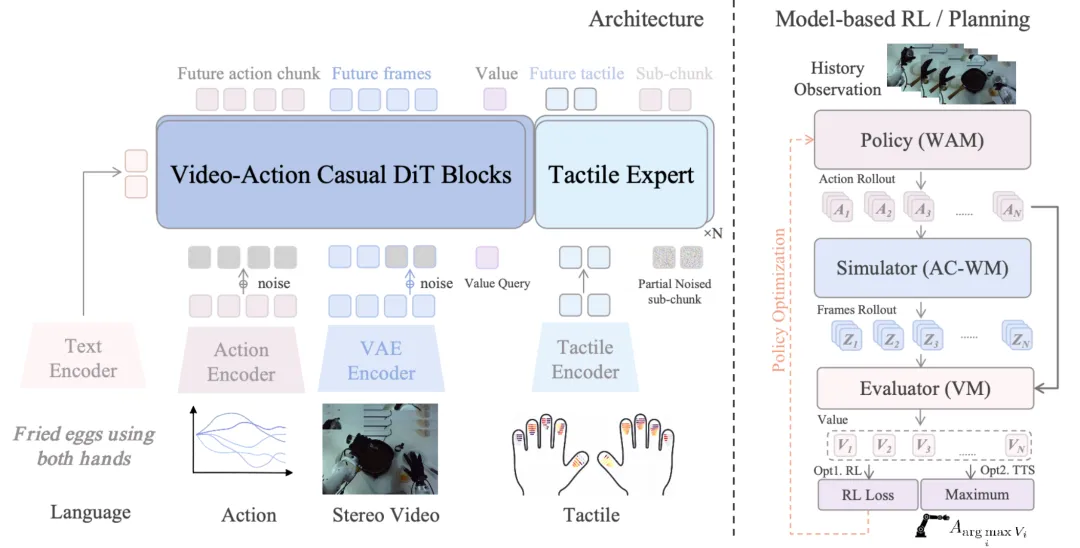
Motus2's approach is to insert action, prediction, and evaluation of three capabilities into the same video mouse action model. Action answers what mouse should do next, predicts what mouse will do when mouse is done, and evaluates the results of mouse responses. These three are not out-of-the-box relationships, but three-way output of the same model.
This information flow design is primarily designed to prevent actions from seeing future information in advance during training, while allowing deployments to be flexible in order to call on simple tasks based on scenarios. Simple tasks can only run on motion generation, and complex tasks can then start on a complete motion generation-prediction-evaluation chain.
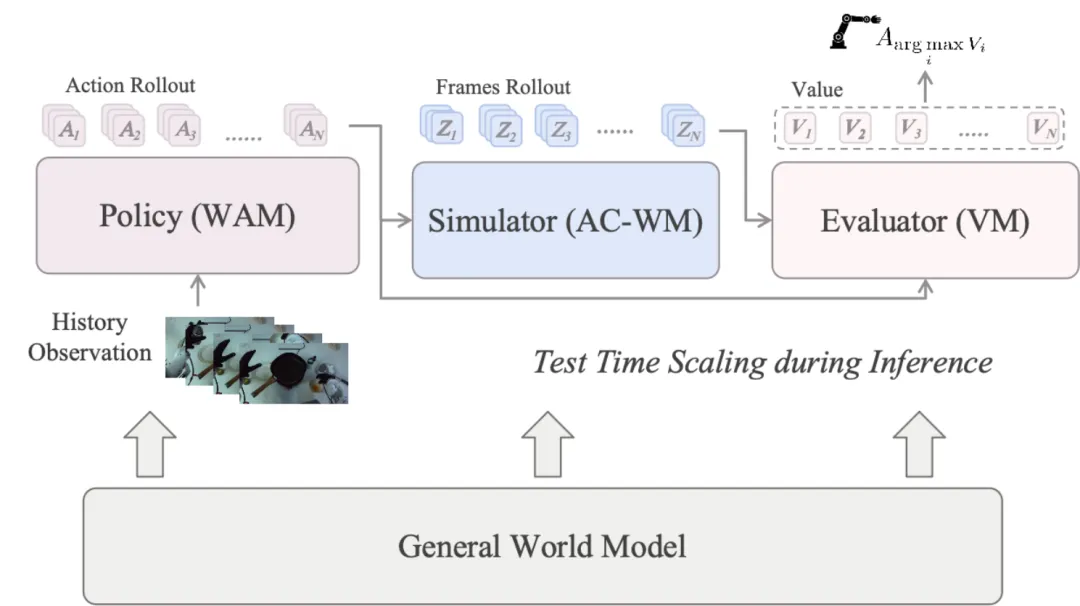
But architectural unification is a prerequisite.The real breakthrough occurs after a closed loop is formed.
03.
Closed-loop evolution, world models start to train themselves to train themselves
The closure of the Motus2 occurs in two phases.
Reasoning StageThe model does not just generate a single action program, but generates multiple candidate actions, predicting the execution results of each program, then evaluating the modules and selecting the highest scoring program. After completing an action segment, the robot re-observes the real-world state and starts the next round of planning.
Stage of trainingThe evaluation scores of candidate actions are directly translated into strategy updates: high-value programs are positively strengthened and low-value programs are gradually weakened.
In other words, the models themselves predicted the future and began to become teaching materials for training themselves.
This radically changed the logic of using robotic data. In the past, robotic learning movements relied mainly on successful demonstration data to tell it how to make a mouse; failure data was largely filtered out as noise. But in the closing loop of the Motos 2, failure and sub-optimal trajectory instead had a unique value so it could help models understand what the mouse was doing, what was going on in the world, why the mouse did not achieve its goal.
The data is the most intuitive proof: the average success rate of the Modus 2 basic strategy was 65% in placing the phone with multiple fingers in two tasks; increased to 67.5% after joining the planning; increased to 72.5% after joining the MBRL; and finally reached 75% when both were enabled at the same time; an increase of 10 percentage points over the basic strategy.
04.
Dual complement of data and perception
But automation is not an aerial staircase, and it requires two bases: sufficient world common sense and complete state information input.
At the data level, Motos2 has taken a path to scale-up the human experience of migration + small robot samples adapted to scale, breaking down the industry pain point of robot data costs being too high and difficult to scale.
It used about 130,000 hours of human-operated video as preliminary training to allow the model to learn general object laws, scenic logic and operational common sense. These low-cost human daily interaction data laid the foundation for the model's broad world cognition. In addition, adapting only a hundred-hour robot trajectory to the field of human coordinated data transferred human operational experience to the physical control space of the robot.
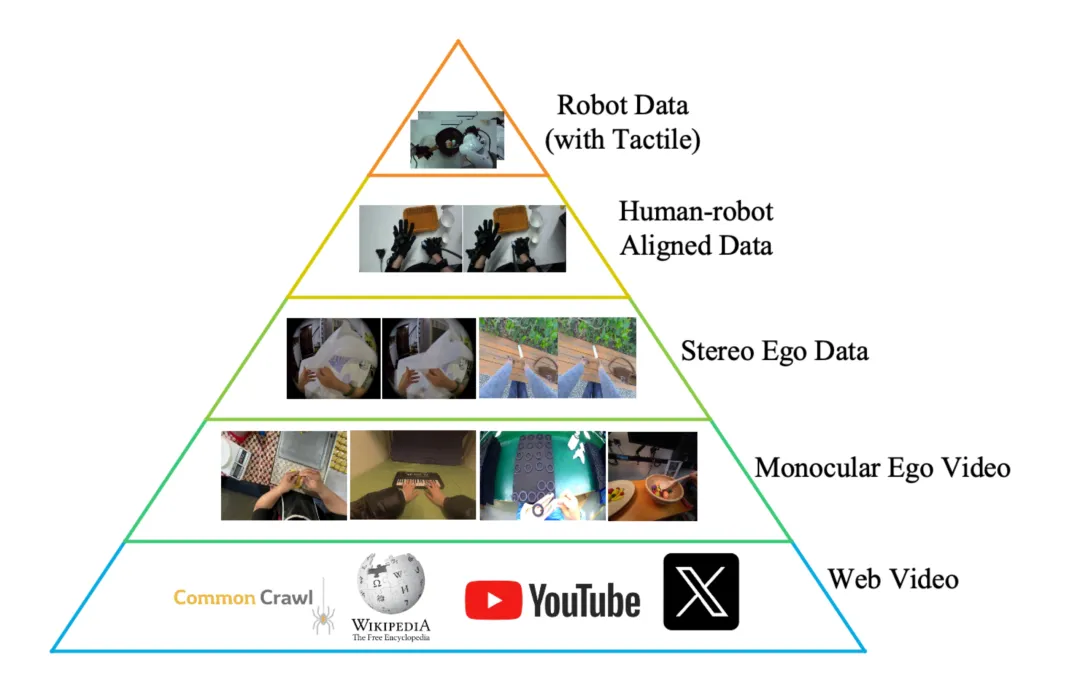
This layered data thinking is highly efficient: the success rate of real-world missions can be as high as 51% with pre-trained models of human data alone; the average success rate of five core missions directly jumps to 84% after 100 hours of robot adaptation training. Human data is responsible for scale, and robot data is responsible for precise landing, each playing an advantage, avoiding the high-cost trap of relying solely on robot data stacking capabilities.
At the perceptual level, Motos2 supplements memory and touch with the blind areas of monochrome vision to provide a more accurate input basis for evaluation and feedback.
Real-world operations never rely solely on the current image. Objects are obscured, positions are moved, and previous observations need to be remembered; changes in contact intensity, sliding deviations, and touch feedback need to be added to a contact state that is not visible visually. Modus 2 respectively preserves historical observations through long-time information mechanisms, sensing contact changes in real time through light-level touch modules, allowing robots to judge the state from a single-dimensional image to a continuous, full-contact experience.
The two supports together answer one question: why can an evolutionary closed loop run on Motos 2, enough common sense to make an assessment with reference, and complete perceptual information to make judgments more accurate?
05.
What is the meaning of this verse?
Based on the GWM Global World Model 5 path proposed by Biomass Technologies, the positioning of Motos2 is very clear: it is an initial attempt to move from L3 "action in the world" to L4 "autonomous world intelligence".
The core of the L3 phase is the model's understanding of the environment, prediction of change, output actions, and, in essence, a smarter executor. The core of the L4 phase is hydrogen-powered autonomous evolutionary hydrogen: the model can judge the results of its own actions, can continually optimize strategies from experience, and the evolutionary dominant from human to the model itself.
From this standpoint, Motos2's current evolution is also focused on multi-tasking strategy optimization, opening up the world to long-term autonomous learning, cross-tasking capability migration, longer-scale memory and iteration, and a long way to go.
Before that, automation was more of an industry vision and concept; after that, it became a concrete path that could be landed, verified, and continued to evolve.
This is also a remarkable signal for the entire physical intelligence industry. Over the past few years, we've struggled with the number of demonstrations, the concentration of action, the abundance of models, which are essentially the inner curve on the L3 dimension. And Motos 2 has opened another door: the next generation of competition will revolve around the evolutionary efficiency curve, who can rely less on man, who can evolve faster from experience, who can go further.
It's a small step, but it's critical enough, to learn better from what you're doing. Motos 2 is the starting point for this new track, and the second half of the whole body world model is about to begin.