Traffic accidents, falls, or even a course of radiation therapy can cause a tumor to become unresponsive.
The brachial nerve, which consists of five brachial nerve roots C5 through T1, is the "baseline" of upper limb sensation and movement. This baseline, once torn, often results in a significant loss of sensation, strength, and control of the entire upper limb, and is accompanied by intolerable neurological pain. The most common cause of adult brachial nerve damage (BPI) is motorcycle accidents in young men under the age of 30, and the incidence has continued to rise in recent decades.
Now, a team from institutions such as the Institute for Biological Robotics at the University of Pisa Santa Anna in Italy, the University of Turin, and the CTO Hospital in Turin have put on a total of about 0.6 kg of soft coat on 14 patients with chronic arm ulcers.
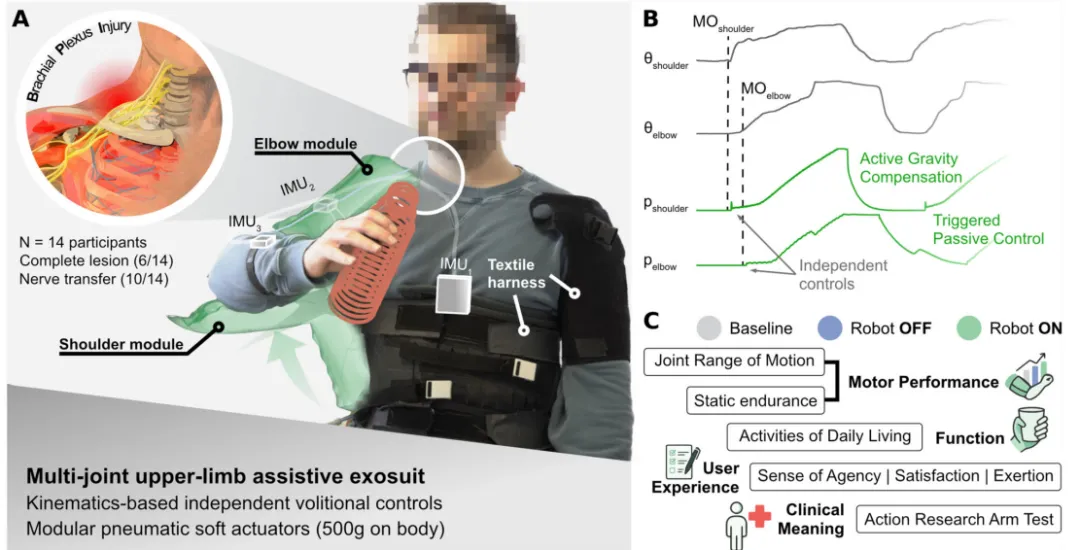
The results of the single test were: an increase in active activity range of 80% to 180%, an increase in static support endurance of about 160%, a decrease in subjective force sensation from 5 points to 10 points, and a decrease in muscle activity of 30% to 60%.
The research has recently been published in Nature Communications.
01.
A soft coat that gets "bloated"
In the past, wearable robots targeted at armpit nerve damage were broadly divided into two routes: one for rigid elbow outer bones, and one for soft or rigid hand gloves. That is, with either elbows or hands, very few people took care of the shoulder joints that actually functioned as sticking shoulders.
The system takes a different path: shoulders and elbows simultaneously.
In hardware, it consists of two soft air-conditioned executors, one responsible for the shoulder, one responsible for the elbow bending and one responsible for the elbow bending, installed via a tow chain and adjustable magic patch on a custom padded fabric backrest, driven by a remote controller. The executor is essentially an air cavity made of 200 μm thick TPU coated nylon film, the shoulder has about 1 lift capacity, the elbow is about 0.4 liters. The manufacturing process is only laser cutting and thermal pressure two steps, accompanied by heat-resistant paper moulding, the production time of a single executor is less than 15 minutes.
The design is modular: it can be used with only one or two together, and the two methods control each other independently.
At the control level, the motion intends to be detected by installing three IMUs (inertial measurement units) on the upper arm, forearm and forearm. The shoulders use a gravity compensation strategy to dynamically "offload" the weight of the arm itself; the elbows are triggered by a passive control valve that, once autonomous motion is detected, inflates the actuator to a pressure value individually assigned to each individual before the test, taking into account strength and comfort.
The researchers also explained why the IMU was chosen: the advantage of the IMU over the brain-electric/optical brain-machine interface, voice instruction, myopic drive, or visual program is that the device is self-integrated, almost independent of the surroundings, does not require electrodes and repeated calibration, is not affected by acoustic conditions, and does not require camera vision and computational delays. The cost is that it requires the user to have at least minimal autonomic movement on the limbs being detected, or a stable learning pattern of movement. For near-term patients with almost no control, severe fatigue, or a large number of non-autonomous contractions, this set of detection may not be reliable enough.
02.
It's a lot harder to lift, but it's also a lot longer.
A total of 14 participants, with an average age of 36.0 years, 12 males and 2 females. Six of them suffered complete genital warts, 11 were injured in a motorcycle accident, another one was injured in a car accident, one was injured in a fall, one was due to radiation therapy for breast cancer.
The test set three conditions: the baseline is not wearing equipment, the robot is off, the robot is wearing but not powered, and the robot is on.
The results of the activity range are as follows: the shoulder joint is raised from about 36° to about 66° before bending, with a relative improvement of about 80% to 90% in the baseline and knuckle state; the outermost extension of the shoulder joint is raised from less than 30° to about 60°, with an increase of about 110% to 120%; the elbow joint bend is raised from about 28° to about 85°, with the greatest increase in width, about 150% to 180%.
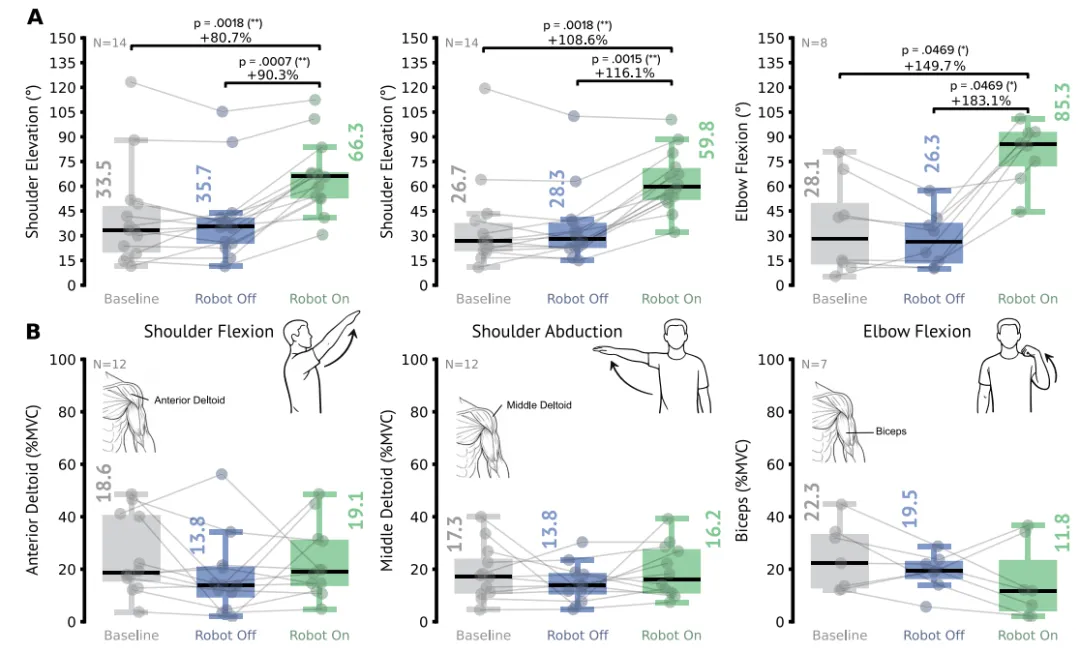
It is worth noting that while the range of these movements is significantly expanded, there is no significant difference between the three conditions, i.e. the movement is amplified, but not switched with more force. Furthermore, the performance in the state of the switch is basically parallel to the base line, indicating that the coat itself has good mechanical transparency and does not cause significant passive obstruction when worn.
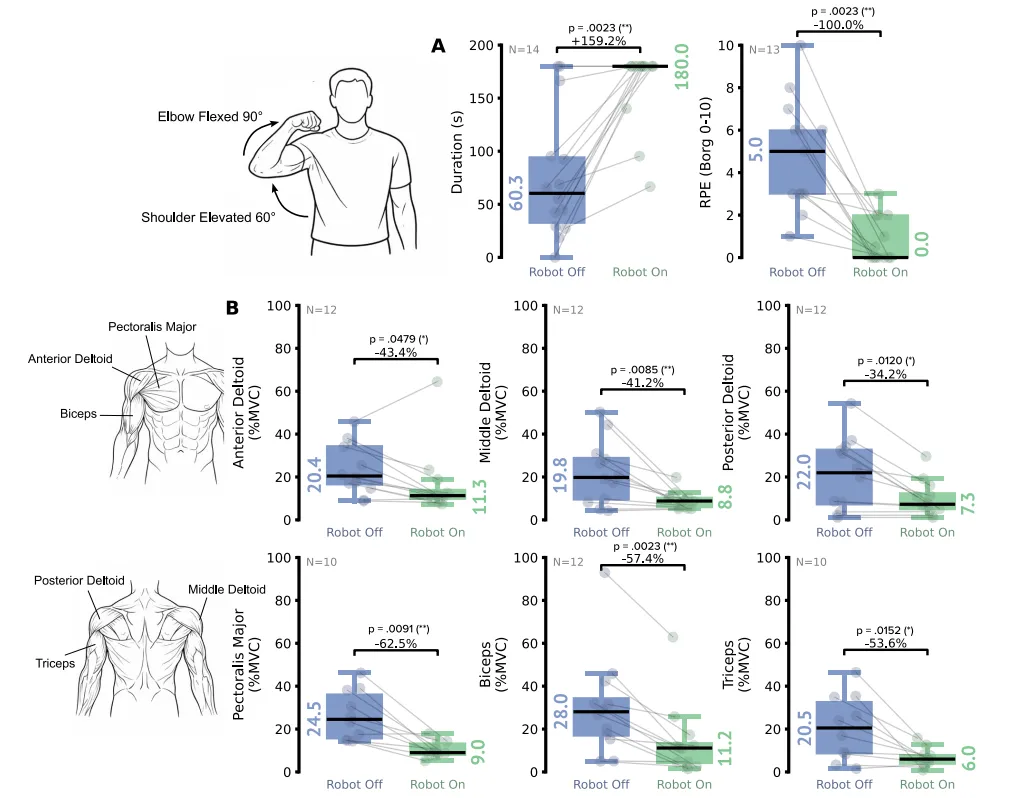
The static endurance test required participants to lift their shoulders to about 60°, elbows to about 90° and hold them for as long as possible, up to a maximum of 3 minutes. The result was that maintaining the median time was extended from about 60 seconds when helpless to about 180 seconds, and the median at the individual level increased by about 160%.
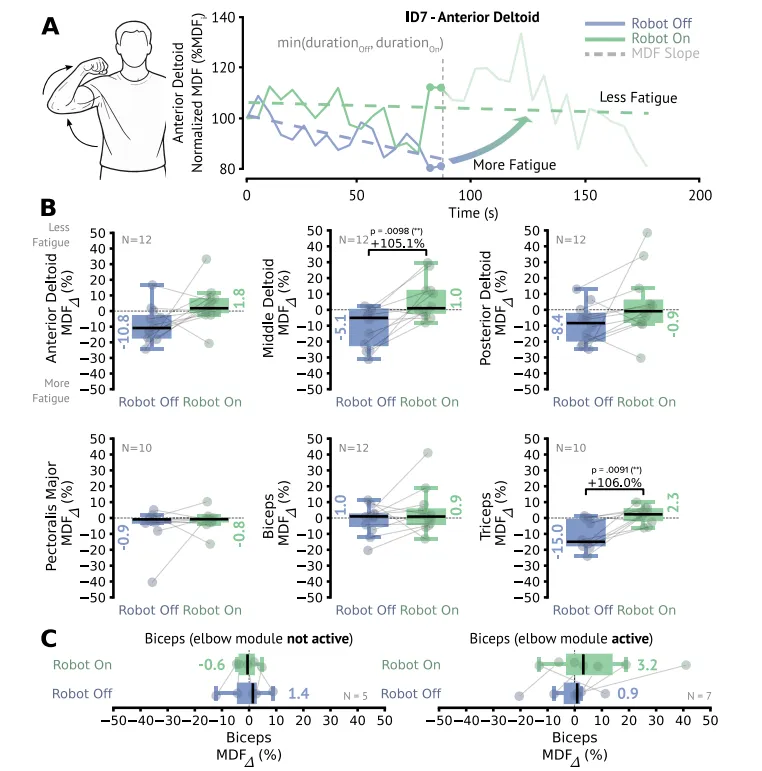
The same is true at the level of the trigeminal muscles: the levels of the trigeminal muscles decrease by about 30 to 40 percent, the trigeminal muscles decrease by nearly 60 percent, and the thoracic and trigeminal muscles decrease by about 50 to 60 percent.
The fatigue indicator also gives a consistent direction. Measuring changes in the frequency of the median frequency of the muscles, the fatigue development of most muscles in the assisted state is slowed, and the median triangle muscle and the trigeminal tricuspid muscle are statistically significant; the median improvement in the anterior tricuspid muscle is equivalent to (+117.9%), but after correction does not reach significantly (p=0.054).
03.
From "lifting your hand" to "eating"
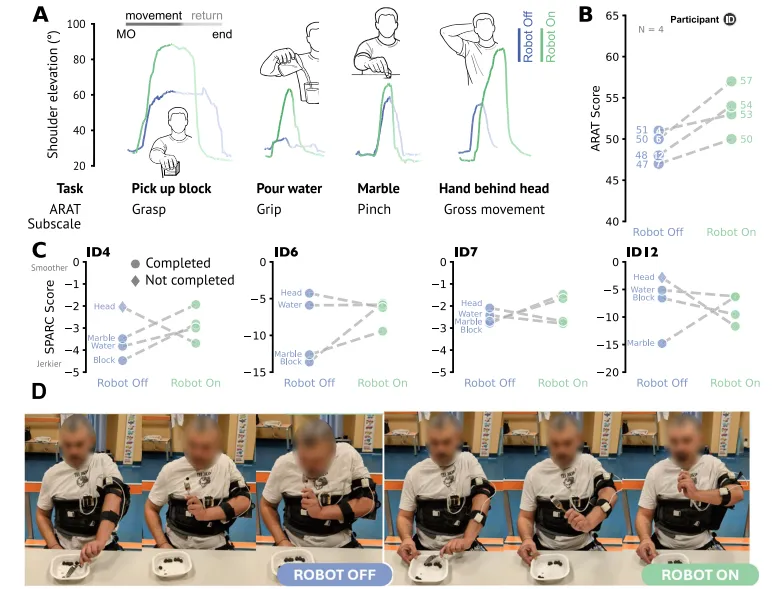
There were four participants with enough left-handedness to grasp objects, and they also completed the ARAT (upper limb movement study) test.
The total ARAT of the four increased from 51 to 53, 50 to 57, 47 to 50, 48 to 54, respectively, an average of 4.5 points.
Interestingly, the results of motion flow concentrations (measured with SPARC spectral arc length) were not consistent: the flow concentrations were generally maintained or improved in smaller participants with ARAT elevations, while the flow concentrations decreased in larger participants with the most consistent drop in the flow concentrations of the "touch-head" task. The author explains that this is likely to reflect that participants are exploring new solutions beyond their usual patterns of motion.
The participants also attempted to simulate everyday activities, such as moving the fork from the tray to the mouth. Qualitative observations showed that the trajectory in the assisted state was more directly stable, with fewer obvious compensatory movements (drunks/turns, shoulders) and smoother, faster execution, a less visible sense of force and frustration in repeated attempts.
This is precisely what the authors emphasize as the "parallel aid" idea: the device does the unloading of limb weight, supports the near-end joint movement associated with the task, rather than imposing a predetermined trajectory. For this group of armor nerve injuries, compensation strategies are often essential to the completion of the task, and an accessory that can enhance function without interrupting these strategies is more likely to fall into real life.
In the subjective evaluation of the user, 10 subjects scored 3.7 points in the sense of agency questionnaire (1 to 5 points), which belonged to the median degree of perceptual control; the improved version of QUEST 2.0 scored a total of 3.8 points. The "weight" one received the highest average score of 5 points, "size", "safety", "endurance", "ease of use", "comfort", "efficiency" more than 4 points, while the "regulatory" Adjustment scored the lowest score, only 3 points. In the "most important characteristics" vote, "efficiency" and "weight" ranked first with 21.4% respectively.
The study showed that no adverse events were observed throughout the single-test regimen, nor did the participants report any discomfort, pain aggravation or skin irritation.
Address of the paper: