“ Robots have "skin sensations"
Putting a layer of "skin" on the robot allows it to perceive the angle at which the skin changes shape.Researchers at the University of Tokyo tested this idea on human skeletal muscle robots.。
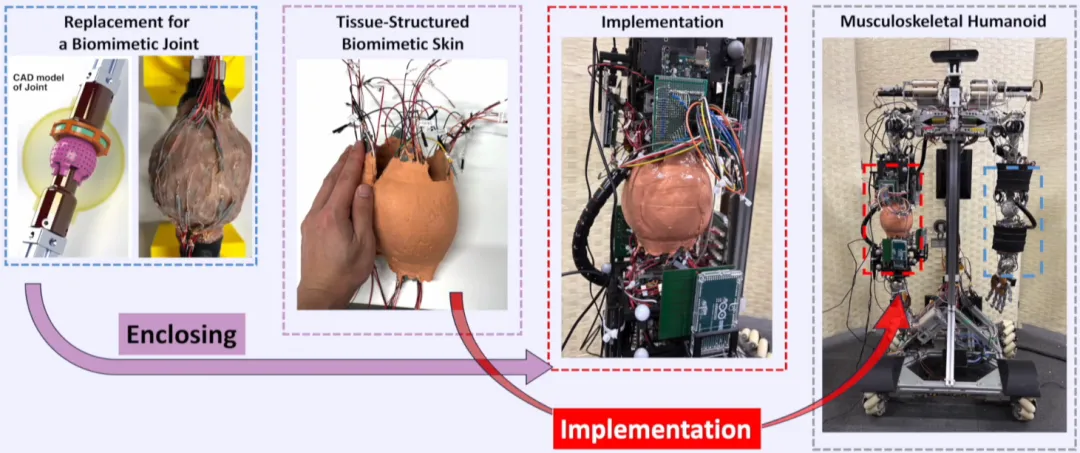
They designed one.Synovial joints covering the skin with tissue layered structuresIt was installed on Musashi-W, a musculoskeletal human-like robot.Based on this layer of skin alone, the average error estimated from a joint angle can be controlled at about 3 degrees.When skin information and muscle information are combined in the right way, the accuracy can be further improved.
01.
Why do robots need to "feel" themselves?
Let's start with a background. In muscle-and-bone-like human robots, the body is a muscle-driven, complex structure.It's hard to measure the angles of the joints directly with the encoder like a traditional machine-connecting robot does.So the current mainstream practice is to use a learning method to reverse the sensory information in muscle length and muscle tension from the perspective of the joints.
But the problem is that these types of robots are oftenA limited number and variety of sensors are available.In the body, the sensation of body is never a function of a single sensor, except for the organs of myeloma and gorgon.There are also a number of mechanical sensors around the skin and joints.More importantly, this redundancy can also help distinguish whether changes in sensory signals come from external interference or from changes in the body's own state.
The idea of the research team was to start from here:Instead of pursuing high-performance sensors that are "less sophisticated" as usual in engineering, large quantities of small sensors are buried in soft tissue instead of "organic" structures that mimic organisms.。
02.
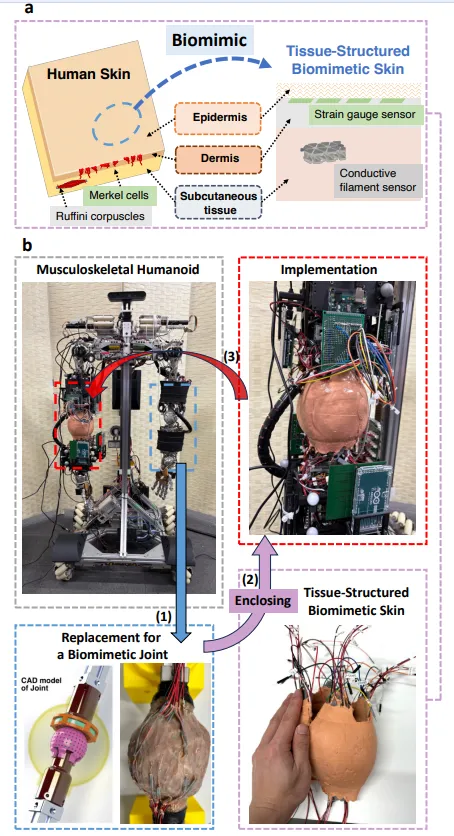
One layer of skin, referring to the three-layer structure of the human body
This layer of skin mimics life.It refers to the three layers of anatomical structure of human skin: the epidermis, the epidermis, and the subcutaneous tissue.To build.
However, the team did not pursue the mechanical nature of fully reproducing biological skin, which is that the human skin has elasticity, heterosexual and nonlinear behavior, and is difficult to reproduce rigorously with a single indicator.Key relative trends: From the outer to the inner layer, the material's flexibility increases gradually.。
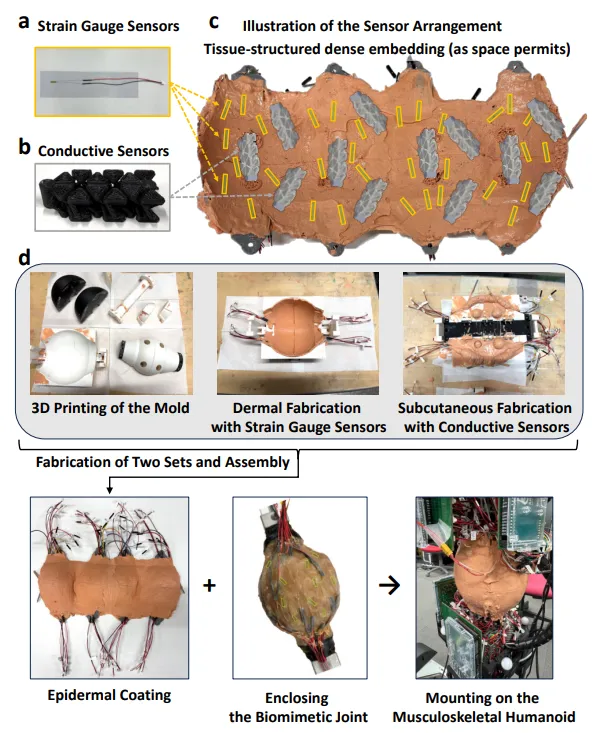
Specifically, the epidermis is made up of 30A hard cyanide, Dragon Skin 30, and the epidermis is made up of softer gel Ecoflex Gel 2 (000-34) and foam Soma Foama 15. The epidermis is about 0.2 mm thick, the epidermis about 2 mm thick, and the epidermis about 10 mm thick, basically referring to the anatomical values of the human body.
In terms of sensors, the team emphasized two things:
One is to mimic Merkel's cells.The stress film sensor, which responds to continuous pressure sensing, is 5 x 1.4 millimeters in size and only 14 micrometers thick.There are 32 embedded.The other is:ImitatingRuffini endings have an electrically conductive "locked shield" structure, which uses conductive Filaflex to create a triangular unit, which is then connected to each other by a claw knot.There are 12 of them.。
These sensorsIt is not as neatly laid out as an engineering grid, but rather based on the distribution of biological sensors, buried as closely as possible in tissue in a semi-random manner.The location also depends on the depth of the biological distribution: the stress film is placed between the epidermis and the epidermis, and the conductive A-lock structure is buried below the epidermis.
The team also learned from this.Leather strapsThe anatomical structure, embedded in the lower layers of the skin by TPU fiber bundles that mimic plaque fibers, allows the shape of the skin to be transmitted to the bone system.Because the rufinis in the organism are arranged along the membrane fibers, the locking structure is also specifically arranged in the direction of the fiber bundle.
03.
3D error, more accurate after integrating muscle information
So what's the use of this layer of skin?
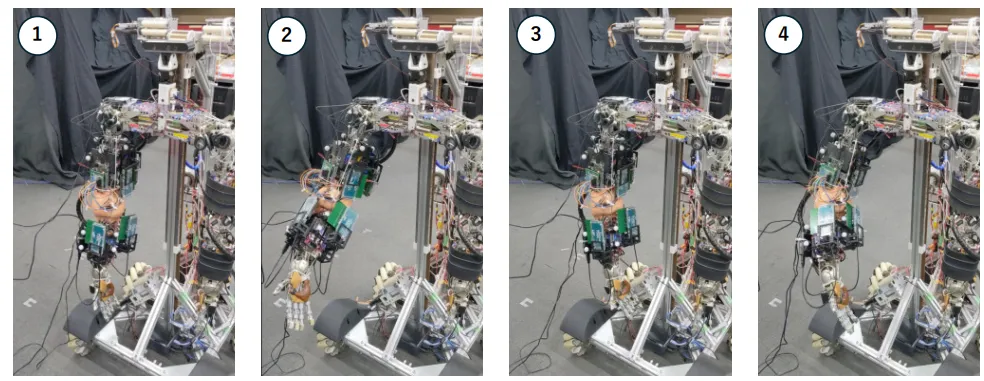
The team had Musashi-W's right upper extremity exercised repeatedly for about an hour.615 groups of sensing data。The built-in power meter is no longer available due to the replacement of the original associated node modules with biosynthetic joints.The team used the OptiTrack motion capture system (Motive 3.0.1) to compute the pitch/yaw/roll three-frequency angles of the elbow joint at the upper and forearms, and then to make an estimate using a multi-layered sensor (MLP).
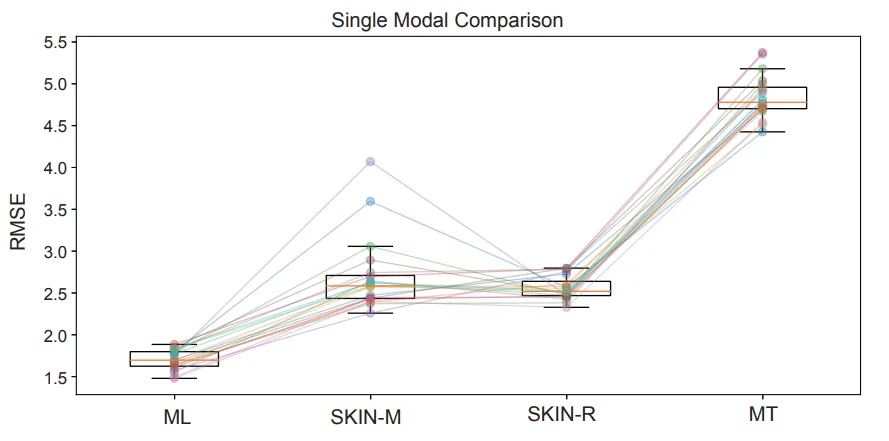
The results of the single-mode comparison show:
- The muscle length (ML) error is minimal, averaging about 1.70 degrees.
- Ruffin's skin sensors are about 2.56 degrees.
- The mercury skin sensor is about 2.69 degrees.
- The maximum muscle tension (MT) error is about 4.84 degrees.
In other words,Both types of skin sensors are highly effective.Muscle strainThis shows that the changes in the shape of the skin around the joints do indeed contain information about body sensation, which is also consistent with the biological findings of "the skin's mechanical sensors engage in body sensation by stretching".
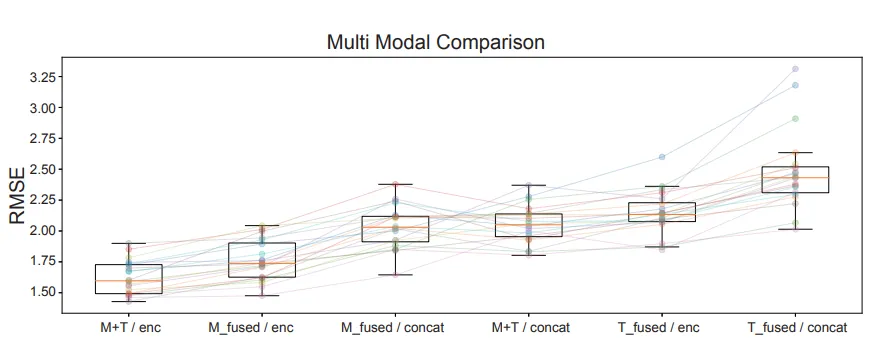
The results of the multi-mode integration were more interesting. The team tested two architectures: concat and encoder, and concluded that:It's the right way to integrate, and it's the right way to increase accuracy.。
The best-performing approach is to integrate muscle-to-skin information encoded (M+T enc), with an average error of about 1.62 degrees, significantly better than muscle length alone.(Holm corrected p<0.001) This suggests a link between muscle information and skin information.May contain supplementary informationIt is also possible to dig through proper signage learning.
But on the other hand,The rest of the convergence conditions have not been more stable than the baseline of muscle length.M_fused ((concat) 2.03 degrees, M+T ((concat) 2.05 degrees, T_fused ((enc) 2.15 degrees, T_fused ((concat) 2.48 degrees, all less than 1.70 degrees.Simply put, polymorphic signals are pulled together, instead of pulling accuracy.
04.
The skin can also be used as a "buffer" and "check-out clue".
In addition to the estimated value, this layer of skin has an added value:Help robots to detect external interference。
In many musculoskeletal robots, the muscles that drive the body are exposed to the outside, and the external force acts directly on the muscles.It is difficult to tell whether the changes in sensory values are caused by external collisions or by changes in the muscles themselves.。
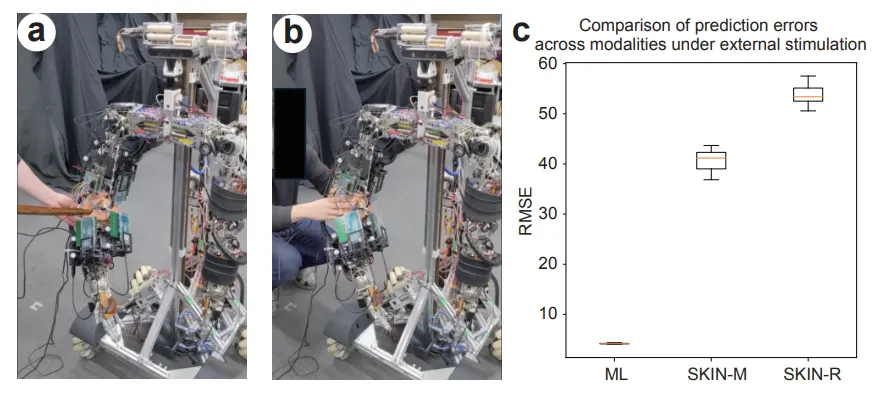
The team used stick-like objects and hands to press the elbow joints of the robot from all directions, collecting data from 157 groups of interference bands. Here is an important premise:They used models trained with "no disruption data" to directly estimate "no disruption data".。
The results were very different:
- Ruffini-type skin sensors: 2.56 degrees → 53.63 degrees
- This is the most common type of skin sensor in the world.
- Muscle length: 1.70 degrees → 4.18 degrees
I'm not sure if I'm going to be able to do that.Local deformation caused by external contact is superimposed on the movement of the joints, causing a significant deviation in the input distribution relative to training.While the muscle length of the signal is relatively limited under the influence of extraneous force, the error remains at about 4 degrees.
This "modal difference in degradation" could in turn be a clue: if the skin side is estimated to have deviated significantly, the muscle side is relatively stable.It might be a hint.External contact occurs in the joint area; on the other hand, if the skin is stable and the muscles are estimated to change,It might be a hint.There are problems with the muscles, such as stress abnormalities, muscle relaxation, and even muscle sensory failure.This distinction can't be made with a single muscle pattern.
The paper also suggests that soft skin outside the joints is covered.It may also serve as a mechanical protective layerIn addition to this, there is a significant reduction in the amount of stress that can be transmitted directly to the muscles, but this has not been quantified.
05.
Linking words with prospects
In summary, the sensors currently in use are much larger than biomechanical sensors and far fewer than real skin.Therefore, this set of implementations should be understood as a conceptual reconstruction of the "organization-level sensory architecture" rather than a rigorous reproduction;The resilience and historical dependence of silicon materials can lead to lag, fatigue and driftThe long-term stability has not been assessed; in addition,Data sets are mainly collected under quasi-static conditionsThe future of performance in high-speed dynamics, as well as online labeling, adaptive learning, and timing models, is still a work in progress.
The range of motion of the experiment (about 50° of pitch/yaw/roll) is not the mechanical limit of the joints.Rather, it avoids embedded sensor disconnects, ensures that the number of effective channels is constant, and allows evaluation to be repeatable, while man-made working spaces.
But the meaning of this work is:It takes biology to the organizational level.In addition to imitating isolated functions, it focuses on the organized integration of a large number of sensors and their support structures.It's also been verified:Without relying on high-precision single-point sensors, without doing a lot of layout optimization, and with just a bunch of "sensor-like elements" embedded in the organization, meaningful joint angle estimates can be made.。
The team believes that integrating distributed sensors into smooth skin structures could lead to mechanical protection, contact detection and complementary sensory information at the same time.Robots that have a broad need to interact with environmental biology could be equally helpful.It is also expected to spread to other parts of the body in the future.