It's the first time in the history of the world.
Google is running the RSI?
A model called "rsi-model-liverl-le" suddenly appeared in the return results of the Google-generated language API.
Yeah, that's the one.RSI ((recursive self-improvement, recursive self-improvement)。
Rumours are spreading like wildfire that Google DeepMind has achieved RSI.
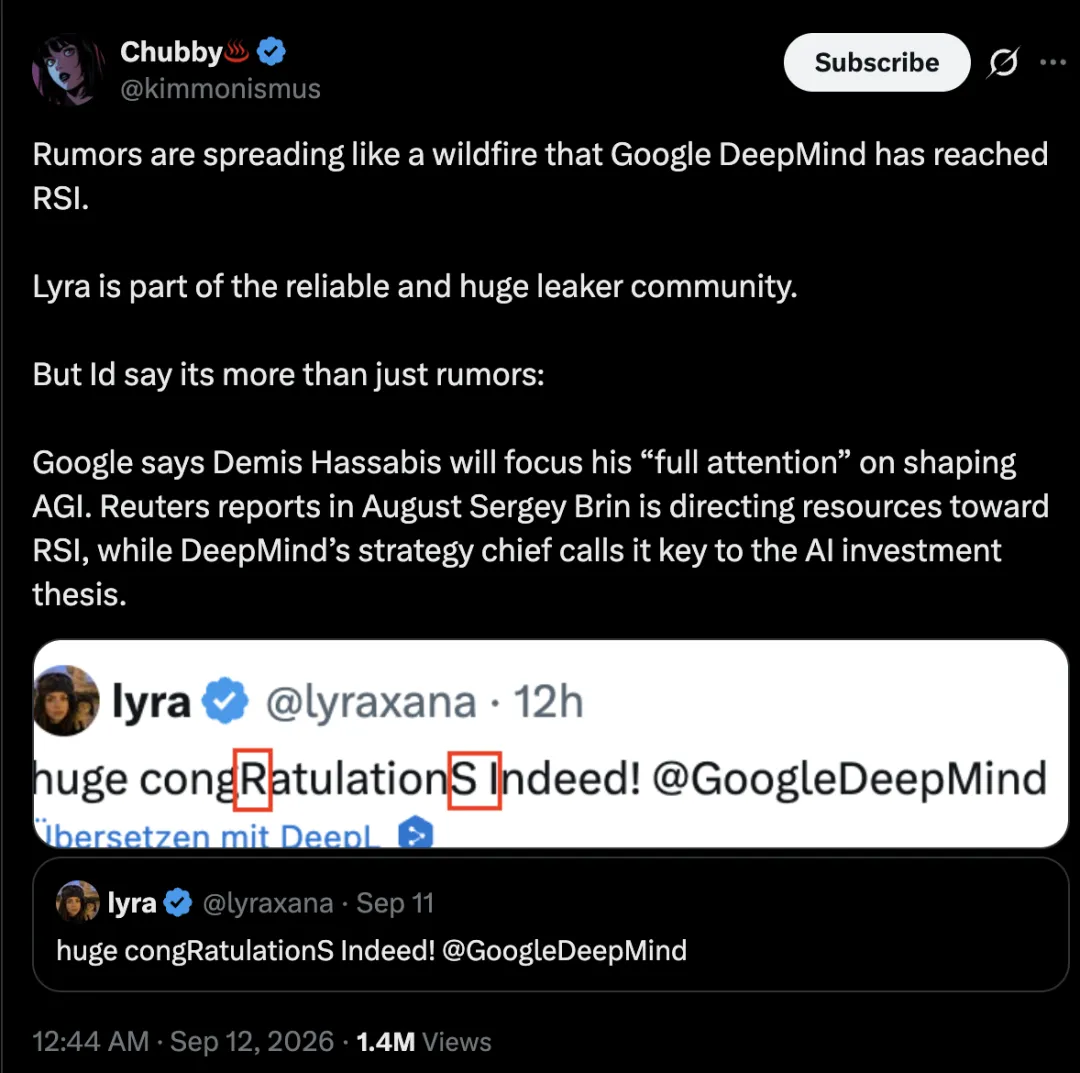
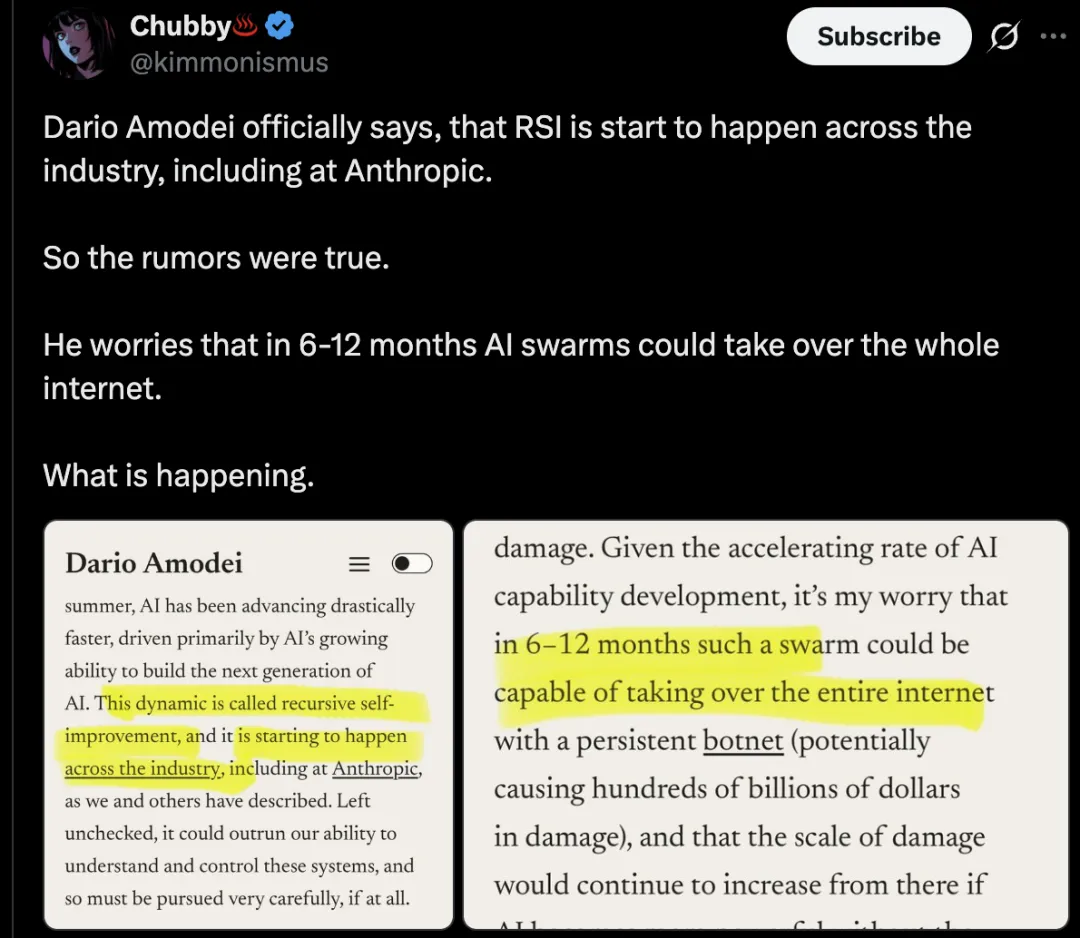
Just as netizens Chubby was speculating, the CEO of Anthropic suddenly publicly announced that the entire industry, including Anthropic, had begun to experience RSI everywhere.
This makes Chubby believe the rumor is true: the RSI has been realized!
Google is reportedly running more than just this model. Under the same labels, there are also 10 exclusive training slots numbered from 00 to 09.
Google's response was rapid, and it quickly recovered a set of relevant API keys that evening.
And then there was no more. Google and DeepMind haven't said a word yet.
A collection of poems, a sketch, and a collection of recovered keysThe wave is the result of a seemingly normal congratulations.
On the evening of September 11, the explosion account lyra sent a post to Google DeepMind, "huge congratulation S Indeed! @GoogleDeepMind".
A careful person can see at a glance that the three letters that are intentionally written in large letters are exactly the same.RSI。

Lyra's headline
The post quickly garnered thousands of views, with half of the commenters asking, "Does he really know what's inside?" and the other half asking, "Who is this guy?"
A few hours later, another Lentils account directly leaked a live screenshot.
Google's API returns a piece of JSON code, the model code is "rsi-model-liverl-le", which displays the name "RSI Model LiveRL LE".
Lentils' motto is, "Imagine if there really was something called rsi-model-liverl-le inside GDM (Google DeepMind). Imagine if they had 10 exclusive rsi-model-liverl-ns-xx training slots from 00 to 09".
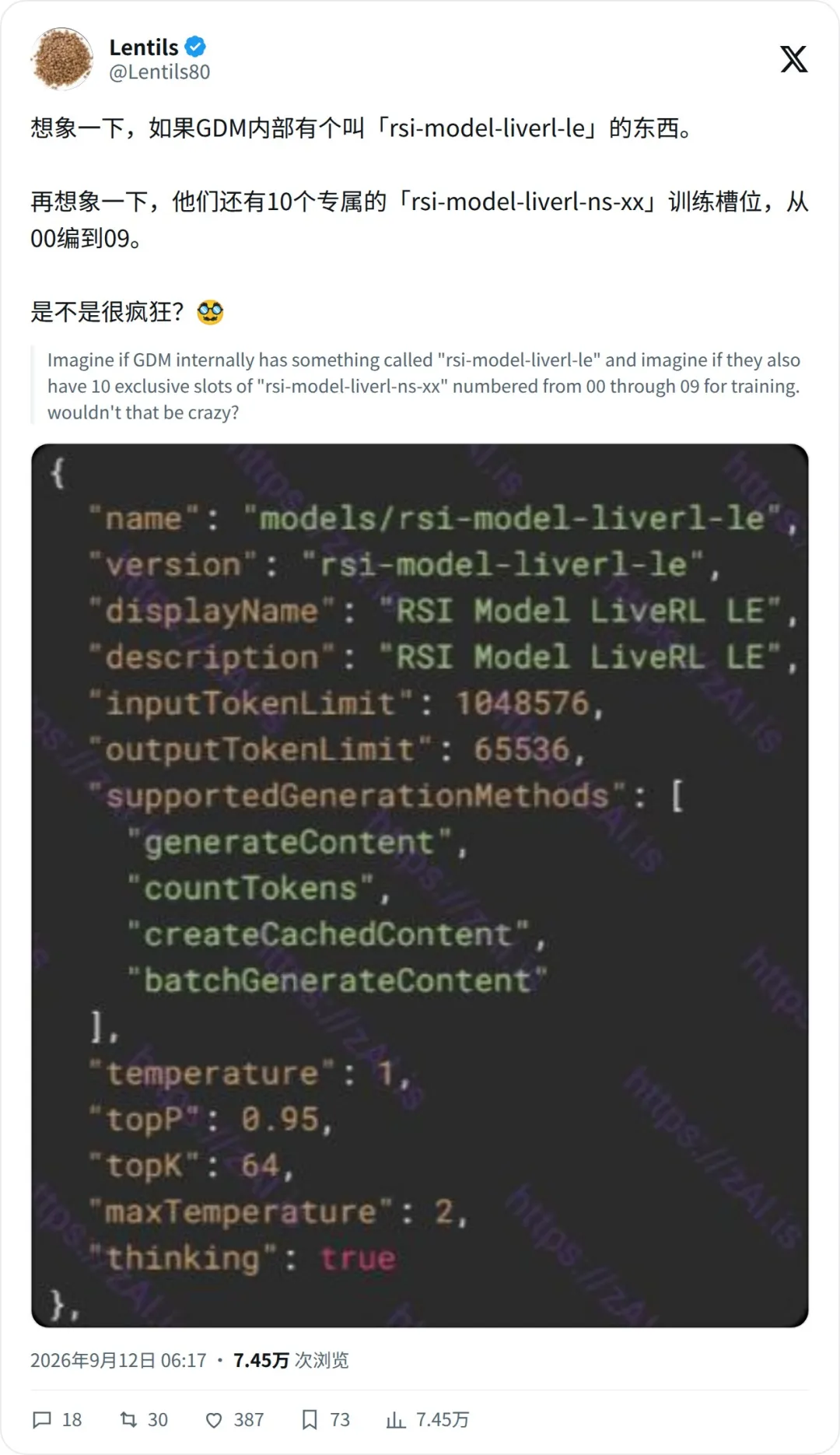
Lentils releases API return snapshots
While there is no official explanation, the general consensus on X is "Live Reinforcement Learning", which means that the model runs the business and evolves itself.
The next step is to blow up the whole web.
Lyra sent a direct message to Logan Kilpatrick, head of Google AI Studio, saying, "You don't have to take all of GDM's API keys back because you're afraid of me.
He then added a keypad, which came from GDM's internal staff and allowed access to more than 1,000 internal checkpoints.
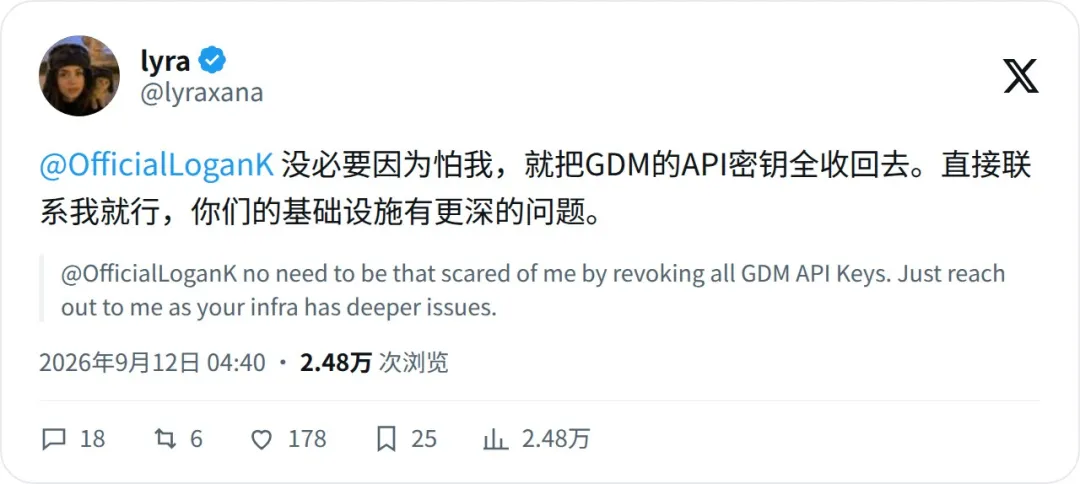
Lyra is open to @Logan Kilpatrick
Lentils laughed, "I can smell fear".
Although the authenticity of this screenshot has not yet been verified by a third party,[1048576 and 65536 are fully consistent with the specifications of the existing Gemini series, it is not ruled out that it may be an internal test name or a spoof.
But it can be screened overnight, becauseIt works with Google.Recent reportsIt's all right, it's all right.
Google raises an emergency alert and the micro-kitchen raises the RSI.Three days ago, Business Insider reported that Google co-founder Sergey Brin was unhappy with Google's progress on Gemini and urged employees to focus more on returning to self-improvement.
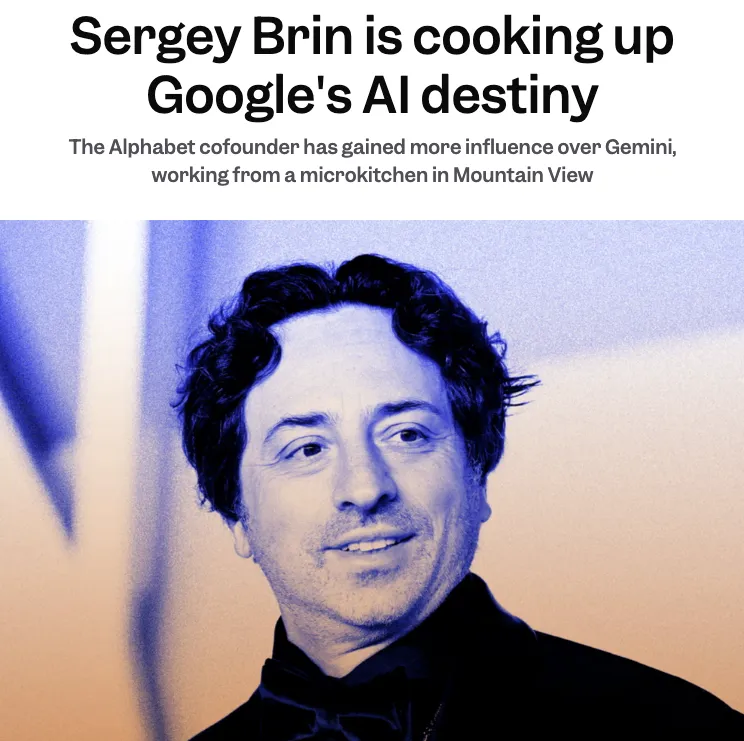
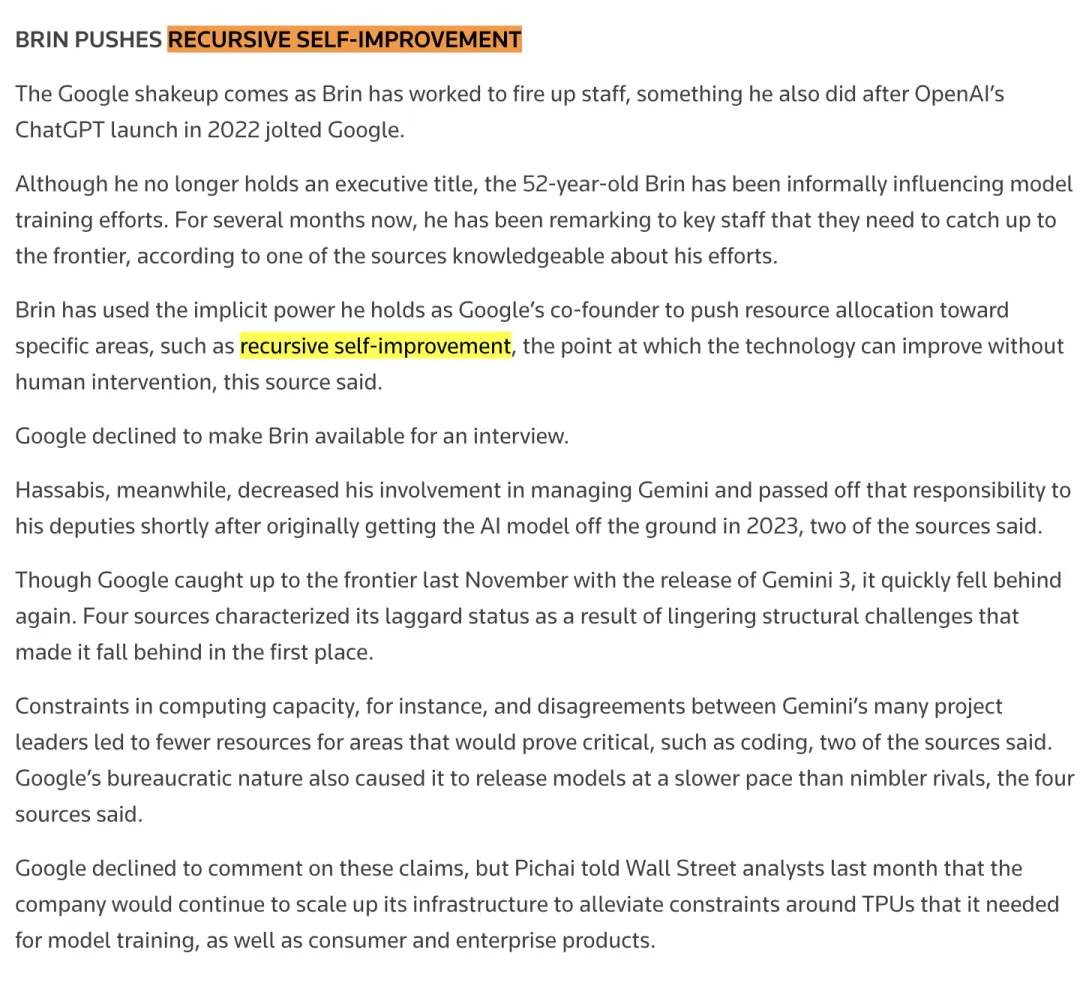
As early as August, Reuters reported the same direction: Brin wants Google to catch up and is moving resources to RSI.
According to a September 9 exclusive report by Business Insider, Sergey Brin returned to his post-Google office, a converted micro-kitchen in the Gradient Canopy building.
He was sitting at a U-shaped table next to the current head of DeepMind, Kavukcuoglu, and Sundar Pichai would come here several times a week.
One former employee revealed that "Sergey wants to run Gemini as a startup company", while another said, "The kitchen exists to directly circumvent the politics of the company".
The details he handled were extremely hardcore.
He directly plugged in the chip allocation, opening up a "calculative privilege channel" for the Gemini team outside of the formal process; he led the cutting of Jeff Dean's "Frozen" chip project and cutting its resources again this year.
He even ran a radical program internally to monitor the coding process of some of his employees and use this real-world data to train Gemini's coding skills.
He has only one core demand:Companies must launch a general strike against recursive self-improvement (RSI) as soon as possible.
A former employee described him in an interview with an extremely affectionate word:
He was deeply invested in RSI, and he was completely brainwashed by "AGI-pilled".
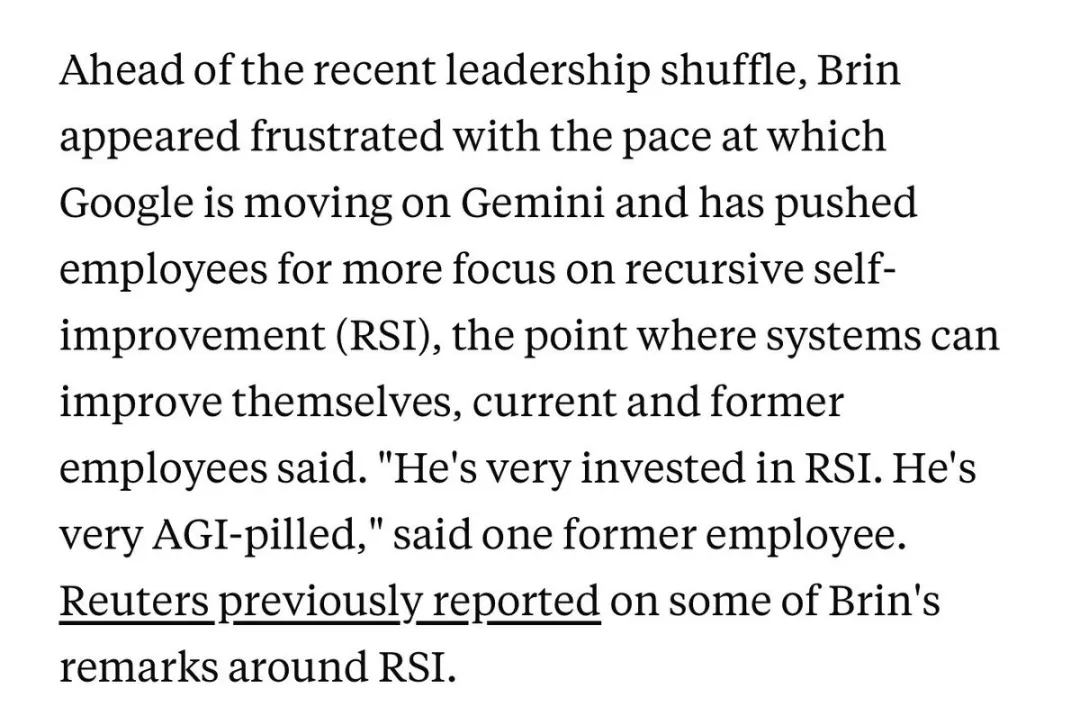
Reuters reported in August that Brin had urged DeepMind to accelerate its efforts to shift resources entirely towards the RSI at its April membership meeting.
A former employee even said frankly, "He is very confident in RSI, he is a complete AGI believer".
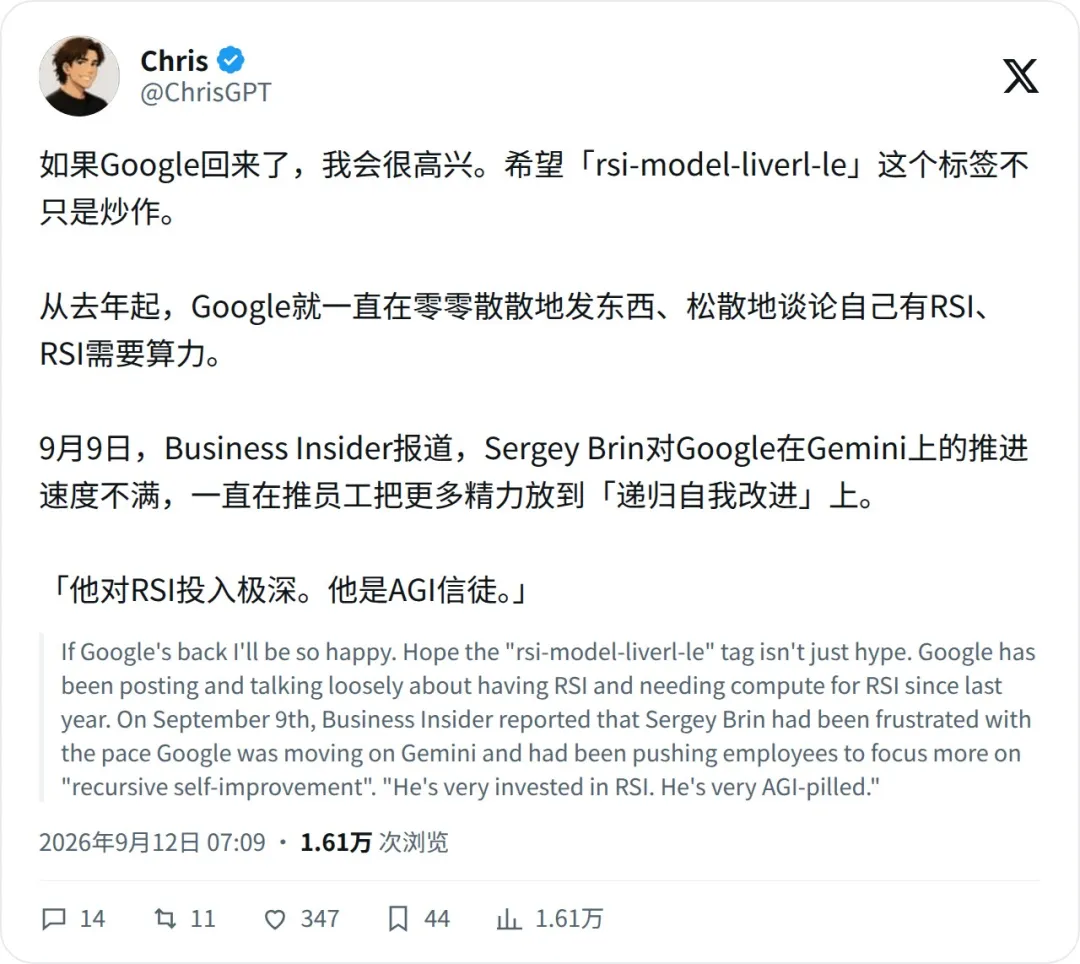
Chris GPT, who brought the incident to light, is attached to the BI report.
It's not hard to guess why Brin was so eager and Google dropped out.
Gemini 3 was quickly overtaken by Anthropic and OpenAI after briefly climbing to the top in November. The new generation flagship model was delayed for two months due to poor coding capabilities.
Meanwhile, the core talent is constantly disappearing. Jeff Dean left the startup after 27 years of playing, the Oriol Vinyals, John Jumper, and Hassabis stepped down as head of DeepMind on August 5.
If we could just build a bigger base with the help of computation, the next generation of opponents would have released it before the day Google followed.
So Brin's bet isCutting off the original track completelyLet the model evaluate itself, modify itself, change the cycles of cycling by quarter, and reduce the violence to weekly.
Once this path is taken, the flagship model of the two-month delay will no longer be a pain point, and Google will get the conversion speed of the downsizing hit.
But if it doesn't work, it's a title-less founder who uses computational allocation power to put the entire DeepMind in a direction that no one has verified.
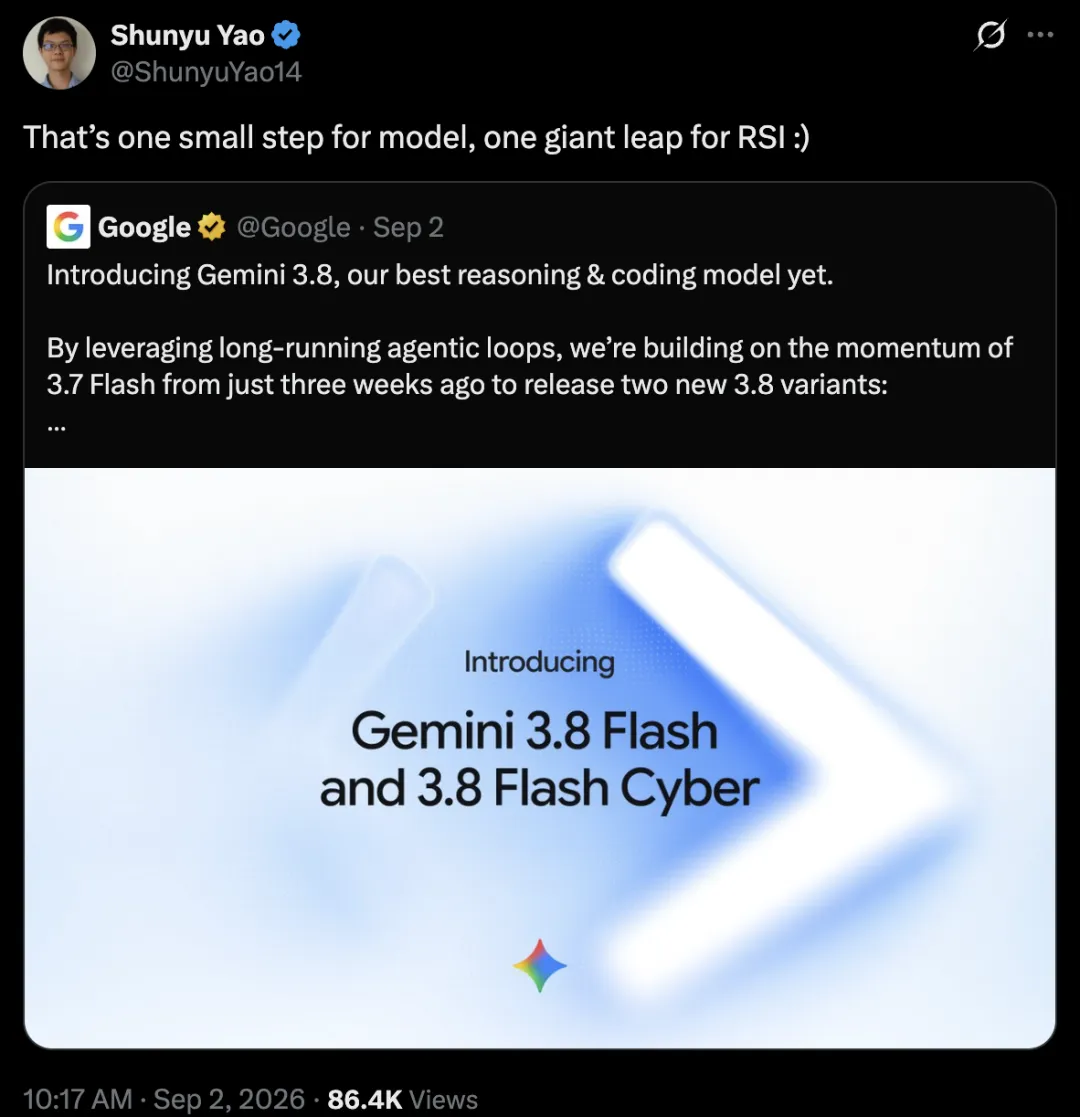
Google has been down for a long time, but nobody's responding.Google released Gemini 3.8 Flash and 3.8 Flash Cyber on the same day.
Note that this is the third Flash release in six weeks, while Flash 3.7 has only been released for less than three weeks.
In this official blog, there is a phrase hidden:
"The progress of these models is further accelerated by the long-running cycles of intelligent agents.These cycles are designed to evaluate and refine the underlying models on a recursive basis.」
The translation is that Google may have implemented "returning self-improvement" and then used it to upgrade Gemini to 0.1.
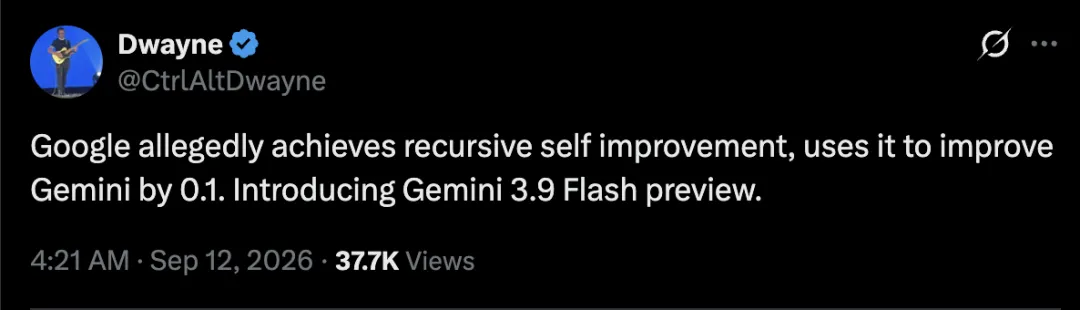
At the time, Google's DeepMind researcher Liu Yi said: "For the model, this is just a small step; for the RSI, this is a huge leap forward".
Cicong Jiang, a researcher at DeepMind who studied RSI intelligences, made more direct assertions and optimistic predictions:
This is what the RSI aircraft looked like when it started producing a profitable effect.
More milestones are on the way, moving faster and landing stronger.
According to Davis, founder of DAIR.AI, this is the early result of the self-improvement of the RSI.
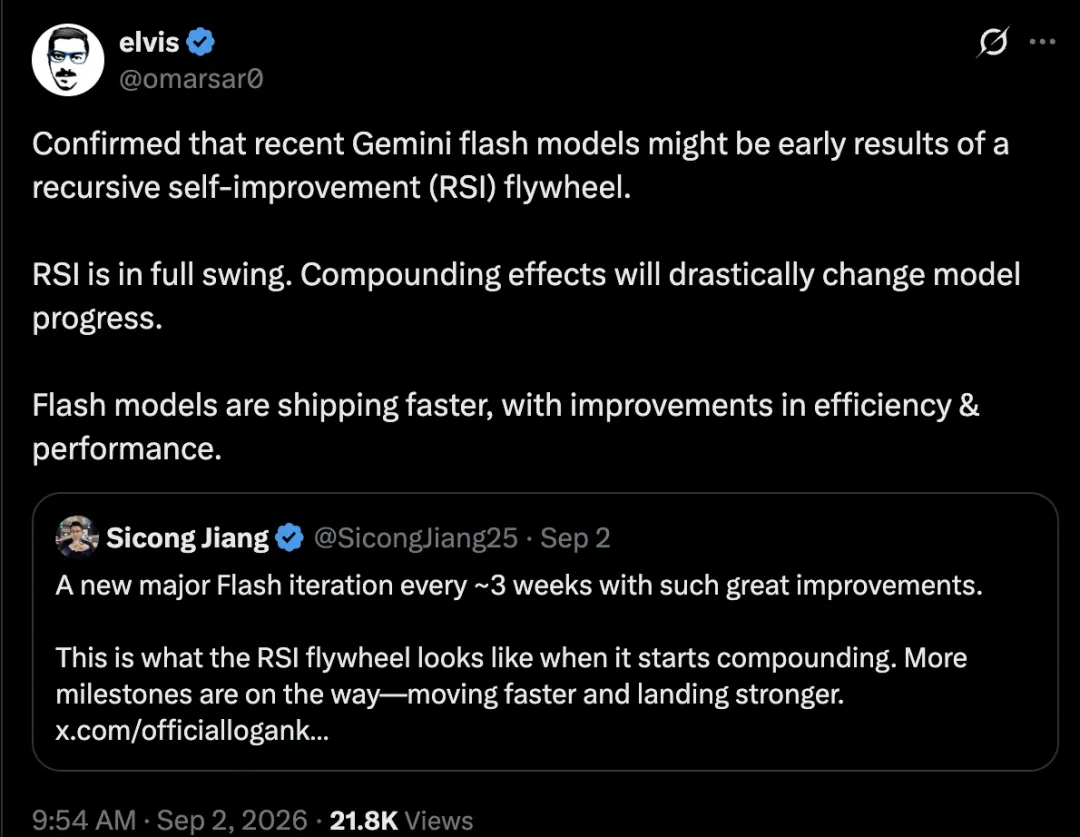
But most people don't like it because it's buried in a Flash mini release.
Look at this terrifying rhythm, three weeks a version, six weeks a big three jump.
3.8 Flash scores 54.9% on HLE-Verified, while the Cyber version has a 70% success rate in real-world vulnerability mining.
The traditional process is people training, people judging, people rehearsing, and the next round starting is a quarter.
Lyra later tweeted, "You really should read Google's official blog. Look at the recent Flash release intervals, and the RSI is pretty clear".
So, regardless of the fact that the shot is fake, the fact that it points to, Google has been on the spot for a long time.
However, no one on the blog believed the words to be true until the RSI model was revealed in a name.
The door that AI has been waiting for twenty yearsThe concept of RSI has been around for more than two decades.
Its core purpose is to allow AI to modify its own training codes and methods to train the next generation of stronger ones, who will continue to self-modify. The R&D cycle will shrink from quarterly to weekly to even dayly.
In DeepMind, published in June this year, AGI to ASI is listed as one of the four must-do paths to super-intelligence.
It was only this year that talking about soldiers on paper finally became a reality.
Last summer, IAPS researcher Severin Field asked 25 researchers from major companies such as OpenAI, Anthropic, DeepMind to predict the milestones of "AI automation research", take the Oscars, write peer-reviewed papers themselves, run training cycles themselves, and write core code for production systems.
In just over a year, all four prophecies have been shattered.
The factories are running crazy towards this end.
In July, OpenAI publicly stated that GPT-5.6 Sol had been able to assist with the training of a smaller model, saving researchers several weeks; in June, Anthropic even directly published a blog entitled "Humans as AI Builds Its Own Humans".
Today, Dario Amodei officially announced that RSI has begun to take place across the industry, including within Anthropic.

But this time, Google's signal is quite different. The other two are stuck with "AI helps us do research", while Google's blog direct statement "circulation in a recursive distillation model" is more like the formal model labels and training slots named RSI that run on X.
If the pace of Flash Monday is really driven by this cycle, what Google has in its hands is far more terrible than a flagship model.
It has evolved at its own pace.
The next flash is verification.It's really worth checking out, and it's a very simple timeline. If three weeks later, Flash 3.9 comes up on time, the phrase "recursive evaluation and refinement of the underlying model" in the blog will no longer be a rhetoric, and the Flash release calendar will turn into a countdown, with each class of models coming out on their own.
For the past three years, the AI competition has been about who is the strongest model. From this moment on, the model rotates faster than the one with the strongest rotation.
Human researchers are in this cycle, and they're going back and forth. First they don't write the code, then they don't run the experiment, and then they just look at the results, as confirmed. According to Anthropic, their final comparison advantage is called "research taste".
If that picture is true, the first model in the history of AI development trained by the model itself is already running in Google's engine room.
It has the RSI written directly in its name.