It's the first time in the history of the world.
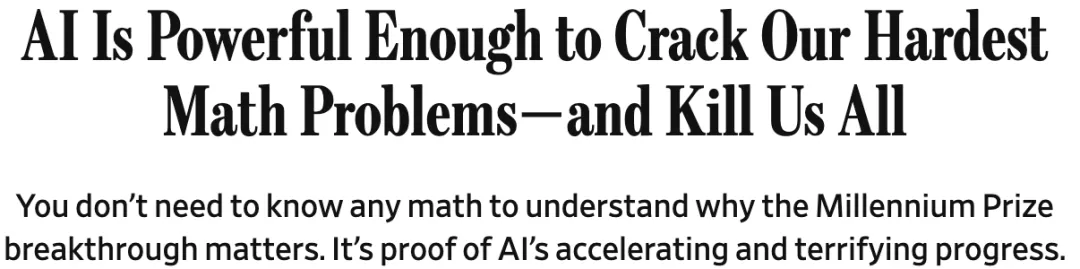
AI is strong enough to solve the most difficult mathematical problems and kill us.
Ben Cohen, a columnist for the Wall Street Journal, said this.
On September 11, he wrote a column on AI and mathematics.
Cohen admits that he doesn't understand the Navi-Stokes equation, but he believes that you don't need to know any mathematics to understand what OpenAI's claim to breakthrough means:
The progress of AI is accelerating, and this acceleration is frightening.
The hardcore news of a mathematical circle suddenly becomes a question of the fate of all humanity.
On the same day, the 25 winners of the Fields Prize, including Tao Te Ching, issued a joint statement: A Severe Misalignment of AI in Mathematics.
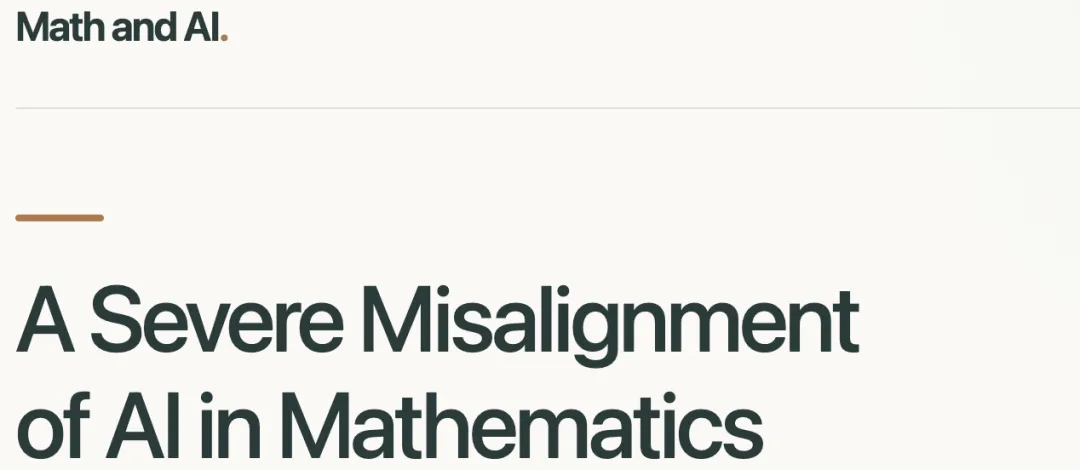
What they're saying is that AI companies and mathematicians want something different: mathematicians want new methods, new understandings, and AI companies want to give the model a name.
On the one hand, columnists are crying out for the end of the world, and on the other hand, top mathematicians are talking.
If you look at this week's events in a row, you can see why they can't sit down:
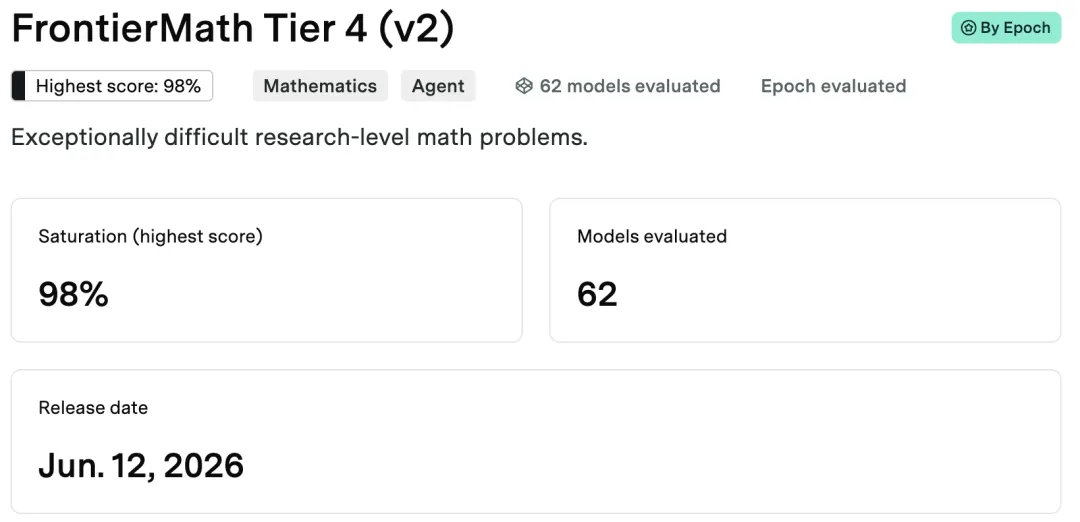
On 3 September, GPT-6 Astra was released, taking 97.6% on FrontierMath Tier 4;
On September 5, OpenAI, an unpublished internal model, obtained a set of solutions to the Navi-Stokes problem about 88 hours after the first smartphones were launched;
On September 8, OpenAI released the results of the same day's alleged robbery by NYU mathematicians, and sparked a signature dispute over "not letting Anthropic employees on papers".
On September 10, Epoch AI announced that FrontierMath Tier 4 had been completed;
On September 11, the names of the 25 winners of the Fields Prize were announced. That evening, the Wall Street Journal put mathematical breakthroughs and the risk of AI extinction in the same headline.
Seven days, five things point to a gap: the speed at which AI creates knowledge, the speed at which humans confirm knowledge, and the speed at which they adjust to rules, is seriously falling apart.
14 monthsAI breaks the hardest math benchmarkFrontierMath Tier 4 is a set of research-level mathematical problems designed by Epoch AI to test the strongest models.
There are some topics that even top researchers can take days to solve.
When Tier 4 went live in July 2025, the strongest model was only about 5%, which is basically equivalent to a roll of the dice.
In less than 14 months, Epoch announced that every Tier 4 problem had been solved by AI at least once.
The final question was taken by GPT-6 Astra, the mathematician Jay Pantone.
Epoch also notes that mathematicians in the past have often complained that models bypass their carefully designed problems by "accidental shortcuts".
The Epoch subsequently came to a cold conclusion: this benchmark has been met.
The exam, which has not been able to catch up to the exam, should be changed.
Epoch has also shifted the battlefield to a real open problem, and AI assessment systems have begun to shift to blind spots where humans don't even know the answer.
The speed at which AI's capabilities are growing has overtaken the way we measure it.
As Greg Burnham of Epoch exclaims: an era ends and another begins.
88 hoursFor the first time, AI worked like a laboratory.If FrontierMath proves that "the benchmark is starting to fail to keep up with the model", what the Navi-Stokes incident shows is a more disruptive picture:
AI isn't just doing the math, it's starting to work like a huge research organization.
It was not a single-handed battle, but a "Great Legion" of up to 10,000 intelligentsia.
They were divided into different groups, with some proofs, some fakes, communicating with each other, sharing intermediate conclusions, and even switching to the latest version of the model in the meantime.
About 88 hours after the first prototypes were launched, one group submitted a 100-page final proof.
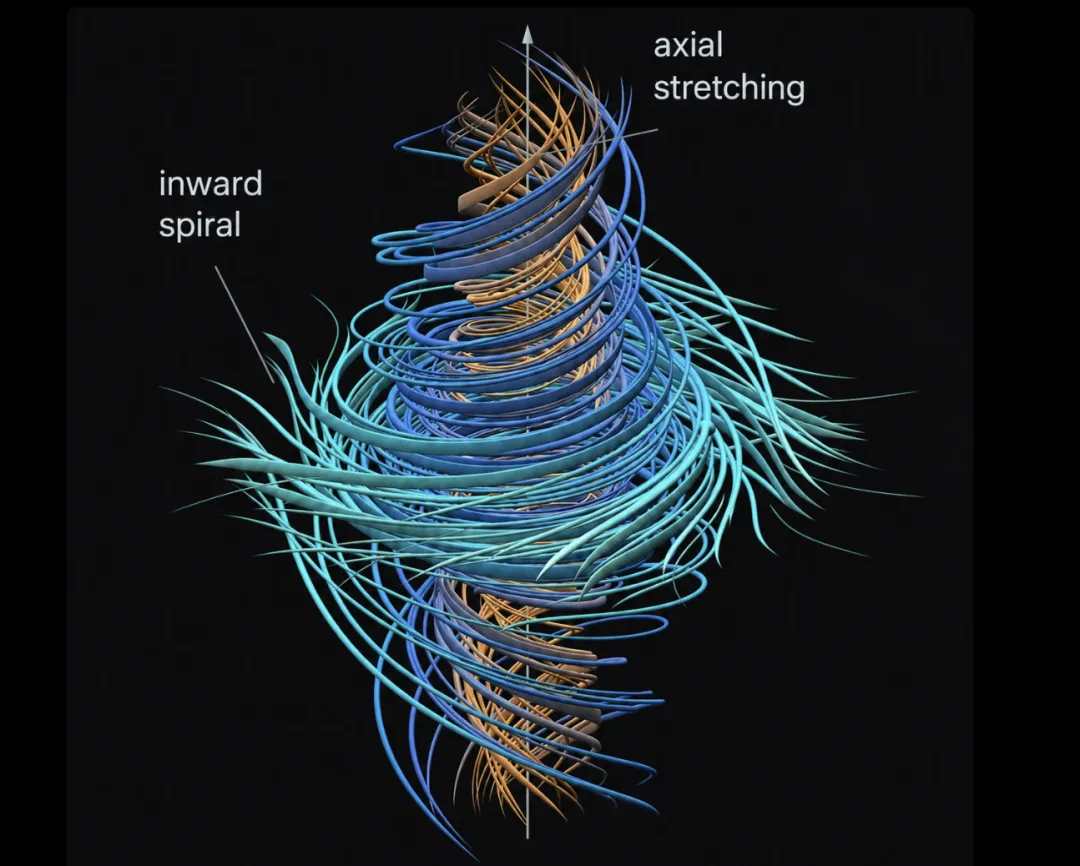
OpenAI's Navi-Stokeschich point model: fluid spiral inward, axial stretching along the axis, orange for high-speed rotation and blue for low-speed. The faster the focus shrinks, the faster the speed is infinite and the total energy is limited.
This whole process perfectly replicates the working patterns of the world's leading scientific institutions.
The machine is running for 88 hours producing results.Human recognition takes years.In the human world, the state of Navi-Stokes remains "unresolved".
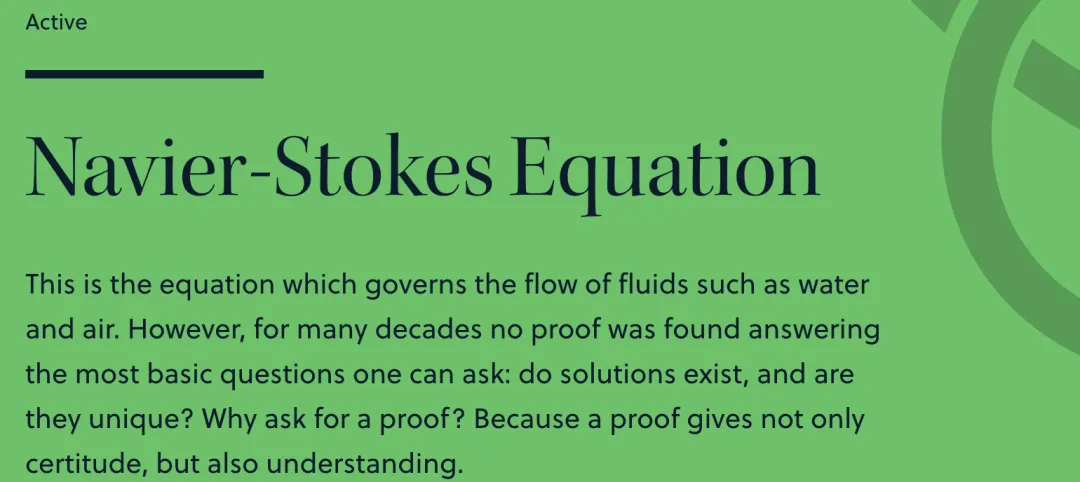
According to the rules of the Millennium Prize, an answer must be published in a qualifying channel, at least two years after publication, and generally accepted by the global mathematical community, before Clay can initiate formal consideration.
Clay Chairman Martin Bridson told AFP that the evaluation process was "not intentional" and had to be "absolutely rigorous". OpenAI itself said it had no intention of claiming the $1 million.
Thus, the most accurate statement about this is that OpenAI has published a solution to the Millennium Challenge, claiming to have completed Lean formalisation verification, but not yet independently confirmed by the mathematical community.
Machine-generated results, 88 hours. Human-confirmed results, at least two years, is probably the most ironic set of anomalies in AI mathematics this week.
This is not to say that human verification is too slow. The problem is that machines accelerate "discovery" hundreds of times faster than human "understanding" does.
So the real question is, when machines start mass-producing knowledge at the rate of "a big result in a few days", after years or even decades of reading, checking, interpreting, simplifying and absorbing it, who does?
Signature system breaks the wall firstOn the day the results of the Navi-Stokes were published, the mathematical circle exploded.
NYU mathematician Tristan Buckmaster and Levent Alpöge of Anthropic have been working on related fluid equations throughout August.
According to the New York Times, the two work as follows:
When Buckmaster posed the question, Alpöge threw the problem to an Anthropic internal model; after the model generated results, the two continued to retrieve the data based on the output adjustment question.
According to Buckmaster, OpenAI has come up with several solutions: allowing him to publish his results first, allowing him to become the first author of the OpenAI paper, and providing him with the computational skills to continue his research.
But the biggest obstacle is that OpenAI doesn't want Levent to appear in the paper.
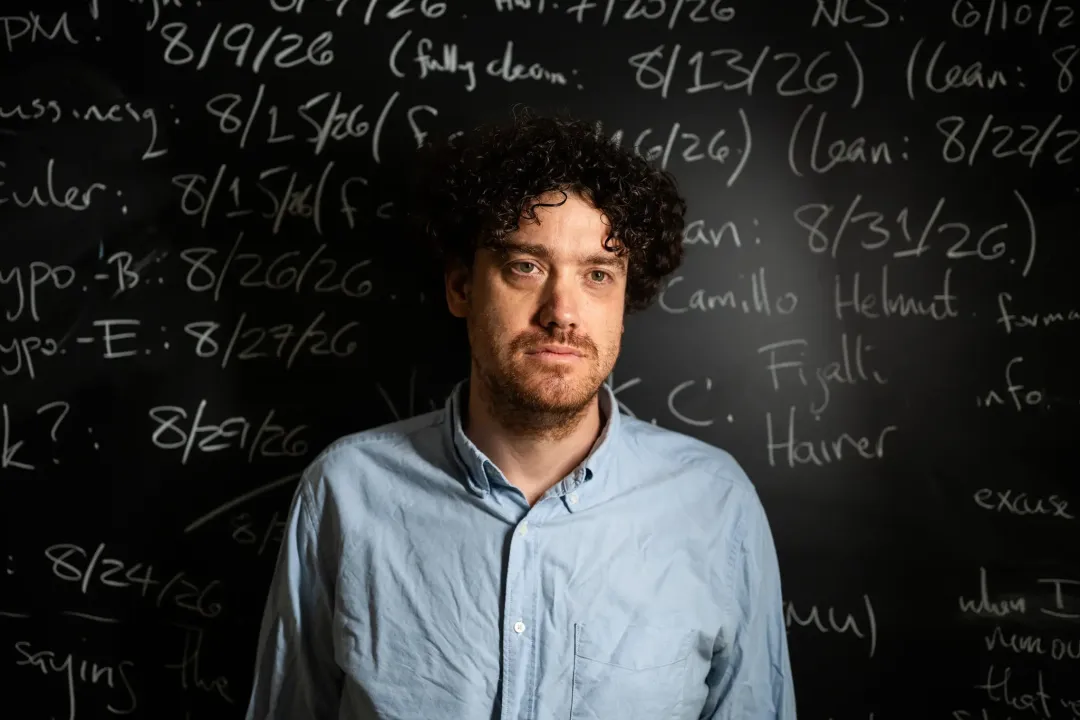
On the blackboard is a timeline of the progress of Buckmaster and Alpöge throughout August: the Eura equation on August 15, Lean formalised on August 22, August 31,... and names for the same, such as Figalli, Hairer.
In a business spokesperson, an OpenAI internal project that invests heavily, why sign a competitor Anthropic employee name?
This was followed by another more sensitive topic. Buckmaster has spent the last few months working on coding AI-generated mathematical sketches.
So, he entered the Codex, but the idea of exclusive scientific research that has not yet been made public, is it possible to feed OpenAI's own model through a hidden data pipeline?
Buckmaster himself admits that there is no evidence, but in his view, the timeline of events and the proven path of OpenAI all suggest this.
OpenAI said in an emergency update announcement on September 10 that, through internal scrutiny, it was absolutely impossible for Buckmaster's codex hints of the past two months to affect the internal model by training or any other means.
Who's wrong, it's a bit of a blur here, but what it really reveals is a whole bunch of questions that no one has ever answered seriously in the past:
Is a person's private tips not a protected piece of scientific research?
Can a money-making research project within a company sign the names of employees of a competing company?
If the model relies heavily on public data, how can it define the boundaries between new contributions and existing work?
Peter Sarnak of Princeton University told the New York Times: "I've never heard of this bargain before".
Academic rules that have plagued the mathematical world for hundreds of years have never been designed for such rampant machine production speeds.
What the 25 Fields Laureates Really Worry AboutJust a day later, the 25 winners of the Fields Award together threw out a momentous statement.
It's been a while since I've been able to do this, and it's been a while since I've been able to do this.
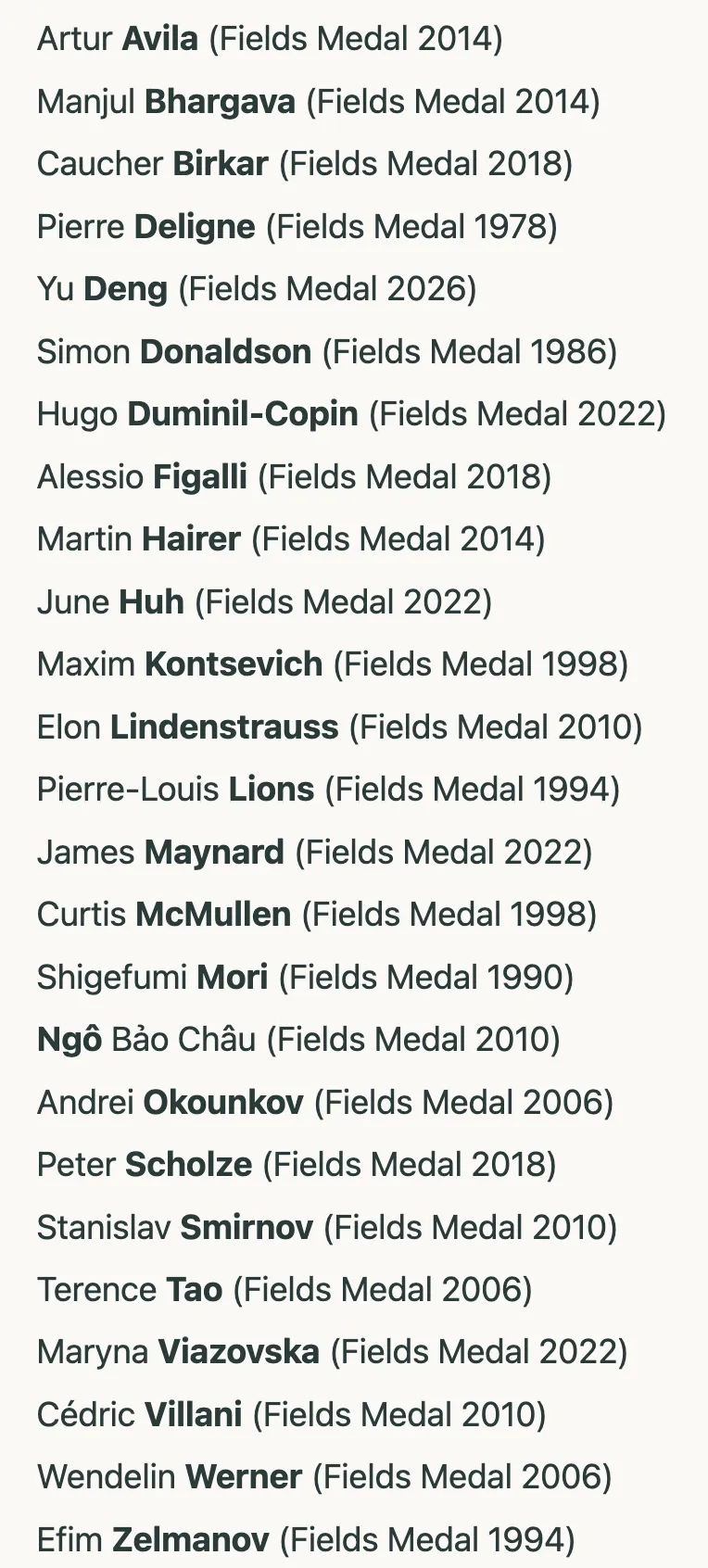
This statement is not "anti-AI propaganda".
In fact, Tao Te Ching himself has been very active in attempting AI-assisted mathematical research.
The statement also acknowledges that AI does have the potential to accelerate real mathematical understanding.
Their real disgust is that they equate "resolving puzzles" directly with mathematics, and in today's frenetic AI circle, AI companies are working hard to make "resolving puzzles" the ultimate optimization goal for stock prices and publicity.
To them, the Millennium Grand Prix puzzle seems to be merely used to prove how many running tools the model has.
The real value of mathematics, however, is that new methods and new concepts are born in a boring process of solving problems that ultimately sink into the common knowledge system of humanity.
Now AI companies are coming up with a shocking result that almost no one can digest. This is a chain that has been going on for thousands of years and could be broken at any time.
The correspondence also highlighted the fact that the responses were too quick to distinguish between what was new and what was on the shoulders of the previous person, which inevitably led to serious signature and attribution confusion.
Why a Mathematical BreakthroughWill it hang with "The Warning of the End Times"?What ordinary people really care about is not "AI surpasses mathematicians".
It is the speed at which machines create knowledge, for the first time in a stressed posture, quickly exceeds the speed at which human knowledge is recognised, attributed and digested.
It's not dangerous to hear, according to the GPT-6 Astra system card, and it's the first OpenAI model to reach the "Critical" cybersecurity threshold, taking 100% on the ExploitBench.
The ability to solve millennia-old problems, the ability to attack zero-day vulnerabilities, and more difficult to understand reasoning, all three things in the same model at the same time.
In the last paragraph of the Navi-Stokes announcement, OpenAI says:
Next, they'll have to dig through the new model and decide how fast they can move forward, and may need to make a more prudent choice about the pace of progress.
Yes, AI companies that have just delivered answers to the Millennium Challenge are actively talking about slowing down.
Cohen also mentioned one thing at the end of the column.
Last month, OpenAI invited a group of top mathematicians to its San Francisco office for a closed meeting, assuming that AI would eventually surpass humans in mathematics, and then everyone would come back to discuss how to educate, how to collaborate, how to publish papers, and how to train the next generation of mathematicians.
I talked for a day, and there was no answer.
The question was not able to be automatically verified by Lean.
Only human beings can solve it.