
It's the first time in the history of the world.
GPT-6 Astra for OpenAI Plus users is finally starting to pay off.
On September 3, OpenAI released GPT-6 Astra, officially saying that "the next few days" will be rolled out to all Plus, Pro, Business and Enterprise users.
As of September 4, Autman announced on X: Astra is now open to all Plus and Business users.
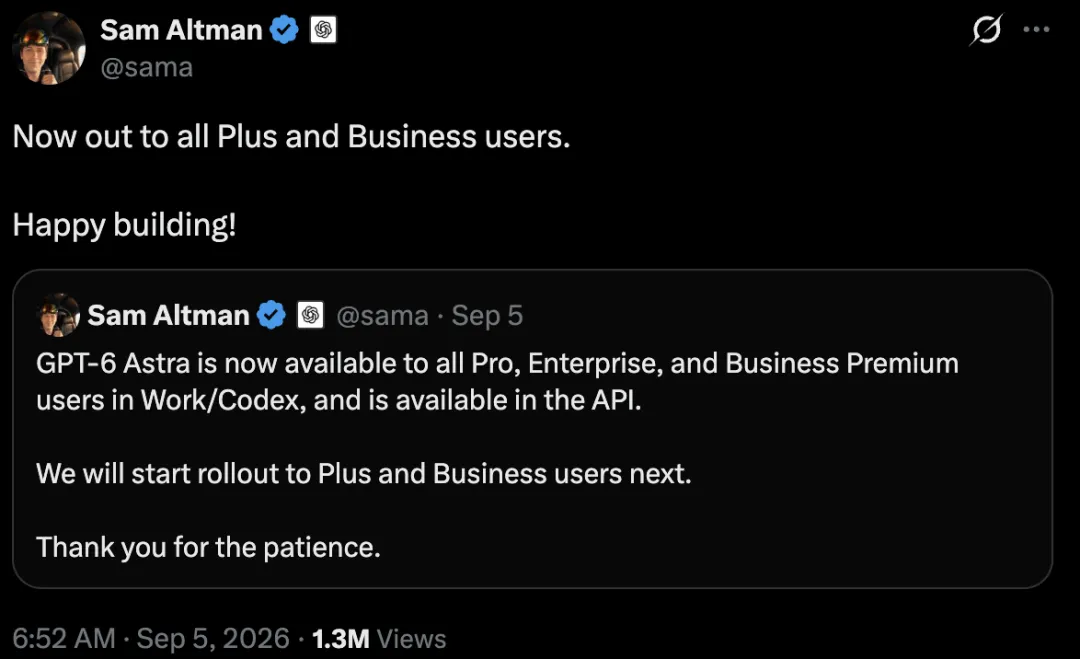
The head of the Codex, Tibo, also posted a message confirming that the push has reached Plus.
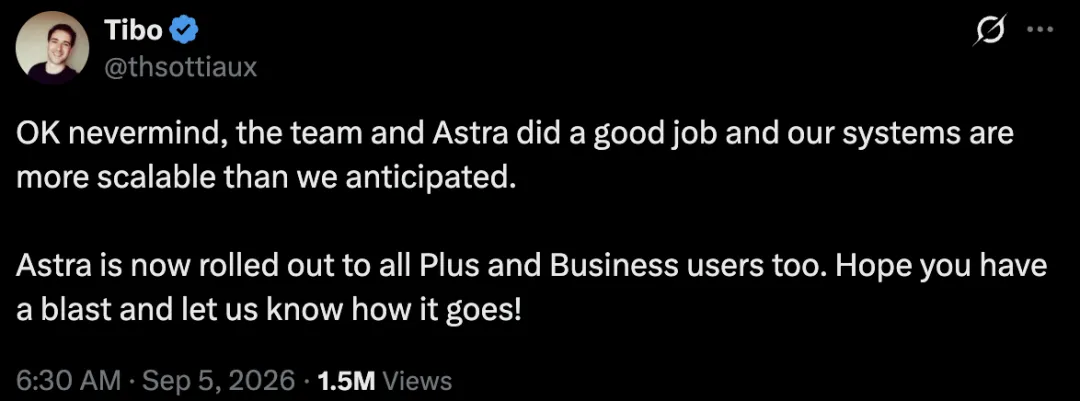
However, when many Plus users turn on ChatGPT, they don't see Astra when they go through the model list.
This is all you need to do is dial the top entry from Chat to Work or Codex.
It turns out that OpenAI doesn't intend to put Astra in your chatbox.
OpenAI makes it clear in helping documentation:
The Plus package includes ChatGPT Work and Codex's GPT-6 Astra, but does not include Chat's GPT-6 Pro. $20 users can use the most powerful model of OpenAI, provided they use it, rather than chat.
Do you want to use Astra in the ChatGPT chat box?
You need to subscribe to a $100 or $200 Pro, or buy a Business, Enterprise seat.
Plus the Astra at your fingertipsNot in the chat boxTo understand this layer, you need to understand the three entrances of ChatGPT.
Chat, responsible for quick queries, searches and brainstorming, is officially ranked as "quick, conversational help".
Work, a "smart body designed for longer multi-step work and product delivery", is responsible for researching, analyzing, generating documents, spreadsheets, presentation documents, reports and websites.
It can be run all at once, or it can trigger repeated runs according to plan or event, and it can be synchronized between web pages, mobile phones, and desktops.
Codex, "focused on software development and technical work", which is responsible for writing code, running tests, and changing warehouses, remains a standalone view of the desktop.
There is also a Voice on the desktop, which can be used to directly open commands for Work and Codex.
Work and Codex share a pool of smart-body usage, while Chat calculates a set of messages separately.
The previous layer was based on packages, the current layer is based on which interface you work in.
Are the Astra in Work and the GPT-6 Pro in Chat the same thing?
The official answer is that the underlying is Astra, but Chat has its own model availability and message caps that can be used with Astra in Work, rather than unlocking GPT-6 Pro automatically in Chat.
The name of the product is also clear.
The "GPT-6 Astra Pro", which is powered by the GPT-6 Astra, does not appear in the official documentation. It is only available for Pro ($100 and $200) and Business and Enterprise, and Plus does not have this entry.
In other words, the same underlying model is broken down into two products at OpenAI, running two sets of quantities.
What did you buy for $20?To get permission is not to use it at random.
The help center provided an estimate table, based on the number of local news reports every 5 hours.
Plus users, Astra is 5 to 45 items; GPT-5.6 Sol is 10 to 100 items; Terra is 25 to 200 items; Luna is 250 to 2000 items.
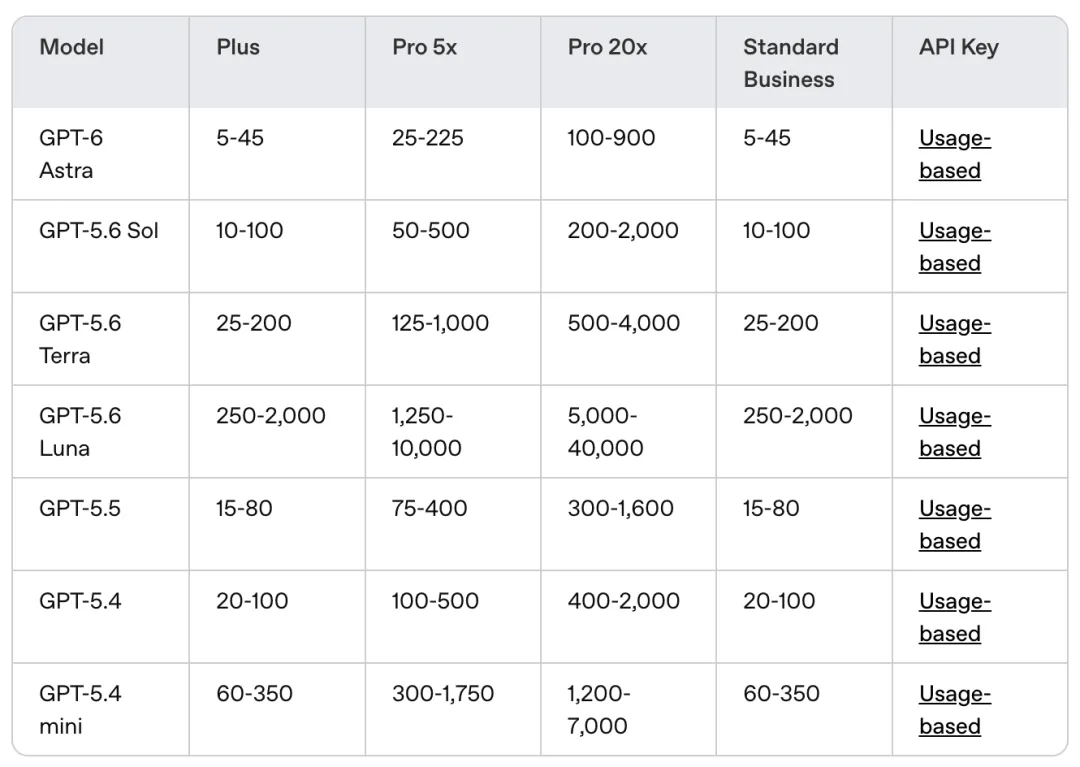
Official estimates of the number of local messages every 5 hours
From Luna to Astra, the same package, the number of messages is two-fold.
The official specification indicates that this is not a fixed limit, the task length, input output scale, reasoning level, start-up or start-up of Fast Mode will all affect consumption.
But the direction is clear: Astra and Sol share a pool and Astra burns faster.
What is the concept of Articles 5 to 45?
If you took Astra to do a full study report, or had it scan a complex bug in a warehouse, one or two tasks could have consumed most of that five-hour share.
The limit is even double: 5 hour window layer, week window layer, and both sides have leftovers to continue. The official writes: You may have hit the 5 hour ceiling in less than 5 hours, even if the weekly quota is still a lot left.
It's a lot easier to look at the gaps in the last paragraph.
Pro 5x packages are 25 to 225 items every 5 hours, Pro 20x 100 to 900 items, Business Standard seats are the same as Plus, and 5 to 45 items.
So is Astra, Plus gets the smallest one.
Plus users will also encounter an invisible wall.
The amount used can be purchased as a bonus, but the purchase of points cannot be obtained in advance of the rights that have not been transferred to the account.
The official saying is that the points are bought by the quantity, not the model access.
This week, OpenAI was released with a reset to the bottom.
On September 3rd and September 4th, eligible Plus, Pro, Business users received a live reset; on September 7th, a worldwide automatic reset was made.
But the Help Center makes it very clear that these replacements cover the entire delay of Astra, that your own account will run out of cash after release and will no longer be reimbursed separately.
Why is it so expensive? Look at the price of the API.
Standard price of gpt-6-astra: $10 per million for input tokens and $50 for output tokens. More than 272,000 tokens for single inputs and caches are billed twice and 1.5 times for output tokens.
Fast Mode is twice as fast and twice as expensive.
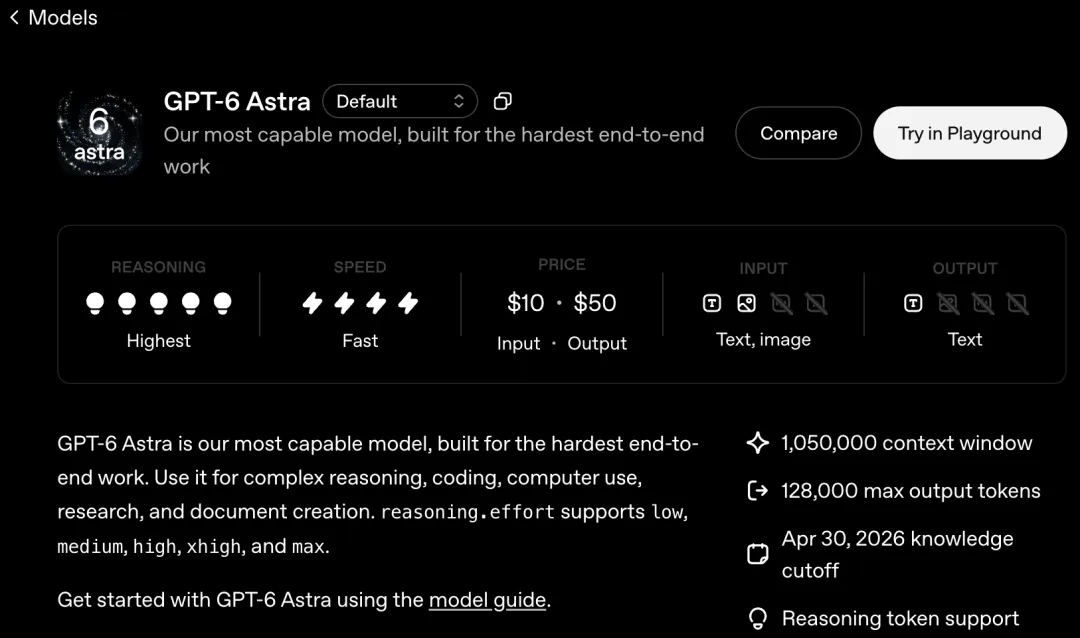
Gpt-6-astra official pricing: $10 for input, $50 for output per million tokens, and twice as much for Fast Mode.
OpenAI hasn't said, "Because computing is expensive, don't give a chat", but at least from a pricing standpoint, it's not a model for everyday chatter.
The official manual also gives Plus users a provincial quota method: Astra starts with a low reasoning rating, which can outperform Sol's high reasoning rating.
It's more like a limited trial set for $20, so you can taste what the strongest model tastes like, but you really need to re-work it, or re-position it, or add money.
The entranceA new wall of authorityBack to the question: Why aren't the strongest models more advanced than the chatbots?
It's easy to see where Astra is headed.
The computer operates.
In the evaluation of financial modeling, engineering and media production in real software, Astra outperforms Claude Opus 5 and Sol. The same children spend 47% less time on computer operations than Sol.
Delivery of the goods.
The ability to highlight a page repeatedly is to do PPT, formatting, and documenting as a template, only bringing the context of the band into the output, and not re-reading unrelated information.
It's a long mission.
Codex adds the ability to write notes across the context window, and the context is filled with extracts that are no longer compressed, and older windows can be searched backwards.
Put it all together, each of Astra's long boards is on the side of the Work and Codex: it's ready to work, not ready to chat or answer questions.
So, the model layer is tied to the input scene: Chat tube Q&A, Work tube delivery, Codex tube code.
Your subscription fee has not changed, but the rules have changed: where you stand at the entrance, decides which model you can use.
The most powerful model of OpenAIGo to work first.It's really worth a look at where OpenAI has put the most powerful model for Plus users.
There were no chatbots; only coding, research, computer operations, and delivery scenes were available.
The distribution sequence of the front-end models has changed: first to the desktop and development platform, then back to the chat box.
This is a redefinition of OpenAI for ChatGPT.
The chat box is still there, but it has gone from the starting point of the strongest model to the last stop.
Work here, what else are you adding?
The event triggered tasks: Gmail came up with new emails, Slack channels had new messages, GitHub warehouses had PR activity, and Work could run automatically.
A timed task can be shared with others, and the other person gets a copy of it, when to run, how to run, and decide for themselves.
Speaking into the work and the codex, you open your mouth and it works, and you arrange several tasks together.
The best models and new features, all stacked on the Work and Codex.
For Plus users, what they bought for $20 hasn't changed much, but the use of the strongest model has changed: from "ask it" to "send it".
Three years ago, everyone saw the big model for the first time through a dialog box.
Today, OpenAI has put the most powerful model into the desktop, while the first input dialog box is left for everyday scenes.