It's the first time in the history of the world.
Can you believe it?
People don't go to university, and research has taken over the work of the "Fields Prize winner".

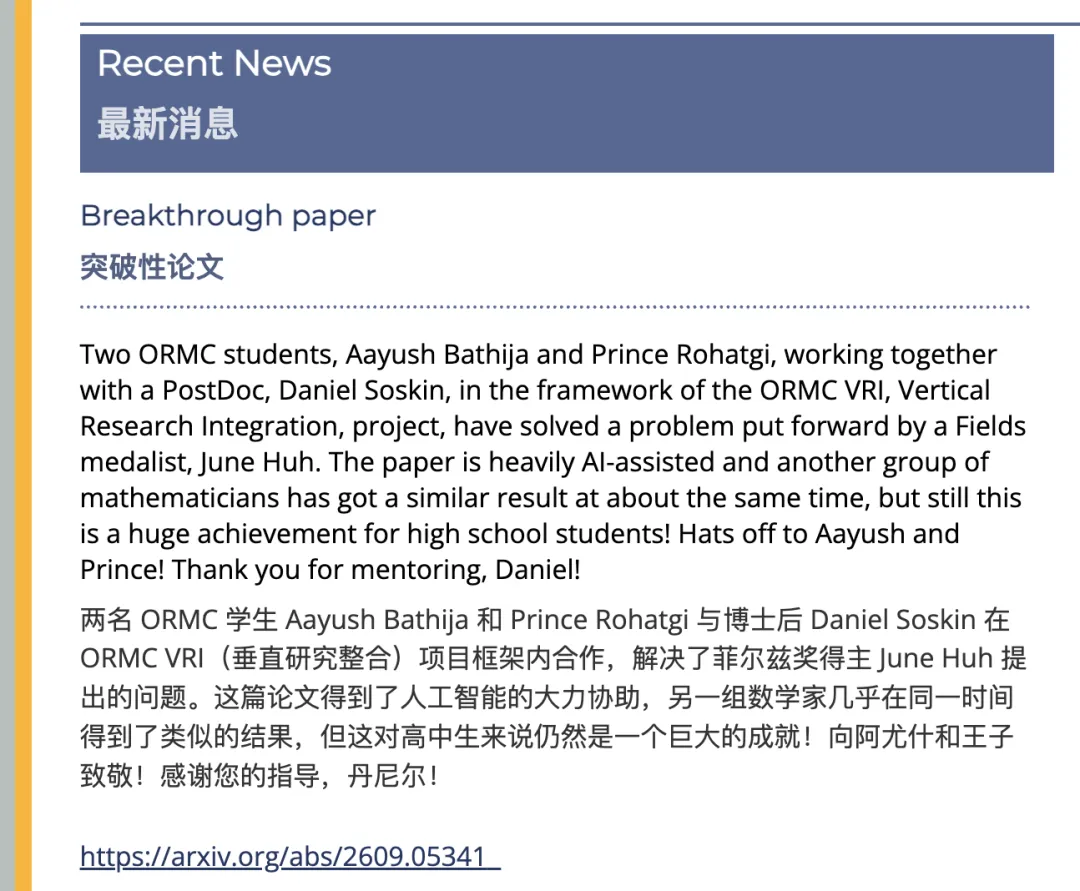
Just today, the UCLA Mathematics Circle released a news story that shocked everyone.
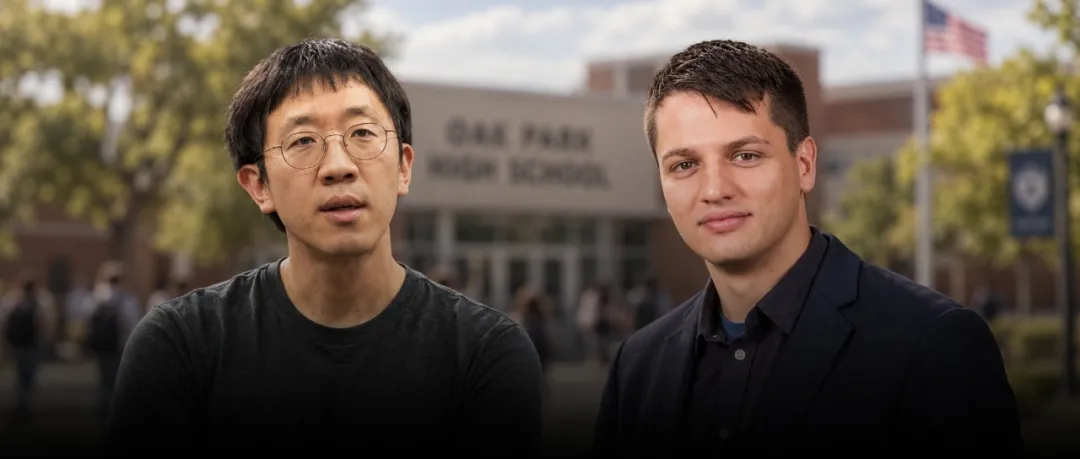
Two high school students, Ayush Bathija and Prince Rohatgi, under the guidance of a post-doctoral fellow, solve a puzzle that mathematician June Huh has never mastered.
What's even more striking is that this proof was done with the help of AI gravity!
One is Claude Opus 5, the other is GPT-5.6 Sol.

Currently, a multi-disciplinary paper entitled "Philosophy of Lorenz" has been published on arXiv and is 75 pages long.
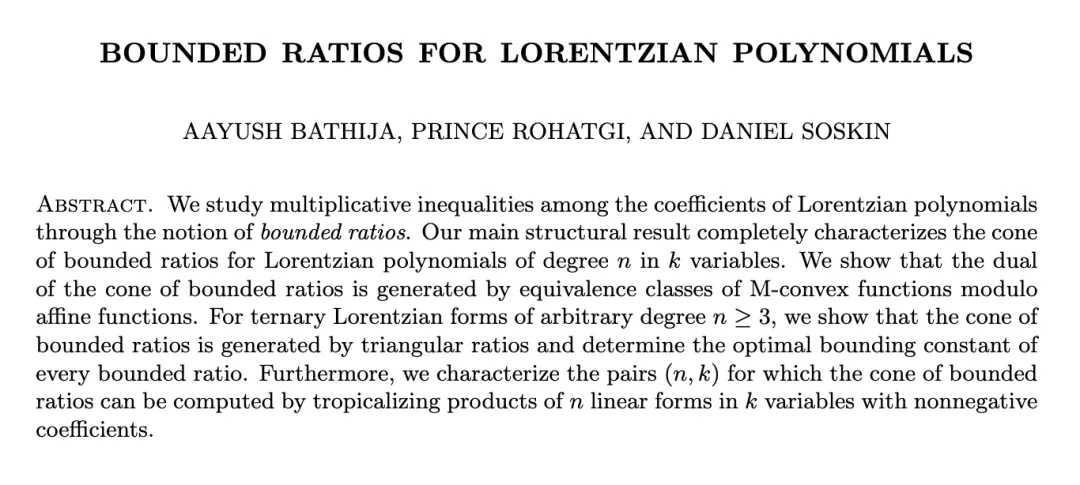
The paper:
The names of two high school students and a PhD student are written in the author's notebook.
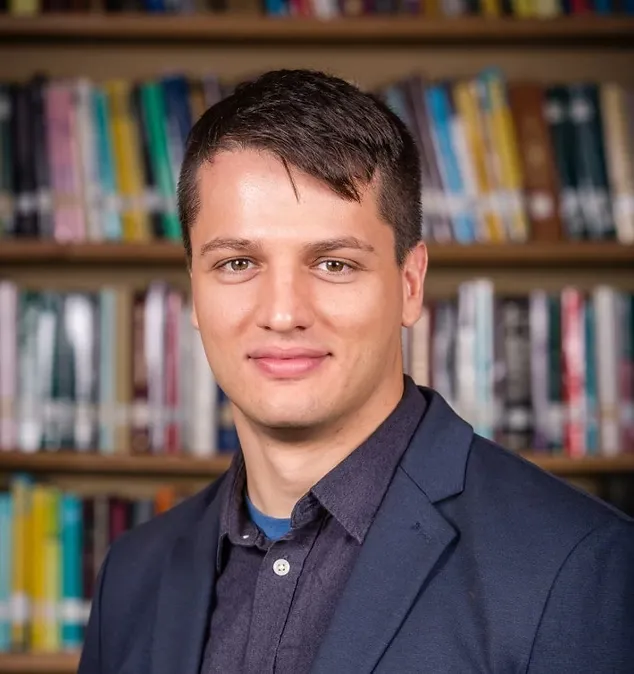
Dr. Daniel Soskin, Ph.D. from UCLA, secondary school instructor
So what questions did they solve in this study?
To clarify this, we must first look at the work of Fields Prize winner Samuel Bauer.
What did they find out?Xu Juar is a South Korean who won the Fields Prize in 2022.
His experience was also quite legendary: he finished high school as a poet, then turned to pure mathematics, and at the age of 39 he won the Fields Prize (which is only awarded to young people under the age of 40).
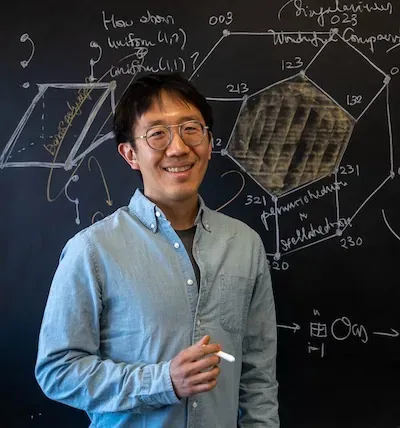
In 2020, he co-founded the "Lorentzian polynomial" theory with his colleagues, which is one of his most important representative works.
The name is a bit strange, but "multivariate" is something we've all seen in high school.
The special thing about the Lorenz polynomial is that it's the same thing as a polynomial.There are strict mathematical constraints between these coefficients that cannot be matched at random.
This set of theories connects problems in combinatorial mathematics with the inequalities between geometries and coefficients.
This study asks how strong these restrictions are.
For example, multiplying some coefficients and dividing them by other coefficients gives you a proportional value.
Is there a "ceiling" that can't ever be broken as long as the polynomials meet the prescribed conditions?
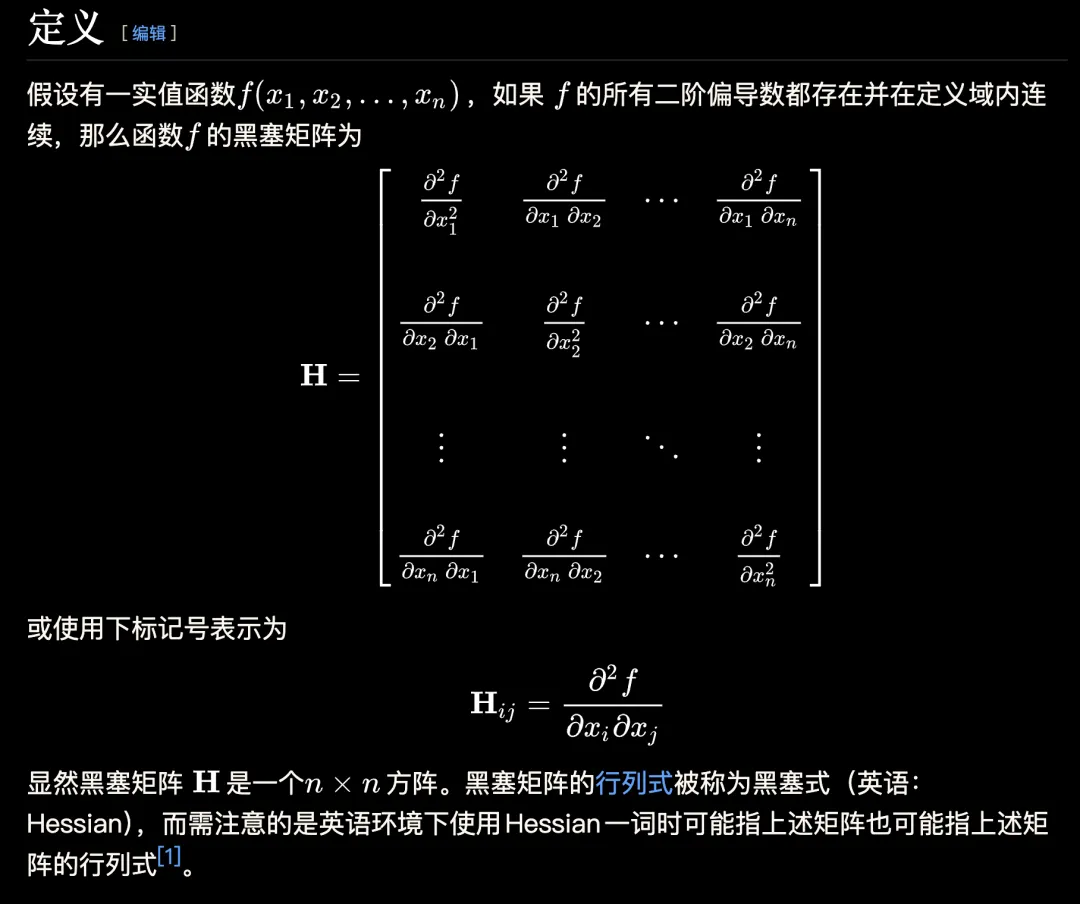
Remember the definition of the classic Hessian matrix in high numbers?
Calculating the ratio of a set of coefficients is not difficult. It is really difficult: in the face of an infinite number of satisfactory polynomials, to determine which ratio values are always bounded and which can be infinitely increased.
If there is a limit, keep asking:How low can this ceiling be pushed is the most accurate answer?
In the past, Suhar and his collaborators have beenSecond Lorentz polynomialIn it, it is drawn which ratios have a limit, and the maximal bound for the three variables is sought.
But this road is not finished yet.
Is there still a law that goes from the second to the third, the fourth, or even the arbitrary number?
The higher the number of times, the more complex the relationship between the coefficients.
That's two high school students who have a gaping hole in this study.
To advance the study of coefficient ratios to a higher number of times, figure out which ratios are always bounded, and further search for the most accurate upper limits.

The paper's most central formula, the Principal Structural Theorem, extends the related conclusions of the previous two Lorentz polynomials to any number of times.
It shows whether a coefficient of proportionality has a uniform boundary and can be fully determined using a set of discrete convexity conditions.
Read here and you just need to remember one question:How high can these constrained coefficients push the ratios?
The following is a simple example to illustrate this "ceiling".
Lawrence polynomial: there is a "balance constraint" between coefficientsLet's look at a polynomial:

Here a, b, c are all positive integers. Write the middle term as 2b, to simplify the relationship behind it.
In this simplest case, it is the Lorentz polynomial, which asks:
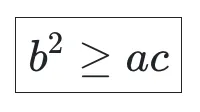
That is to say:The coefficients at both ends are large, and the coefficients in the middle cannot be too small.This is an introductory example of the Lawrenz structure's multi-channel nature.
For example, a=4, c=9, you have to have b>=6. You can't just change b to 1 and expect it to stay in this polynomial family.
This constraint becomes more complex when the variables are more frequent, requiring various derivative results to meet specific conditions together. The formal definition involves a matrix that describes curvature, which has a characteristic value structure of "one positive, remaining negative" under strict conditions.The name "Lawrence" corresponds to this positive-negative structure.However, just remembering that "coefficients are bound by a whole set of interrelated constraints" is enough to understand the main line of this text.
So let's deform the inequalities that just happened:
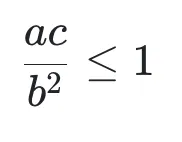
It's called a"There are boundary ratios".This ratio is greater than 1 regardless of the coefficient chosen.
But then again:
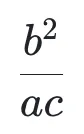
There is no single ceiling.
For example, a fixed a=c=1, so that b continuously increases and still satisfies the Lorentz condition, the inverse ratio can be arbitrarily large.
So, naturally, the question is:
In the face of more complex polynomials, multiplying and subtracting different coefficients, which combinations have limits and which don't?
This paper aims to provide a systematic answer to this question, and the second example above belongs to an existing underlying situation.
Two high-school students with a combined AI are breaking upThe two students who wrote this paper, Ayush Bathija and Prince Rohatgi, are both from Oak Park High School in Oak Park, California.
They are also members of the UCLA Olga Radko Mathematics Circle (ORMC).
Aayush is an AIME qualified senior in high school. Prince is also a senior in AIME, and has also worked as an AMC 10/12 teacher in mathematics.
In the past, a high school student who wanted to get into the "Fi Grade" field needed at least five to eight years of college and doctoral training.
But this time, under the guidance of Daniel Soskin, Ph.D. in mathematics at UCLA, they fought a beautiful lightning battle directly with AI.
At the heart of their solution is deep embedding AI and formalized computing tools into the core workflow of mathematical discoveries.
The central idea of the proof as a whole can be understood as:To check whether a ratio is likely to go out of control, first study how it changes in extreme circumstances.
Turn complex numbers into simple indicesSet t to get closer to 0, and take three coefficients respectively:

So, what?
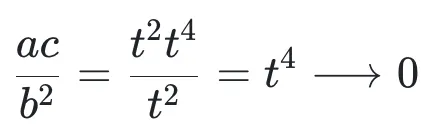
The reverse is t-4, which tends to be infinitely large.
The most useful point here is:The law of multiplication becomes the law of addition and subtraction of the index. The positive of the index directly tells us whether the ratio will decrease or explode.
This extraction of the idea of "dominant bias" was used in the paper."Tropical" approachesThe existing Lorenz polynomial theory tells us that a legitimate loop pattern is governed by a so-calledM-convexityThe rules of discrete convexity control.
It can be understood as a mathematical rule of "what velocities of change can occur simultaneously".
The key steps of the paper are to demonstrate:As long as a ratio can be infinitely multiplied, it can find a pathway that has this subtractive characteristic, exposing the uncontrollable.
Therefore, the examination of these paths can be upgraded to a complete proof. The proof uses tools such as curve selection in semi-algebraic geometry.
And let's not forget that all these high-profile stories were created by two high school students using AI.
Claude and ChatGPT participated in "Demonstrate Thought".In a thank-you note, the authors directly show off the paper.
Claude Opus 5 and GPT-5.6 Sol are the core tools for this proof.
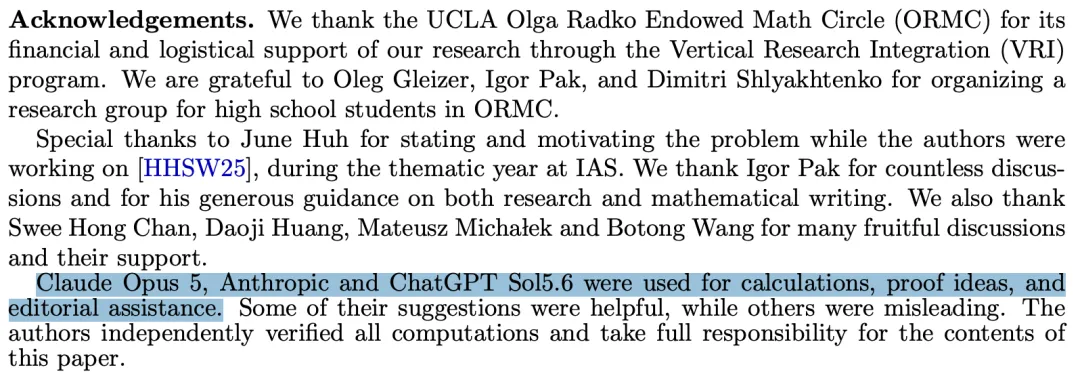
They are usedCalculation, proof-of-thought and editing assistanceThis is especially important when it comes to "proving thinking".
This means that the use of the model has been explored in depth: in the face of an unresolved problem, looking for a possible derivative pathway.
However, the author also makes it clear that there is another side:Some suggestions are helpful while others are misleading.
They stated that the entire calculation had been independently verified and that they were responsible for the contents of the paper.
These phrases outline the real boundaries of this collaboration: AI can provide ideas, researchers need to screen, knock, and turn valuable clues into verifiable arguments.
The model gives a seemingly beautiful answer, and the study is not over. The question of whether the conditions are complete, whether the inference is established, whether the boundary situation is missing, must continue.
AI has entered the exploration phase, and rigorous verification remains a prerequisite for achieving results.
The support of post-doctoral tutors and ORMC research projects is therefore extremely important. Both students have access to real open questions and conduct research under professional guidance. AI is embedded in this collaboration to assist computing and thought exploration.
Fields Award winners collectively cried outBut it didn't stop.What is dramatic is that just the day before this study was published, there was a sudden surge in the mathematical community.
Twenty-five Fields Prize winners from around the world have jointly signed an open letter warning: "AI is destroying mathematics itself!"
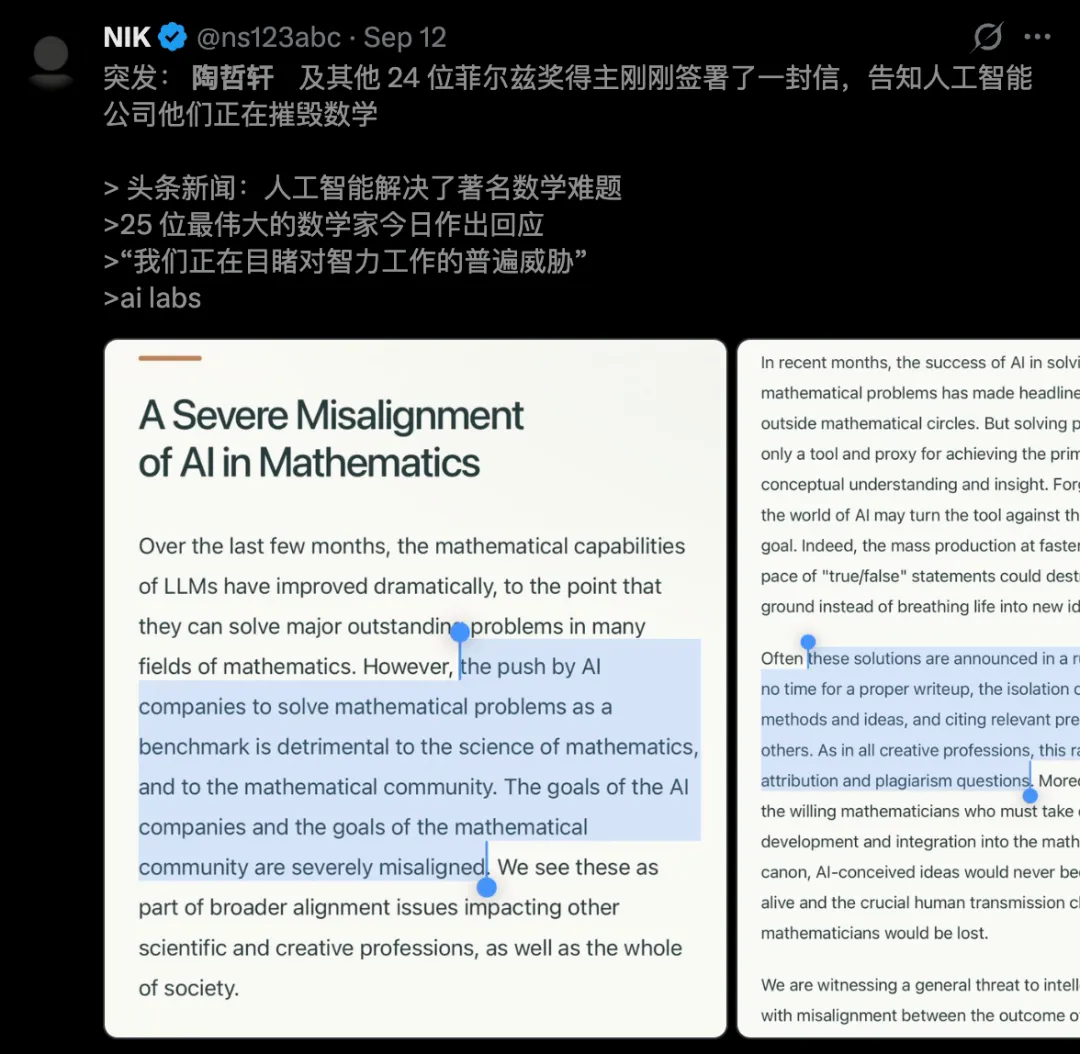
He is also one of the signatories.
Partial list
It was unthinkable that two high school students with AI-assisted skills had achieved results in their own direction of research.
The 25 Fields Prize winners are concerned that the rigorousness of pure mathematical research, the purity of scientific research, may be being shattered by algorithms.
But the story of Ayush and Prince gives a different side.
After AI lowered the research threshold, it was released not only the "resolving speed", but also more people's access eligibility.
An AIME-qualified high school student, guided by a post-doctoral fellowship and assisted by AI, meets an undefeated Fields Award winner.
It was almost impossible five years ago.
The forefront of mathematics is no longer just for those who have walked through the door for decades.
As for whether this is good or bad, the mathematical community has a long way to go.