The essence of intelligence is "learning uncertainty", the core of which is interfering with observation, learning and utilization. To make robots in an environment of uncertainty like organisms, the mainstream answer is to stack data to the quantitative level of large models. But the cost of collecting real machine data makes this path almost impossible to replicate in the field of robotics.
In Nature npj Robotics, a team of researchers from Beijing Aerospace University, Guangzhou University, Beijing Institute of Space Control Instruments and the South Pacific University of Technology in Singapore, proposed PhyFilter: to view learning errors in neural networks as a low-frequency signal that can be "deleted" by using robots to feedback on their own real-time state with known microstructures, and to modify online learning outputs.
It is an instantaneous lightweight module, unrelated to a specific model, with filter parameters that can also be learned automatically, without the need for manual adjustment. On quadruped robots, drones, aerial functioning mechanical arms and acceleration perception quadrants, a strategy trained only in a flat simulation can directly cross stone slabs, grasslands, sands and gravel roads, and aerial mechanical arms can complete centimeter-level scraping at 5 m/s of wind interference.
Research has shown that the feedback mechanism of physical filtering can be another way of generalizing beyond "stacks of data".
The paper:
DOI:10.1038/s44182-026-00114-y
Website:
Code:
Background: Is the generalization of robots based solely on stacks of data?
Over the past decade, large-scale language models have made remarkable progress with the addition of mass content, large-scale networks and computing, and have made scaling data the default path to general intelligence. But when intelligence needs to land on physical entities, this path immediately encounters resistance: the data needed to train robots must be collected in the physical world.
One path is artificial remote operation, but obtaining a quantitative LLM-level human demonstration is technically difficult, time-consuming and expensive, and even large-scale industrialization attempts like Tesla still depend on the collection of throughput and scalability; the other is relying on simulation engines (Isaac Lab, MuJoCo) and video generation models (Sora, Cosmos) to synthesize data, which, while beneficial in some tasks, is still constrained by sim-to-real gaps, high computing costs, and the lack of standardized cross-platform data formats, software and hardware interfaces.
The team turned their point of view to the biology: the biological power of generalization does not come solely from "scalization". A large body of evidence suggests that the physical structure acquired before or after birth itself promotes the biology's adaptation to an unseen environment. Motion in the cranial cortex is co-dominated by forward signals, feedback circuits are driven with the forehead, and dynamic evolution is minimized to minimize the overall energy function; zebrafish cubs integrate their natural physical component structures with real-time feedback into continuously updated internal brain models, thereby responding effectively to unpredictable visual disturbances.
This raises the question to be answered: unlike an LLM in the digital world, where real robots have structured physical precedents and real-time feedback from environmental interaction, can they leverage these "ready-made" physical structures to improve the generalization of robot learning?
The core method:
"Learning disabilities" as a signal that can be ignored
PhyFilter's starting point is a previously neglected amount of learning disabilities.
For real-world mapping and learning models, the difference between the two is the learning deficit, which comes from sensory noise in unseen scenes, external interference or unmodeled interaction, which is the root cause of generalized failure.
It seems that the model output can be corrected as long as it is known in real time that the learning defect is present; but the deployment phase is not labeled, and the learning defect cannot be acquired instantaneously.
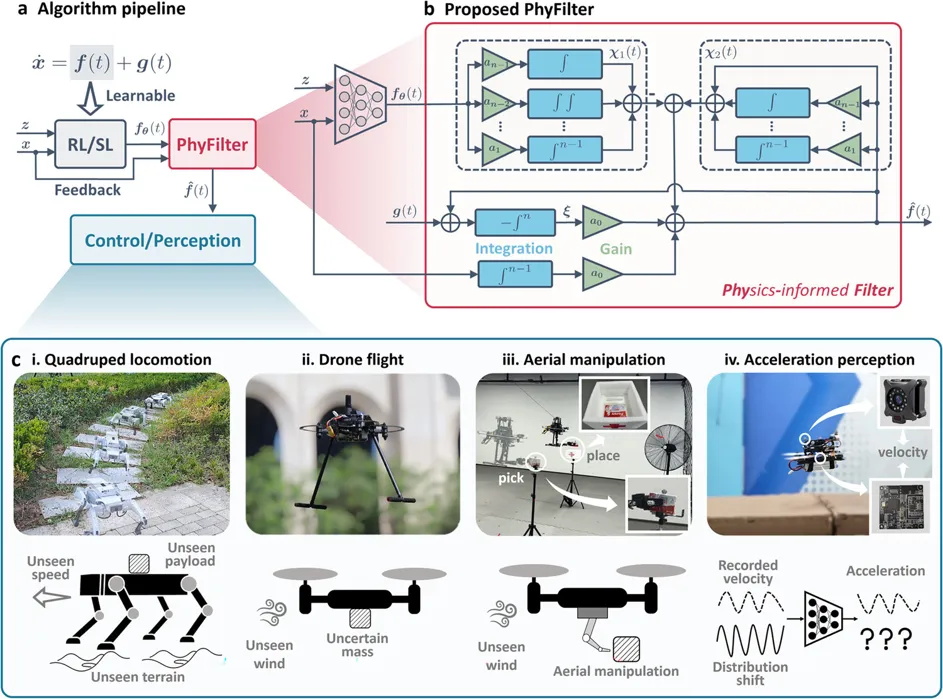
Figure 1 - PhyFilter framework: a) Learning to enhance the output of physical information filters; b) Implementation of PhyFilter; c) Four types of representative verification platforms: quadriplegia, drone flight, airborne mechanical arms and acceleration perception.
Inspired by the low-pass wave characteristics common in human visual and auditory perception systems, the team wrote the goal into a high-level low-pass wave form. If the low-pass wave form is achieved, the low-frequency characteristics of the learning gap can be captured and compensated in a timely manner; the low-pass wave process can itself be seen as an adaptation to an unseen scenario by a robot.
The real technical difficulty lies in learning that residues are not measurable. The team's approach is to introduce the robot's own real-time state feedback with the preceding differential equation structure, and to rewrite the original form of higher-ordered derivatives and learning residues as an implementation that relies solely on measurable signals, thus completely avoiding the direct higher-order differentiation of the labeling model.
The resulting PhyFilter has several key characteristics:
In contrast to previous physics-informed methods that require re-training a modified network, PhyFilter is a model-free lightweight module that can be directly deployed on a trained model.
Second, degradable, expandable. If the one-stage filter is set, this achievement will decay into a purely feedback-driven perturbation observer, while the higher-stage form can handle complex residues beyond the one-stage situation.
Third, the parameters can be learned automatically. Filter parameters were originally designed to be manually configured at mature but cumbersome points, with stages being very unintuitive. The team reinterpreted the filter parameters as the control input of a power system, transforming the filtering problem into an optimal control problem, and then used Lagrange multiplier method to analyze the gradient, combining Adam, small batches and early stops to optimize. Experiments showed that the parameters learned automatically are basically consistent with parameters tuned manually.
In calculating costs, in drones flying and in air-operated mechanical arm experiments, PhyFilter runs on STM32F765 microcontrollers at 500 Hz in real time, proving it is suitable for lightweight platforms with limited resources.
Assessment: Four types of real robot systems
The team validated PhyFilter in four representative scenarios: quadriplegia, unmanned aerial mechanical flight, aerial functional mechanical arm, and acceleration perception, the first of which is reinforcement learning (RL), and the latter three are supervised learning (SL), covering two mainstream paradigms of current robot learning.
Four-legged exercise: simulating training in the flat, directly across four real-world terrains.
In order to emphasize the generalization capability, the simulation training environment only includes flat, and only uses standard parameters of randomization. The results show that under five random seeds, the maximum training returns of the strategy to be added to PhyFilter are consistently higher than the baseline, and the pace is more coordinated.
In the generalized test, robots were required to move at a high speed of 2.83 m/s outside the training set and with an extra load of 15% to 60% body weight (11,86 kg), up to 137.33% above the training limit. In scenarios not seen in stairs, horizontal rough lanes, slope rough lanes, wavelength ground and gravel paths, the success rate of PhyFilter was 70%, 80%, 50%, 80%, 40%, while the baseline was 0%, 10%, 20%, 0%, combined with custom-controlled RL2AC was 0%, 20%, 10%, 50%, and 0% respectively.
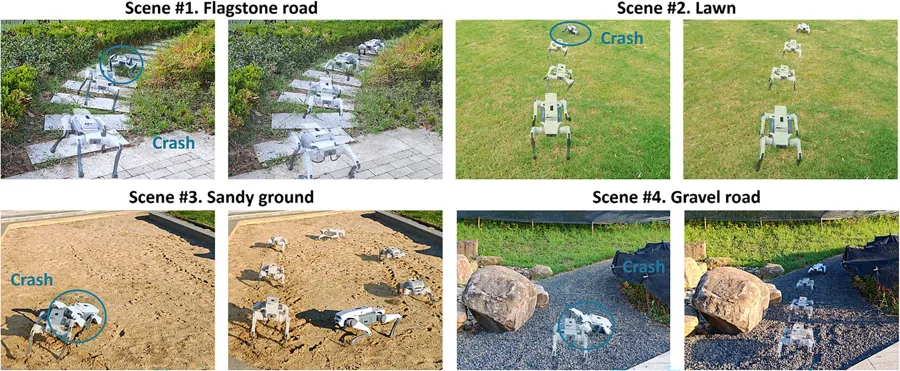
Figure 2. The strategy is to simulate flat training, without any deployment, and directly test rocks, grassland, sand and gravel roads (left: baseline, right: PhyFilter).
The real-machine deployment also doesn't make any adjustments. The baseline strategy quickly destabilizes the sand and gravel routes, while the strategy guided by PhyFilter runs steadily throughout the entire terrain. A more interesting finding is that even when the modification is turned off during deployment, the strategy is still able to successfully migrate to all types of real terrain.
Unmanned Aerial Vehicles (UAVs): Plug-in or ground-to-ground replenishment of a generalized shortboard.
In the supervised learning scenario, the team superimposed the PhyFilter on top of the previous SEER-I. SEER-I combined with offline functional math lessons and online self-adjustment controls to effectively capture quality uncertainty in drones, but its tracking performance deteriorates significantly once unknown disturbances of this nature are introduced.
In the 2 m/s round tracking mission, the average absolute tracking error decreased by 30.22% compared to SEER-I and by 50.17% compared to baseline after joining PhyFilter. Further uncertainty estimates show that SEER-I can only capture quality uncertainty, while PhyFilter can simultaneously detect wind disruption and inherent dynamic uncertainty.
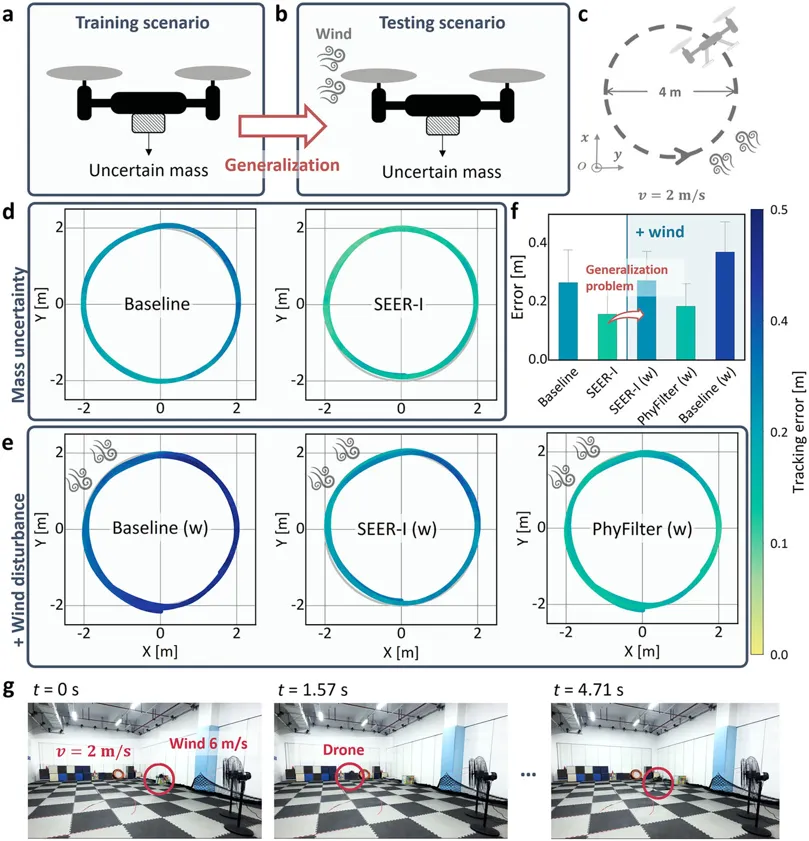
Figure 3 Drone Experiment Results: The training phase only takes into account quality uncertainty and the testing phase involves additional wind interference.
Air-operated mechanical arm: 5 m/s, crawling at a level of centimetres below wind interference.
Air-operated mechanical arms require high-precision end control with strong combinatorial dynamics and external disruption. The team designed an emergency-rescue-style discharge mission: the mechanical arms need to take medication from the tripod accurately and place it in a designated area, with a maximum tracking error of only 2.5 cm. Experiments used a 380 W fan to produce wind speeds of up to 5 m/s and to introduce an additional 0.3 kg of unmodeled load.
The results showed that both the baseline and SEER-I failed due to the lack of wind interference and quality uncertainty, with only PhyFilter completing all four phases, improving the baseline by 23.99% and 55.04% respectively in mean and square deviations compared to tracking errors.
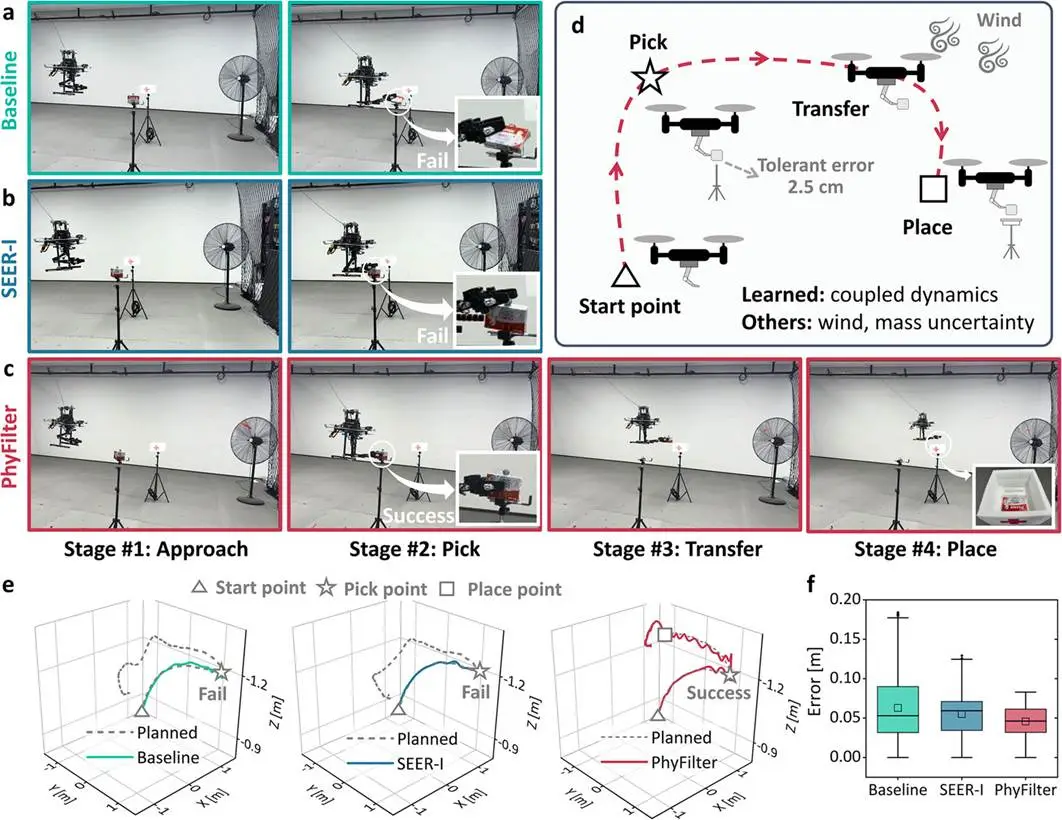
Figure 4: Aerial mechanical arm experiments - a c-base line, SEER-I and PhyFilter's deployment execution process; e c-f 3D tracking performance vs. error comparison.
Acceleration perception: Neurotransmitters are still reliable when distributed.
The team trained a two-layered neural network with real flight data, mapping historical speeds as acceleration, training set speeds of 0 to 2 m/s, and test sets of 0 to 3 m/s. Pure-learning models showed a marked generalization failure in the test set, while the PhyFilter, which introduced a high degree of accuracy in mechanical structural knowledge, was superior to the Rubber Micrometer RD, the Tracking Micrometer TD, and the discrete Micrometer DD, after carefully tuned classical baselines, and maintained a consistent advantage in the sample interval of 0.002 to 0.018 s.
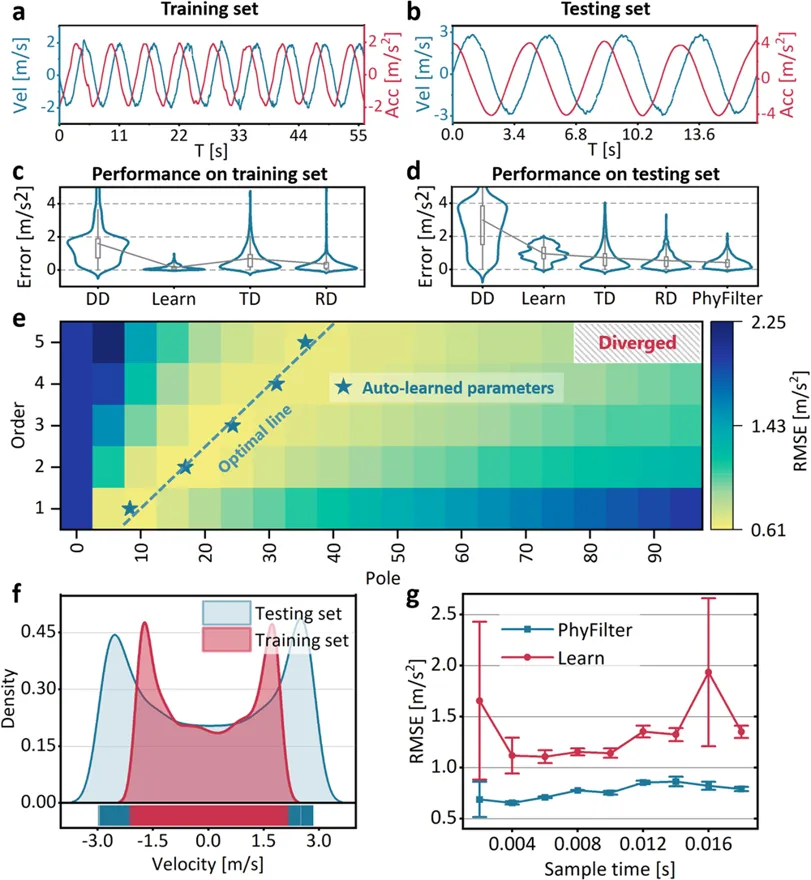
Figure 5. Accelerated perception experiments. e Fusion phase and polarity, the star number is the parameter for automatic learning; g RMSE contrast at different sample intervals.
Taking the four cases together, the conclusion is quite clear: in order to bridge the sim-to-real gap, the existing mainstream paradigm relies on domain randomization, which essentially pursues average performance in numerous random environments, using precision-switched robotics, similar to the idea of classical robotic control. While PhyFilter does not require excessive domain randomization, it can unify domain randomization and precision within the same framework: when robots enter scenarios outside of the training distribution, PhyFilter is activated to amplify; while in very small familiar conditions, workers will automatically decline in adaptation, thus retaining precision.
Building Space and Development Potential
The work has three limitations, which are also subsequent directions of research.
Second, PhyFilter currently only enhances learning's "outputs". A smarter approach is to use the knowledge gained during the filtering process to refine the parameters or structure of the original network, and continuous learning ("continual learning") may be a viable path to achieving this goal.
Second, while a parameter automatic learning algorithm is reliable, it requires a complete forward-track rollout each generation, which limits its efficiency on large-scale data, and intermittent or parallel rollouts are improvements worth exploring.
Third, in addition to neural network prediction errors, there may be a mixture of other uncertainties in learning residues. For example, modeling mismatches in quadruped cases.
Overall, PhyFilter offers a complementary idea to "data scaling": robots are not image generators lacking in physical precedent, but rather have well-structured dynamic models and continuous source real-time feedback. Using these existing physical structures, perhaps more closely to the essence of biological generalization than continuous expansion of data sets.
Key authors
Project leader: Postdoctoral researcher at the South China University of Technology (SINGAPORE) MARS Lab, research areas include VLA, WAM, PINN etc. He has published several papers (IJRR, TRO, ICLR, RAL, CoRL, ICRA, RSS etc.) at top AI, robotics, control journals conferences.
What are you doing here?
Guoxing: Professor of the Faculty of Aeronautical Sciences and Engineering of Beijing Aerospace University, Ph.D. student advisor, national level youth talent, mainly engaged in theoretical and applied research in the direction of intelligent autonomous control of drones, multi-drone system synchronous control, satellite denial of unmanned positioning, air agility control. Many papers have been published in IJRR, IEEE journals (including IEEE T-RO, T-Cyber, T-AES, T-IE, T-II, T-ASE, RA-L), ICLR, ICRA, AIAA JGCD and others.
What are you doing here?
He is a dual-tenured assistant professor, PhD student and head of MARS Lab at the School of Mechanical and Aerospace Engineering and Electronics and Electrical Engineering at the South Pacific University of Technology, Singapore. He has published several papers in top AI conferences and journals (IJRR, NeurIPS, ICLR, CVPR, CoRL, ICCV, ECCV, ACL, AAAI, MobiCom, IROS, IJCV, TIP, TNLS, TMC, IOT-J, TCYBE, RSS, etc.).
What are you doing here?