In the vast majority of today's real-life scenarios, a slipping fall of a robot, or a sudden cardiac arrest of a joint, means that the task is immediately declared over and can only wait for the operator to be lifted up, checked out, repositioned. Few people have calculated carefully: for these small and large accidents, how much the actual application of the robot would have to pay for the hidden running costs; and how many potential landing scenarios there are, precisely because the pump failed, the pump failed, the pump failed, and it was too late to go from the pilot to the mainstream.
In the past few years, the robotics industry has always been on a racetrack of faster-than-expected performance: record-breaking speeds of upgrades, overturns, running-cooles, and other high-difficulty turnarounds. But there's one question that affects commercialization, and it's rarely answered positively: When a robot leaves a perfect laboratory environment and enters a real world full of uncertainty, who will get it back on track after it falls, hits parts, or loses parts?
The answer is often people, and this is precisely the biggest cost trap of intelligent commercialization.
For robots who really want to get to the millennium, it's more important to be able to jump faster than to run faster. The limit of ability can be slowly broken, but the basic threshold for commercial landing must first be passed. On September 9, 2026, smart companies launched the launch of the new robot full-body intelligent technology Light REACT. At a time when the peak of athletic ability is widespread in the industry, lighting innovations are aimed at the most tricky failures and disruptive adaptation problems in real applications.
Light REACT allows human-shaped robots to automatically resume operation after a fall
01.
The old-fashioned ceiling: Why can't robots always throw down the ceiling?
In ideal laboratory environments, robots can perform every action with precision as instructed, ground level, load constant, no accidental collisions. But once in real scenarios like factories, outdoors, and homes, countless unpredictable variables can cause failures: uneven ground level leads to gravitational deflection, accidental collisions lead to joint force abnormalities, and long-term operation leads to parts aging loss. For actual landing applications, failure is never a low-probability event, but a state of operation.
For a long time, the industry has dealt with the mainstream thinking of robotic failures and disruptions, always staying within the framework of switching to a pre-set mode.
The technical team writes an emergency control strategy for the known type of failure in advance; the robot identifies the location and degree of the failure by means of the fault-diagnosing module, and switches to the corresponding prediction automatically or manually. This logic is still applicable in a single scenario, specifically the type of failure, but its ceiling is predestined from the beginning: the possibility of failure can never be reduced, the degree of structural damage to machinery, multiple angles and intensities of external disturbances, and subtle changes in environmental conditions, with an infinite combination.
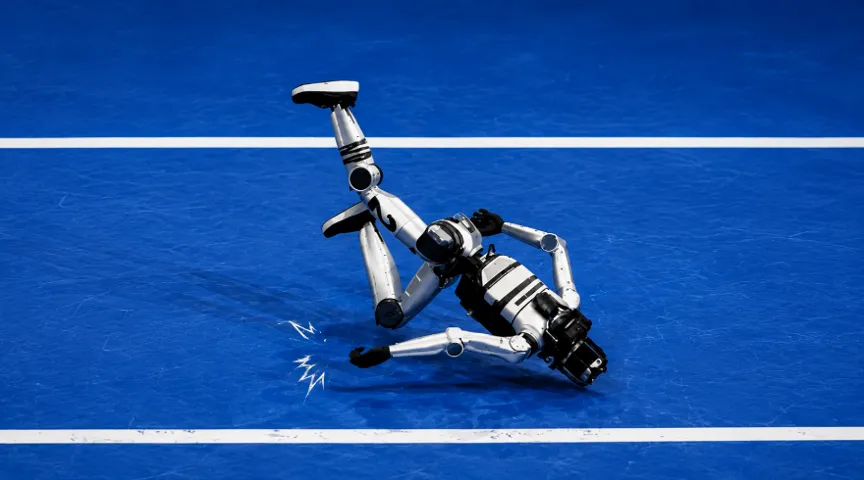
More importantly, the vast majority of abnormalities in real scenarios do not have a clear brake failure label at all. It is not a non-black-and-white brake normal/inefficient brake duality state, but rather a large number of continuous intermediate states: decreased output due to long-term wear on the joints, decreased grip force due to wet ground. These blurred, non-standardised abnormalities cannot be simply classified into a specific type of default, nor do they naturally trigger the corresponding emergency forecast.
The underlying flaw of this model is that the ability to adapt to failures is entirely inherent in the core control strategy. All response schemes are pre-written, and not the ability of the control system itself to respond to real-time physical states.
This type of flaw response can be sustained in a small number of robot demonstrations and pilot scenarios. Few failures in the pilot phase, low frequency, and supporting maintenance teams follow up, the problem will not be exposed. But once it goes to scale, the contradictions will escalate. Imagine, when a factory deploys hundreds of robots a day, there are several of them waiting for man-made processing due to various unpredictable small anomalies, the maintenance costs will continue to accumulate as the number of machines increases linearly, and the production losses caused by the shutdown will also accumulate, even eventually exceeding the cost of robot replacement manpower itself.
This is at the heart of the problem, that wrestling can never be a simple performance experience problem, but a business issue. Without solving the problem of autonomous adaptation after a failure, robots can only perform in showrooms and cannot really become a tool of production that can be replicated on a large scale. In other words, it is not after scaling that resilience is considered, but without resilience, that there is no scale.
02.
Light REACT: Adapting Failure to Rebuild Literature on the Shelf
The newly-created answer is a thorough reconstruction of the underlying idea. They no longer define failure as an engineering problem that should be addictive diagnosis-repair, but instead define it as an In-Context Learning problem.
This transformation is easily understood in comparison to humans: when we walk without accidentally stomping on our feet, we don't have to go to the hospital to take a video to determine which patch wears the wound, the extent of the injury, and then re-learn the walking posture according to medical instructions. We instantly perceive the abnormality through body feedback, find the wound is unable to move, and then naturally adjust the pace. Throughout the process, we don't update the parameters of the pattern of walking patterns in the brain, we just adjust the way the movements are performed according to the actual body feedback.
All-Body Context Learning, implemented by Light REACT, is essentially about giving robots the ability to adapt to this biologically similar, innate environment.
Specifically, the mechanism has three core characteristics, which together constitute technical barriers distinct from the old paradigm.
The first is unlabeled perception. The robot does not need to receive any labeling signals from the system to identify the faulty areas and degree. When a joint fails, the change is directly reflected in the motion feedback: the expected range of motion is not achieved, physical gestures and predictions deviate, and the power distribution is abnormal. These differences are contained in the recent history of full-body interaction, becoming the entire basis of the robot's ability to judge itself for its current mobility.
The second is no-parameter updates. Throughout the adaptation process, the robot's model parameters remain completely unchanged, neither requiring on-site re-training, nor having to wait for new models to be released from the cloud. It relies on continuous rolling updates on interaction.
The third is a single strategy covering the entire scene. Light REACT does not design separate control modules for clenbuterol to clenbuterol to clenbuterol to clenbuterol to clenbuterol to clenbuterol to clenbuterol to clenbuterol to clenbuterol to clenbuterol to clenbuterol to clenbuterol to clenbuterol to clenbuterol to clenbuterol to clenbuterol to clenbuterol to clenbuterol to clenbuterol to clenbuterol to clenbuterol to clenbuterol to clenbuterol to clenbuterol to clenbuterol to clenbuterol to clenbuterol to clenbuterol to clenbuterol to clenbuterol.
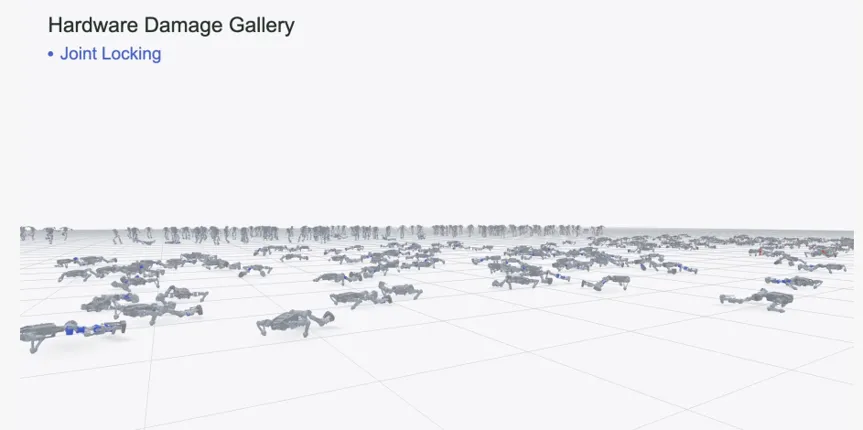 Synaptic failure in a simulated environment
This ability does not come out of nowhere, but is the result of a specially designed training phase. The LightSource innovation team synthesized a huge amount of body-wide interaction context data in a simulation environment, covering different failure locations, different injury levels, walking, crawling and fall recovery scenarios. Based on these data, the core of the Transformer training strategy is not how to make a move in the face of some kind of failure, but how to judge the current ability from the history of continuous interaction and adjust the body-wide movement accordingly.
Driving failures in a simulated environment
This is also the origin of the name REACT controller: it is an abbreviation of REsilient humAnoid ConTrol, which refers not to a specific function, but to a completely new whole-body control model.
03.
Real entrance vouchers for mobile smart, landing apps
Light REACT is the first of its three phases of scale-up pre-training, scale-up alignment, and scale-up deployment of lightning. If the previously released LightNav-0 solution is that lightning enables robots to navigate autonomously in the real world, then Light REACT's solution is that lightning enables robots to run and wrestle in the real world.
Why is full-body flexibility a landing pass? We can unravel its profound value from both commercial and technical dimensions.
From a commercial perspective, the core of scalable landing applications is the continuous decrease in unit costs, with maintenance costs being the largest variable. In industry, there is a key indicator called the availability threshold, which is the ratio of the actual running time of the device to the total time. For this highly complex intelligent device, unplanned shutdown time directly determines its input output. If a robot waits for maintenance for an hour or two a day due to various small failures, its economic price would be greatly discounted, even less than directly employing people.
Light REACT's autonomous adaptation capabilities, in essence, greatly enhance the robot's unplanned shutdown immunity. Small failures and disruptions no longer require artificial intervention, and the robot itself can adjust to continue to work. This means that maintenance costs will not grow linearly with the number of machines, but will be maintained at a relatively steady level.
From a technical point of view, the evolution of physical intelligence depends on the interaction of real-world data, while continuous data accumulation requires robots to be able to run continuously. In the industry, it is often said to be a data flywheel, but the premise behind the data flywheel is that robots can continue to run in real-world scenarios, continuously generating data. If an accident occurs, the data chain is broken and the flywheel cannot turn at all.
With full-body agile intelligence, robots can continue to operate with failures in imperfect states, continuously generating interactive data under real-world scenarios. These data will flow back to the training link, counterfeiting the next round of model iterations, forming a vertical cycle of pump running-accumulating-optimizing pumps.
It is worth noting that no one in the industry is aware of the importance of stamina, but previous research has largely focused on the adaptation of single joints to a single scenario, such as how to adjust walking posture after a leg drive failure. The breakthrough is that it extends the whole of the thinking of literary learning to whole body control, covering the whole chain from fine-grained adjustment to overall patterns of behavior switching, eventually forming an upgrade to the model of whole body control.
04.
What is the meaning of this verse?
Ever since, the robotics industry has had a conventional mindset of prioritizing performance, and people are keen to refresh various performance indicators and pursue performance effects that are more visually impactful. But as the industry moves away from the concept, people will find that deciding whether a product can't be popular is never how high its upper limit is, but how stable its lower limit is.
Light REACT does not deny the importance of motor skills. Running fast, jumping high, determines the limits of a robot's abilities; but falling off, injured, and moving forward, determines the limits of a robot's abilities. Without a limit, the limits are difficult to commercialise.
In the past, the robotics industry has used demonstration videos to demonstrate what I can do. But the real world is not a laboratory, it is full of disruption, wear, accidents and long tail failures. Robots have to learn to keep working under imperfect conditions from being taken care of to become scalable productivity tools. Light REACT is enhanced by the robot's ability to autonomously respond to accidents.
From this point of view, the release of Light REACT is more like a release of an industry signal: the robot competition is shifting from one that is harder to move to one that is more capable of functioning in the real world.
When robots are no longer just shredded showrooms, but can, like real workers, continue to move forward in the kitchen, it's the age of scalability with physical intelligence that really sets the stage.