Robots are learning a ability that once belonged only to humans: to remember the world they've been through.
When you first enter a room, you don't store everything you see in a flash. You remember the key structures: where the door is, where the table is, where you just walked through, and where you are now.
It is this selective memory that supports continuous human action in complex environments. For robots, this is also a problem that must be addressed in the real world.
In April this year, LingBot-Map, a streamlined 3D reconstruction of the open source LingBot-Map basic model, explored a new technological route to the core issue of "how robots remember space". Without the need for complex hardware, and with only a regular RGB camera, robots could complete real-time camera posture estimation and reconstruction of three-dimensional structures of scenes, thus filling key technological gaps in real-time space perception.
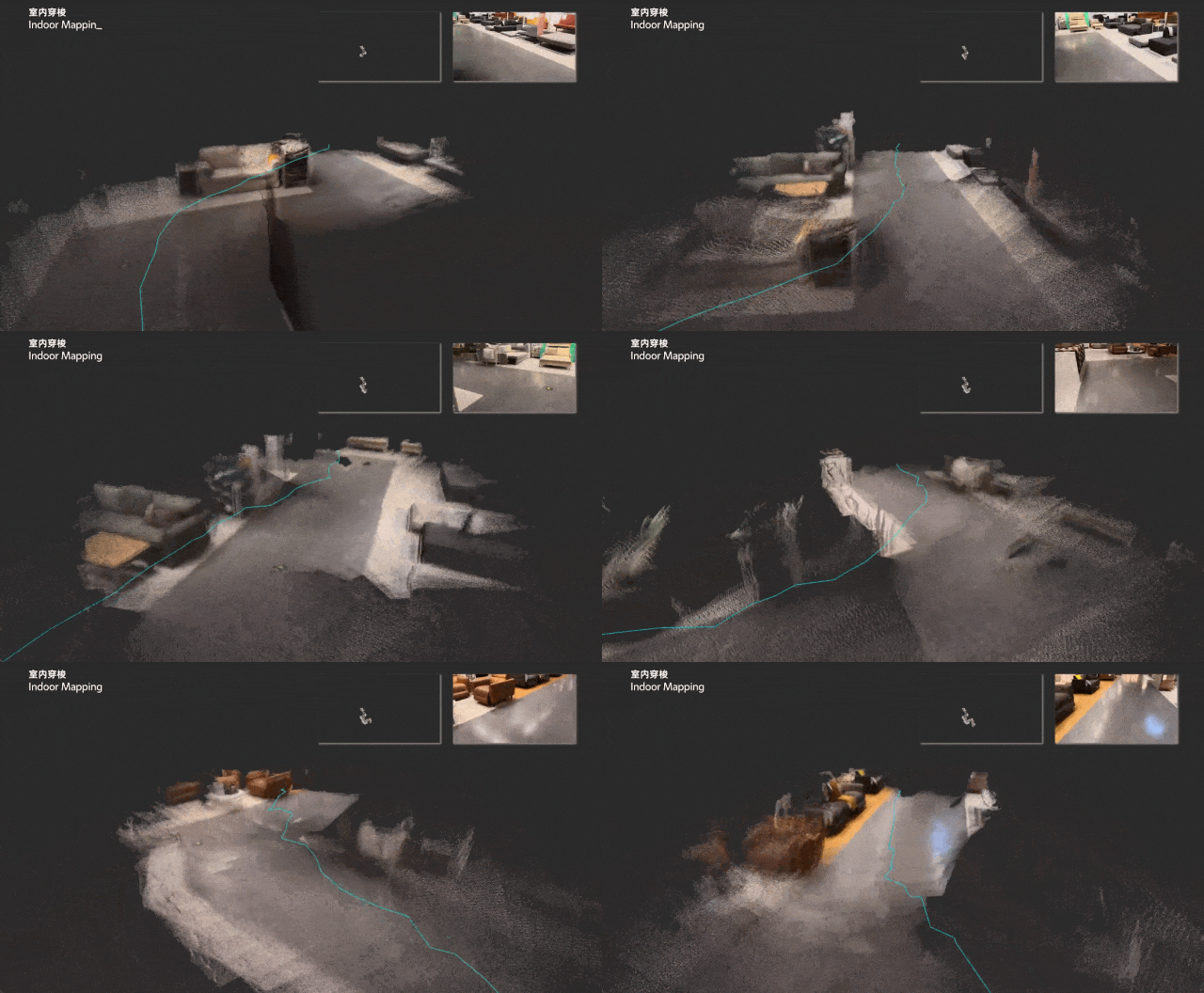
The LingBot-Map remains extremely robust in its long sequences across multiple rooms, in the face of dramatic environmental changes and dramatic changes in perspective.
As of now, the official GitHub project, LingBot-Map, has received 16.9K Stars, 1.9K Forks, and has made multiple appearances on GitHub Trending, making it one of the top-rated open source projects in the field of 3D vision.
Address of the project:https://github.com/Robbyant/lingbot-map
Address of the paper:https://arxiv.org/pdf/2604.14141
The main page of the paper:
Hugging Face links to:
This is the first time I've seen this.
It is surprising that this study has now gained new recognition.
His paper, Geometric Context Transformer for Streaming 3D Reconstruction, was selected for ECCV 2026 Oral, which will be reported orally during the conference. At the opening ceremony of ECCV yesterday, the editor-in-chief of Machine Heart also saw the work on the list of Award Candidates.
From the high attention of the GitHub community, to the recognition of top visual conferences, LingBot-Map has completed double verification from developer ecology to academia.
More importantly, it reflects a change: the competition for space-sensing robots is moving from seeing the world to remembering the world.
LingBot-Map has completed open-source community verification before it is approved.
Prior to joining ECCV Oral, LingBot-Map had already garnered a lot of attention in the open source community, with developers working on various secondary developments around the project.
Some have quickly completed replay verification, others have moved it to different hardware environments to try and run it, and developers have begun to explore new ways of gathering space data.
Everyone's play is fun, and this community-driven exploration often illustrates its vitality more than just the number of stars.
To enable more people to experience faster: from deployment to visualization
For many research projects, the disclosure of papers does not mean that ordinary developers can actually use them. Linkages such as environmental configuration, dependency on installation, and result demonstration are often the distance between the paper demo and the actual experience.
Soon after LingBot-Map became open source, developers created native desktop front-end and 3D point-to-point cloud viewers that run locally on Apple Silicon Macs, allowing users to see more intuitively the results of space reconstruction generated by the model.
At the same time, developers have also created a Pinokio-based launch key, which further encapsulates the environment configuration, depending on the installation and the Demo running process, so that users without complex configuration experience can quickly experience LingBot-Map.
These attempts complement the important link between research results and development experiences, enabling more users to truly access and use this streamlined 3D rebuilding model.
More devices running: consumer-grade hardware adapted
In addition to optimizing usage processes, developers have begun attempts to expand the hardware scope of LingBot-Map.
Developers ureeey made an adaptation attempt for the RTX 4060 8GB display device, reducing the display pressure by optimizing the operating strategy to allow the LingBot-Map to run in lighter GPU environments.

The implication behind such attempts is that when models are no longer confined to high-configuration workstations but are able to enter more ordinary development environments, the technology will have the opportunity to be tested, modified and applied by more people.
From camera to smart glasses: exploring new inputs to extraction
On the X platform, some developers are concerned that past high-precision 3D scanning tasks typically depend on professional LiDAR devices, or require complex offline optimization processes, while traditional methods are also vulnerable to stability challenges in long-term continuous input.
By contrast, the LingBot-Map can be reconstructed in real-time using ordinary video streams, run on a single GPU, reach about 20 FPS, and handle longer serial inputs of more than 10,000 tons.
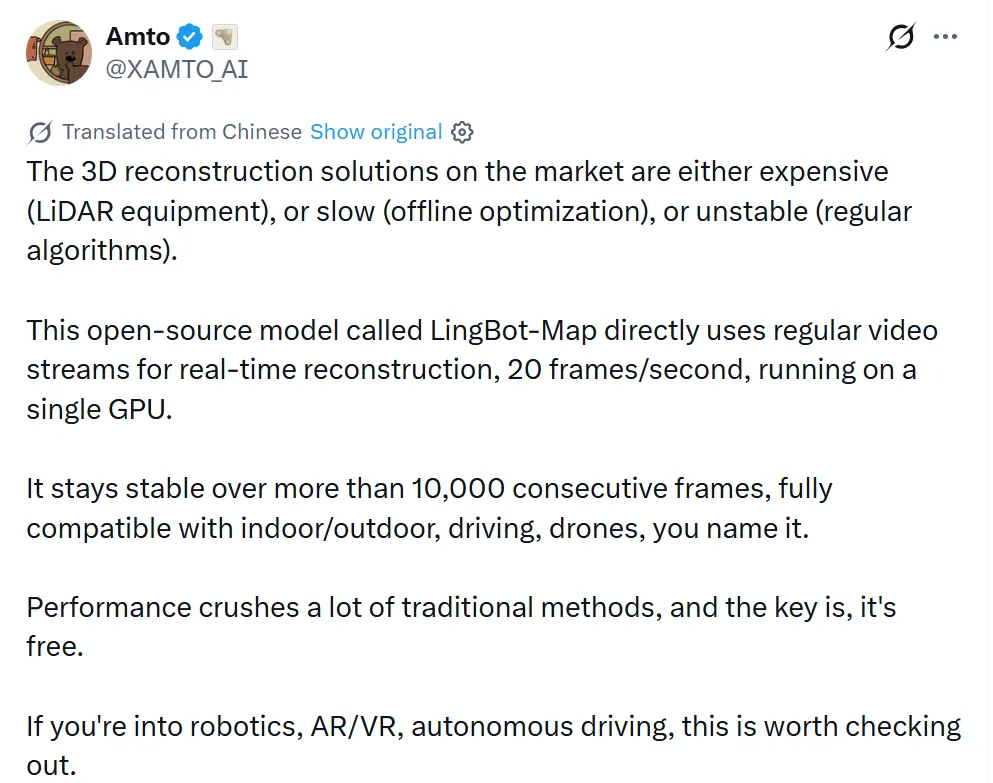
For these developers, LingBot-Map offers a lighter spatial perception path: reducing dependence on dedicated hardware and complex processes, giving real-time 3D reconstruction capabilities more access to robots, AR/VR, autonomous driving, and more.
On the basis of this, LingBot-Map has been added to consumer-grade devices.
He converted the Ray-Ban Meta Gen-2 (LiDAR-free) smart lenses into 3D scanning devices, collected data via the Mobile App, and called for the LingBot-Map rear end to be deployed on the RunPod, completing a 3D map of the space in about 30 seconds. Even with fewer video clips, indoor scenes were better reconstructed.
In addition to the smart glasses, the user runs the LingBot-Map on a typical Dell desktop and collects a single video from his desk, and after about 61.5 seconds obtains an interactive three-dimensional cloud model.
These are only part of the community's exploration after the open source LingBot-Map. For a 3D visual research project, this ongoing secondary development is uncommon, suggesting that LingBot-Map has begun to enter the real use scene.
Following the open source, the team continued to update scripts, reasoning optimizations, instance cases, and troubleshooting to further improve the project's availability and stability. At the same time, the official also showed the results of the ultra-long video reconstruction: in about 25,000 shots of 13 minutes of indoor walking video, the LingBot-Map still maintains continuous reconstruction, generating complete 3D space representations.
Community enthusiasm, of course, is just one aspect. What really determines the long-term impact of a research outcome is whether it solves key issues in the field.
Behind ECCV Oral, how does LingBot-Map redesign robotic space memory?
So what exactly is the problem that LingBot-Map solves? Why a streamlined 3D rebuilding model that attracts developers to continuous expansion and gets approval from ECCV Oral?
The answer needs to go back to the most central challenge of robotic space perception: how to enable robots to maintain long-term memory of space in the ever-growing video input while avoiding unlimited computing and storage costs over time.
For robots, 3D reconstruction requires understanding the environment. Where does the robot see the current image and at the same time respond to where it is now? What is the relationship between the area it has passed through and the current image?
This means that the model needs to continuously estimate the camera's trajectory and generate corresponding depth information, ultimately forming an ever-expanding three-dimensional map.
In contrast to offline reconstruction, streamlined reconstruction faces a core contradiction: retaining more historical information can enhance spatial consistency; but the longer the history, the faster the computing and storage costs will increase.
Currently, there are roughly three routes.
One method is similar to remembering all history. For example, a causal attention-based scheme caches all the information in the previous file. This model has a complete context, but the amount of memory and computation increases as the sequence grows.
Another method is to compress the historical state, such as a circular network structure. Excessive compression can cause the model to forget critical geometric information and cause trajectory drift after a long run.
There are also methods that combine traditional SLAM to maintain stability through keyword selection and optimization algorithms. However, these methods rely on rules of artificial design and require additional optimization processes that are difficult to keep up with in real-time.
So the real problem is that robots are faced with a growing stream of video, which spatial information must be retained and which information can be abandoned?
LingBot-Map calls this problem context management in streaming reconstruction. It seeks to make models that, like human spatial memory, retain only the most important geometric clues rather than recording all observations.
GCA: Divide the space memory into three layers so that the model knows what to remember.
To solve this problem, LingBot-Map has proposed Geometric Context Attention (GCA, attention to context in geometry).
Its core idea comes from the traditional SLAM: a stable space system, which typically requires three types of information: a fixed reference point, used to determine coordinates; information about nearby regions, used to determine current locations; and long-distance history, used to avoid cumulative drift.
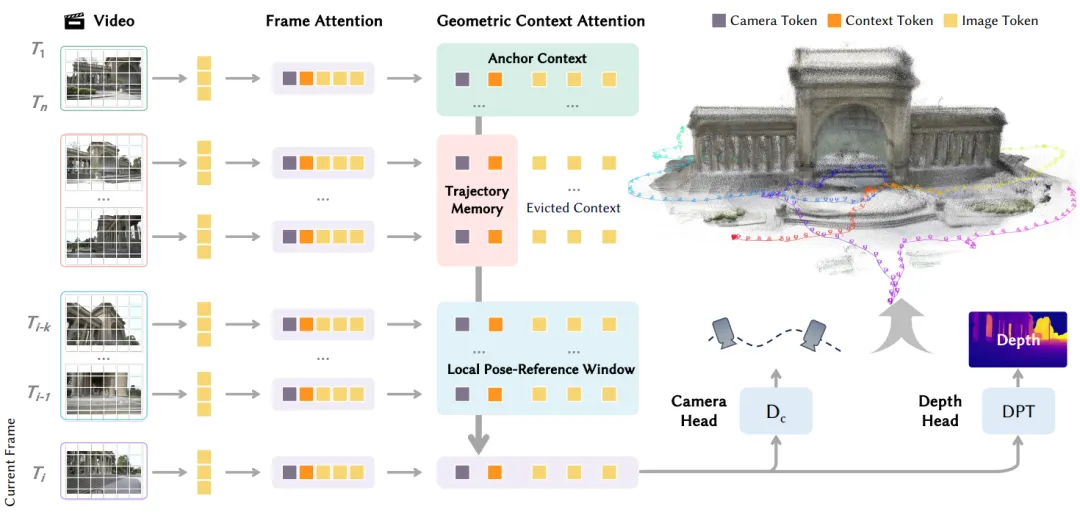
LingBot-Map processes. The framework processes the current view relative to the initialization set [T, T]. The DINO backbone network extracts image characteristics and then refines them through alternating focus layers and GCA layers. In GCA modules, the input view aggregates the context from the focal point, the local gesture reference window [T, T] and the context information on the trajectory memory. Finally, the head of a specific task predicts the camera's posture and depth charts, thereby achieving a robust, memory-efficient 3D reconstruction of the sequence.
The first layer: Anchor Context, which builds space coordinates. It is responsible for remembering "where I came from". It provides a stable benchmark for the entire three-dimensional coordinate system, rebuilds the most frightening coordinate drift in space, has a focal point, and the model is still clear of where the first wave occurs when it processes 10,000 tones.
The second layer: the Local Pose-Reference Window, which maintains localized precision. It is used to capture local geometric details near the current location. It is equivalent to the instantaneous perception of "what's around me", which ensures the accuracy of the step-by-step reconstruction.
The third layer: Trajectory Memory, compressing long-term history to avoid drift. This is a more critical design throughout the architecture. It compresses huge historical information into extremely compact step-by-step tokens to retain the "impression" of past paths at a lower storage cost. It is this mechanism that makes LingBot-Map's memory consumption almost constantly increase with video length, processing 100 tons and processing 10000 tons, with total computation and memory occupancy maintained at almost the same level.
The efficiency of this design is significantly improved. In a 10,000-ton sequence, traditional causal attention requires about 5 million tokens; GCA only requires about 70,000 tokens, which is nearly 80 times more compact, and the computing and memory consumption of a new image is growing almost at the same rate as the total number of tokens.
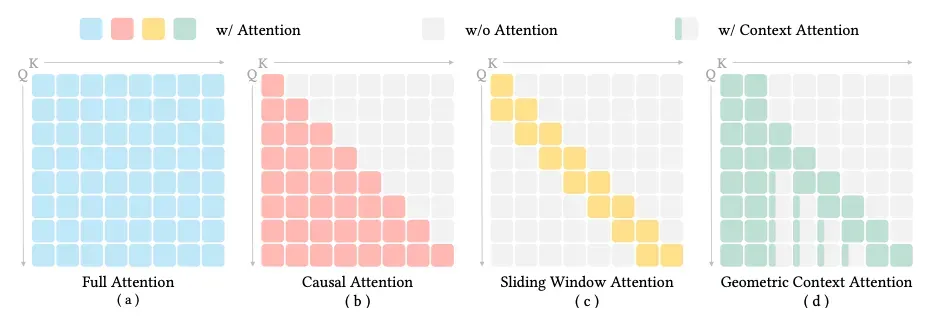
Attention disguise comparison. Each box represents a set of Tokens, consisting of a small above context Token and a larger image Token. (a) Full attention will focus on all tokens. (b) Causal attention supports routine processing, but calculates expenses as the sequence length increases linearly. (c) Sliding-window attention) While limiting simultaneous computing costs, it loses context on the longitude. (d) GCA will divide the context on the sequence into constraints (n=2); departmental windows (k=2) and trajectory memory, maintaining the nearly constant computing costs as the sequence length increases and retaining rich longitude information on the context.
How does it perform on benchmarks?
Experiments have also confirmed the effectiveness of LingBot-Map.
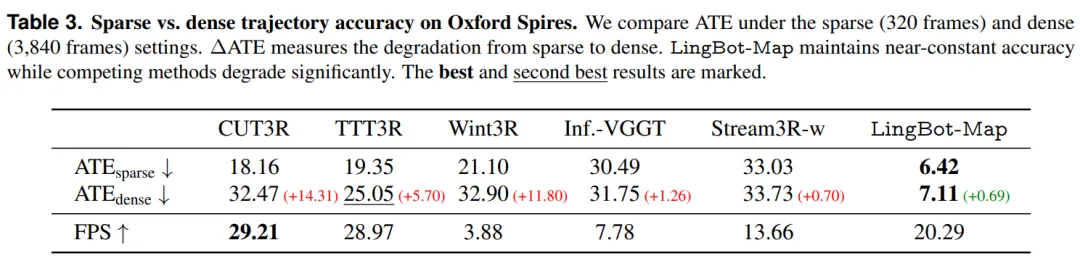
The team first tested the data set at Oxford Spires and set the short-range positioning capability and long-range stability of the test models in two different configurations.
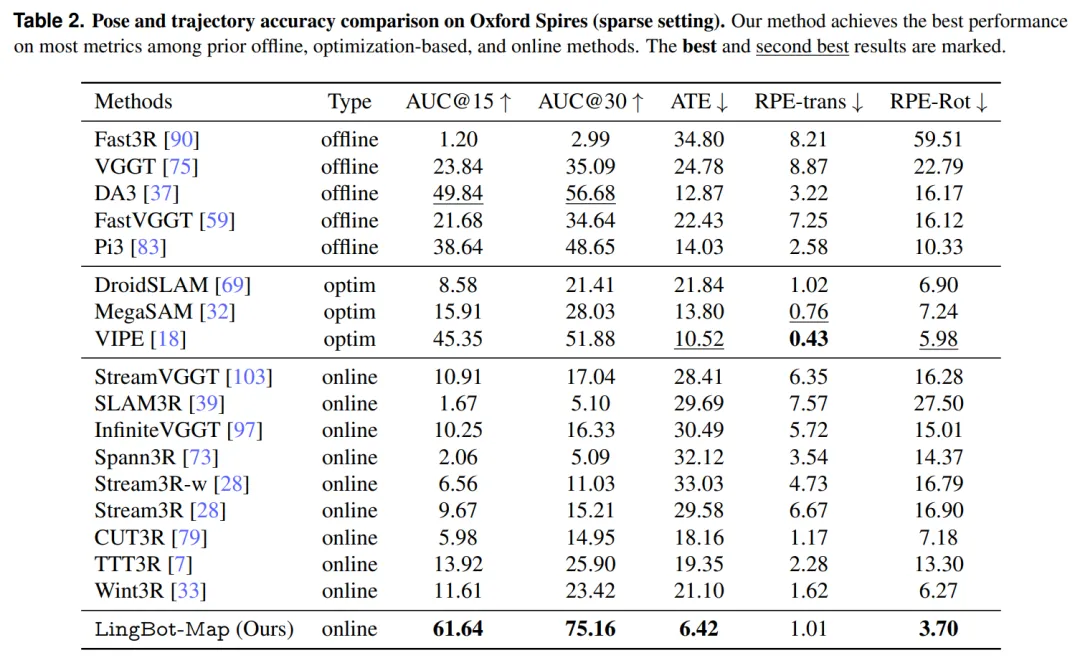
In the scarcity setting, the team took a 320-ton image (with 12 ton samples each) test, with LingBot-Map achieving the best results on almost all indicators.
Although the LingBot-Map uses a streamlined online reasoning method, it still performs significantly better than the strongest offline baseline method. Specifically, the AUC@15 of the LingBot-Map reaches 61.64, significantly higher than the 49.84 of the best offline method DA3 and more than double that of the VGGT (VGGT is 23.84). On track-level precision indicators, the LingBot-Map reduces the ATE from DA3's 12.87m to VGGT's 24.78m to 6.42m.
LingBot-Map also performed better than traditional optimization methods that rely on cross-sectional projection error optimization. It outperformed the best-performing optimization method VIPE, both in position precision (AUC@15:61.64 vs. 45.35) and trajectory consistency (ATE:6.42 vs. 10.52).
The advantage is even more apparent in comparison between online flow methods. Other flow methods have a common problem of memory forgetting: as sequences grow, the model gradually loses geometric information that has been observed in the past, eventually leading to cumulative drift. LingBot-Map reaches 61.64 and 6.42, respectively, improving position accuracy by about 10 times and decreasing by about 2.8 times on trajectory errors.
Under the density setup (complete 3840 tons), the team further tested the model's ability to rebuild in long-series flows. As the trajectory length increases from 320 tons to 3840 tons, most forward-looking methods experience significant performance declines due to cumulative drift problems.
By contrast, LingBot-Map has always maintained a lower error rate, with ATE increasing from only 6.42 to 7.11.
This demonstrates that the three layers of context structure of GCA, including anchor context, trajectory memory and local window, are able to effectively maintain long-distance geometric consistency without the need for explicit optimization or loop closure detection.
It is worth noting that while LingBot-Map maintains the highest trajectory accuracy, it also achieves competitive reasoning speeds of 20.29 FPS, achieving the best trajectory estimation in all streamlined methods.
When it comes to producing high-quality 3D maps, the team rebuilt three data set test point clouds in ETH3D, 7-Scenes, NRGBD.
In the ETH3D data set, the F1 of the LingBot-Map reached 98.98, up 21.70 percentage points from the 77.28 of the second Wint3R.
In the 7-Scenes data set, the F1 of LingBot-Map reached 80.39, and performed best on both indicators of Accuracy (0.02) and Completeness (0.07).
In the NRGBD data set, the advantage of the LingBot-Map is even more apparent, with its F1 reaching 64.26. The NRGBD contains a large number of complex indoor environments and fine geometry structures, in which other methods can easily cause surface blur or structural duplication of the reconstruction result due to cumulative position drift, while the LingBot-Map has a stronger trajectory estimate of the ability to withstand drift, which can directly improve the quality of reconstruction in such scenarios.
The following is the result of a qualitative comparison. In simpler scenarios (a few sets above), TTT3R and Wint3R have already had problems with building edge misplacement. As the complexity of the scenarios increases (a few in the middle), competing methods have begun to emerge with duplicate structures and blurred surfaces, due to cumulative position drift leading to the same geometric structures being projected to different locations.
In some of the most challenging multi-building outdoor scenes, the gap is even more pronounced: TTT3R and Wint3R almost completely lose spatial consistency, the generated point clouds shrink and fragment, and even fail to differentiate between independent buildings. By contrast, LingBot-Map always maintains a clear geometric structure, profitable building edges, and continuous wall surfaces, demonstrating that the long-term geometric consistency capabilities offered by GCA builds can be directly transformed into high-quality 3D renderings.
Quality comparison of point cloud reconstruction.
From a model to a robotic system of spatial perception
In fact, looking at the technical layout of LingBot-Map, LingBot-Map is not isolated.
For a robot, true spatial understanding is not a single capability. It first needs to understand the immediate environment, then needs to accurately judge the distance, and finally, it needs to integrate continuous observed information to form a long-term memory of the entire environment.
LingBot-Vision, LingBot-Depth, and LingBot-Map have been deployed around these three links, corresponding to visual structural understanding, high-precision spatial perception, and persistent spatial memory respectively.
Among them, LingBot-Vision's idea is to refocus the model on the boundaries in the image. It argues that the contours and shape-shifting regions of objects contain a large amount of geometric information, which is an important clue to robot understanding of space. Based on this, the team proposed Masked Boundary Modeling, so that the model can autonomously learn the representation of the image-level boundaries without the need for artificial marking or additional edge detectors, and use this boundary information to enhance visual representation.
By masking depth modeling (Masked Depth Modeling, MDM), the model is able to combine visual contexts in RGB images to infer the depth of information in the missing area. Thus, robots can not only see objects, but also more accurately judge the position relationships of objects in three-dimensional space, especially when processing transparent, reflective, and dense objects.
LingBot-Map further addresses the problem of memory by converting the visual information in continuous video into a stable three-dimensional representation of space through streamlined 3D reconstruction, allowing the robot to update its environmental awareness as it moves and retain the memory of areas already explored.
The three combined to form a spatial intelligence link from perception to understanding to action.
When a robot can continue to perceive, understand, and remember its surroundings, it will be able to perform more complex navigation, patrol, operations, and mission execution. Driven by the LingBot-Map, it is a key step from seeing the world to understanding and using the world.