It's not hard to get a smart body to complete a task, but it's hard to get it to learn to improve from each task. Currently, most smart bodies are "delivery-on-type": they fail, require artificial replication logs, modify tips, add tools, and retest.
This is what the RSI (Recursive Self-Improvement) is all about. It's not about letting the model train itself, it's about letting the intelligent organism generate improvement schemes from real-world task feedback, performing verification, maintaining effective improvement, and helping the intelligent organism to continually optimize.
As early as June 2012, the open-source AI Agent platform openJiuwen, jointly built by a team from Huawei Labs, Huawei Cloud, Terminals, and Computing, released the Auto Harness capability, enabling the intelligent body to automatically optimize its entire set of "working equipment". This time, openJiuwen brought the full RSI framework to the WorkSwarm cluster of office smartphones, leading the way in supporting the two-dimensional optimization of "extractable Harness + Artifacts".
For office tasks across documents, code, data, and tools, this means that working methods can be improved, items can be continually refined, and experiences of success and failure can be used for follow-up tasks. Users can start experiments like creating ordinary tasks, see optimization processes, and get verified results.
OpenJiuwen RSI Framework: How to replace the real engineering loop
OpenJiuwen RSI is not a fixed optimization algorithm, but an engineering framework that allows different self-replicating tasks to run steadily. It is central to the process of converting task goals into executable, evaluable improvements through four-tier collaboration, using versioned optimization objects, verifiable executable evidence, and scalable algorithms.
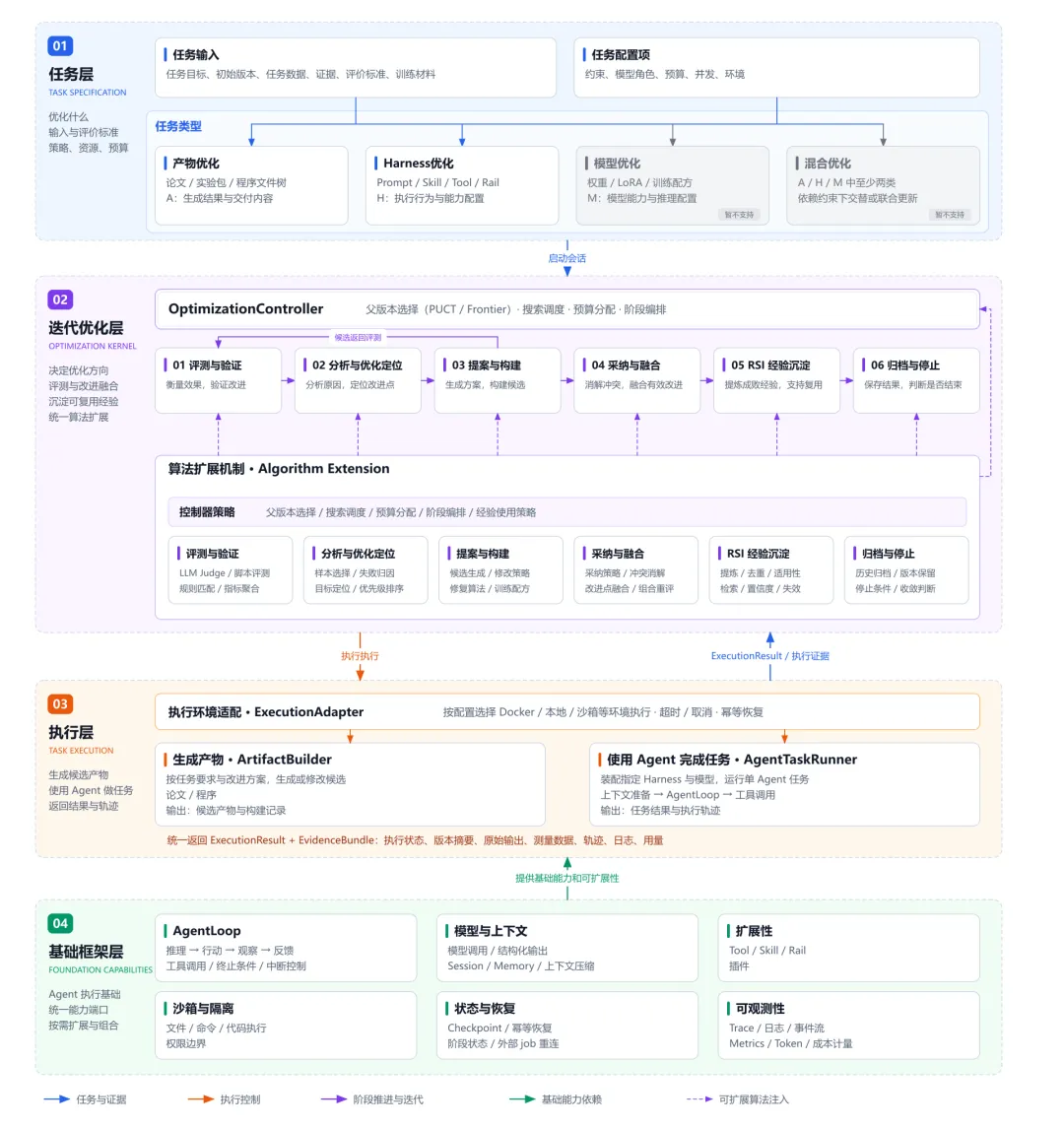
The task layer defines "what to optimize, how to evaluate, how much resources to use"; the iterative optimization layer decides "what to try next, what improvements can be adopted"; the executive layer is responsible for "really running up and returning evidence"; the basic framework layer provides a unified capability to run, model with context, sandbox isolation, state recovery, and observability.
The entire process consists of six phases: evaluation and verification to establish baselines; analysis and optimization of positioning from failures, trajectories and indicators to find the cause; proposal and construction to generate candidates and reassess them according to the same criteria; adoption and integration to resolve conflicts; combinations to effectively improve, forming new versions; RSI to experiment with sedimentation refinement methods and applicable conditions; and finally, by filing and preserving the results; judging whether or not it ends. As long as there is budget and room for improvement, the parent version is chosen to continue to alternate.
Reliability comes from a clear division of tasks. AgentLoop is responsible for single-task reasoning. AgentLoop is responsible for single-task reasoning. AgentLoop is responsible for single-task feedback. AgentLoop is responsible for cross-version optimization. The controller is responsible for cross-version optimization, avoiding verification using subjective judgment from the generator. Each evidence is bound to the version and evaluation context, and candidates must be re-evaluated after filtering, merging or configuring changes; failure to execute, inefficiency of the evidence and poor performance will also be recorded separately. The reasons for the problems, assumptions, unimproved points and adoption or adoption will be preserved, so that the next round can both draw on success and avoid inefficiency.
In a unified mission expression, phase interface, and lifecycle, different objects can use their own algorithms:
Scientific papers optimize the reception of research objectives, preliminary draft or experimental materials and evaluation criteria, select parent versions of Frontier, propose research plans, construct papers containing research content and experimental results, and evaluate whether or not to adopt them.
Scientific research algorithms optimize the receiving process file tree, task data and standards, select parent versions through PUCT, arrange searches, generate source code modifications or fixing programs. Candidate constructs run to guide the next round of searches using script evaluation, rule matching and indicator aggregation comparison effects.
Harness optimizes to run the current version first, and then reload the candidate to run the same task group based on mission results and trajectory diagnostics. Improvements can only be adopted after self-assessment, and methods and conditions of application will follow.
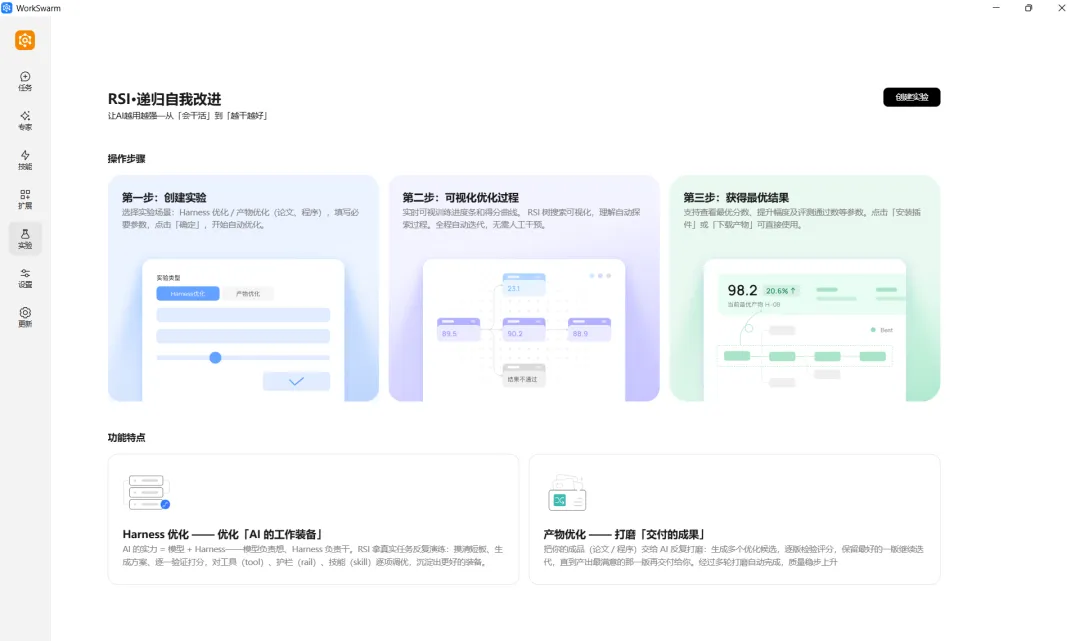
The framework has been incorporated into WorkSwarm: with the newly added "experiment" mode, users can start Harness optimization or product optimization like creating ordinary tasks, see each round of improvement processes and search paths, and finally get verified Harness plugins or papers and program products.
Harness Optimization: Four Steps to Transforming Failures into New Abilities
Harness is the smart body's workload: Prompt decides how to understand tasks, Skill provides professional methods, Tool is responsible for the actual operation, and Rail constrains the execution process. When problems arise at these junctions, WorkSwarm can be used directly from failures to help users improve equipment.
1) Build optimized data. Prepare a JSON evaluation set, with each use case containing use case identification, task requirements, evaluation methods, and reference responses and rating rules. Recommend prioritizing actual failed tasks.
[{"id": "case_001","input": "需要 Agent 完成的任务","judge_method": "llm","reference": {"solution": "参考答案","judge_rubrics": "评分规则"}}]
2) Create experiments. Go to the "Experiments" page of WorkSwarm and select "Harness Optimization", fill in the name of the experiment, select the optimized model, test model, and initial plugins, and then select the assessment set, assessment method, and maximum turnaround time to be created.
3) Automated iteration. WorkSwarm first runs the current Harness, builds the baseline, then generates the candidate modification around Prompt, Skill, Tool and Rail from the failed use case and execution trajectory. Candidate verifies that the target use case has been repaired, and then re-locates the entire assessment set to confirm that the overall improvement has been achieved, without compromising the original task. The page continues to show scores, iteration, model usage and search trees, which programs have been tried and which have been adopted.
4) Installation use. After the experimental output of the valid version, click "Install Plugins", optimally Harness is imported and heated as a plug-in package, without manually copying any content; version information is retained and can be returned when needed.
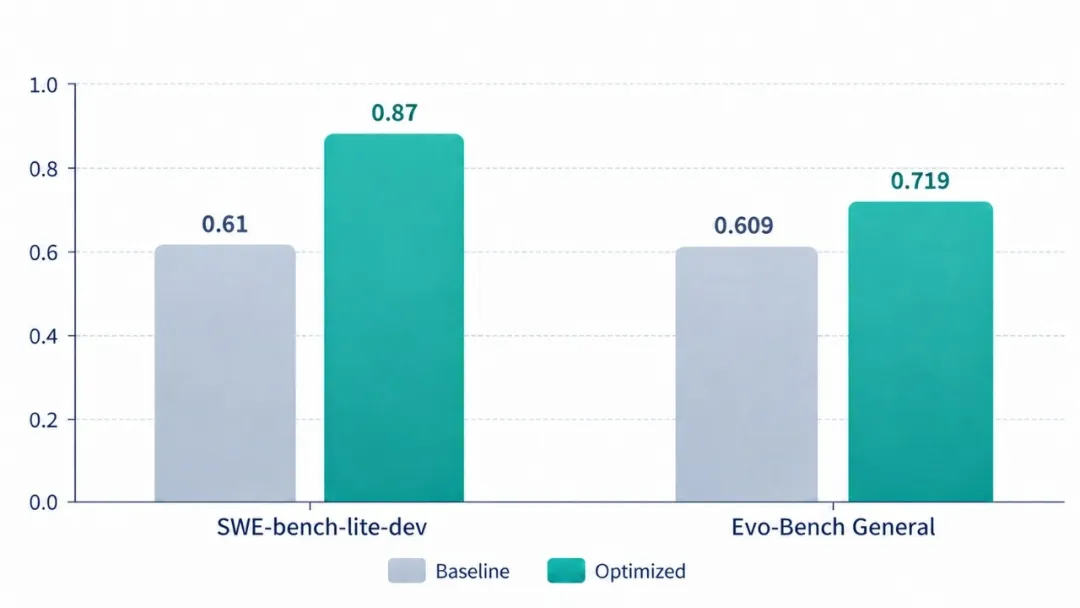
Under the configuration of the DeepSeek-V4-Flash mission model, up to 5 Epoch, Harness optimised the pass rate on all 23 SWE-bench Lite Dev tasks from 61.0% to 87.0%; after freezing the optimization, Harness increased the single execution rate on the Evo-Bench General 64 independent evaluation tasks from 60.9% to 71.9%.[3] The results show that optimization returns can be generalized to non-participating optimization tasks as well as coverage of participating iterative tasks.
2 Research paper product optimization: continuous refinement from research concepts to manuscripts
In WorkSwarm, you can both imagine what is happening from a research paper and submit existing research papers that continue to be optimized.
On the "Experiments" page, select "Product Optimization" and "Documents" in turn, and fill in the Optimization instructions (research topics, target issues, or focused improvement directions) or select the local paper folder to set the maximum iteration times that can be created.
During the run, the detailed page shows the current scores, optimal papers, model usage and turnaround times; the paper optimizes the tree to record the generated versions of each turn, clicks on the nodes to see the change in this turn, the evaluation results and the reasons why it was not adopted. After the experiment is completed, the current best product is previewed, and the full paper is downloaded with a confirmation click.
3 Research algorithm product optimization: submit a task package and look for an improved version
For algorithmic programs that can be run and evaluated, WorkSwarm supports automated trials of multiple versions from existing implementations to deliver optimal results.
It is recommended to pre-install and call rsi-program-dataset-creator Skill, generate a task pack containing running and evaluating information such as an initial program, scorecard, and select "Product Optimization" and "Process" on the "Experiments" page, respectively, to select the task pack folder to create and start optimization.
In the optimization process, the detailed page shows the current best scores, model quantities and program optimization trees, with each node being a candidate program, clicking on which changes, evaluation results and failures can be viewed; the intermediate can be suspended and then continued. After the experiment is completed, a single click downloads the best programs selected after multiple attempts and evaluations for subsequent verification, integration or development.
4 - Calculative compatibility: lowering the cost of multi-cycle optimization of the RSI
The essence of RSI is to use computational intelligence: repeatedly generate candidates, execute tasks, evaluate results, run thousands of model calls at a time; in the optimization process, prompt words, tool descriptions, and task materials are used repeatedly, and tool calls, evaluations, and retests result in frequent interruptions and resumes. If each round is recalculated in the same context, the larger the optimization scale, the higher the wait and resource costs.
OpenJiuwen algorithms rely on an upgraded computing infrastructure that allows the logic engine to "read" the task state of the smartphone, a framework through which Agent Hint transmits information such as running, waiting, recovering, and finishing tasks to the engine, helping the engine actively navigate between upgrading the NPU display, CPU memory, and remote cache (KV Cache): waiting to unload to low-cost storage, pre-recovery, pre-emption, and timely release of resources, thereby reducing multi-cycle optimization, and allowing the smartphone to use the algorithm more efficiently while continuously improving.
This benefit was also confirmed in experiments to optimize the algorithm process, starting with computational proficiency, TTFT ((First Token Delay) decreased in average value by 15.83%; P90 decreased by 19.16%; Token Acceleration KV Cache life rate increased by 7.53% to 14.36%; HBM and DDR peak usage decreased by 22.82% and 30.74% respectively.
What is the meaning of this verse?
OpenJiuwen RSI has formed a complete link from creating experiments to obtaining optimized results:
Harness Optimization will improve the way smart bodies work based on failures;
Artifacts to optimize the delivery of products such as grinding scientific papers and algorithmic processes;
Combining computational efficiency, reducing repetitive computing and reducing resource expenditure.
From two-dimensional optimization to Harness to Artifacts, openJiuwen RSI makes optimization a continuous process that users can initiate, observe and reuse: every change has evidence, every adoption is verified, every round of experience helps the next round.
Subsequent frameworks will continue to enrich search, evaluation and integration algorithms, enhance cross-tasking experience replication, and optimize and blend model access across a unified architecture, allowing Harness, Artifacts and Models to synchronize within clear evaluation standards, budgets and security boundaries.
The RSI experimental mode is now available on WorkSwarm, and interested users can go to the official website to download it and experience it instantly:
WorkSwarm is an instant experience:
This is the first time I've seen this.https://github.com/openJiuwen-ai/
AtomGit code stores: