It's been a long time since I've been able to touch.
How to get to the stage of using potatoes
In the physical world, all contact must be powerful, and the operation process must be all kinds of contact.Touch sensors let robots know what's going on, and they're moving from screening screens to screening screens. The touch penetration rate for some smart hand manufacturers has risen from 20% in 2025 to more than 60%.
The industry knows that touch is useful, but how to use it is still a question number, and only with a good touch can the business continue.As Lifeifei said, when robots operate, touch data and the ability to truly integrate touch with visual, perceptual and spatial data are essential.
In June this year, T-Rex, published by 34 people, including JIM FAN, T-Rex to design touch-independent model architectures and algorithms, and to enable touch experts to read signals, designed a time-space touch encoder to capture time changes in touch power and the spatial distribution of contact surface shapes. The success rate of the mission increased from 6% to 65% of the π0.5+ touch string, providing a reference to how to use a good touch string.
But in production life, the requirements for success rates of up to 99%, 99.9% and even 99.99%, how to overcome the 30%+ gap, is a common challenge for the industry, and touch remains one of the key breakthroughs.
Too many choices don't know how to use multi-tech routes for long-term complementary coexistencePressure resistance, capacitance, hole, visual touch have become the four mainstream touch technology routes in the industry, and off-the-shelf technology is becoming more and more mature.
The process of compressed resistance is mature, low cost, easy to attach, flexible, and easy to use.Warwick, Foley New Materials, Mechanotechnology and others have been delivered in bulk.
Capacity sensitivity is high and supports multi-modal measurements such as three-dimensional force, proximity, and more.He is an expert in mountaineering technology and has achieved mass deliveries.
Hull's high accuracy, high stability, long lifePasini played a key role in the creation of a full-fledged layout with a physically intelligent body, clever hands, numbers, and large models.
Optical touch includes three-color light and one-color light technology routes with the highest spatial resolution, rich in patterns,There has been a steady increase in the number of people entering the country with robots such as the Millennium robot, the AI robot and others.
Off-the-shelf with high sensitivity and ultra-wide linearity measurements.Racing technology is already in placeSigning a batch order for hand-held touch modules。
A high-end straight-handed scientist's fingertips are pointing towards the visual direction of touch.Last May, Sharpa Wave made a surprise appearance, with its fingerprint integrated with the self-developed high-resolution visual touch sensor (DTA), which has become a key platform for the world's leading laboratories to explore the next generation of sophisticated operations.
The high intensity of finger-point touch is due to its pioneering implementation of the closed loop of the finger-point touch-model-operating loop, which is an industry that knows how to use visual touch data.Visual touch transforms tactile problems into mature visual problems that directly output image information, integrate more easily into existing model architectures, and have more open-source sensors and data sets based on visual touch.
However, there is a bottleneck in the measurement frequency (slow) and data processing capacity (big) of the visual touch, with high computational requirements for end-side chips and limited application scenarios.Other tactile technology routes still have the power of war.
And the touch is coming fromThe tip of the fingerI'm going toThumb and forefinger、Arms / Dry、Whole bodyElectronic skin is expanding, with different areas focusing on different indicators, and multiple technological routes will complement coexistence.The fingertips are the core parts of finely crafted operations, focusing on sensitivity, accuracy, multi-mode perception, emphasizing sensory coherence; the mind, in turn, are primarily responsible for grasping contact perception, position judgement, adjustment of posture, attention to scale, stability; while other parts of the body focus more on safety interaction, attention to flexibility, stability, and longevity.
PartsTouch sensor companiesA multi-threaded layout has been made.Modular technology, sensing robots, and other multi-modal convergence routes have been implemented in a dual-line layout of optical touch + vibration. In contrast, modular technology has expanded from optical resistance to optical touch, whereas optical robots have expanded from fingerprint optical touch to holistic touch solutions.
Lack of standards makes it difficult for touch terminals to be used and firmly cemented into industry consensusThe manufacturers' requirements for touch primarily include six aspects: first, resolution/sensitivity/precision; second, program matching; third, stability, including consistency and durability; fourth, data transmission; fifth, mass production capacity; and six, price.
Performance is a key indicator for agile manufacturers, but lack of standards increases downstream collaboration and difficulty in industry deployment.Currently, the industry does not have uniform standards for touch sensor performance such as sensitivity, accuracy, lifespan and calibration, customers cannot directly judge good or bad with labeling parameters, need to test, and increase the difficulty of up-and-down collaboration. Data interfaces are incompatible and restrict the efficiency of industry deployment.
In terms of performance,Program matchingIt is also important to note that this is not always the case in the United States.This consistency includes the consistency of the same batch, different batches of products, consistency of performance after long use and stable supply capabilities. In addition to the flexibility of touch sensors, another emerging application of touch sensors is consistency. Because data collection is a long, highly repetitive process, data drift, poor repetitiveness can lead to data scrapping.
In order to balance performance, stability, and price, companies across different technology routes have built barriers to cement stability from underlying materials, structures, chip design, mid-level algorithms, and back-end engineering capacity and labeling capabilities.Material formulation, structural design, algorithms, and chips are the first shield, from 0 to 1, to determine how the product is made; and the second shield, from 1 to 1, to determine product consistency and cost.
Build a touch loop - data model - Apply the shutter loop to make the touch loop better with the shutter.Simple parameters are the first step, but they only provide touch hardware, without supporting simulation environments, sensing algorithms, or scene adaptations, and most customers may not know how to use them, making it difficult to prove the value of touch.Manufacturers of touch sensors need to prove the value of touch and how the church market is being used.Parts manufacturers are turning toThat's it.More underlying, longer-term infrastructure platform rolesThe focus of competition has also shifted toWho can make tactile data bricks better with bricks。
Making touch sensors is no longer a challenge in the industry, and the extreme scarcity of touch data is the key issue.Touch-based multiple-choice devices have become the focus of touch sensor manufacturers' layout.
It is necessary for large model manufacturers and tactile manufacturers to have a common definition of what operating data is collected from which scenarios and how it is marked after collection.When the downstream demand scenario is unclear, some touch manufacturers such as AI robots, AI robots, and AI robots start to develop large-scale touch models on the ground, and self-construct numerical intake lines and release datasets to provide scenario solutions.The big tactile model here is more like a small model of the vertical sphere.It supplements, not replaces, basic model manufacturers.
When real tactile data is extremely scarce, simulated tactile data becomes a complement.Simulation platformsIt's alsoTest optimization of touch sensing algorithms before deployment under safe and controlled conditions。However, simulation still faces the Sim2Real Gap, and it is particularly difficult to accurately reproduce complex physical interactions (contact dynamics, friction, material elasticity).
Finally, real-world deployments have feedback flows from real data, so that real-world data can be deployed in real-time.I'm going to change.In addition to this, it is important to be aware of the importance of the use of sensors and sensors for sensing sensors and sensing data.The sceneApplications to the appThe greater the capacity of the entire chain, the faster the pace of generation, the deeper the fortifications that are built.
Capital betting on multiple technology routesApple Touch - Data - Models - Applications of closed-loop companies get more bonuses
This is not a complete statistic, as of August.In 2026, about 20 touch sensor companies completed about 30 rounds of financing, and have disclosed funding of about 4.45 billion yuan, covering various technology routes.
Among them, Pasini's total deployment, two consecutive rounds of cumulative financing of 2 billion yuan, the first of the early technology deployment spectral instrument business, the expansion of visual touch technology in 2025, the completion of the E-Round over 1 billion yuan financing this year, the single financing of other visual touch manufacturers such as AI robots, Millennium robots in excess of billion yuan; his mountain technology financing completed the B-Round financing of hundreds of millions of yuan; the single financing of pressure-blocking enterprises in the tens of thousands of yuan level.
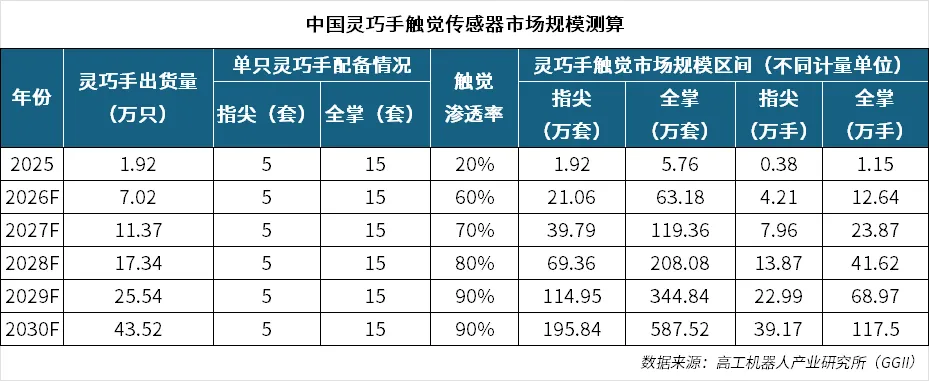
Measurement of the size of the soft touch sensor marketCurrently, the volume of shipments in touch enterprises includes multiple capacities, such as pumps, pumps, pumps, pumps, pumps, multiple pumps, etc., which are unified into pumps and pumps, in which the pump is a sensor module, such as a finger point sensor, and pumps are converted into 5 units.
Flexible hand-held touch sensors are typically configured between 5 sets of fingertips*5) and 15 sets of fingertips*5+ thumb*9+ palm*1).In 2026, China's Intelligent Touch Sensors are expected to ship between 21.06-63.18 million units, and support between 4.21-12.64 million hands, with the increase in Intelligent Touch Penetration and superimposed touch penetration rates, reaching a compound growth rate of 2026-2030.74.61%。
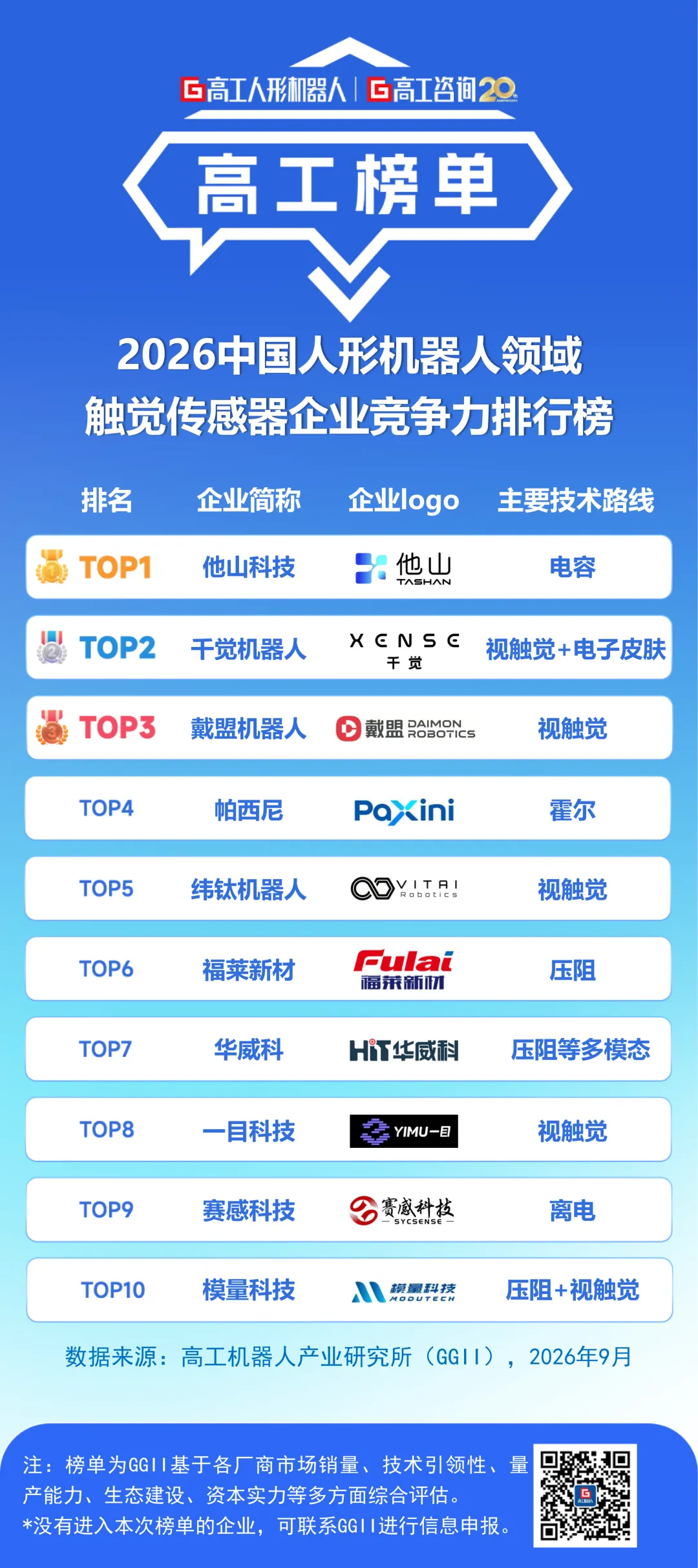
 Competitiveness of touch sensors in the field of humanoid robots in China 2026
Domestic touch sensors are still in the phase of a multi-technical pathway parallel, full-fledged, and GGII, through a comprehensive assessment of the market sales, technological leadership, mass production capacity, ecological construction, capital strength of various enterprises in the field of human robots, combined with open data and expert interviews, has released a ranking of competitive touch sensors enterprises in the field of Chinese human robots in 2026.
He wrote at the end:
The industry of touch sensors has not yet been tailored.Different areas, different application scenarios, different focuses on touch sensors, and the complementary advantages between different technological routes determine the long-term coexistence situation. At the same time, companies continue to iterate around the industry's demands for product performance and rich product types.Of course, the future doesn't rule out the possibility.It's all new.TechnologyRoutes。
While exploration of how to use touch is still ongoing, it's clear that the industry is right.Uniformity, modularity, ease of use, reductionIt's the pursuit that tests enterprises.Technology innovation, process innovation, tactile sensing algorithm innovation, mass production, labelling and so on。
On June 27, this year, the National Standards Program for Rocket Robot Parts Touch Sensors Part 1: General Technical Specification and Rocket Robot Parts Touch Sensors Part 2: Data Format Requires Rocket Official Standards, which was approved by the National Committee for Robotic Standardization Technology, and the development of the national standard will drive the industry into a new stage of markup traceability.
Will the next breakthrough for smart startups to connect multi-million-dollar investment vehicles like Elite, Chevy and others to heavy-duty construction be flexibility and demonstration-free?