Multi-purpose, small-scale, high-frequency switching lines are becoming the norm in manufacturing, relying on pre-programmed, repeated execution of traditional automation equipment, and it is increasingly difficult to keep up with the pace of production line changes. The integration of artificial intelligence, robots, multi-modal perception and motion control technology with industrial-grade intelligence is one of the focused growth directions in factory automation transformation.
As opposed to general-purpose intelligent solutions, industrial-purpose intelligent solutions can't do well. Operational stability, reliability, production rhythm and processing assembly accuracy are the bottom line that industrial customers cannot compromise, while vertical industry Know-How, which is rooted in real production lines, is the ability of general models not to directly give.
From the carrier's point of view, industrial machine intelligence is not limited to a certain type of robot shape, fixed base, mobile operating shape, quadruped, human shape, and intelligent magnetic drive, respectively, to find its location in scenes such as dump, assembly, inspection, assembly, and production line flow.
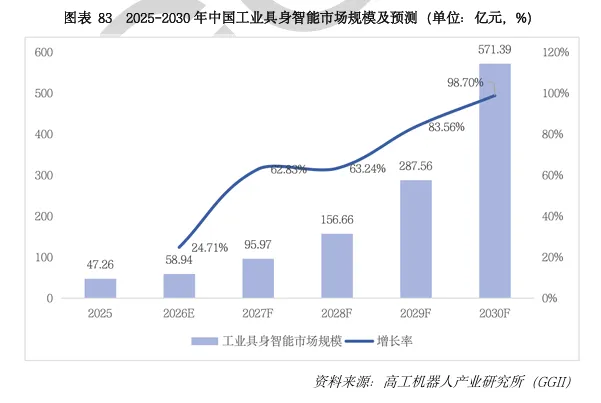
According to the GGII Institute of Advanced Robotics Industry (IGII) data, China's smart industry market size in 2025 is about 4726 billion yuan; GGII expects the market size to reach 5935 billion yuan in 2026, a growth rate of 25.58%; the market size is expected to exceed 571.39 billion yuan by 2030, and the compound growth rate of 64.62% in 2025.
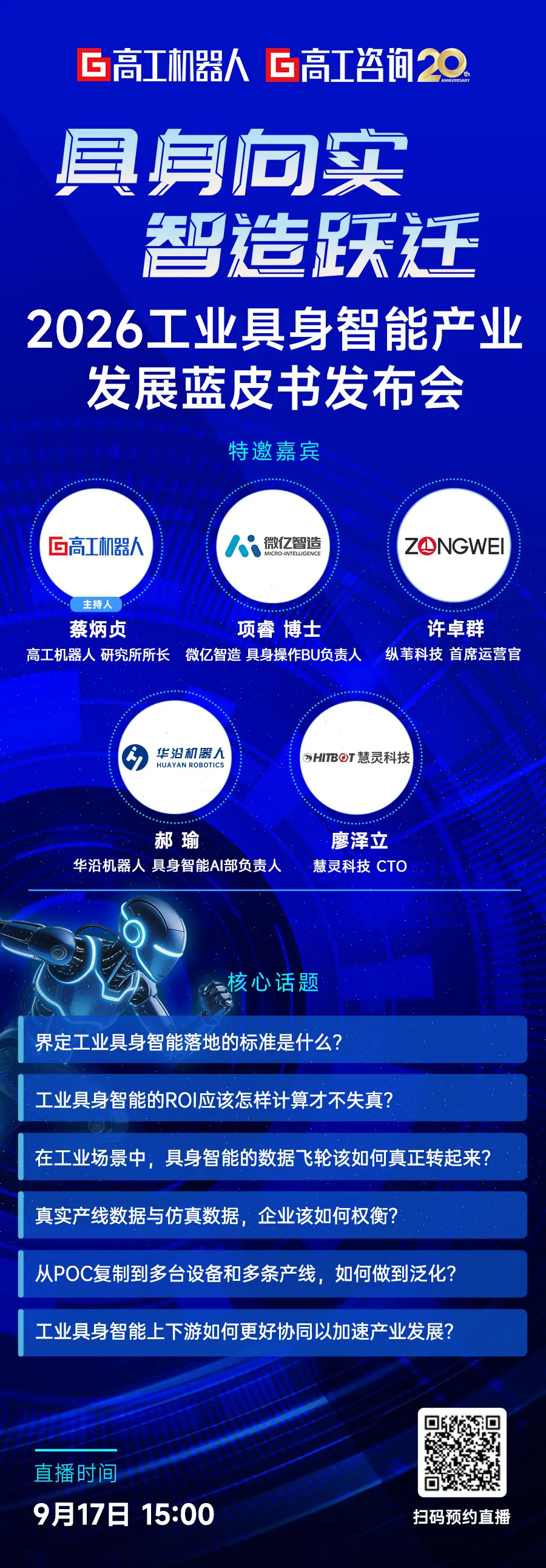
Around this emerging market, the Joint Micro-Billion Institute of High-Industry Robotics (GGII) together with micro-technology, longitudinal robotics technology, China-wide robotics, and Huilin technology, representing enterprises in the industry chain, have compiled the Blue Book for China's Industrial Equipment Intelligent Industry Development Project (2026), which provides information on technology development research and development opportunities for industry stakeholders. The Blue Book Project will be released online, please lock the video number of the High-Industry Robot, please click the booking button below to get a live broadcast reminder.
↓↓↓ Click here to book the Blue Book Festival.
Industrial intelligence is behind it.
What landing issues are worth considering
Based on a large number of enterprise research and field cases, Setup Concepts, Backgrounds, Industry Chains, Markets, Business Stories, and Prospects, the Blue Book System depicts the industry as a whole and attempts to answer the following industry focus questions:
Where is the boundary between industrial machine intelligence and traditional industrial robots, general machine intelligence, and how do different forms of industrial machine intelligence fit into their respective industrial tasks?
Where is the cost focus and technical competition for upstream core modules - downstream core devices - downstream system integration and supporting devices - along the three-tier chain, joint modules, end executors, sensors, and software systems?
Operating systems, data and simulation, multimodal perception, VLA models, world models, adaptive controls, cloud-side-to-end collaboration, how do these technologies work together to transform intelligent decision-making into physical movements that meet process requirements?
How will the four big barriers of money, technology, data, and brands shape the competitive landscape?
To address these issues, the Blue Book Project explores the boundaries between the capabilities and product formats of the smelting industry with physical intelligence, analyzes key components such as joint modules, end executors, sensors and software systems, and combines industry measurement with enterprise projects to observe how technology is transformed into productivity to provide opportunities and pathways for industry to choose.
By bringing together industrial research and corporate practice, the Blue Paper aims to foster a clearer development consensus among industry stakeholders around technical capabilities, process adaptation and application values.
Four companies joined forces
Practice of industrial equipment from the production site
The joint edition unit of the Blue Book Group brings together the main enterprises from all sectors of the industrial hardware chain. At the same time, the GGIII invited representatives of enterprises to participate in the conference to explore the implementation of industrial hardware intelligence on six core topics.
The following list is incomplete; you can help by expanding it.
▌Micro-billionths of AI
Through its self-developed, full-featured software-hardware system, Microsoft is committed to providing open-box, highly flexible, autonomously perceived, learned, decision-making, and complex-duty intelligent industrial products and solutions. At its core, Microsoft builds a cloud-side-to-end integration collaboration architecture, builds three product lines of EIIR products, AI-enabled intelligent products, and modular products, and builds an industry database of over 23TB of more than 1.6 billion pieces of targeted data, based on real-world product lines.Currently, micro-billion-scale industrial smartphones, equipped with Intelligent Quality Assurance, Multi-Arm Synchronous Assessment, Repair Integration and Substrate Robots, have been rolled out in industries such as 3C electronics, automotive manufacturing, new energy, semiconductors, and have entered the European and American markets since 2025, serving more than 25 of the world's top 500 and international industry leaders.
▌Colonial technology
Long Range Technologies is an industrial technology company focused on motion control, intelligent magnetic drive and advanced motor technology, with its independently developed and self-developed sTrak intelligent magnetic drive transmission system, based on fully self-developed controllers, high-precision motors and drivers, and sTrak Studio control software with modular operation and virtual simulation capabilities, forming a complete product line covering S ring, X-channel, W overload, L mixed flow lines, with a maximum speed of 6 m/s, repositioning accuracy of up to ±5 μm, load coverage of 2 kg to 2000 kg, and pioneered the development of multi-heavy mixed-channel transmission technology in the country.Based on the underlying technology from the same source, Vertical Technology has further extended its product range to joint modules and unbroken rectangular motors. Its magnetic drive line has an annual design capacity of more than 150,000 meters and has been certified by MTBF (average failure-free working time of 100,000 hours) and TÜV South Germany CE certification, with product deliveries covering more than 16 countries and regions worldwide.
▌Around the Robot
China's core robotics team has been focusing on motor, servo drive and motion control research and development since 2005, and has worked in the field of underlying motion control for more than two decades, building a series of collaborative robot product matrix with a rated load of 3 kg to 60 kg, covering Elfin, Elfin-Pro, Elfin-Ex and S series large-load robots, joining speeds of up to 370°/s, repositioning accuracy of up to ±0.015mm, real-time control refresh frequency of up to 2000Hz. In April 2026, China released the Echo, HY series seven-axis man arm, with a rated load of 3 kg to 15 kg, and control accuracy of ≤0.02Nm.
With a focus on artificial intelligence, HRC is a self-developed artificial intelligence control platform that transforms AI decisions into precision, smooth, and safe physical movements, connecting different upper-level AI capabilities through open interfaces, forming a general execution foundation for switching brains and brain-stabilizing brains. Currently, its products cover more than 40 industries and more than 60 industrial scenarios, including 3C electronics, automotive manufacturing, semiconductors, and new energy.
▌China and China
HuiLing Technologies is a provider of physical intelligent infrastructure focused on the development and application of industrial embedded intelligence technology. HuiLing Technologies started with robotic hands and intelligent endpoints to implement technology and gradually expanded into motion control, software system platforms and industry application solutions, building a three-tiered technology system covering AI vertical models, HITBOT OS embedded intelligent operating systems and modular hardware components.
Based on this system, HuiLing Technologies is able to provide integrated physical intelligent body solutions for different industry scenarios, from needs analysis, program design, system development to deployment implementation. Currently, HuiLing Technologies focuses on the three major areas of smart laboratories, smart manufacturing, and new retail, and its general-purpose intelligent biosynthesis system has been implemented in experimental processes such as particle building, immune filtration, program design, automation, and data feedback optimization.
—END—