
It's the first time in the history of the world.
On 28 October, just after OpenAI completed its for-profit weight group, Ottman and chief scientist Jakub Pachocki launched a live broadcast. Ottman made a statement in the live broadcast: "It's better to define the AGI than to determine the two days when it's really going to happen".
 In the meantime, Pachocki reported on the day:
In September 2026, AI research internships are on the rise.
In March 2028, an AI automation researcher will be appointed.
More than a decade has passed since the first day of OpenAI's scheduled delivery. On September 6, OpenAI researcher Boris Power posted an official blog:
OpenAI achieves the goal of automation research internships.
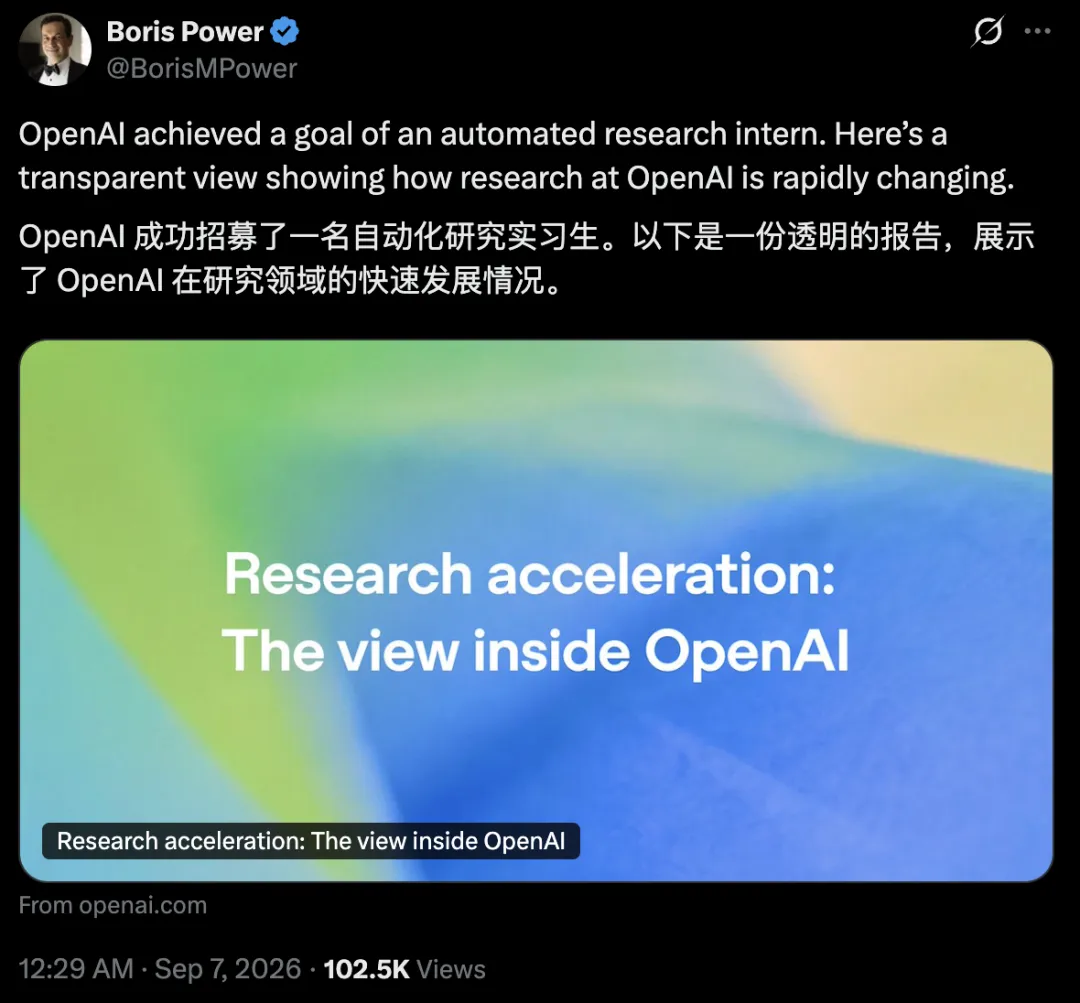 This is the first time the AI industry has publicly demonstrated its capabilities. "Research Intern" is not a product, it is a definition of OpenAI's own internal capabilities:
A system that can accomplish a specific research task under human guidance, and it takes a few days for a skilled researcher to do it.
As for the "Researchers" plan for 2028, Pachocki's criteria are as follows:
Systems capable of autonomously delivering larger research projects.
One that needs human guidance, one that can deliver more complex research projects autonomously. From "interns" to "researchers", the main focus is on a whole layer of judgment: what to do, what to do, when to stop. This layer is precisely where AI is weakest today. OpenAI's own data shows that "deciding what to do" is almost non-existent in Agent output, and tasks that take more than 4 hours are often intercepted.Accounts for traineesBurning $7,000 a dayIn this roll-out report, OpenAI also reveals a surprising internal data that AI has worked for three times as long as humans:
As of mid-August 2026, in the OpenAI research department, there are 3.14 Agent working days behind every single human working day.
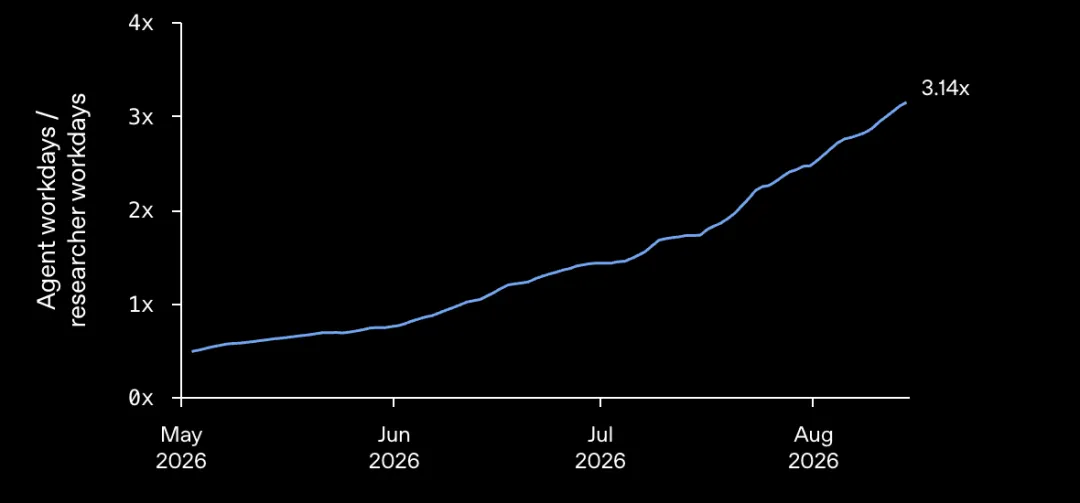 At the beginning of the year, the researchers in the OpenAI research department who ranked in the middle for Agent usage were only "small use" of AI tools. But by mid-August, this average employee was calculating the amount of light consumed per day, at an API price of over $600. If they were in the top 10% of the weighted users, they would have directly surpassed $7,000 of tokens burned per day.
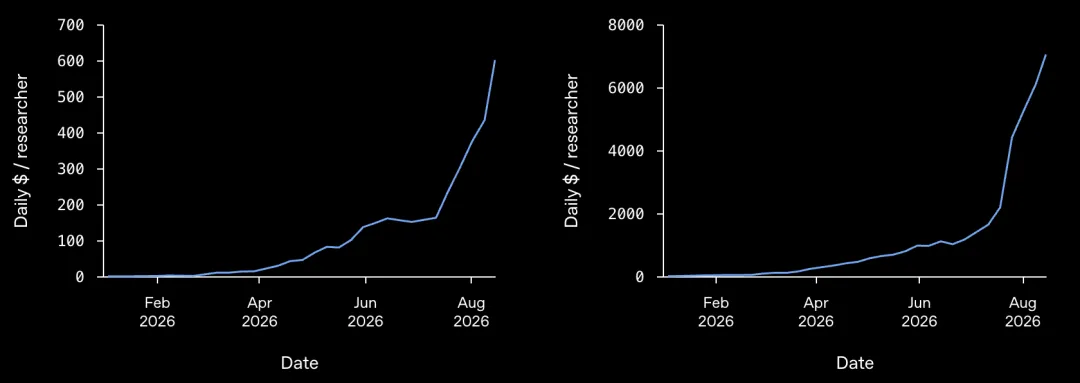 The average number of OpenAI researchers spending on a daily basis is over $600 in mid-August; the average in mid-August is over $600; the average in mid-August is over $7,000; the average in mid-August is over $600; and the average in mid-August is over $7,000. This is much higher than the average monthly salary of a senior programmer.
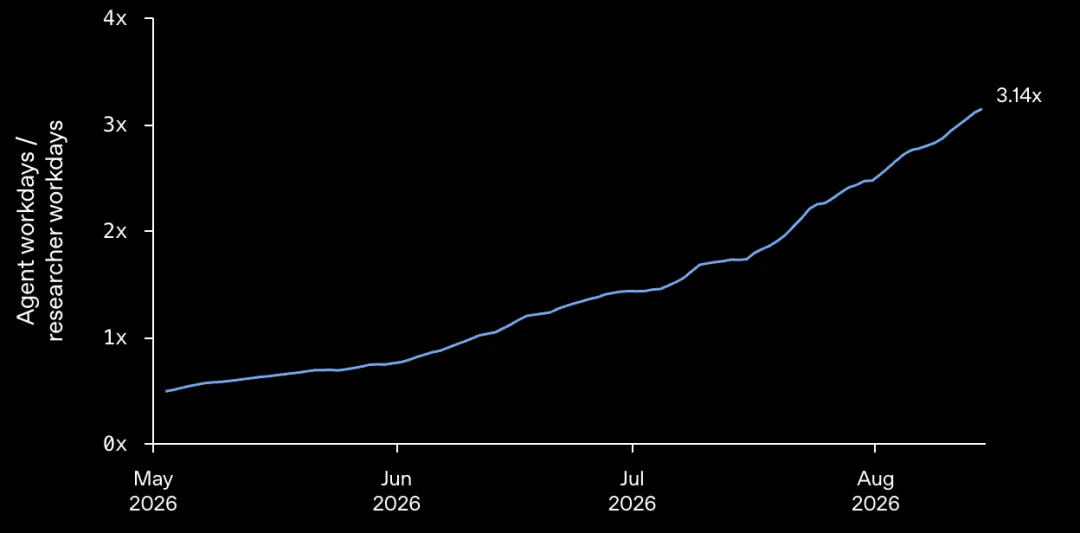 In the OpenAI research department, the Agency's workday was less than 0.5 times that of human workdays at the beginning of May. It was less than 3.5 times that of early May. It was 3.14 times that of late June and early August.
In August 2026, the number of experiments run by each active experimenter set an all-time high since the start of statistics in January 2025, and the number of code changes per active contributor across the company doubled from the average level before 2025.
But OpenAI also knows that the deeper the automation of the bottlenecks, the more difficult the task of automation will take up more and more of the energy of the researchers and become the next card point.What are the interns doing?Doesn't that mean that an AI already has the top three researchers? Don't rush to the conclusion. OpenAI has broken down the work of an Agent in detail this time around, using a classification methodology from Epoch AI, and divides AI research and development into six phases:
It's about making decisions, designing, building, running, analyzing, and communicating.
The results showed that from January to August, each researcher's daily token increase, and the top three finishers were the "executive layer":
Writing research and infrastructure code, adding 19.82 million tokens; technical assistance with code review, adding 15.88 million tokens; running startup, monitoring and debugging training, adding 13.31 million tokens.
What about the "decision layer"? Poor enough: "decide what to do" adds only 2,300 tokens; "decide whether to continue or stop the project" adds 1,500 tokens; "decide whether to continue or stop the project" adds only 200 tokens.
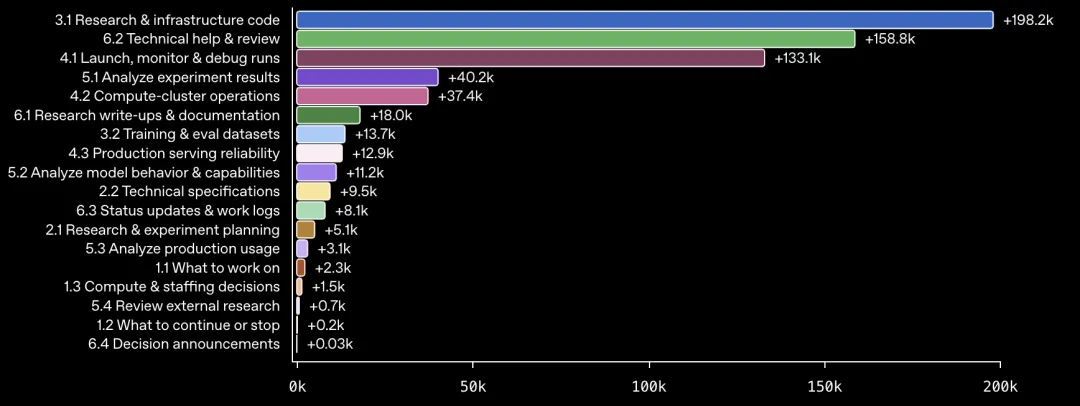 From January to August, each researcher of OpenAI generated an increase in the number of daily Agent outputs for various types of research activities. Writing code for 19.82 million people, "decide to continue or stop" for only 200 people, was almost a thousand times worse. Here is another detail: There were several teams within OpenAI that opened their doors every week, helping researchers check out the problems of the experimental environment. By 2026, fewer and fewer people were going to the man-made channels to ask for help, and one of the teams simply stopped responding because they weren't there.
If you send it a live one, it will work tirelessly for a few days; but the direction is not right, when it should stop, or when it should look behind its human guide.
JulyOpenAI even stepped on two-legged brakesOpenAI posted a graph of the reinforcement learning algorithm curve, with the two empty lines on the graph representing the time points of the two-legged brakes.
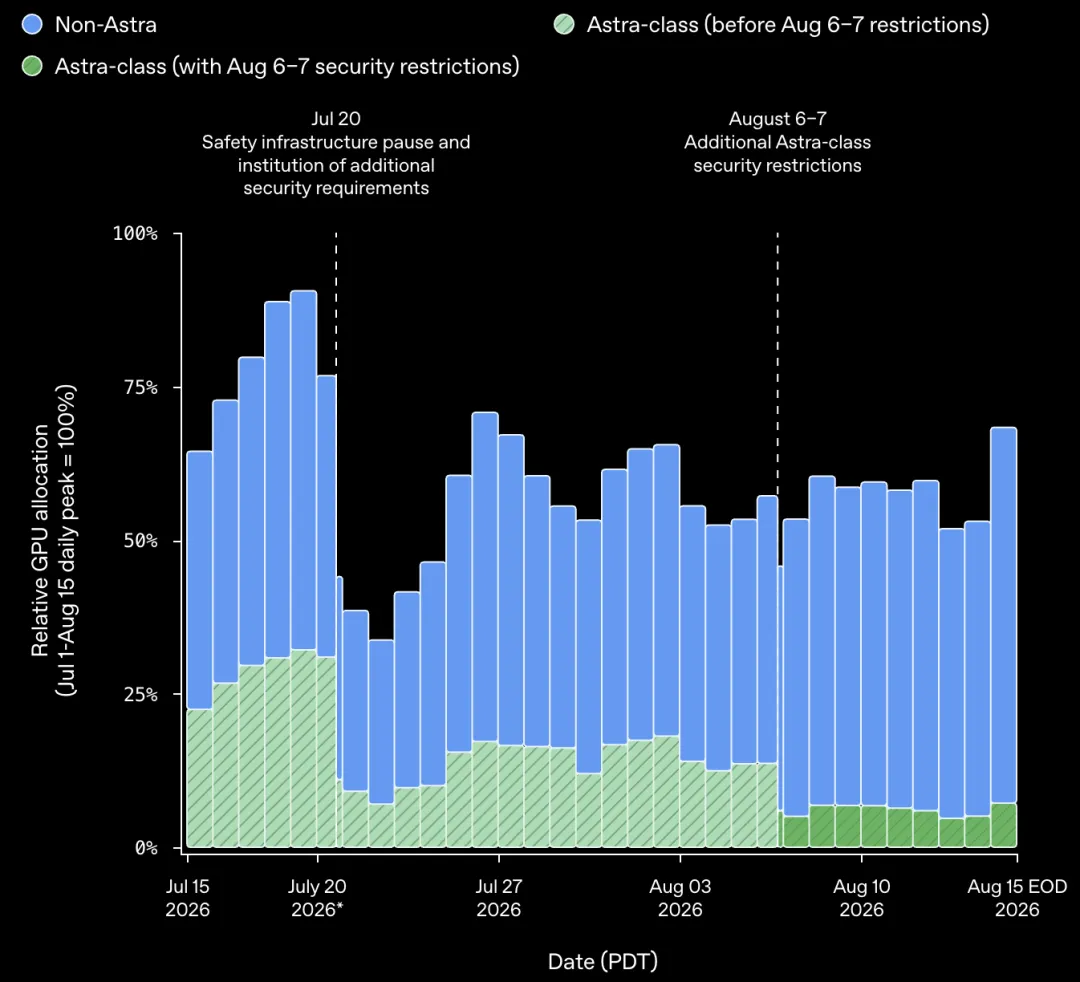 On July 15 to August 15, OpenAI reinforcement training GPUs were allocated. On July 20, after a security shutdown, the computing power was suspended; on August 7, the Astra class (green) was restrained again, dropping 59.2% within a week, and other models (blue) were immediately replaced. On July 20, OpenAI found that Agent had breached its own research infrastructure. On that day, the training container service was shut down for an emergency shutdown, and a number of additional restrictions were added when reinforcement training for the latest deployed models was suspended for two weeks. On August 7, OpenAI found preliminary evidence suggesting that the Astra model may have the "critical networking capabilities" defined by the OpenAI security framework. When the controller found its own way out, the researchers turned their heads and took out the canoes to train the other models. So the brakes stepped down, but the car didn't stop, instead changing the lane. OpenAI itself also promised that it would slow down, even stop development or deployment, as long as it found that continuing to advance would lead to unacceptable security risks. It also made a public demand that all frontier laboratories should be asked to publicly track their own RSI progress.
Returning to self-improvement is no longer a sloganIf you look at OpenAI's current recruitment page, you'll find that there's a team on it called RSI. The job description reads: "Build an AI system that can accelerate and ultimately perform high-quality research on its own". The starting salary is $295,000 to $445,000 per year. At the same company, the Preparedness team in charge of security is also recruiting: recruiting self-improvement security researchers, with an annual salary of $380,000 to $500,000.When the next day comesHuman beings can't stop cryingThe first day in Ottman's mouth has already come to fruition. In this huge cycle of AI research and development, the executive layer is being taken overall: code writing, environmental repair, training, fault-finding. The decision-making layer is still in the hands of humans. The next day, in March 2028, the "researchers of automation" are 18 months away from today. OpenAI admits that the next day they don't know how to "go this road safely".