
It's the first time in the history of the world.
"You're in trouble, help me see".
The value of a pair of AI glasses could be hidden in a few words like this.
When it comes to strangers, visually impaired people don't need an AI that can talk about anything, but a helper that can tell them what's around them, what to pay attention to.
The AI glasses on display at the JDD are targeted at this demand: access to the JoyAI-VL-Interaction model, continuing to understand the environment from the first point of view, providing assistance to people who are completely blind and visually impaired, and reducing the "must-ask" moment.
It's a smart lens full of love and hope. It's also a small intersection of the Jindong AI route.
During JDD, JD released and open-source JoyAI-Echo WM real-time interactive world models and brought a complete set of matrix upgrades to the physical world models.
From understanding the environment, to judging when to respond, to predicting what will happen after action.
Behind a pair of glasses, a whole set of technical layouts from the screen to the real world unfolds.
The difficulty is not knowing when to open the door.After wearing this pair of glasses, the rules in the chat box are no longer valid.
You're on the road, and there's a car rolling over on the left, and there's a staircase on the right, and you're being greeted at the front.
The glasses don't have a sign. If you wear them, everything flows together, and it has to decide for itself: Should the car on the left not remind you? Should the person in front not tell the user?
In the last two years, we have seen that the model is not allowed to wear glasses. The first question is not to talk about it.
Traditional programs typically consist of a set of modules packed together with sensors to identify objects, then trigger the rule engine for distance, and finally modify language models to generate text-to-speech.
What's even more troubling is that the puzzle architecture is not "misinformation" in a complex dynamic environment, it's "misrepresentation", and that's not to say, it's not to be said.
JoyAI-VL-Interaction is on a completely different path.

Github:
It is an 8B scale, visual-core interaction model, and the world's first fully open-source interaction model and system.
From an architectural point of view, it integrates perception, reasoning, and interactive decision-making into the same model rather than a set of detectors and rule engines on the outside.
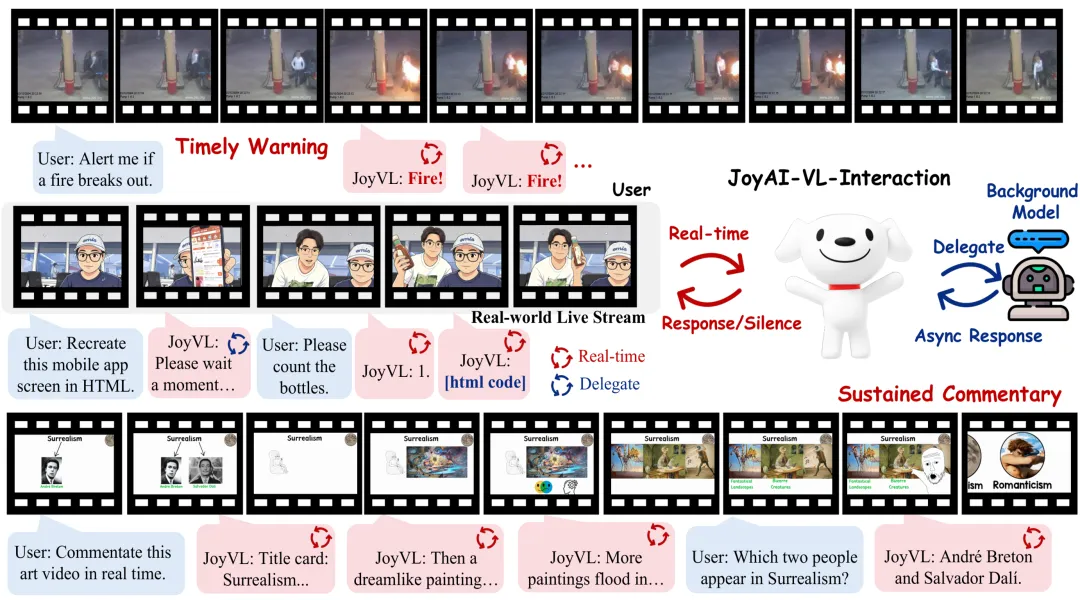
It can understand continuous video streams in real time, determine when to speak, when to shut up, and respond to sub-second pressures.
When faced with complex problems, such as the need to call tools or do deep reasoning, asynchronously delegate to the backstage Agent to do it, the frontstage continues to stare at the scene, not to put people there because the backstage is busy.
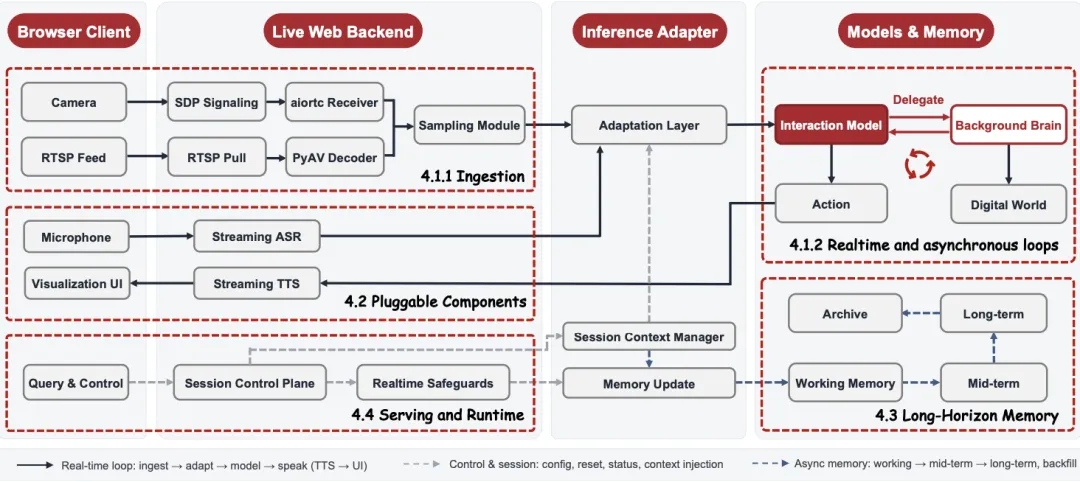
The vice president of the Jingdong Group, and the vice-president of the Jingdong Exploration Institute, said that this is the world's first open-source multi-modal comprehension model capable of truly autonomous interaction in real-time. In 58 real-world blind reviews, the winning percentage of assistants with a bean bag video call was 77.6%, compared to Gemini's winning percentage of 87.9%, achieving the best results in the field of streamlined interaction models.
It is based on the paradigm shift from "answering questions" to "continuing presence".
Previously, AI was about asking questions, giving answers; now it has to decide for itself when to talk, what to say, what is beyond its ability to give backstage.
And the problem that a pair of glasses pushed out, going up and down, is what the JDIS has been working on for the last two years.
Smart on the screen, not enough.When AI keeps looking at the real world through wearable devices, it needs more than the ability to read a text or a picture.
There's a lack of understanding, generation, real-time interaction, world modeling, physical operation, and machines can only be smart on screen.
In contrast to digital AI, physical AI requires not only the scaling of physical data, but also the continuous learning of scaling, new breakthroughs in basic physical models, and new dimensional hardware collaboration without a digital AI.
Data, models, algorithms, hardware, and all four legs go together to enter the physical world.
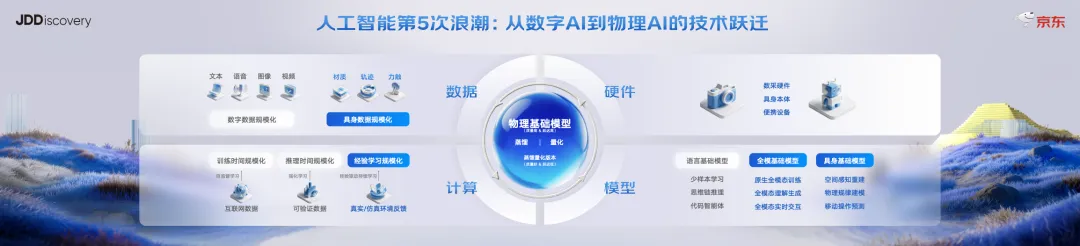
This is the logical starting point for the focused demonstration of the JoyAI base model matrix in JDD.
It's not because of the amount of hydrogen, but because the physical world naturally requires a whole set of collaborating capabilities:
It's a great way to create visual content (JoyAI-Echo LongVideo, JoyAI-Image-Edit).
This is the first time I've seen a video in real time (JoyAI-Video-Edit).
It's a great way to learn how to listen to people and talk to them.
To understand and simulate the laws of the world (JoyAI-Echo WM),
In the end, it came down to robot operation (JoyAI-RA).
Each piece emerges as an independent model, and together they form a complete link from "seeing" to "moving".
The first of these models to look at is JoyAI-EchoWM.
So let's let the AI go through it in our minds.Using a robot's perspective to create a simulation video of "If I walk three steps forward, reach out to get that cup", the physical rules are correct, the collision is real, and you can know that the move won't work without actually reaching out.
To put this capability into practice is to explore JoyAI-EchoWM in the world model direction.
If the video model focuses on physical authenticity: how the world works, it should simulate accurately; then JoyAI-EchoWM focuses on interactive authenticity: how the environment responds after people enter the world.
JoyAI-EchoWM is a real-time interactive world model.
It is capable of continuously generating and dynamically adjusting images and sounds based on the user's control signals, earning a combined score of 81.7 in the WBench navigation rating, an interaction score of 87.2, leading the way.
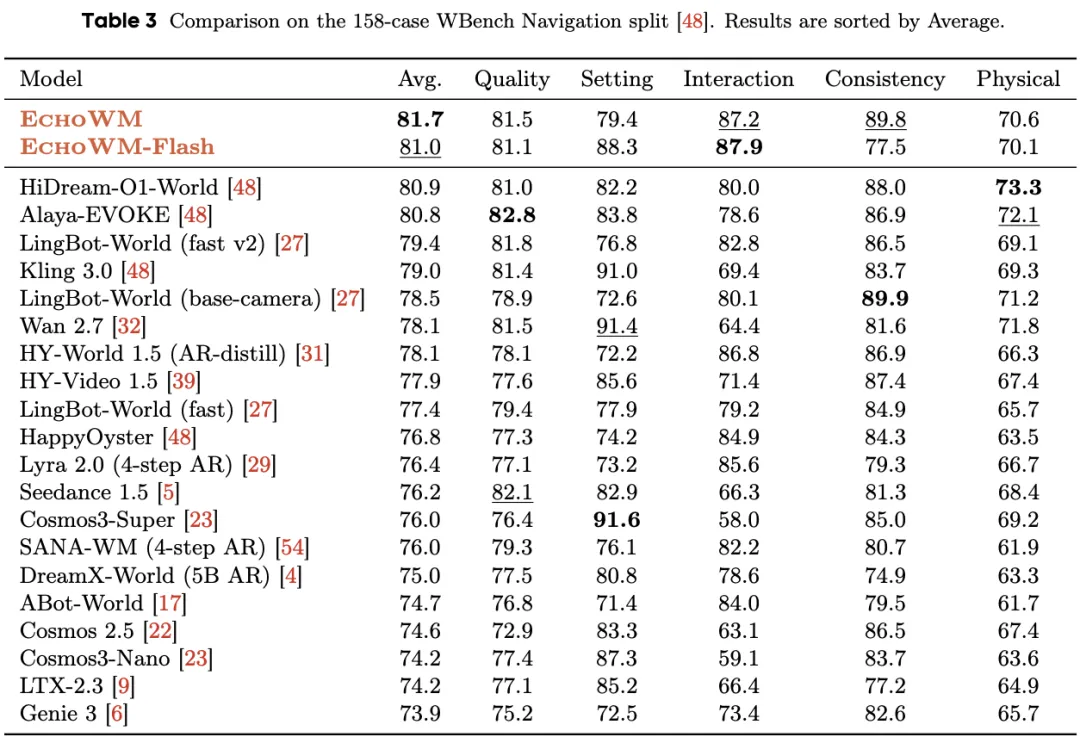
More importantly, it generates a world where not only the surroundings, music, and voice evolve in sync with the images, but a world where you can "go in", not just a video that ends after you've played it.
JoyAI-EchoWM is an interactive engine for immersive environments, and they can go on to this day without separating them from JoyAI-Echo's technological accumulation.
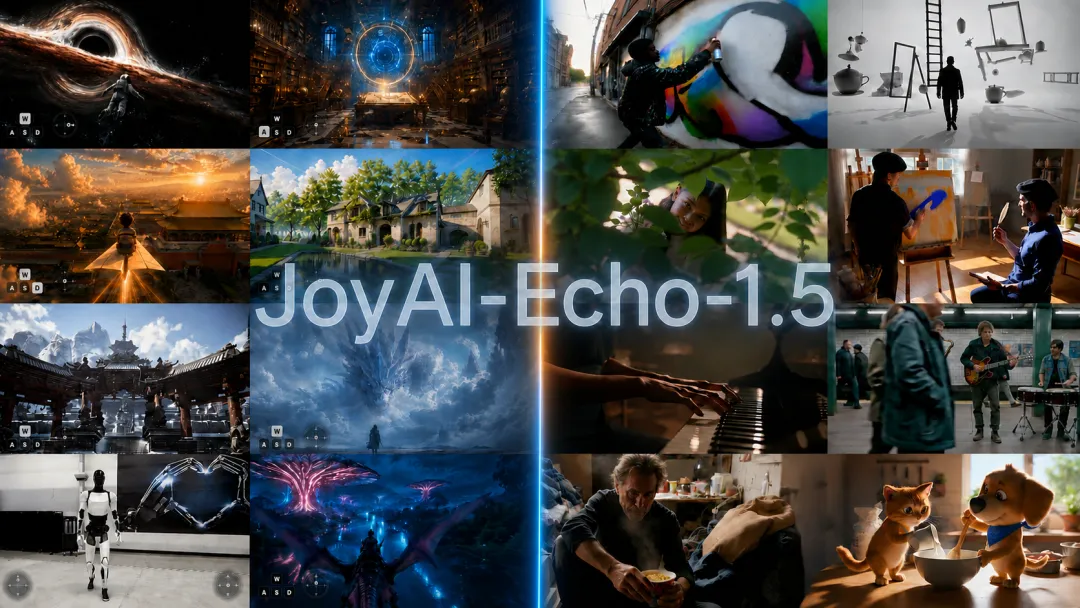
JoyAI-Echo made key innovations in multi-mode memory, audio synchronization and post-training of long-range video, "laying the technical foundation for the second half of the video world model".
In 2026, the World Model is one of the busiest tracks in the AI industry.
Jindong's differentiation is not in model parameters, but in holding real physical scenes of warehouses, shops and production lines in hand.
These scenes have no standardized stage setting, no pre-set lights, and even the level of the ground is uncertain. But for this reason, whoever can run the world model in these non-standard scenes gets the real ticket.
From Models to the Real World: Data Closures and Industry LandingsThe basic model matrix is the heart of capability, but the ability to truly enter the physical world requires two pipelines: one for data and validation, and one for real business.
In this line of data, Jindong simultaneously showcases the three EgoLive, JoyAI-Sim and JoyAI-RA 0.5.
EgoLive is the largest-scale, first-ever open-source data set focused on real-world mission-oriented human daily activities.
JoyAI-Sim is a simulation tool chain that assesses the performance of robotic models at low cost by synthesizing human-cognizable data and supplementing real data sets such as EgoLive with extreme or long-tail scenarios that are difficult to cover.
JoyAI-RA 0.5 is a general-purpose visual-language-world-action VLWA framework designed to combine the dynamic pioneers of the physical world with visual semantics through a dual-action alignment mechanism to achieve large-scale operational learning across heterogeneous data.
EgoLive has captured 2,000 hours of high fidelity 60fps video, 65,866 pieces of data, 346 real-world scenarios, and scenes covering storage, homes, and pharmacies.
JoyAI-Sim has improved the performance of simulation and real machines, achieving 90% consistency, and 3.2 times faster efficiency.
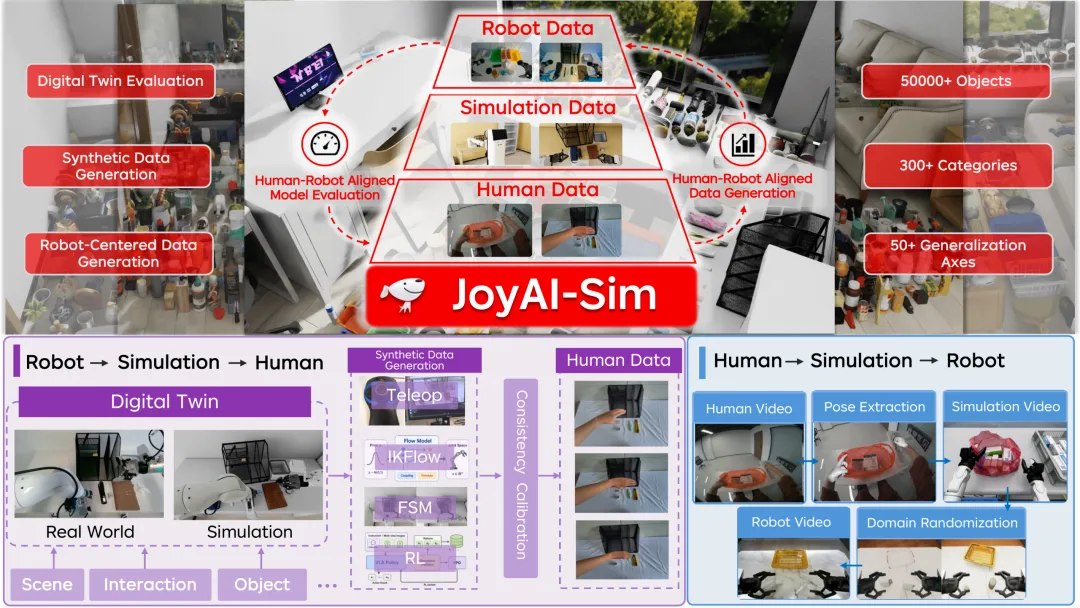
JoyAI-RA 0.5 stands at the end of the chain and learns physical dynamics from human video, making robots more stable in real-life scenarios.
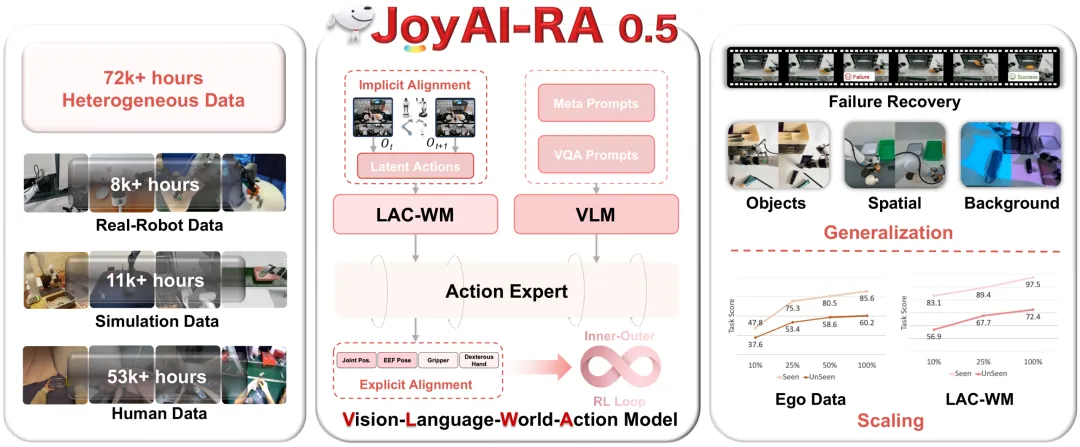
Three things come together: a complete pipeline of "taking data → building a simulation → running a real machine".
In this line of business, JDD simultaneously demonstrates the five major industry models of retail, logistics, health, industry and government.
These models are faced with orders, medical records, drawings and equipment rather than prompts.
JINGDOM QIA 3.0 is ranked number one on the HealthBench, where you can see the medical images of CT, nuclear magnets, and 3D transcripts that are more accurate than GPT-5.5 by almost 15 percentage points.
JoyIndustrial 2.0 received more than 1 billion industrial calls, VisCAD 1.0 opened up the entire chain from CAD graphics to parts assembly, and the core design task preceded the overall model by 15 percent.
OxygenVLM 4.0 has supported core e-commerce businesses such as map search, material quality checks, logistics superbrain 3.0 and government big models, which are also embedded in their own processes.
The strategic path of Jindong is very clear: from digital intelligence to embedded intelligence to physical intelligence.
In this release, the system explains Jindong's judgments on the evolution of AI.
Over the past 75 years, AI has undergone four major changes, from early expert systems, statistical models, to deep learning and basic models.
The entire evolutionary process is essentially a continuous scale-up around data, computing and models. Now, AI is entering the fifth technological change: from the digital world to the physical world.
The path is also clear: using data that contains more physical information to train full-mode and body-based models; allowing models to interact with the environment and evolve continuously; and eventually deploying models to various types of physical hardware and equipment to assist users in the physical world in various tasks.
In this context, it divides the technical system into three parts:
Digital intelligence: first understand the content and build model capabilities in the digital world.
Incorporated IntelligenceDeploying AI models to real-world hardware devices to enable natural, real-time interaction between people and devices.
Being physically intelligent• Deploying models into the human body, allowing robots to help humans complete all sorts of tasks in production and life.
The core of the company is not only the accumulation of talent and technology, but also its unique advantages: rich business scenery, a large number of physical terminals, real operational data, and complete feedback loops.
He also gave a milestone for the next three years:
By the end of 2026, full-mode real-time interaction models will reach the world's highest standards, setting the stage for embedded intelligence.
By 2027, complete the large-scale collection of embedded datasets, and the embedded model will be world-leading and landing in both general capabilities and vertical scenarios;
In 2028, the JoyAI base model matrix will enter more into life and production, serving hundreds of thousands of industries and millions of families.
The world-class JoyAI base model matrix that the JDIS wants to create is the same: to move AI from the digital world into the physical world, helping JDIS become the world's largest physical world operations center.
Sounds like a big deal, but it's a lot of hard data to digest, build a simulation, repair a machine, run a process, and you can't save it.
But it was also this weight that constituted the Forbidden City.
With more than 20 years of underground storage, logistics, retail, and health scenes, its models boomed from day one into real business, rather than lab demos.
In the past few years, the users of AI have been people who are sitting in front of the screen and writing.
Now, its users have become a constantly changing, never-ending world. No one has asked it questions, and no one has told it when to turn around.
The article opens with a pair of glasses that help one person see the path ahead. What Jindong wants to do is make the model see the entire physical world.
From a pair of glasses on a nose beam to the world's largest physical world operations center. It's a long way to go, but the direction is clear.