It's the first time in the history of the world.
Today, the whole Internet is eating this OpenAI goose.
Last night, OpenAI officially announced that the Navi-Stokes equation, one of the millennium's puzzles, had been formally solved by an internal model.
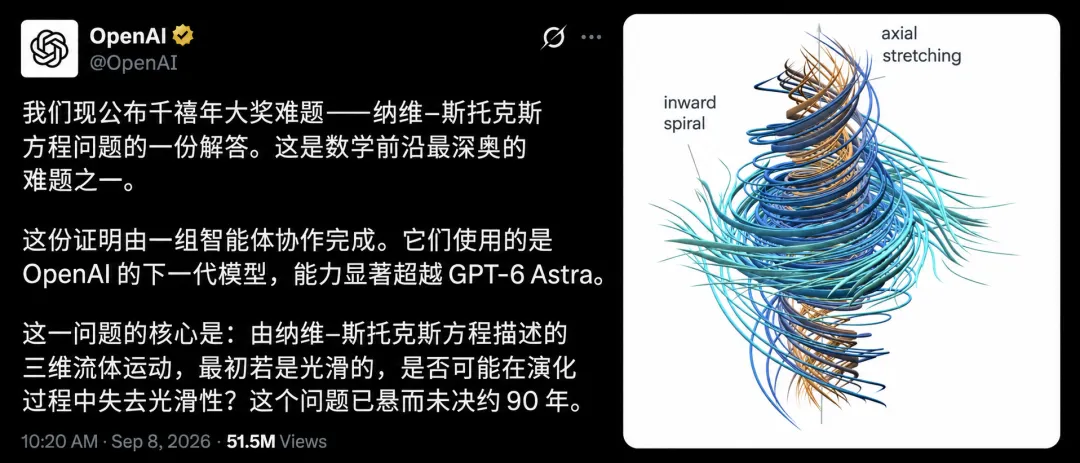
However, behind this, things are never that simple.
There is a saying that mathematicians at New York University, struggling to find inspiration, have just figured out a way to solve the "Millennium Grand Prix" problem.
As a result, the OpenAI giant has moved on, directly mobilizing massive computing power, "violent cutoff", not only to try to steal the paper, but also to bully and force the team to remove the signatures of employees of competing companies.
It is not yet known whether this claim is true.
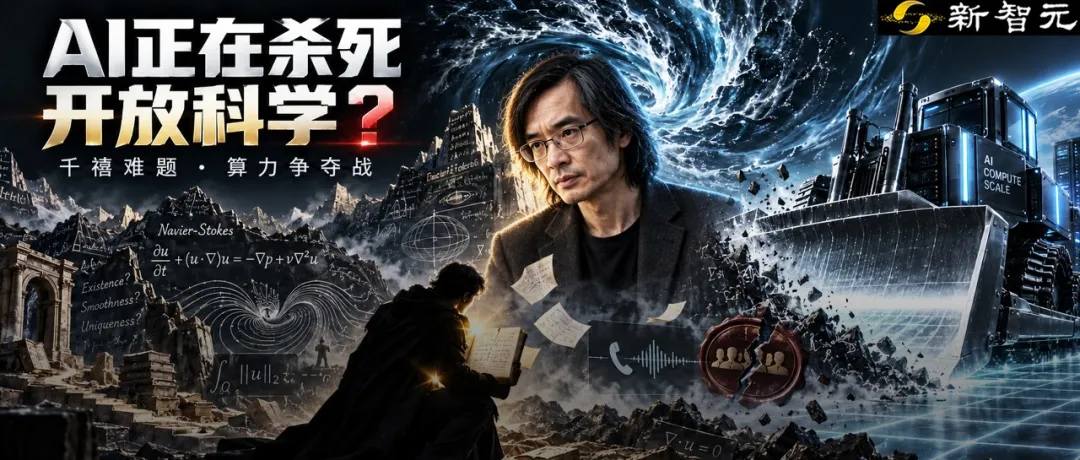
But the winner of the Fields Prize, Tao Te Ching, had issued an angry statement a few hours earlier: AI is killing hundreds of years of open science traditions!
He raised a frightening view that AI's violent intervention is fundamentally destroying the centuries-old tradition of "open science".
Future mathematicians will never again dare to reveal the direction of their research.
OpenAI is a "gang-style" operation.The torch of the story is the Holy Grail Tenavi-Stokes equation in the field of fluid mechanics.
As one of the seven "Millennium Grand Prize Puzzles" awarded for the study of mathematics, it has plagued mankind for more than a century.
Months ago, a team of New York University mathematicians, Tristan Buckmaster and Leven Alpöge, attempted to use AI to solve several important problems in fluid mechanics.
After months of exploration, they finally made substantial progress and found a hopeful path to solving the problem.
However, nightmares also follow.
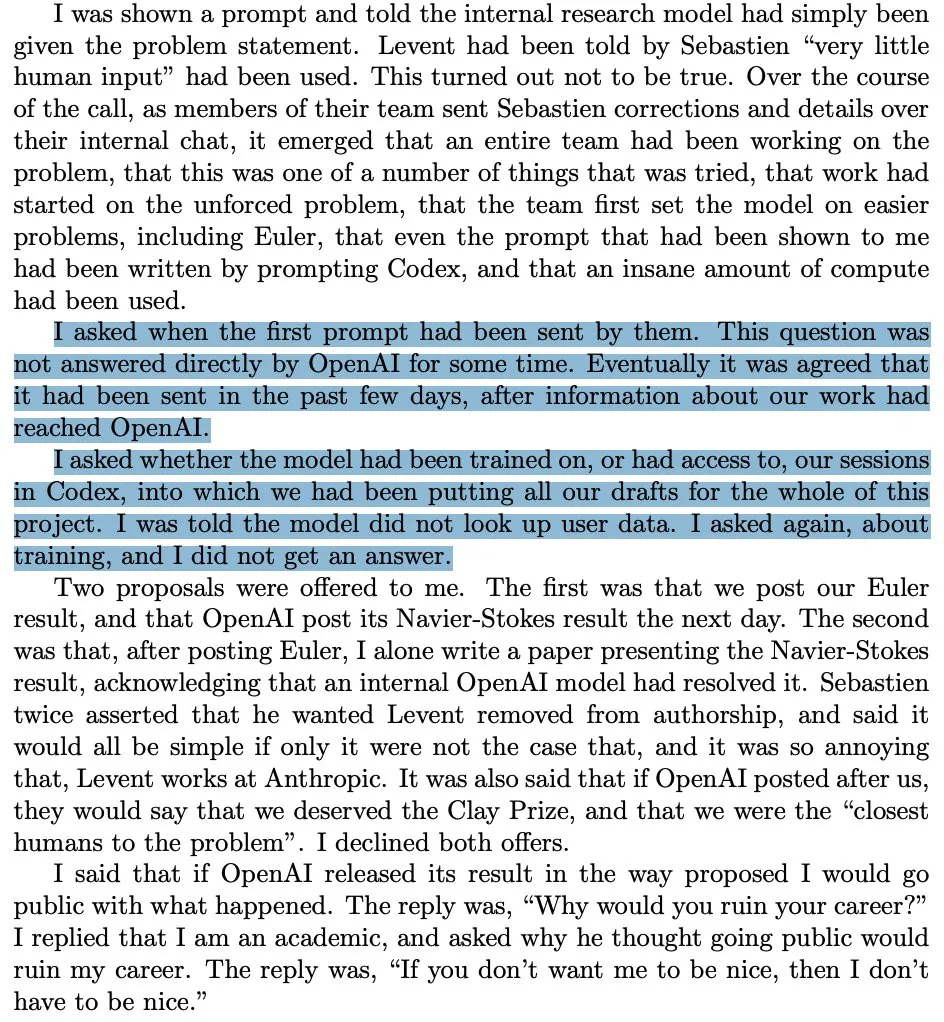
According to Buckmaster, OpenAI has been hearing about this through some channel in the "last few days".
Knowing that human mathematicians have figured out a way, OpenAI immediately put its latest models in the effective direction they found, using pressure-level computing to make violent moves.
It is even more infuriating to see a follow-up "public relations operation".
When OpenAI came to the New York University team with the results of AI crackdowns, they didn't just try to control the outsourcing of the research, they even proposed the condition: If you want to publish together, you can, but you have to get the Anthropic collaborators out of the signature!
This was the beginning of the academic world's immediate upheaval.
The founder of Hugging Face, Thom Wolf, blasted directly on X: "What is this** about the way mathematicians work and communicate science?
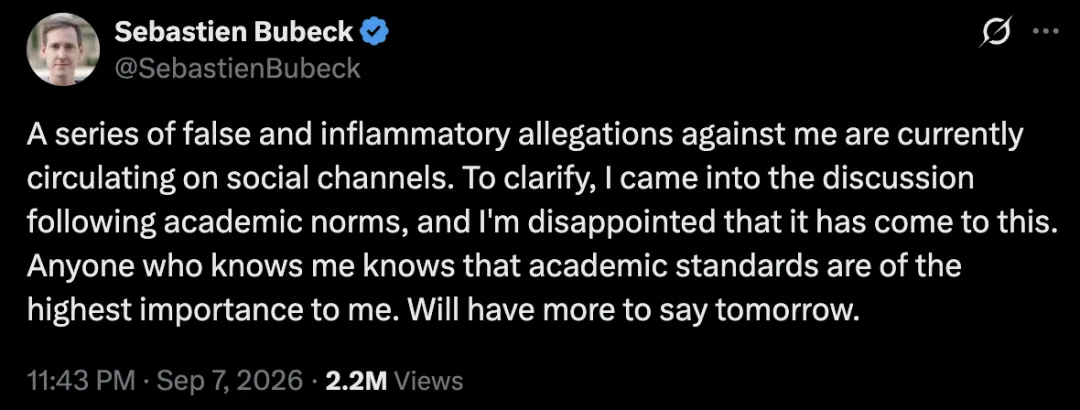
Although OpenAI researcher Sebastian Bubeck issued an emergency clarification claiming that this was a "false accusation", the fury of public opinion has burned to the ground.
Currently, the closest possibility to reality is that Buckmaster drawcards have not been successful, but OpenAI has been successful, and the methods used by OpenAI are not necessarily self-invented.
And behind this tragedy, a deeper crisis is revealed.
Taoge's warning that AI is flattening mathematicsEarlier, Tao Zedong was a proponent of AI-assisted mathematical research. But this time, he felt deep concern.
In the preface, he gives the parable.
"A country may be facing a severe shortage of drinking water, but it is surrounded by a shallow sea".
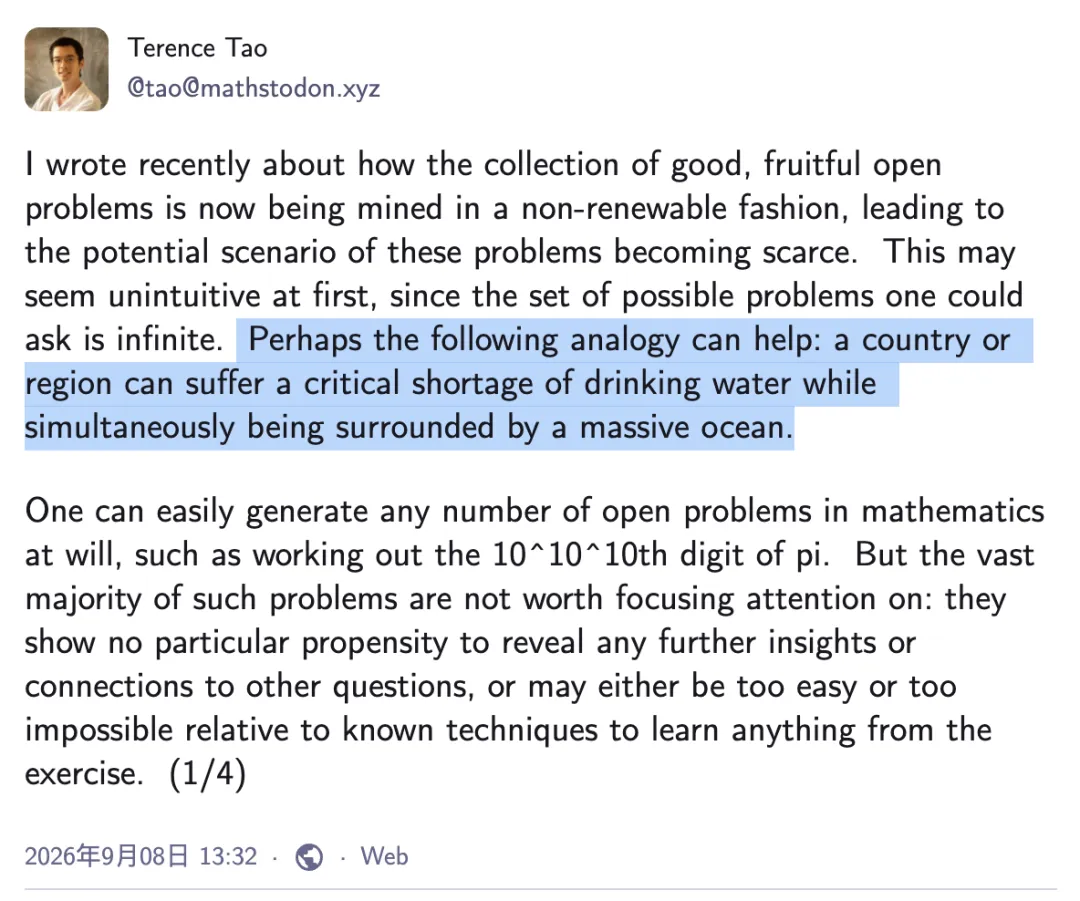
Taotzeong pointed out that the mathematical world never lacks "problems". You can easily ask a 10^10^10-digit question about the circumference of a circle, but these questions are like seawater with no drinking value.
Determining whether a mathematical problem is "worthy of study" is a long, careful and subjective process.
In traditional mathematical studies, there is a "difficulty terrain". Some problems, such as the plains, are easy to solve with existing tools; some problems, such as high mountains, require enormous effort; and some are impossible to overcome in depth.
It is this upside-down terrain that constitutes the beauty of mathematics, leading mathematicians to explore and build deep connections between different fields.
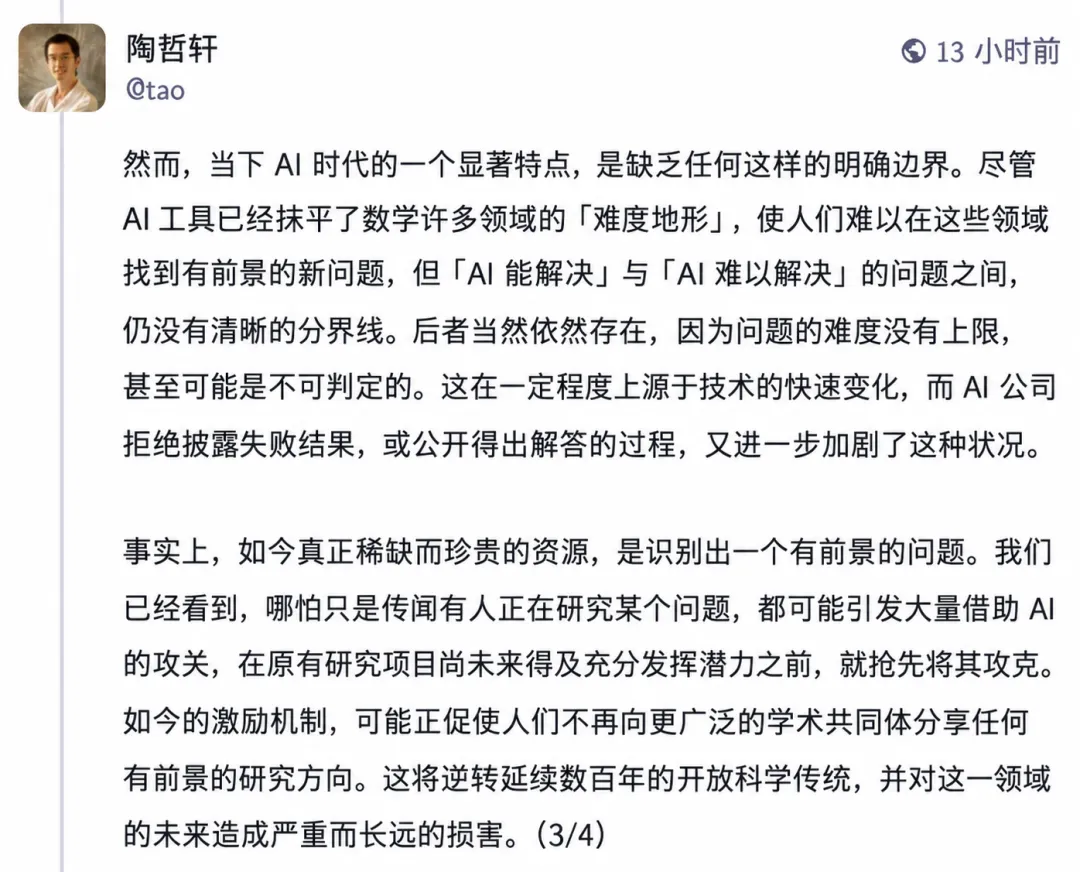
"However, the characteristic of the AI era is that it lacks any clear boundaries", Taotze pointed out sharply.
When powerful AI tools (especially those with opaque black box models of operating mechanisms) flooded the mathematical world indiscriminately, they were like a huge steam turbine, directly flattening the "difficult terrain" that had originally been up and down.
It is no longer possible to identify the geometrical structure of this discipline, and it is not known which problems are promising and which are dead end.
Even more deadly, finding a "problem with prospects" is the most scarce and precious resource in science today.
In the past, once mathematicians discovered a potential direction of research, often sharing it enthusiastically at academic conferences, or interacting with colleagues in workshops, was the cornerstone of "open science".
We all have something in common, and together we push the boundaries of human cognition.
But in the age of AI, this sharing has become suicide.
Whoever dares to open their mouths, the calculating sniper will kill whoever.In the article, Taozi wrote a warning:
We've seen that even rumors that someone is studying a problem could trigger massive AI-driven efforts to level the playing field before the original research project reaches its full potential.
Imagine a human mathematician enthusiastically telling a colleague in a coffee shop: "I was recently working on a new intersection of the Navi-Stokes equation, and this is the idea"...
A few hours later, a cluster of servers from Silicon Valley's giant began to run wild. Thousands of H100 graphics cards followed the mathematician's whimsical ideas and made millions of trials and trials.
A week later, the giant released a pre-print paper announcing that its AI model solved the problem.
Human mathematicians have spent months, even years, trying to find directions for their intuitions, which are instantaneously blurred by the violence of AI mass computing.
In the face of this reduction, what is the only way for human scientists to defend themselves?
Just shut up.
Tao Te Ching pessimistically predicted: "The current incentive mechanism is moving towards 'no longer sharing any promising research direction with the wider academic community'; this will reverse the centuries-old tradition of open science and cause serious long-term damage to the future of the field".
If every researcher hides his inspiration; if all the discussions go to the ground; if there is no real clash of ideas in academic meetings, then the only thing left to declare is the results of the paper...
The scientific community, too, has died.
Do we want answers or wisdom?The appeal of Tao Te Ching was immediately welcomed by the collective support of the AI community.
Gary Marcus is a strong philosopher: "AI companies should be more concerned with who can bring new scientific insights, rather than relying on the power of computation to announce the solution!"
This raises one of the most fundamental questions in scientific research: Do we do it to get the ultimate answer, or do we do it to gain intelligence in the process?
In basic disciplines such as physics and mathematics, the "answer" is often not the most important part. The process of proving Fermat's theorem gave rise to many important tools in modern algebraic geometry; exploring the course of Pongaly's conjecture greatly contributed to the development of topology.
As the netizens commented on the Taoiseach's post: "Nobody ever said the answers were the most important part. We need to focus on finding out why they were so difficult in the first place".
However, today's AI giants are turning science into a "marketing game".
They crafted the answers using a black box model, did not reveal negative results, did not reveal the process of solving the problem, only to show off at the conference: "Look, our model solves the Millennium Challenge!"
He was unopposed in his criticism: "The indiscriminate use of powerful solving tools, while achieving the short-term goal of solving the present problems, will cost the ecosystems to nurture the next wave of progress".
The lack of detailed analysis, the lack of refinement of new insights into "original solutions", is of little or no value to the long-term development of human science, and may even lead to negative pollution.
Protecting the Bottom Line of Human ScienceThe wave, triggered by the "fluid dynamics dilemma", has remained unresolved.
In addition to being false, it has ripped open a wound about AI ethics.
We are at a crossroads.
To the left, AI has become a resource for all human scientists, using it to explore the unknown universe together, continuing and thriving the open science ecosystem.
To the right, several technological giants with a monopoly on computing have turned into greedy "reward hunters" who not only extract the last vestige of human data, but even begin to plunder the spark in the minds of human scientists.
At the end of the article, Tao Te Ching proposes an initiative. He believes that we must establish new social norms that should be rejected by the academic community for the answers that lack deep insights and that are concocted only by black box violence.
"It's like a modern food donation campaign that no longer accepts arbitrary donations -- even if it can actually be eaten -- but must maintain a standard that is widely accepted by society".
If mathematicians didn't have the courage to talk openly about "where should we go", even if AI calculated the ultimate formula for the universe, humans in the spiritual world would eventually become beggars.