It's the first time in the history of the world.
The Millennium Challenge has been solved by AI!
The world of mathematics and AI may be witnessing an unprecedented super-earthquake.

Recently, New York University fluid mechanics and partial differential equations mathematician Tristan Buckmaster made a major breakthrough.
A mysterious model within OpenAI has grappled with a key problem of the Navi Stokes equation.
It is said that this is very likely to be "the next generation of Bel".
Tristan reveals that he has not yet obtained the AI manuscript.



Today, Tristan's four-page manuscript explodes in circles, and everyone's screen is filled with the words "shock".
What's even more exciting is the 100 pages of evidence that OpenAI has released in the coming days.
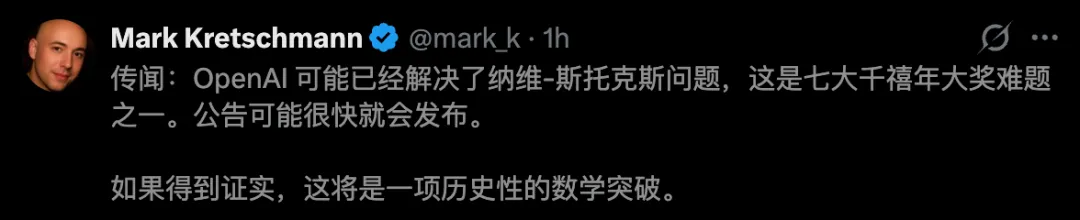
 The Millennium ChallengeOpenAI is about to take over the city
When it comes to fluid mechanics, it's called the Navi-Stokes equation (N-S equation). It's the "physical bible" that describes the real world of fluids.
In mathematics, it is also an impregnable peak.
In 2000, the Clay Mathematical Institute of America named it one of the "Millennium Grand Prix Puzzles".
Whoever solves this puzzle will receive a $1 million prize and the highest honor in academia.
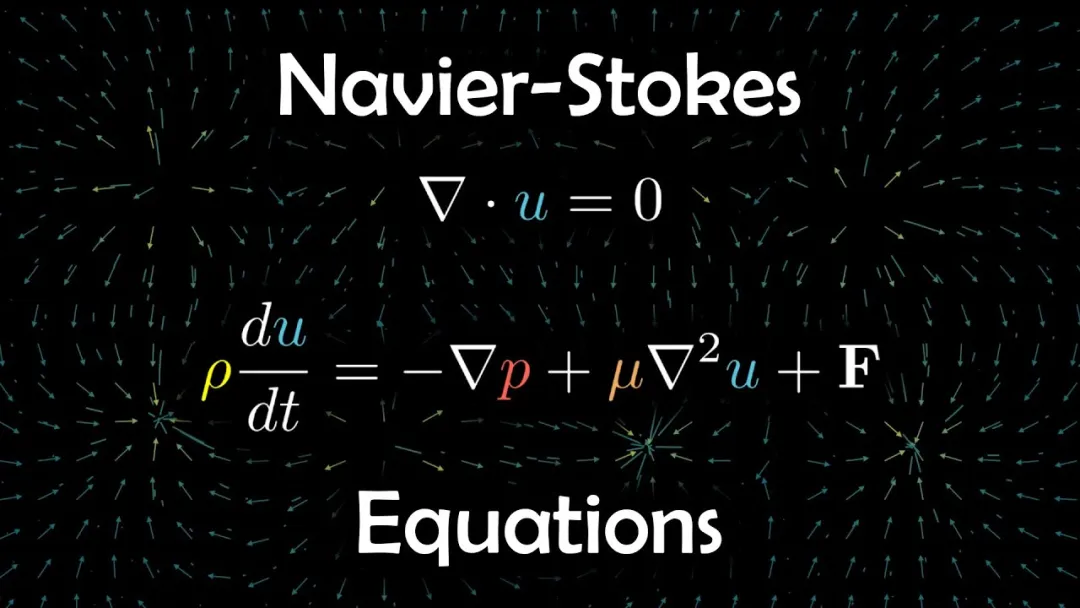
Put it into our lives and talk about how the N-S equation studies how water and air move.
Whether it's a bubble of milk rolling in a cup of coffee or a stream of air running over the surface of an airplane's wings, or the ocean flowing deep into the Pacific Ocean, it's all about it.
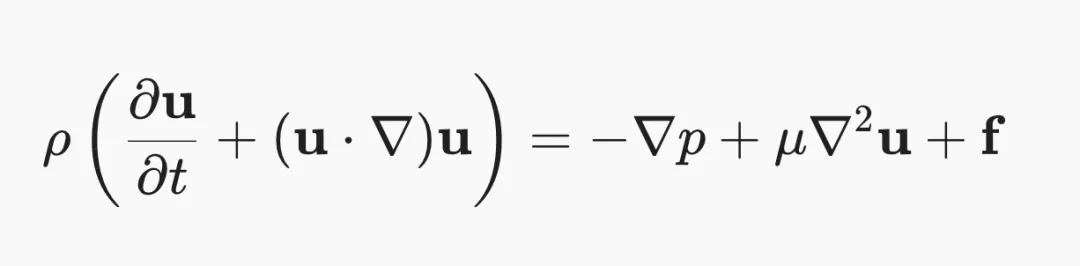
This is the group of partial differential equations created by 19th-century mathematicians Navier and Stokes:

However, many years later, mathematicians have not yet fully solved a core problem:
Whether the solutions to these equations will always remain stable, or whether mutations may occur as soon as the "explosion" occurs under certain conditions.
Who would have thought that the mysterious model of OpenAI would be broken?
According to Tristan, the model directly generated a hundred-page proof manuscript, completing the N-S equation in an "extreme force-driven" explosion proof.
It's not really a problem to be solved by outside forces.It is worth noting that one limitation this time is "extreme force driving".
While it can be thought of as fluid motion, the external world still plays a role. Extroversion in mathematics is a function of precise definition and cannot be replaced by an intuition with a stick.
Some may ask: Is allowing external forces not a relaxation of the subject?
The key is that Clay's official title would have allowed this route.
In Fefferman's formal statement, two C's and D's allow for the construction of a qualifying smooth initial state and smooth outer force, demonstrating that there is no complete smooth solution that meets the requirements.
So, if the proof of OpenAI really meets all the conditions, then the result of the force exerted could also solve the official grand prize.
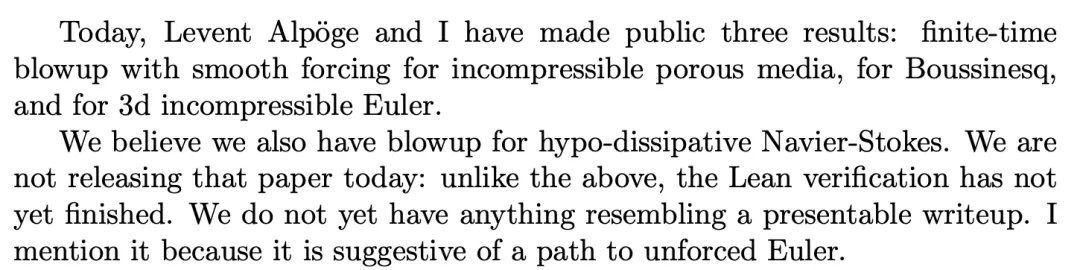
Three major mathematical breakthroughs open on the same dayAt the same time, another group of AI mathematical results were made public.
Tristan and Levent Alpöge announced that, with the help of LLM, they had obtained a finite-time explosion of three fluid equations under smooth external forces.
Today, the paper and Lean formalised the code, all online.
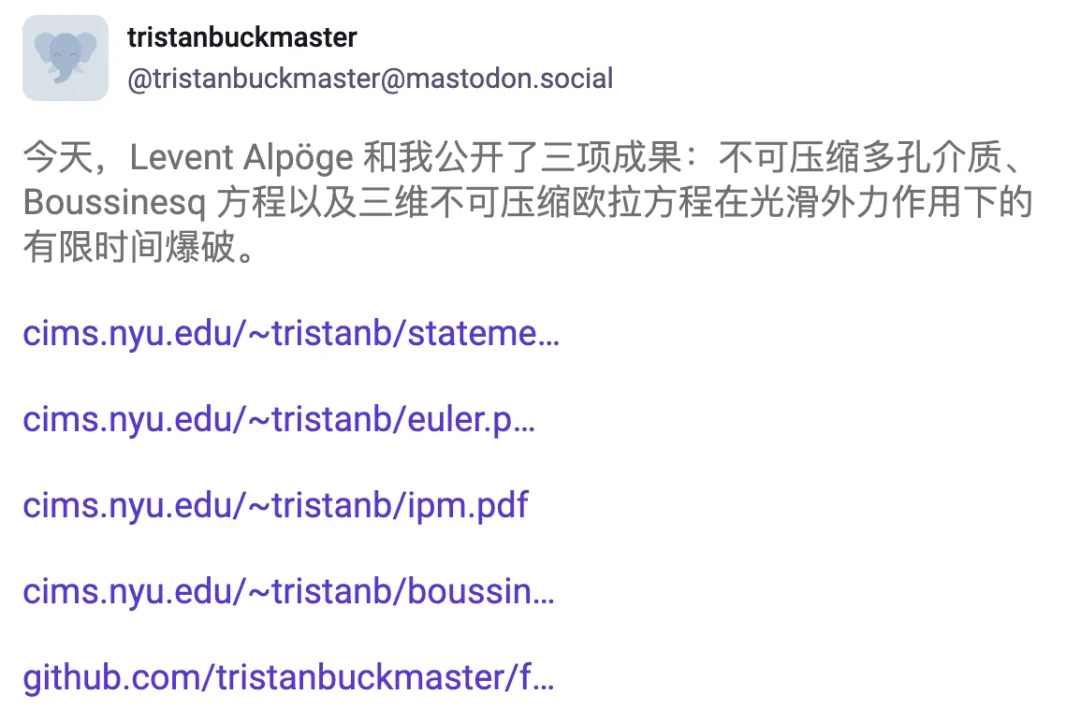
The three results of this disclosure correspond to the uncompressed porosity equation, the Boussinesq equation, and the three-dimensional uncompressed Eura equation.
In common parlance, they involve fluids passing through porous materials, fluid interactions with flow, and the ideal fluid motion of a solid being ignored.
The common breakthrough was to break the existing external force path and advance to "smooth external force".
This is crucial because if the external force itself is rough, it is difficult to tell if the flow is out of control from the internal mechanism or if the external input has already buried the problem.
When the external force is elevated to a smooth surface, the roughness of the source is eliminated.
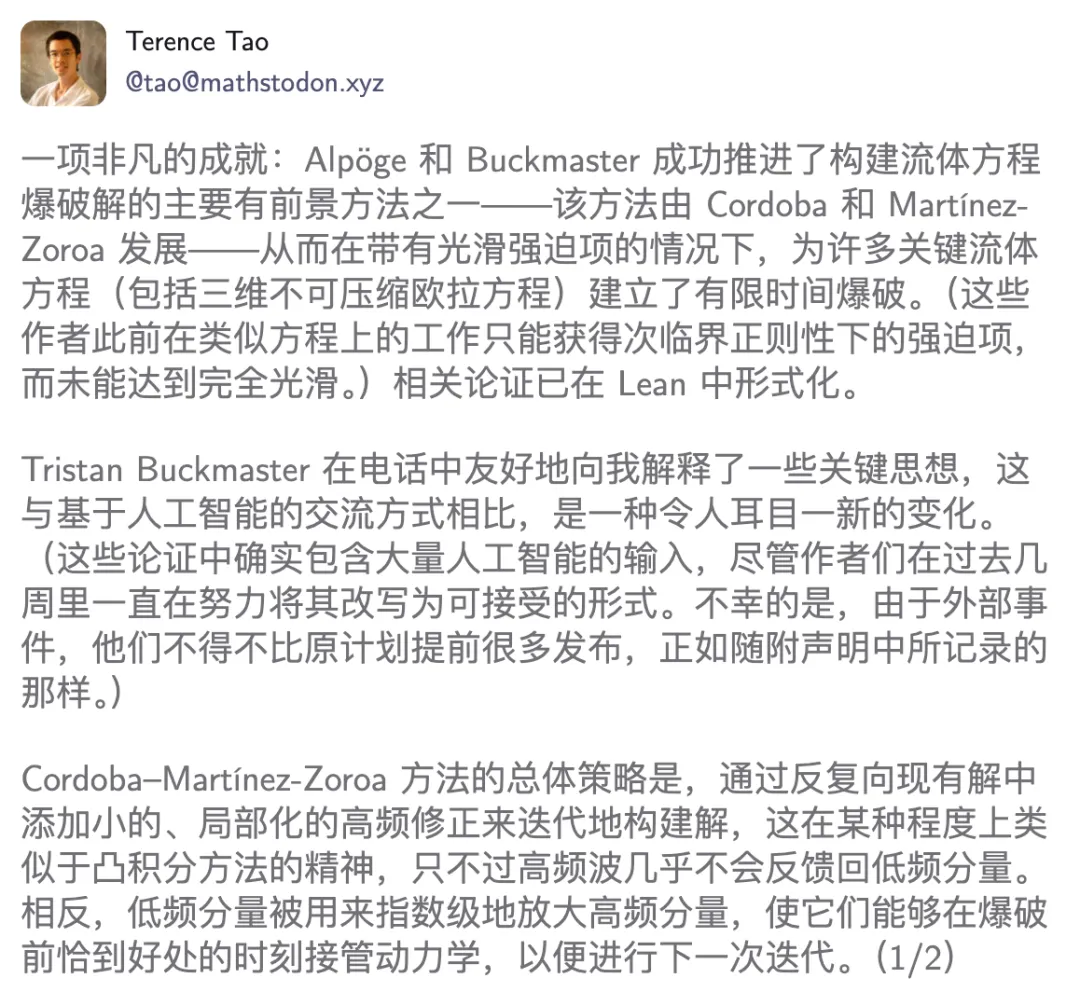
The idea for this study was drawn from the years of research by Diego Córdoba and Luis Martínez-Zoroa.
Tristan followed this path and continued on with the help of Claude, Codex, and GPT-5.6 Sol.
Even Astra has moved on, finally preparing documentation and reviewing arguments.
For almost the first time, the winner of the Fields Award, Tao Te Ching, gave a high rating of "outstanding achievement".
According to the Taoist interpretation, the authors are repeatedly adding very small, very local high frequency disturbances to existing flows.
The term "high frequency" refers to the rapidly changing subtle structure in space. It can be thought of as a large-scale flow, superimposed on a layer of increasingly fine texture.
The trick is that large-scale flows magnify these tiny structures, while the reactions of tiny structures to large-scale flows are strictly controlled.
When the new structure grows strong enough to take over local dynamics at the right time, it creates the conditions for the next round of more subtle disruption.
One round at a time, the change moves to a smaller scale, eventually creating a solution that is out of control in a limited amount of time.
The hardest part is figuring out where the disruption is, how fast it grows, how big the error is, and whether the whole process can be rigorously connected.
In Boussinesq's model case, the fundamental changes in amplitude and frequency can be summarized as a fairly simple constant differential equation.
However, technical details such as space interception have allowed the simplified paper to reach 76 pages.
This also explains why Euler's breakthrough could not directly declare Naveen Stocks bankrupt.
The higher the frequency of interference, the stronger the dispersion of interference.
The above method relies precisely on increasing high frequency structures. If it were to be advanced to the Navix stocks, it would prove that the explosive mechanism could still be established if the resistance continued to weaken these structures.
Taotzeo's judgment was that in principle there seemed to be nothing to prevent this path from continuing, or even to exclude the possibility of ultimately eliminating the external force.
But he also made it clear that the implementation of this plan will face a huge number of technical difficulties.
This is a crucial step in judging the prospects of research, the distance from the declaration of proof of completion.
OpenAI's results have been cut short and the web has been turned upside down.More dramatically, an experience revealed by Tristan in the accompanying statement pushes the debate in a different direction.
How did the results of OpenAI come about?
According to him, "with a smooth external force" is a very special research route, opened by Córdoba and Martínez-Zoroa.
He and Alpöge have been pushing behind closed doors, and hardly any other team has done it along the way.
So when OpenAI told him that the internal model attack was also an "extruder-driven" situation, he was shocked.

It will start on September 3rd.
At the time, the entire web was raving about anthropic Claude solving a major mathematical problem called the N-S equation.

It was also the day that the progress of Tristan and Alpöge's research was leaked to OpenAI.
Tristan immediately contacted a renowned mathematician at OpenAI, explaining the situation and emphasizing that this was his personal collaboration with Alpöge and was unrelated to any institution.
The other responded on the same day, wishing to learn more details, and also suggested that they could provide computational support.
Tristan had originally proposed a call next week, but OpenAI wanted to talk as soon as possible. On September 6, Sébastien Bubeck joined the conversation, and the three made two calls that afternoon.

Tristan Buckmaster, mathematician at the University of New York
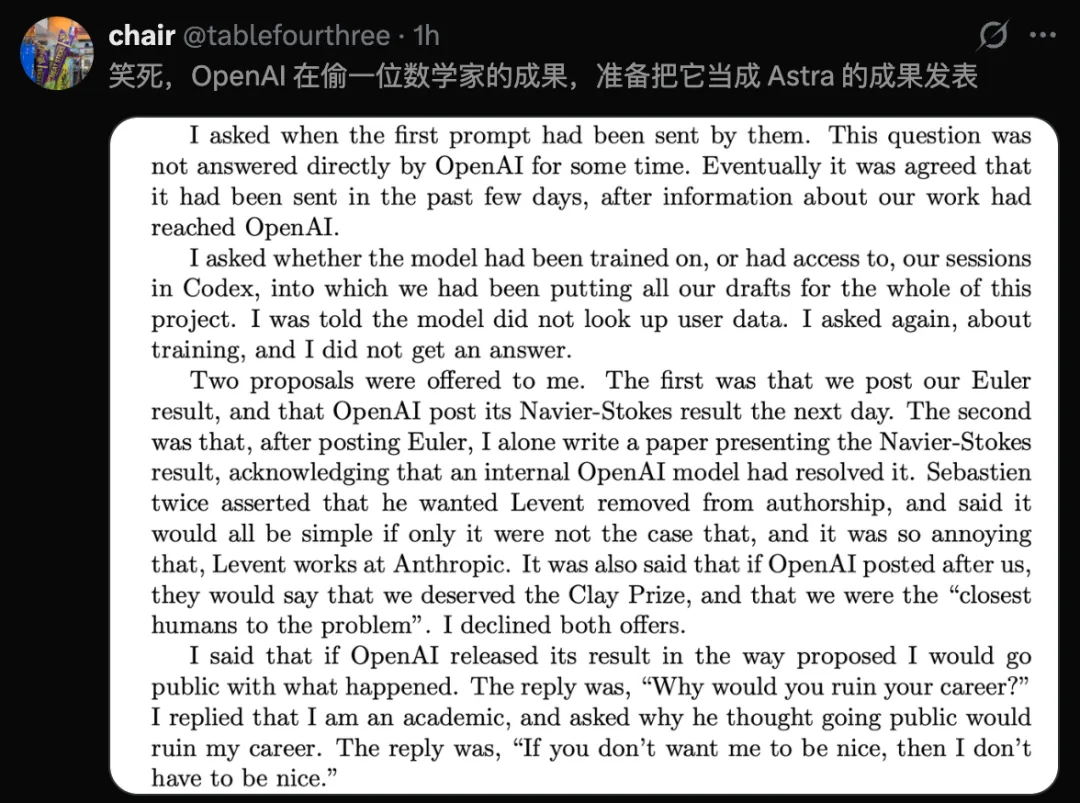
It was also on the phone that they heard the news of the "100-page proof".
Tristan immediately asked, "Have they ever used user data training such as project drafts, sessions, etc".
The answer was that the OpenAI model didn't look for user data; as he continued to ask "training questions", there was no answer.
A request to remove the signature of anthropic staffThen, when it comes to how to publish, Tristan and OpenAI are once again in a dead end.
At the time, OpenAI offered two packages.
One is that the Tristan team first released the Euler results, and OpenAI released the "Navithstock results" the next day.
The other is that they wrote their own papers, published the results of Navientox, and noted the results from an internal OpenAI model.
One of the hardest things for him to accept was the question of signing.
Bubeck twice explicitly requested that Alpöge's signature be removed because Alpöge was an employee of Anthropic.
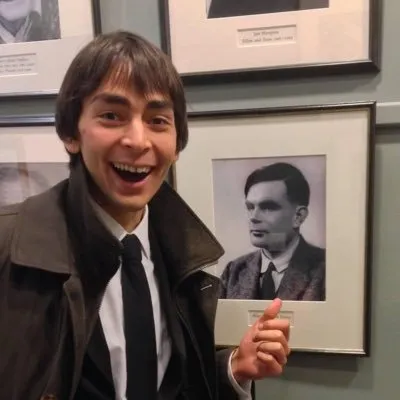
Anthropic employee Levent Alpöge
All of this is waiting for OpenAI's response tomorrow, when the truth will be revealed.
Mathematics may be entering its own "AlphaGo moment".
If this hundred-page document proves to be ultimately verifiable, and the research process can confirm the independent contribution of AI, then there is an extreme case of AI pushing the boundaries of human knowledge autonomously.
That year, AlphaGo took an unexpected step for human chess players. Now AI may be writing the next line that a human mathematician hasn't written yet.
Of course, there is still a need for full proof and a clear exchange of sources of results.
The history of mathematics can be rewritten by AI, but every step is mathematical.