“ A new player has arrived on the World Model Track.
By 2026, what robots really lack may not be stronger hands, faster legs, or even a bigger model, but an understanding of how the world is changing itself.
It's not difficult for a robot to see a cup on the table. The real difficulty is that when it reaches for the cup, it can't know what will happen next: the cup won't move, the mechanical arm won't touch the table, the human hand will suddenly come out, and what to do next if you catch a failure for the first time.
In other words, what robots need to answer is not just, "Oh, what did I see now?"
As the industry continues to explore models of the world, the Robotics Conference learned that recently, the Scalabot team adopted the open-source test program and test kit WorldArena 1.0 Track 1 as an offline evaluation standard, both to support the rapid evolution of the world model and to objectively compare the submitted results to other models. Currently, the combined score of the HERON-World Model (EWMScore_P) is 75.80 points.
Scalabot is committed to building a robotic understanding of the world, driving the core capabilities of future and autonomous action to move intelligence from models to the real world. Around this goal, Scalabot is building a HERON model system that covers space intelligence, world models and action intelligence, creating a continuous learning loop through real-world data, simulation data and robot feedback, driving physical intelligence from single-point mission capability to migration, and scalable general intelligence.
What breakthroughs did the HERON-World Model make? The Robotics Workshop looked at the model description in detail, found that it had significantly improved from data strategy to model architecture, and extended the boundaries of the world model's capabilities from physical to social.
01.
A multi-source data system that allows models to see a world rich enough
The first threshold of the world model is data. The industry's common practice is how much hydrogen is used, the amount of Internet video data is large, the cost of obtaining it is low, stacking it up, and so on. In industry-wide data pyramid strategies, the bottom layer is usually bulk Internet video data, the middle layer is infinitely generated synthetic data, and the top layer is real robot data.
The selection of the HERON-World Model is quite different: its training data does not select general Internet video data. It builds a three-tiered data pyramid, the top of which consists of real robot remote data, simulation data reconstructed based on real-life scenarios, and first-person video.
Real robot data is closest to final execution because it records the movements of real robots in the real environment, visual observation, state of the body, and control commands, directly providing the most reliable correlation between what the mouse does and what the mouse does, and is responsible for the model's actual execution focal point. HERON-World Model data covers different body shapes such as single arms, arms, wheeled arms, and human figures, allowing the model to access patterns of movement and interaction under different bodies.
However, real-world collection has natural limitations, some situations are difficult to repeat, some are highly dynamic, and there is even a safety risk of failure trajectory. Hence, the HERON-World Model uses simulation data to complement real-world collection of rare states that are difficult to cover with high frequency, dangerous interactions, failed trajectories, and specific scenario combinations.
The third category of data is first-person-operated video. This mainly allows the HERON-World Model to see scenes of difficult low-cost coverage in large amounts of robot data, such as household objects, tool use, hand-to-hand collaboration, and various long-tail human-to-object interactions.
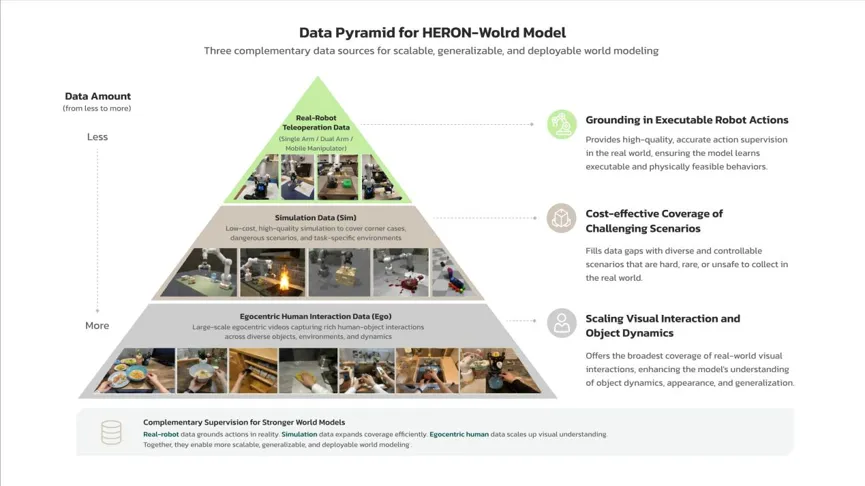
The three types of data form a clear collaborative logic, with robot data providing real action experiences, simulation data expanding the combined space of action and consequences, and human video increasing the abundance of interaction, enabling models to reach a world far richer than a single source.
In an interview with the Robotics Forum, the answer to the slowdown was not that the data was not enough, but that the data was not enough.
The world model has a very simple premise: unseen is hard to understand. The world model requires the use of intense video clips, which contain a large amount of physical interaction between humans and objects. Most Internet videos are entertainment content, such as talking, teaching, and pure dancing, and even through Tag screening, a large amount of irrelevant content still requires high-cost filtering. The proportion of such content in Internet videos is extremely low, and the cost of filtering is much higher than direct collection.
The question behind this judgment is worth thinking about in the industry, which is the core competitiveness of the data strategy, how much data can Silicon get, or can Silicon determine which data is worth getting?
While most teams were still using the Internet's data-sharing model, the Scalabot team chose a more unique path to allowing robot data to provide real action experiences, simulate data expansion moves and consequences, and the abundance of human video expansion interactions to help models expand the world they see with increasing quantity of data, ultimately using less but more accurate data in exchange for higher training efficiency. This is precisely based on Scalabot's deep understanding of the data-sharing and collection paradigm.
02.
How to turn different movements into the same fluent language?
The data is correct, and the next problem is more difficult. Because these data come from different sources, each of which speaks different languages. The movements of robots may be at the corners of the joints, human operations may only be hand-wrist trajectories; different robots have different coordinate systems, frequency controls and body structures; some data have complete movement labels, some only partially, and some not at all.
Most approaches are to replenish, that is, replenish the missing, redirecting the different and unifying them into a standard format. The Robotics Workshop found that the Scalabot team did not think differently, they did not make all the data the same, but instead allowed the data to retain the characteristics of different sources while converting some of the really valuable parts of the model into a language that could be shared.
What exactly? It's mainly divided into three points.
First point: Physical spatial alignment. The HERON-World Model mainly uses video timing as a benchmark, synchronizing different frequency control directions with visual trajectories; converting joint trajectories into endpoints through orthopaedics; using hand-eye labeling to unify the robot base, camera, endpoint and human wrist into segments of the public reference system, while specifying the direction of the coordinate axis, unit of length, rotation representation and grabbing state.
After these processes, the movements from real robots, simulated environments, and first-person human video are further grouped into three categories of signals that share a common physical meaning: self-motion, end-of-operation movement, and grab-state. Each move is centered on a video clip that describes the cumulative changes from the beginning to the corresponding future moment.
Second point: Action Token projection. For different end executor configurations, such as arms, hands and different claw structures, there are still differences between them that are difficult to completely eliminate by explicit rules. The HERON-World Model does not require that all actions have a perfectly consistent numerical form, but uses light action encoders in different data domains to further project different actions into fixed-dimensional Action Tokens, allowing the shared network to learn the common rules between different actions and visual results in a unified video prediction task.
The HERON-World Model doesn't really want to learn about some kind of robot-specific form of action, but rather a more general rule of thumb as to what visual changes and consequences they bring when different actions act on the world.
This is why the HERON-World Model does not require that first-person human video must provide standard robot control commands. In the process of data processing, the video undergoes snippet cleaning, three-dimensional hand gesture estimation, camera trajectory recovery, trajectory verification and quality filtering, and then converts the camera movement, hand movement and grip state into a unified motion representation. Even if these movements are pseudo-labels, they can still serve as weak controls into a unified training system.
A problem that can't be avoided in actual data collection is that the quality of the data is inconsistent. Some videos have full action labels, some have only partial credible labels, and some don't get data labels at all because of blindness or handshake.
The HERON-World Model does not have the full-motion marking set up as a gateway for video access to training. Full-motion, only partly credible motion marking, or even videos that cannot obtain a data tag because of a screen shading or handshake separation, can be entered into the same training system. For missing motion components, the intensity is monitored through component-level masking and confidence control, rather than simply depicting the missing value as zero. This allows the vision to be used by the model itself even if it changes with time, or even if a video does not have complete motion information.
In the Scalabot team's view, data isomorphism is not a bug, it is a feature. Forcing all data into the same template would lose the unique information value of different data sources. Therefore, the Scalabot team chose a more difficult but more effective path, by designing a framework that allows the data to retain its properties while being unified.
03.
MoT+MoE is the best way to scale up data?
It is clear from the data sources that the problem of data unification has been solved, and the model architecture has been adopted because with the increase in pre-training data, the scenes, objects, scope of action, perspective and contact patterns facing the model are expanding rapidly.
The challenge of this expansion is that behind different movements there is a completely different mode of movement modeling. When the body of a human or a robot is moving, such as a moving chassis forward or a humanoid robot walking, the model needs to focus more on the overall movement and the changes in the structure of the scene. But when the model deals with instantaneous movements such as grab, contact, it needs to deal with local geometry, contact relationships and precise interaction.
The answer is simple: competitive arguments. This also makes the problem of a single-expert model the more data, the more competitive the arguments, the more unstable the training, and the lower the quality of production.
The solution to the HERON-World Model is an innovative MoT+MoE dual architecture.
MoT (Mixture-of-Transformers) is an architectural design that combines different modules with proprietary parameters, and uses shared attention to open up intermodal interactions. MoT architectures combine single-mode attention mechanisms, achieve parameter separation and knowledge isolation to achieve world-wide knowledge that can both make full use of the integrated VLM model.
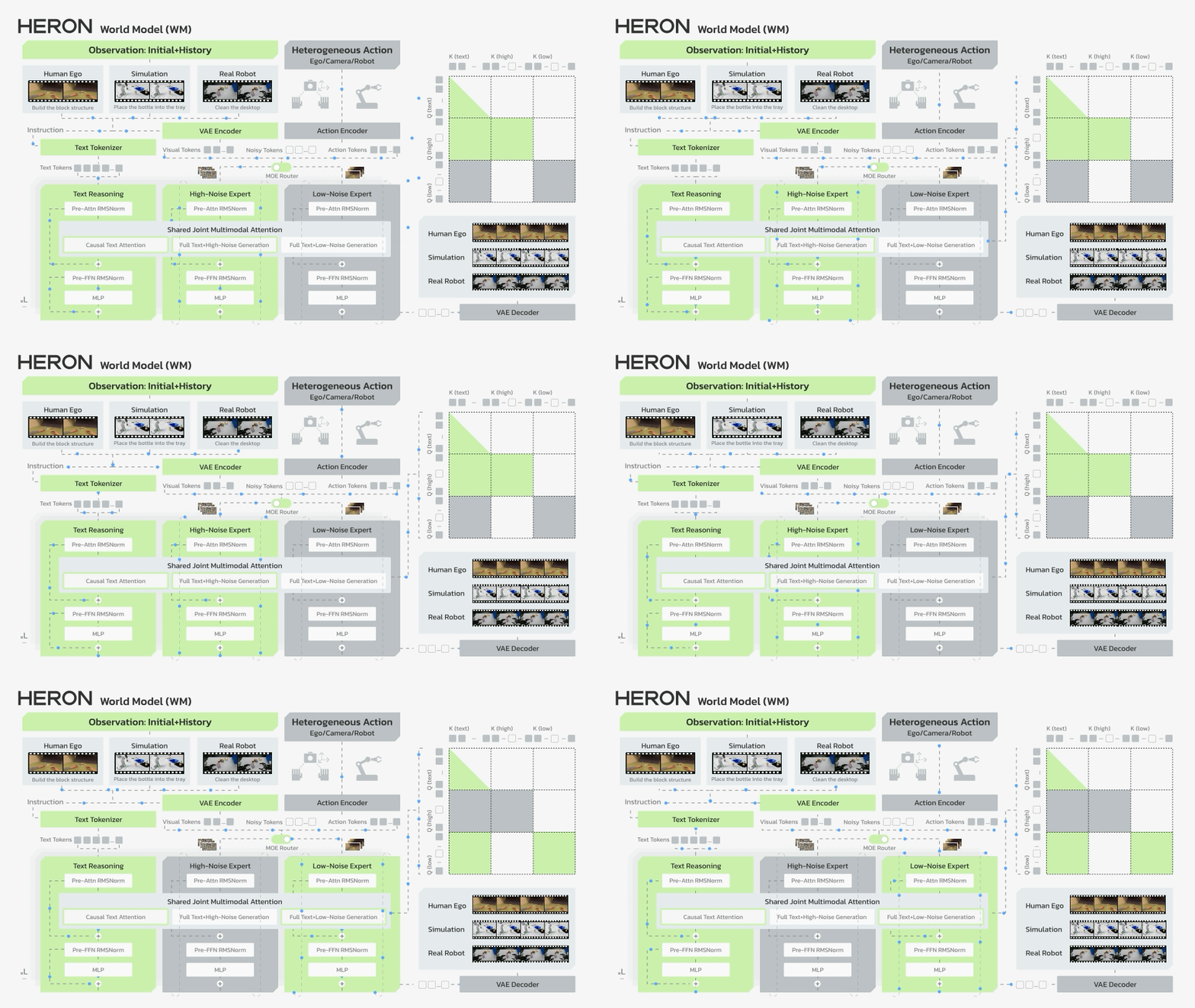
The high-noise stage is the first stage of the corresponding propagation process, which is responsible for high-noise experts. The task of this stage is to establish the future overall structural staging layout, the overall position of the object, the roughness of the movement trajectory. It can be understood as "building the skeleton". After entering the low-noise stage, the switch to low-noise experts.
The barriers to the division of labor between the two experts are very clear, not that they are forced to do the same thing, but that they are forced to do their jobs in the production process. One is responsible for writing the future and the other is responsible for writing the future in detail.
The reason for this is straightforward: previously, industry data sizes were relatively limited, single-expert models were sufficient to accommodate a single area of data distribution, and the architectural complexity of MoE was uncalculated. However, as the data size grew to a critical point, the forms of action became more diverse, increasingly complex, forcing models to switch back and forth between different modeling methods, while a unified set of parameters was difficult to meet all needs at once.
The value of MoE is reflected at this critical point. After breaking down into a dual-expert model, the division of each parameter is clearer, with high-noise experts focusing on the overall structure and low-noise experts focusing on local details, which fundamentally bypasses the training instability caused by particle competition. While the data and parameter scale continue to expand, it can still guarantee the production quality of the world model.
MoT and MoE combine to form the complete design of the HERON-World Model at the architectural level. MoT ensures that knowledge of different models is interspersed and uninterrupted, MoE ensures that the generation tasks of different particles are specialized and uninterrupted. The two designs work together, supporting the model with stable training and high-quality generation under large-scale data.
This is precisely the answer that Scalabot gives at the model architecture level: when the size of the data reaches a critical point, the division of the model architecture is essentially more important than stack parameters.
04.
From Single-Smart to Multi-Smart: Raising the Borders of Capacity
The HERON-World Model provides a complete answer to all three of these questions: data sources, data unification, model architecture. But if we take the lens a little further, one question naturally arises: what are the endpoints and real needs that this system can support?
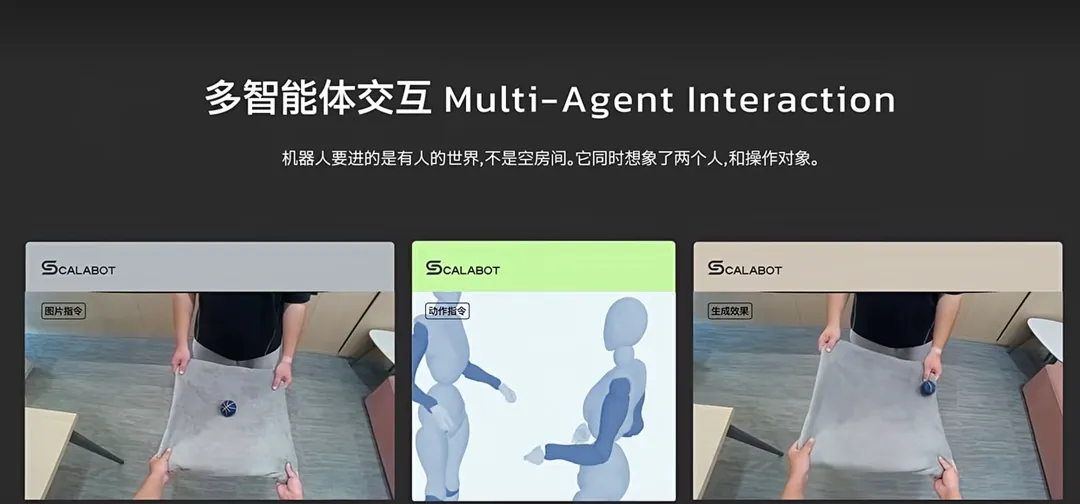
The Robotics Workshop learned that based on this system, the Scalabot team added multi-intelligence interaction data for pre-training, allowing models to learn how the physical world changes when multiple intelligences interact together, and the initial results have already shown good results.
For example, two people pulling the two ends of the towel by coordinating their movements make the ball roll in a specific direction on the towel. This is a typical multi-intelligent coordination task: each person's movements transmit influence through the towel, and the movement trajectory of the ball is the result of the superimposition of two people's movements. The HERON-World Model can accurately predict the direction of the ball rolling under this coordinated action, and the predictions are consistent with common sense.
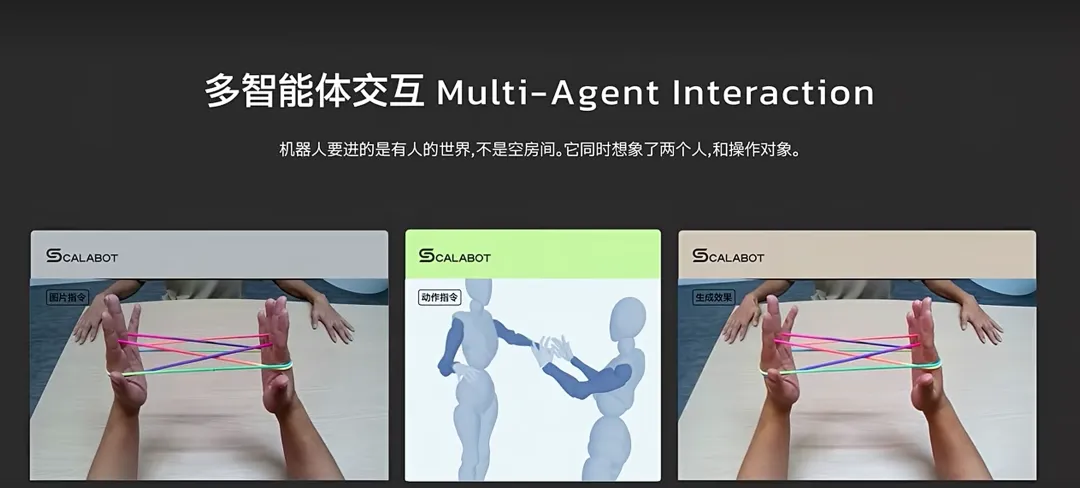
Another example is the knitting knot knot knot, where two people individually manipulate the two ends of the rope to weave a specific knot style through a series of synchronized movements. This scenario is more complex because the shape changes of the rope involve multiple contact points, the transmission of multiple forces, and the precise timing co-operation between the two operators. It can be found that the HERON-World Model shows predictions of changes in the knot style that the model has a full understanding of the physical laws underlying the interaction of behavior between multiple intelligences.
From these two demos, it can be seen that the HERON-World Model not only learns what a single action corresponds to, but also learns how the results change after multiple actions overlap. The latter requires the model to build an implicit understanding of multi-intelligent interaction, which is not a simple data stack that can be solved, but is essentially an effective model of the interaction structure itself.
Currently, most world models focus on single-intelligence scenarios. A mechanical arm crawls on the desktop, a robot completes a fixed process on a flowing waterline, and a single task is performed in an uninterrupted enclosed space. This scenario assumes that changes in the environment are controllable, assuming that no other intelligent body changes the environment at the same time, and that robots are the only source of uncertainty in the scenario. Its limitations are obvious because the real world is not a single game.
In a family scenario, the robot moves in the living room, while the family members walk around, talk, use objects. The rationality of the robot's path depends not only on its own understanding of the environment, but also on whether it can predict the next steps of the family members. In a warehouse scenario, multiple mobile backpacks and mechanical arms need to work together in real time without interference. In a factory scenario, robots in different locations need to complete the assembly process together.
If the world model could only predict the consequences of a single body's actions, it would never really get into these scenarios. When multiple intelligent agents are introduced into the scene, the world model's answer to the question of how the world will turn into a melting pot, how the world will turn into a melting pot we are all moving, is changed. This sounds like a simple variable increase, but it is essentially a mass shift in predicting dimensions.
In a multi-intelligent scenario, the actions of each intelligent organism change the state of the environment, and the changes in the state of the environment in turn affect the decisions of the other intelligent organisms. It is a dynamically coupled system, where A's actions change the environment, B perceives its own actions after the change, B's actions further alter the environment, and A makes new responses. Each intelligent organism must not only predict the consequences of its own actions, but also the consequences of the actions of other intelligent organisms, and the combined effects that result after these consequences intertwine.
Therefore, the introduction of multiple intelligences is an inevitable path for the evolution of the world model, but it is also dramatically increasing the predictive difficulty of the world model. The model should not only consider the interaction between the intelligences and the surrounding objects, but also consider the physical reactions that will be triggered by the behaviour between multiple intelligences, the overlapping of the two interactions.
The successful exploration of the HERON-World Model in the direction of multi-smart bodies is actually an extension of the entire technical route of the Scalabot team to maturity. Because the design of the data pyramid is naturally compatible with multi-smart body data, the unified framework of Action Token naturally supports multi-action input, and the distribution model of MoE demonstrates greater capacity resilience in multi-smart body scenarios.
This also made the Robotics Conference realize that at a time when the industry is still debating how to make a single-intelligence world model, the HERON-World Model is actually answering a more difficult question: what will the world look like when multiple intelligences change the world at the same time?
05.
Where will the end of the world model be?
Overall, although the HERON-World Model is the first model of the Scalabot, it was not initially designed for a single-engine version. Its data level is multi-core, multi-source compatible; the architectural level reserves MoE's resilience for scale expansion; the capability level has validated predictions of multi-intelligent interactions, and the judgments of these three nodes point to the same endpoint: the landing place of a physically intelligent one is never a single robot, but a real world where multiple intelligences coexist.
From day one, it may have taken into account the real cost of collecting data, the physical constraints of the entity, and the locking of the model to the real machine. This technique may be closer to the essence of physical intelligence than a purely algorithmic competition. Because of the two-word definition of physical intelligence, it's never just said that robots have bodies, but that intelligence must grow from interactions with the real world.
From this point of view, the design of the HERON-World Model in the three domains of data, architecture and multi-intelligent agents addresses the same question: how to make the model continue to learn and evolve from the real world. In the past, selling 100,000 robots meant selling 100,000 devices. In the future, if these 100,000 robots could continue to produce high-quality data in the real world, and they could continue to collaborate with each other, interact with each other, and change the world together, the harvest might be not just human robot orders, but a continuously expanding world experience library.
Because it can be predicted that the body moves back and forth, and after scaling it will necessarily move towards homogenization. The model moves up and up, and the open source and basic model will also become more popular after the spread. Therefore, what is really scarce is the pipeline that connects the two, which is the continuous acquisition of data from the real physical world, and then the closing of the data into model capabilities.
Once this closed loop runs, the advantage will not be linear, but it will accelerate itself in the same way as the flywheel.