What can be done with an open-source CAD, several marketable magnets and magnetometers, a sample PCB, and publicly available collection code and mapping algorithms?
The answer is: a magnetic touch sensor that can work.
In 2026, a phenomenon worthy of caution emerged on the physically intelligent track: some companies just a year or two after its inception, quickly launched products such as the world's first supermaterial touch electromagnetic electromagnetic superconductivity. The product images are sophisticated enough, and the technical names in the manual are complete enough.
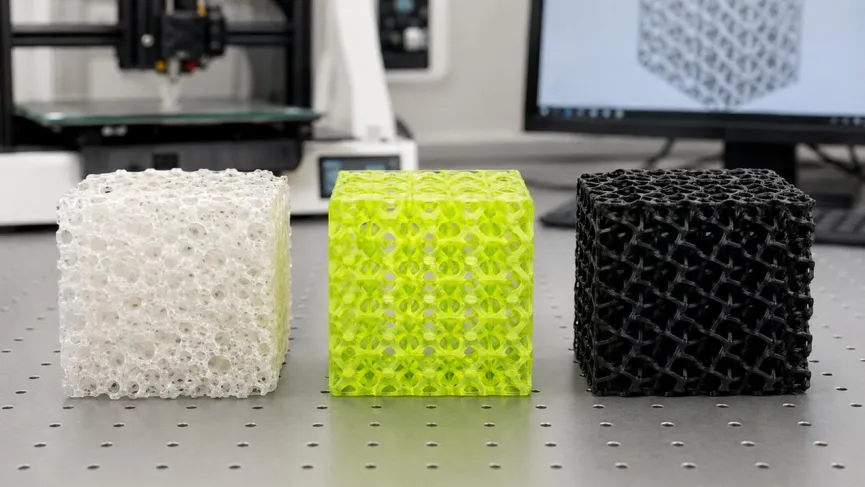
The problem is that when these products are compared in parallel with open-source projects like ReSkin, AnySkin, eFlesh, there is a lot of traceable correlation between magnetic pathways, PCBs, skin replacement structures, microstructure topologies, and algorithm processes.
This is beyond the normal scale of publicity.
Open source can shorten R&D cycles, but it can't generate original CVs for a company.
Touch sensors require the common support of material formulation, magnetic circuit design, structural topology, signal collection, labeling methods, modeling and batch consistency. Teams that actually complete the bottom breakthrough often need years to hone one of the links and then take longer to get the samples to the production site.
Today, some later researchers have attempted to compress this process into a few simple actions: downloading documents, reproducing structures, changing appearances, renaming. When open source technology entered the commercial narrative in this way, self-development became a valuation language, no longer describing R&D capabilities.
01.
It's a technological spectrum that has been made public.
To discuss open source replacement, we must first clarify the technical spectrum of ReSkin, AnySkin and eFlesh.
As early as 2015, the Sugano Laboratory at Suzhou University pioneered the technical concept of "magnetic elasticity interface + magnetic sensing + data drive"; from 2016 to 2020, the team continued to produce high-level results in this direction, with its proposed uSkin coating, a thin distributed robot skin coating with a spatial density of centimeters, measurable triaxis, published in the authoritative journal IEEE RA-L and the top conference ICRA in the field of robotics, and more publicly in the Chinese language, laying the groundwork for the early academic path of this technology.
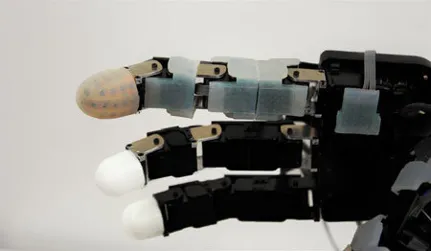
It was this magnetic touch skin pathway, founded by Earnhardt, that paved the way for subsequent Meta AI's ReSkin, AnySkin and NYU's eFlesh.
In 2021, Meta AI and a team from Carnegie Mellon University released ReSkin. It separates the flexible magnetic interface from the electronic sensing portion, restoring contact information through magnetometers and machine learning models, emphasizing low cost, replaceable and cross-case use. Related design ideas, experimental methods and paper records are open to public consultation.
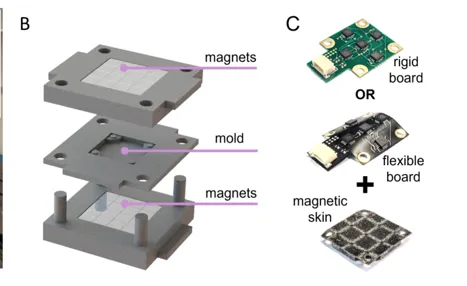
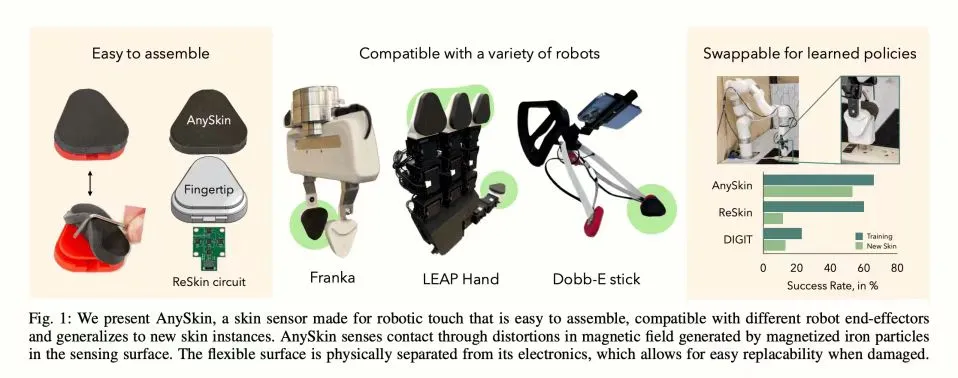
In 2024, AnySkin explicitly wrote in its paper that its work was based on ReSkin. It further addressed the consistency issues between adhesive, skin replacement and different sensor instances, making touch screen skin easier to install, disassemble and reuse.
In June 2025, a team from New York University released eFlesh, further advancing this path toward low-cost and parameterized manufacturing. The public eFlesh continued to advance modularity and low-cost manufacturing: using consumer-grade 3D printing, existing magnets and magnetometer circuits, introducing parameterized cut-cell microstructures, and opening design tools from models to printable files, collecting code and learning models.
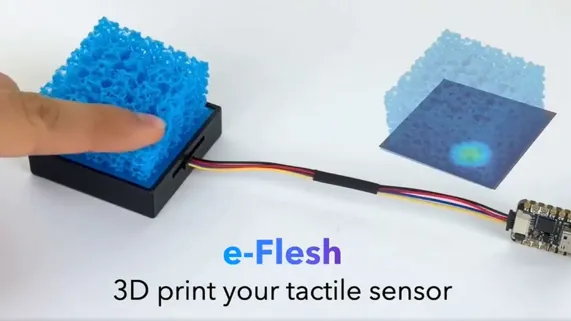
The paper explicitly states that all design documents, code and tools for converting CAD to STL are open source.
The reference section of the warehouse also leaves a sentence:
“If you build on our work or find it useful, please cite.”
The only requirement is "citation". This is not a complicated requirement. If you use the relevant results, you should explain where the technology came from.
The eFlesh warehouse is licensed by MIT. MIT permits use, modification, distribution, and sale, but requires copyright and license declarations to be retained in copies or substantive portions of the software. The eFlesh warehouse is an academic reference request. The two are not the same issue, but they share a boundary: they can be used, improved, and commercialized, but they cannot retell the results as their original inventions.
02.
What is it that is deliberately hidden and erased?
If a company develops a new product based on ReSkin, AnySkin or eFlesh, with better packaging, mass production, long-term design and customer adaptation, it certainly has industry value.
The problem arises in another aspect: the technical spectrum is systematically deleted.
The name of the open-source project does not appear in the official website's technical description, does not enter the prior art of patents, does not appear in the financing materials and media manuscripts; in comparison, it is a continuously encoded expression of the exclusive program, the kernel of the kernel itself, etc.
If this were the case, it would no longer be a self-developed or non-self-developed conceptual debate, but a question of whether the source of the technology was properly disclosed.
A team with the ability to download GitHub warehouses, with the ability to follow CAD reproduction sensors, and with the ability to retrain MLP models, without the ability to write a sentence based on an open source work on the official web, can hardly be interpreted as mere negligence.
Open source does not lose people, it deliberately hides open source to lose people.
03.
Three self-developed pumps must be priced separately
Discussing open-source commercialization, it is not possible to confuse all businesses. There are at least three types of market participants.
Category 1: Open source use and open acknowledgement
These enterprises develop products based on existing papers or open-source warehouses, retain the necessary copyright and licensing information, proactively explain the source of the technology, and clearly list their own projects.
This pathway has clear industrial value. The transformation of laboratory programs into products that can be mass-produced, durable, labeled and delivered, as well as supply chain, manufacturing, quality control and customer service capabilities. Engineering innovation based on open-source completion should receive reasonable commercial returns.
Explain on what technology you're based on and don't undermine the engineering value of your business.
Category 2: Using open source but hiding the source
These companies enjoy the time and cost advantages of open source, while minimizing the technological spectrum in the official web, patent, financing materials and media coverage, and even packaging highly synthetic solutions as their exclusive self-development.
On the one hand, they use open-source results to reduce R&D costs, and on the other hand, they derive additional market valuations from entirely original lithium.
Loosening licenses may allow for commercial use, modification and distribution, but specific projects still need to comply with the corresponding copyright and licensing provisions. Academic citations, commercial disclosure and authenticity of advertisements also fall under different levels.
MIT is not a blanket, and commercialization does not mean omitting technology sources.
Category 3: Real completion of underlying self-development
Real self-development doesn't mean that even every screw is made on its own. It means that companies have the right to define, interpret and continuously iterate key technologies.
Why materials are arranged this way, why magnetic paths are arranged this way, why the structure uses this topology, how temperature drift is corrected, how batch differences are labeled, why algorithms can be generalized across sensors, and whether they can be positioned after failure, these questions must be answered by R&D records, experimental data, and continuous product iterations.
Truly self-developing companies typically have continuous experimental records, version iterations, patent specimens, and fail-safe databases. They can not only make first-generation products, but also explain why second- and third-generation modifications need to be made.
After all, single-generation products can be reproduced and continuous iteration can only be based on understanding.
04.
How do real self-developers cope with the loss of gold content in their self-development?
Companies that are really investing in underlying R&D are facing an asymmetrical competition.
On the one hand, the costs of material experimentation, chip development, structural transformation, equipment input and mass production failures are all borne; on the other hand, it is possible to start from an open warehouse, complete physical reproduction in less time, and then enter the financing, subsidy and procurement system with the same label of purely self-developed aluminum.
When both are placed in the same set of evaluation criteria, companies that seriously disclose the source of the technology may even appear to be not autonomous enough. Those who clarify the technical boundaries are repeatedly questioned, and those who do not disclose the source may receive higher valuations instead.
Poor currencies drive good currencies away, often not because they are stronger, but because the market lacks effective identification mechanisms.
If industrial funds, policymakers and purchasers continue to use self-development as a simple indicator, but lack technical resource scrutiny, resources could flow to teams that are better at packaging than those that are better at solving underlying problems.
Real self-development is valuable because it provides not just a product, but the ability to continue to produce the next generation of products. It is able to reconstruct programs as the supply chain changes, redefine metrics as the customer's tasks change, and continue to break down as existing technology reaches its limits.
The answer is that the product is out of existence, and self-development determines whether the technology can continue forward and whether the industry can progress in the future.
05.
Who paid the bills for inflation?
Capital assumes the valuation risk first.
If a company's core technology relies heavily on undisclosed open source projects, the so-called barriers may be just a set of unrecognized external dependencies. Upstream projects that stop maintaining, change licenses, or arise intellectual property disputes can affect product generation and company valuation.
The purchaser assumes the risk of delivery.
When sensors drift and fail, can the supplier explain the underlying mechanism? Does the labeling model need to be pushed back after replacing materials and devices?
A real R&D team takes on competitive costs.
They have spent years building materials, chips, algorithms, and mass production systems to compete with open-source replicators while claiming that products made entirely by silicon itself compete on the same price table.
The cost of open source communities is much higher.
When public outcomes are repeatedly stripped of their source and packaged into commercial barriers, researchers recalculate the risk of being open. Loosened licenses may be diverted to non-commercial agreements, critical data and process details may cease to be public, and projects may be directly closed source.
A company's swap saved half a year, and the entire industry could lose open tools for the next decade.
06.
Touch track requires a technological trace
The industry doesn't need to hunt witches, and it doesn't need to fund theories based on when the company was founded, but rather a set of open, verifiable technology tracing mechanisms.
A company can, of course, stand on the shoulders of giants. But it can't erase the names of giants while selling its height. Touch sensors need to sense the tiny power, and the industry needs to restore the perception of facts. From now on, every single word of pure self-discovery is worth asking three more phrases: where did technology come from? where is the real increase? what is the evidence?
The bill has been sent. It's time to answer.
Sources and references:
eFlesh: Highly Customizable Magnetic Touch Sensing Using Cut-Cell Microstructures
2. eFlesh official code and design file warehouse
AnySkin: Plug-and-play Skin Sensing for Robotic Touch
4. AnySkin opens a source code warehouse.
ReSkin: Versatile, Replaceable, and Lasting Tactile Skins
6. The text of the MIT License (commercial needs to specify the source of reference)