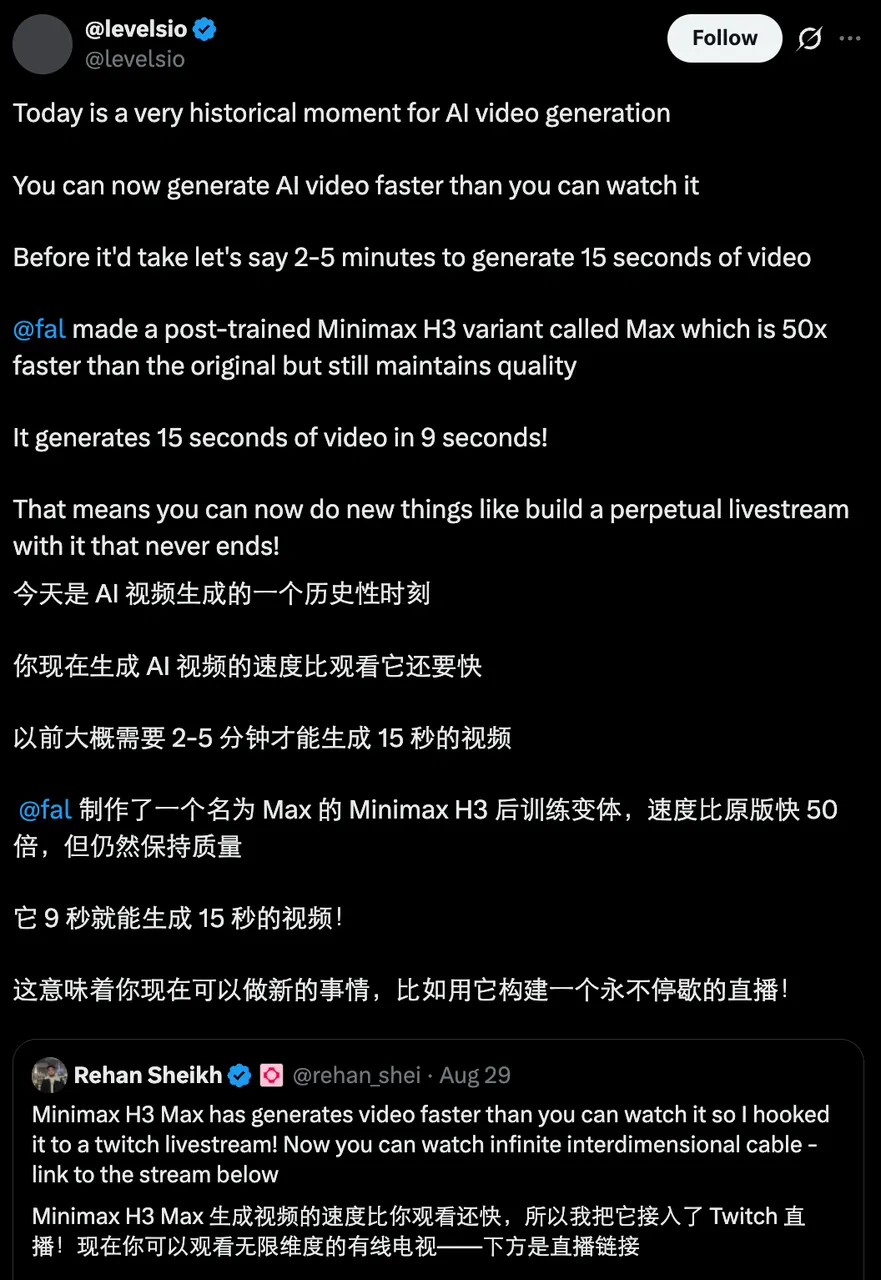
Recently, there has been a remarkable change in the field of AI video generation: the speed at which video is generated is already faster than the speed at which you watch video.
It's a high-speed video model based on the open-source weighting of the MiniMax H3 that can generate 15 seconds of video in 9 seconds. That is, the video has not yet been seen, and the next one may have been generated. This makes "high-speed video" one of the hottest keywords in the recent wave of AI video products.
However, for ordinary users, calling this model from the cloud has a certain threshold and costs, requiring time to pay for the video generated, and may be over-budgeted without being careful to play.
But as of today, this concern can be eliminated, because Pavo (the video creation platform launched by Agnes AI) has just uploaded an "extremely fast video" mode: opening a page without registering, typing a sentence or uploading a first snapshot, you can directly generate a 5-second video, and the sound comes out together.
More importantly, after registering, there is a free version available on the Pavo platform called Agnes Video 2.5 Flash, which is ideal for repeat error testing.
The era of free video production is here!
As for this number, which takes about 10 seconds, the ultra-fast model that is available for free without registration, how fast it is and the quality of production can not be seen, we can test directly.
Extremely fast, would you use it?
As far as the quality of production is concerned, placed on the premise of "free + 10 seconds", it completely exceeded expectations.
Open a Pavo page, no login pop-up window, no compulsory registration, and the middle of the page is an input box.

I'm going to try it again.
In the first video, we entered the following sentence:
"Real film footage, a rainy night at the front door of a convenience store, a young woman in a pink robe staring at a clear rainbow as she stepped over a pool of water and rose flowers. The convenience store's warm yellow lights are displayed on the wet road, the rainbow is clear, and the footage slowly follows from the back of the side.
Click generate, we've got a table: 9.49 seconds. You know, now the mainstream model generates a video, waiting time is generally calculated by minute.
This 5-second video is as follows:
In the picture, the characters, clothing and raincoats as a whole remain in a stable state, and walking movements are also more natural.
What's even more surprising is the sound. Extreme speed mode produces videos of self-contained sound, and the background rain and the sound of walking on water are very real. This speed, this price (free) can also make a sound, and that's a real smell.
We uploaded a photo of the character, strictly restricting the use of the character's clothing accessories, etc., and tried to keep the results consistent with the reference image in the subject and the scene, and the video went live for about 9 seconds.
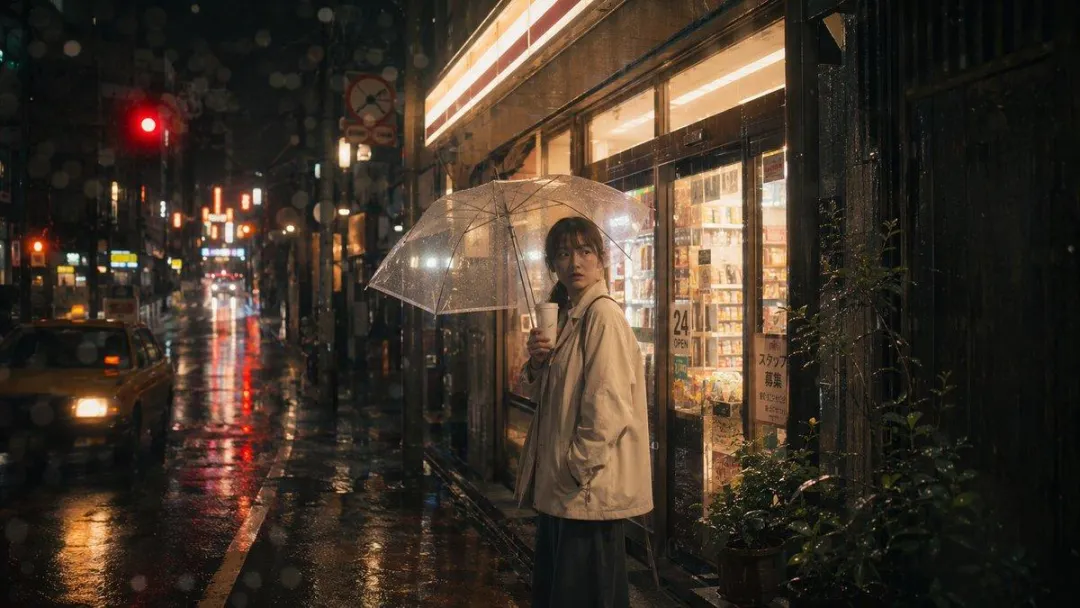
The following are the specific suggestions:
"Strictly keep the women's appearance in the headscarf, the pink coat, the dark long coat, the transparent raincoat, the white paper cup, and the layout of the convenience store and the rainy night streets consistent. The women first look quietly to the left side of the street, then turn to the right side of the convenience store's automatic door, the raincoat trembles slightly, the jacket is blown underneath. The yellow taxi on the left side drives slowly, with a small amount of water flowing on the tyres, and the lights on the wet side of the road are reversed as they change.
The person and the rainbow remain stable during the turn, and the welding movement is also relatively natural, and the whole is not clearly deformed.
The whole process went down, and the extreme speed pattern gave the deepest impression, not how surprising a video was, but the "try" movement became unburdened for the first time: thinking about what to lose, after ten seconds to find out, dissatisfied again.
Three free opportunities, and then what?
Extreme speed mode offers three free generations per day, but if you really want to make a complete work, three shots are enough.
Pavo doesn't use "free" to "cheat in and kill" people. After registering, users can use Agnes Video 2.5 Flash for free, while receiving 200 points per day to experience the full version of Agnes Video 2.5.
Agnes Video 2.5 Flash is currently free-to-play and supports up to 5 images and audio inputs at a time, but can't input video; generating specifications are limited to 720p, with single lengths between 4 and 12 seconds.
The full version of Agnes Video 2.5 supports 720p, 1K and 2K, with the same length of 4x12 seconds, and supports input video references.
Pavo grants 200 points per day, calculated by consuming 2 points per second generated, equivalent to producing a maximum of 100 seconds of video per day to grind through the critical lens surplus.
Speaking of functionality and price, we have to look at the movie effects. We tested disaster-style scenes, character performances, and more difficult moves and cameras.
Disaster scenes are created using free Flash. The atmosphere of the dock and the feeling of giant oppression are both in place, and the escape direction and actions of the three workers are also reasonable, and if you look at it as a "preliminary draft", it is quite sufficient.
In the character test, the first shot was too fast, we didn't modify the prompts, directly play them twice with the same setup, the shot was more natural, and the tone of the characters matched the plot, and oral exaggeration problems also improved.
The mirror is too fast.
Speaking a little faster, the language is exaggerated.
A natural, tone- and mouth-fitting mirror
Finally, we made an MV with the official version of Video 2.5. Compared to Flash, the official version of Video 2.5 supports direct-to-video uploading of reference videos, which can also generate 2K images, which are more suitable for processing the complexity of the tempo of the footage.
In this video, wide-angle close-ups, camera spaces, elevator switches and low-seat sliding switches feature the characters in the different positions, which are essentially consistent in the different positions, and the blue and silver tones and overall rhythm are captured very well.
In practice, Flash and Video 2.5 can indeed form a low-cost combination. First, use Flash to test a large number of pointers, movements and lenses, use free quantities for high-frequency trials, and then use daily grants to generate critical lenses, or improve resolution.
What's more, the "low price" bought a pretty good model capability.
Agnes Video 2.5 is ranked 19th on the Artificial Analysis Live Video list with 1080 Elo, reaching the level of mainstream players globally, and priced at just $1.5 per minute, only 11 minutes away from Veo 3.1 at 14th place, which charges $24 per minute.
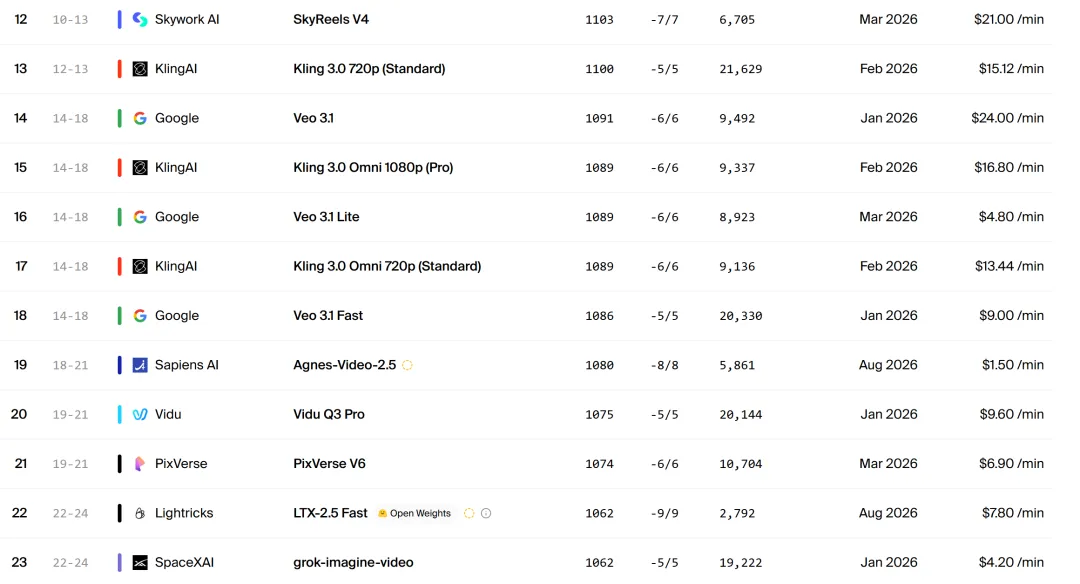
At 1080 Elo, Agnes Video 2.5 is ranked 19th, with a price of $1.5 per minute significantly lower than the nearest ranking model. Data source: Artificial Analysis, as of September 7, 2026.
Are you saving money by doing short plays, movies, and commercials?
While producing a video is cheap, making a full-length work is never just about the money it generates.
Anyone who has actually made a full-length work with AI video knows that torture is a process. In short, all short plays are not a video, but a filter web, scattered footage, material, and versions that test the editing ability. And often, it's a whole lot of work, depending on each other between nodes, and it's not uncommon to go back and forth together.
Pavo's idea is to manage the loss of these processes as well. The tool is a whole "unlimited canvas".
Text, images, and video are nodes on the canvas, which are linked together into a creative process. The most direct benefit of doing so is that the cost of "changing" has dropped: support continues to be generated from any intermediate node, and local problems are solved only in that loop, without repeating the entire link. The same material can also pull out multiple branches, while testing different models, hints, and constructs, each version being retained and retraced at any time.
There is also a special solution to this problem of character consistency: characters, products, scenes can be stored as subjective assets, repeatedly called in multiple shots, without worrying about the protagonist's face in one shot.
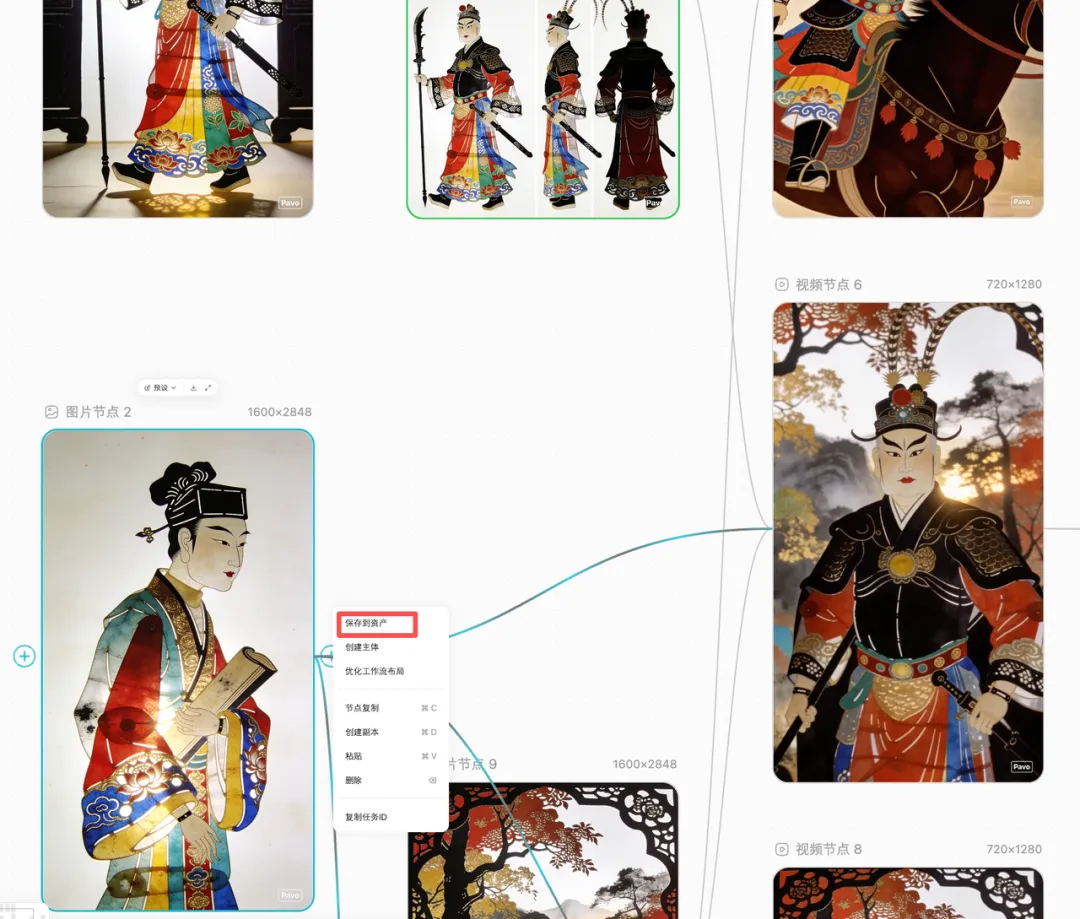
As for positions and movements, which are difficult to describe in purely suggestive terms, Pavo gives them a "3D director's stage": the position of the characters, proportions, postures, positions can be arranged directly in three-dimensional space, multiple shots and special positions can be previewed and reproduced, without necessarily relying entirely on luck.
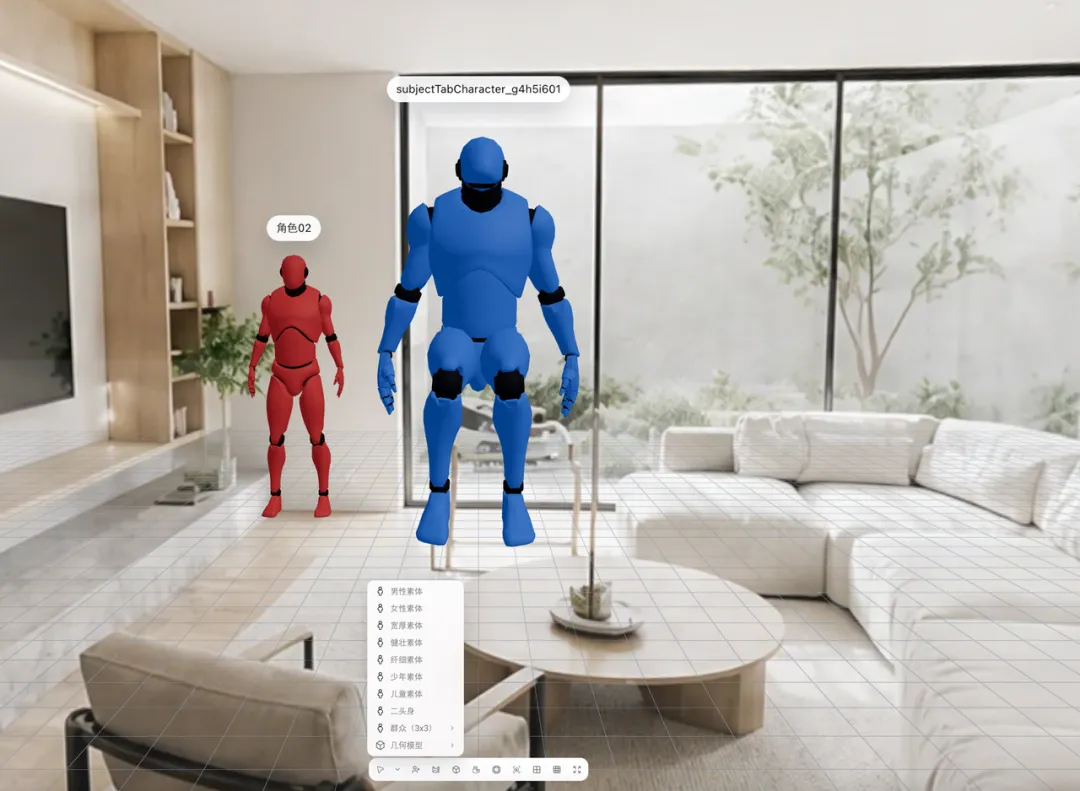
Going up and down the stairs, the dirty activity in the process can be delivered directly to the Agent: you use natural language to express the needs clearly, it is responsible for understanding the tasks, organizing the steps of creating the corresponding images and videos, and it also brings with it the context memory, that is, when changing the needs, without having to repeat it over and over again every time.
Therefore, making short plays, MVs, advertisements, and Pavo Province is not just about generating money. It's about drawing fewer cards, working fewer jobs, moving materials back and forth between several tools, which are often more valuable than the price of the model itself. In other words, the low cost and savings Pavo creators perceive come not only from model optimization, but also from less inefficient production and more efficient creative processes.
And why the word "province" is so important is worth discussing separately.
Why is the word "province" so important?
Over the past year, AI has changed the way it produces short films, commercials, and MVs, but anyone who has actually used them knows that the most difficult part of the creative process is "trying". Each attempt takes time and effort.
So, where extremely fast generation is really worth paying attention is probably not just "a few times faster". When the original minute-level wait is squeezed to about ten seconds, then superimposed on "free", the generation starts closer to a manual operation. The creator does not need to weigh "this value is not worth it" repeatedly before generating the key at the point, and the test itself becomes more intensive. This difference is worth paying attention to, because good ideas rarely come out, most are tried out.
Pavo has a whole bunch of ideas that are about to come out, and Pavo has a whole bunch of them -- dismantling scripts, choosing models, adjusting the filth of these processes, running them with Agent, short plays and even special creative patterns that go all the way from a story idea to a movie.
"No need to register + free every day" solves the psychological barrier of "good trouble, expensive, easy to use". When anyone can verify a picture, a lens, almost effortlessly, an AI video will leave the professional team's desk and become a way of expression for ordinary people.
If you don't have the money, you'll have to try it.
I'm going to try it again.