What's missing from "I'll execute" to "I'll take over"?
In today's rapidly evolving Agent, Harness has allowed large models to touch the real world, be able to call tools, modify code, and run experiments. But when the task extends from a few tens of minutes to a few days, the system still needs one person to stay in front of the screen for a long time to decide where to go next.
The key to this bottleneck is not just the lack of model capabilities, but the fact that the existing Agent has largely automated "execution" without actually automating the execution of "driving". Harness gives the ability to model action, humans give model decision-making. Once people leave, the project stops with it.
To address this problem, institutions such as Microsoft, Shanghai Transportation University, and others have opened up Argus, a general-purpose Agent reasoning suite for long-cycle research missions, and released technical reports. The system is designed with evidence-driven, automated, multi-agent collaboration, core and vertical decoding, allowing Agent to extend research into multiple fields for several days without intensive standard feedback.
The report covers 27 Campaigns, 1,548 hours of wall clock time. On average, one active request for human intervention is made every 40.7 hours; the report's work is 95.1%-98.7%. This time, Argus delivers not only a high-score benchmark, but a complete production-level result book. The team has delivered results on a wide range of tasks including AI4AI, GPU Kernel, model training, AI4Science, chip design, AI4, math, AI4System, and more, reflecting Argus's universality and real research-level intelligence.
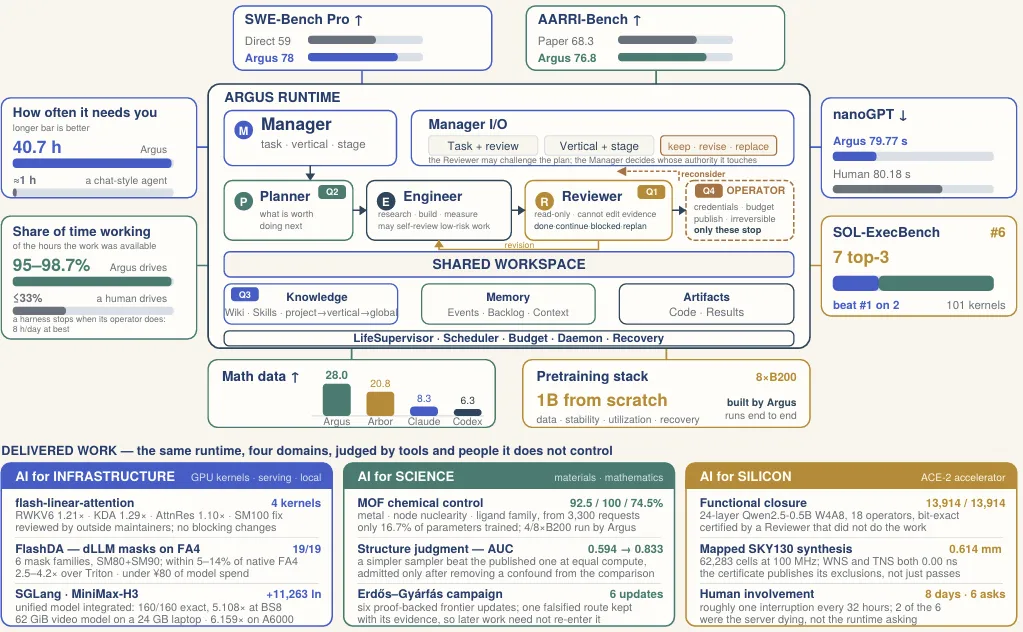
Figure 1: Overview of Argus running time, capability benchmarks and delivery results.
Argus: Who Drives the Harness for Days?
The paper:
The code is:https://github.com/lbx154/Argus
The main page of the project:
Open source library of project results:
The mathematical problems of the project are live:#counterexample-live
From Goal-Driven to Evidence-Driven: Who decides the Agent's next move?
Over the past two years, the main advances in Agent engineering have focused on Harness: borrowing autonomous driving FSD as a metaphor, models like engines, Harness as a propulsion system, but really deciding where the vehicle is going is still the person sitting in front of the screen. In short missions, like ordinary autonomous parking vehicles, the task itself can provide clear feedback; once the task extends for several days, research problems often have neither a stable reward nor a clear goal from the beginning.
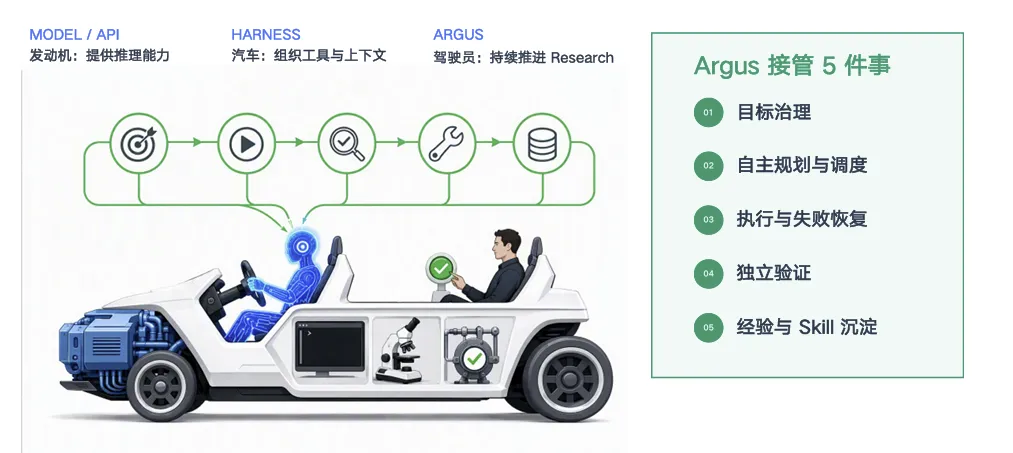
Figure 2: Argus transforms the role of human beings from a continuously driven driving position to a co-driver by implementing autonomous scientific research through auto-research.
Argus calls the previously unautomated location above Harness Driver. It can continue to rely on evidence when the plan conflicts with reality. The goal, written at the beginning of the study, is only an initial assumption of the least information phase; if the Agent can only chase the predicted endpoint from the Goal-Driven and even repeatedly waste the Token on impossible targets, the goal will be stunted. While Evidence-Driven has shifted the control logic: step by step, the decision is based on evidence rather than the initial assumption of the plan.
1. Has the work been completed and is the quality good enough?
2. What is the next step that is most worthwhile in the light of the current evidence?
3. How should the experience gained in this round change systemic behavior?
4. Do the remaining issues involve decisions made only by humans?
02 When a general-purpose customized long-distance operation is in place
Argus organized the long-term project into a sustained Campaign, then dismantled it into a series of boundary-clear Mission. Its basic closing loop is Manager → Planner → Engineer Reviewer → Manager:
With reference to the /goal model of the OpenAI Codex, the Argus design orientation can be more clearly positioned. /goal is to extend the single-cycle cycle of an agent into a persistent cycle with a goal state; Argus is to organize research projects into multi-role, multi-harness, immersible knowledge lengths. The former responds to "how to keep the agent going, and the latter responds to "how to keep the agent going, and how to be effective when the agent doesn't stop working".
1. Managers have mastered the transformation phase, process approval, and overall strategy;
2. Planner to plan specific tasks based on current evidence;
3. Engineers access real code libraries, experiment and execute;
4. Reviewer Independent review workpieces and verify innovation and effectiveness, report to the Manager or call back the Engineer.
The focus here is not on the multiple characters themselves, but rather on the context. So many characters work together to prevent the agent from becoming a simple local crawler, each character has its own unique context but a shared workspace, so much so that not all planning, execution, verification is handed over to one agent to complete, which can improve token efficiency.
System saving is a complete set of workpieces; only through the experience of the evidence threshold can Wiki and Skill be accessed and replicated for subsequent tasks under Project、Vertical or Global scope.
At the same time, Core and Vertical remain united: Core is responsible for role permissions, evidence submission and human boundaries, Vertical is responsible for what the field experts define as valid evidence in tasks such as mathematics, GPUs, materials, and related human skills and knowledge; Vertical can significantly improve the quality of the delivery of research tasks, as well as provide an interface for human experts and agents to synchronize and optimize work processes.
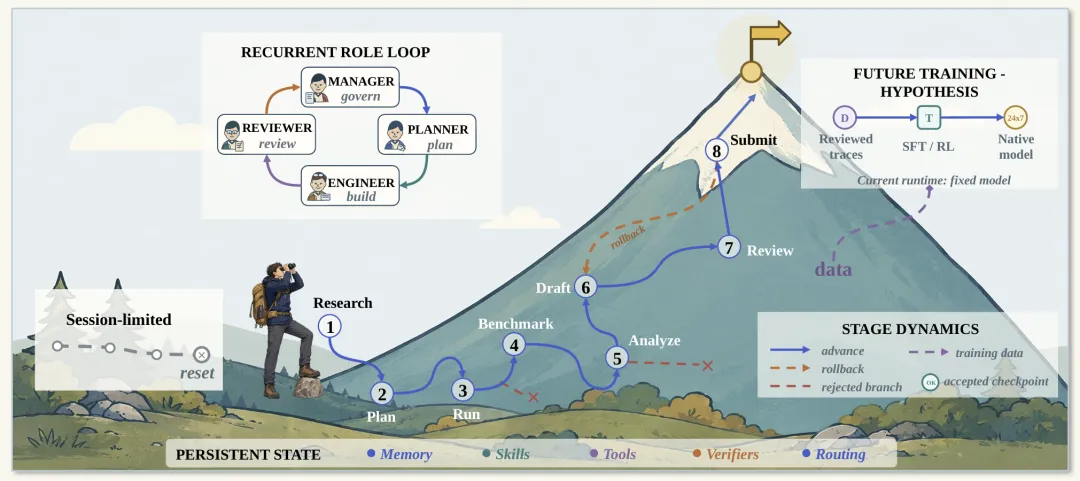
Figure 3: Argus' long-range operating mechanism. The four types of roles revolve around a perpetual state cycle, and the Campaign can be advanced or rolled back through eight study phases.
After 1548 hours, what did Argus leave behind?
In less than a month after Argus became open source, we have already made outstanding contributions to research into infrastructure, materials, chips, mathematics, and AI systems, and we are the first team to publish a complete end-to-end mathematical speculation on solving filter logs and open all operating trajectory sessions. Here is a summary of the results after Argus became open source:
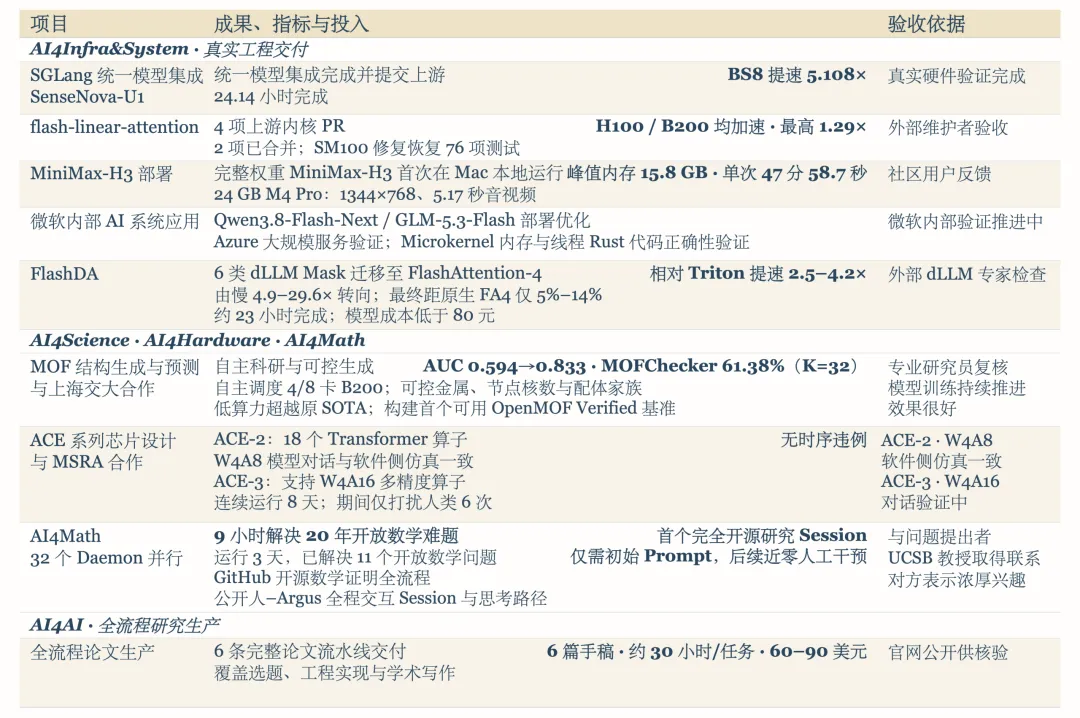
Figure 4: Argus representative research results, key indicators and basis for acceptance
As shown in the table above, Argus first transforms continuous operation into acceptable real delivery in AI4System & Infra, the first step in completing precise engineering results from automated execution to autonomous research; subsequently, the task extends from AI infrastructure to AI4Science, AI4Hardware, AI4Math, and the evaluation criteria also move from whether or not Argus has completed a set set of tasks to whether or not Argus can explore unresolved real-world research problems, thus advancing automated research from automated delivery to automated exploration; on this basis, Argus also extends the entire research process in the direction of AI4AI from single-point outcomes to evidence-driving continuous tasks, without humans constantly pushing on the screen, thus forming a pathway from authenticity to exploration across realms.
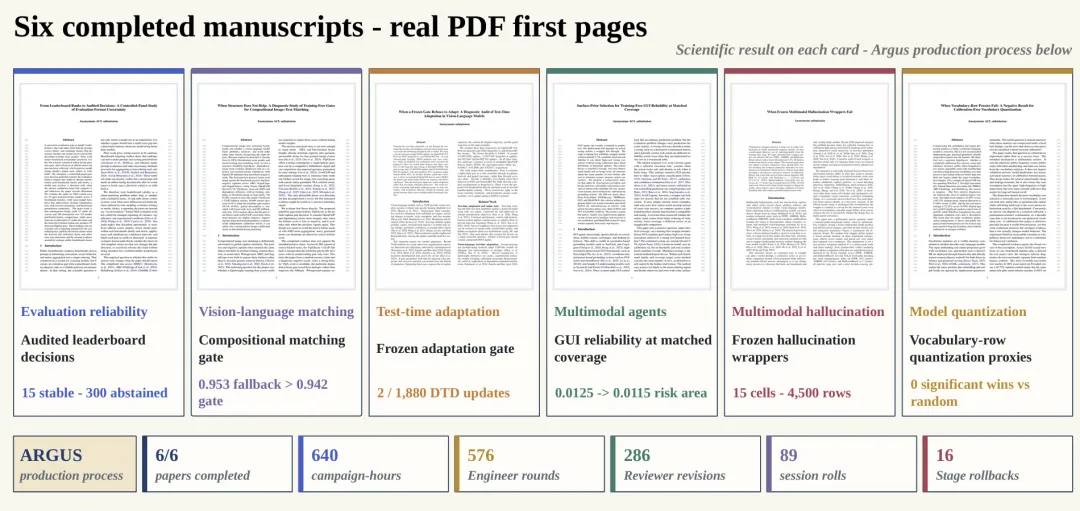
Figure 5: Argus delivery results in the production of the entire process paper.
Combining these results in one month, Argus is a gradually deepening value chain: automated objects are driven by one-time execution of evidence-driven research, greatly accelerating research progress, and this is the most direct answer to "who drives the agent after people leave the screen".
After the shutdown of the screen, the project did not go to zero
Long-term intelligence is the transformation of tokens into intelligence, and the use of intelligence to continuously advance a research project and generate real value. Argus calls on models that had originally broken into each other to call organizations into a continuously running research system, allowing Evidence-Driven to control the direction and then to automate the ability to absorb experience.
Argus demonstrates not just a longer-running Agent, but a new way of organizing research: Harness solves how models operate, Driver decides how the system continues to progress, and the speed of research is no longer constrained by human work and leisure time.
Introduction by the author
Argus was co-developed by researchers from multiple universities led by Microsoft and Shanghai University of Transportation.
Argus, let everyone have their own digital lab!