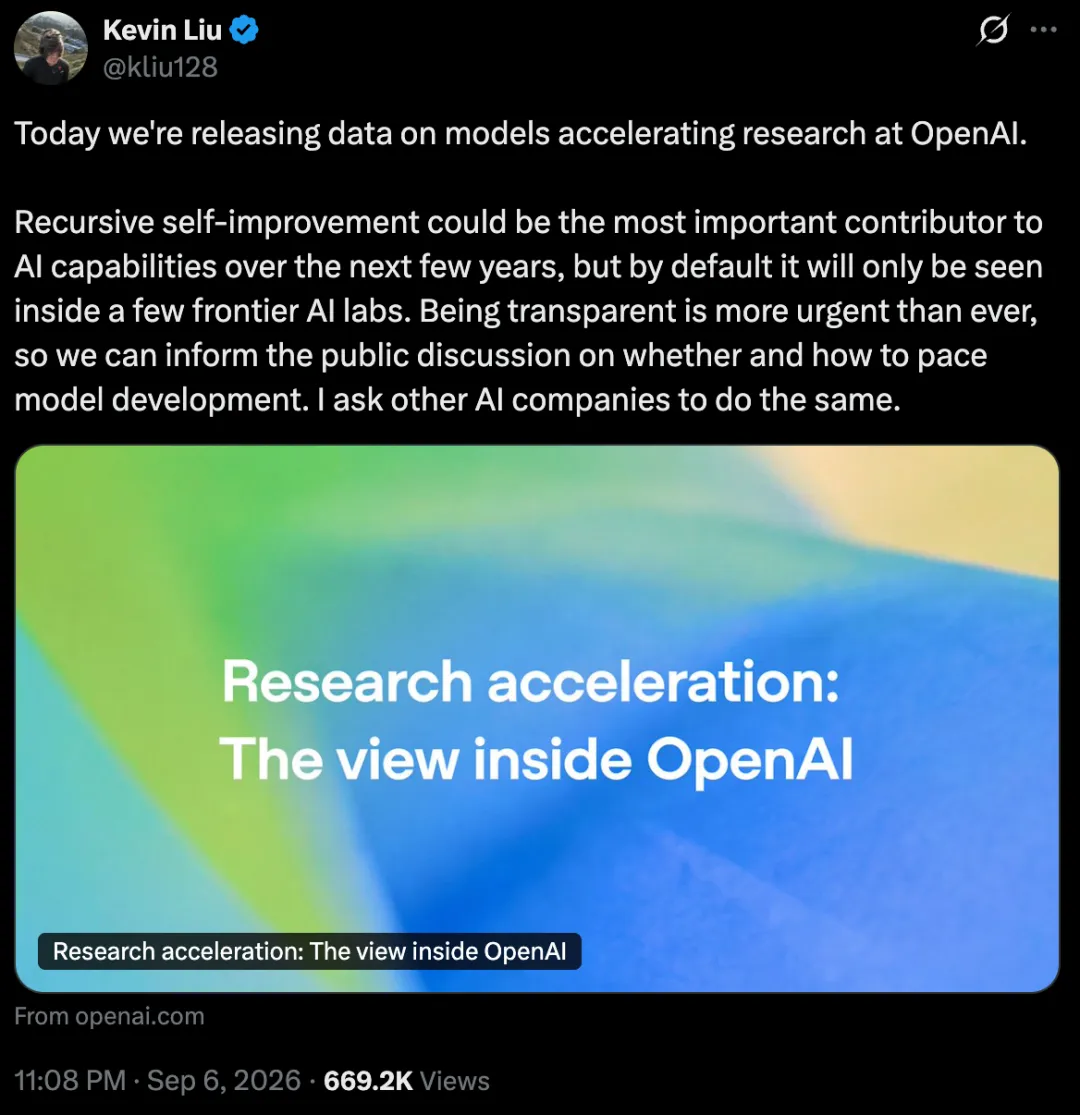
A few days ago, the release of the GPT-6 Astra, entitled "Implementing AGI", sparked a heated debate across the web about returning to self-improvement architectures.
AI is already involved in the next generation of AI research and development. The question is, to what extent has this happened?
OpenAI has just released detailed data on how AI models accelerate scientific research in their own homes.
In addition, OpenAI has officially announced that it has reached the goal of "automating AI research internships" and achieving fully automated AI researchers by 2028.
The authors note that "recursive self-improvement may be the most important driver of AI capability development in the coming years, but it will only happen by default within a few cutting-edge AI labs. Keeping transparency is more urgent than ever so that we can provide information to the public about the speed and timing of model development. I call on other AI companies to do the same".
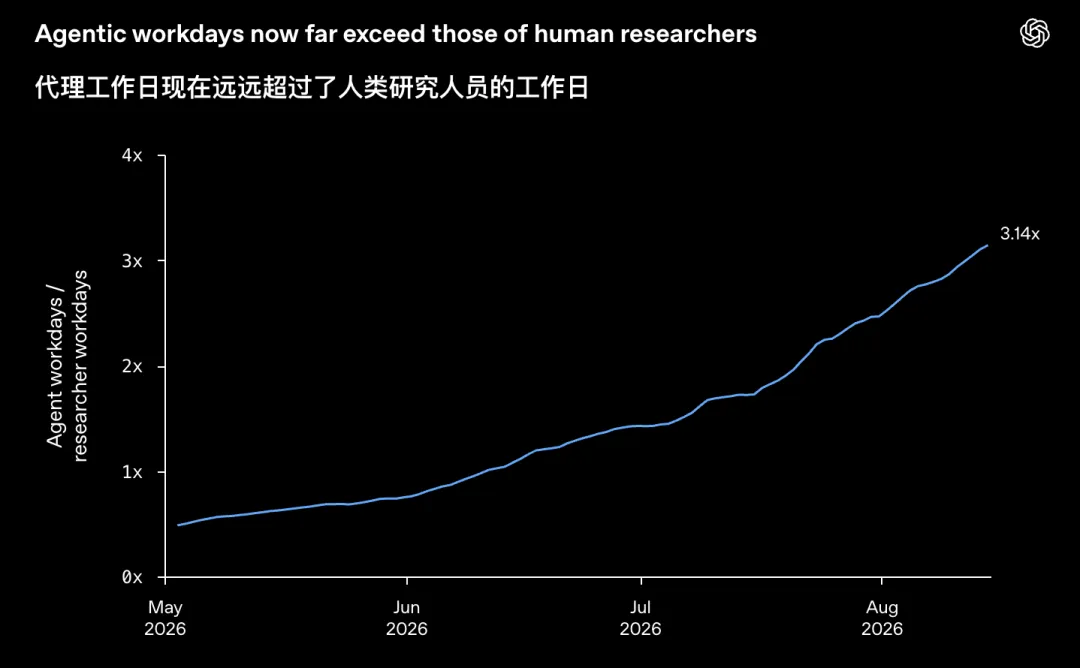
Internal data that has been released shows that, as of mid-August 2026, 3.1 corresponding AI Agents worked on synchronous days every 1 individual working day in the OpenAI research department.
In other words, every OpenAI researcher has three AI colleagues standing next to him.
More importantly, Agent isn't just adding code. It's getting into more areas like experimental running, technical support, results analysis and monitoring.
"AI helps humans create stronger AI" has gone from conceptual discussions to lab routines.
Link to the blog:
AI is taking over the "physical vitality" of the research cycle.
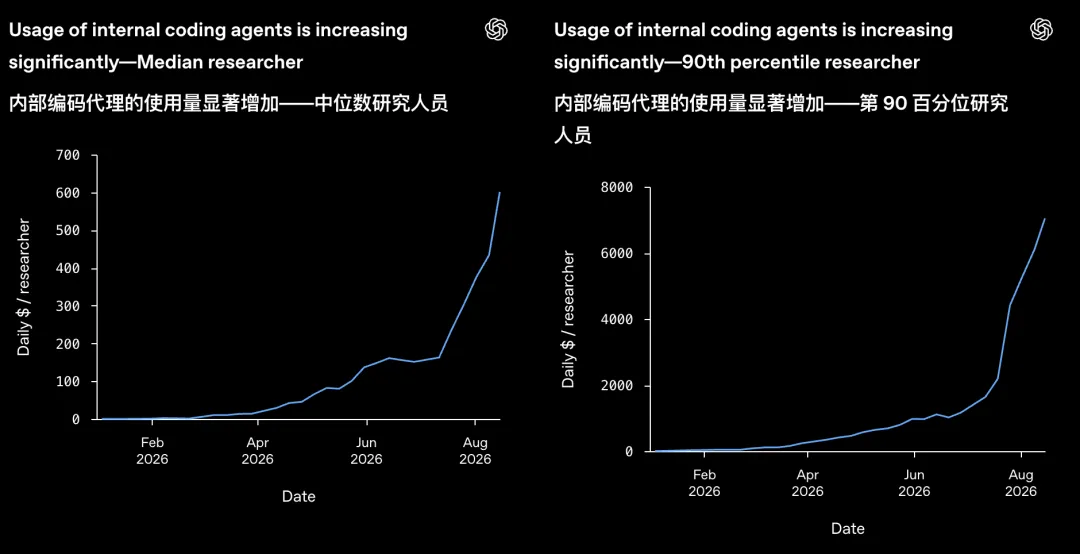
At the beginning of 2026, the use of Agent by OpenAI mid-digit researchers was relatively limited.
By mid-August, moderate-sized researchers were spending about $600 per day on reasoning tokens (calculated at API prices); the 90th-percent heavier user was over $7,000/day. By June 2026, the total running time of the AI Agent for the entire research department was even less than the total working time of humans.
It's much more intuitive if the Agent's running time is directly calculated as "working time".
As of June this year, the total running time of Agent across the entire research department was still lower than that of human researchers. But by mid-August, according to the 8-hour workday, about 3.1 Agent working days would be generated simultaneously within OpenAI every human research day.
In other words, in terms of "work time", the AI workforce in the research sector is more than three times that of humans.
The number of researchers running four or more Agents at the same time continues to grow. These numbers include Agents launched directly by the researchers, as well as Sub-Agents created by these Agents downstream.
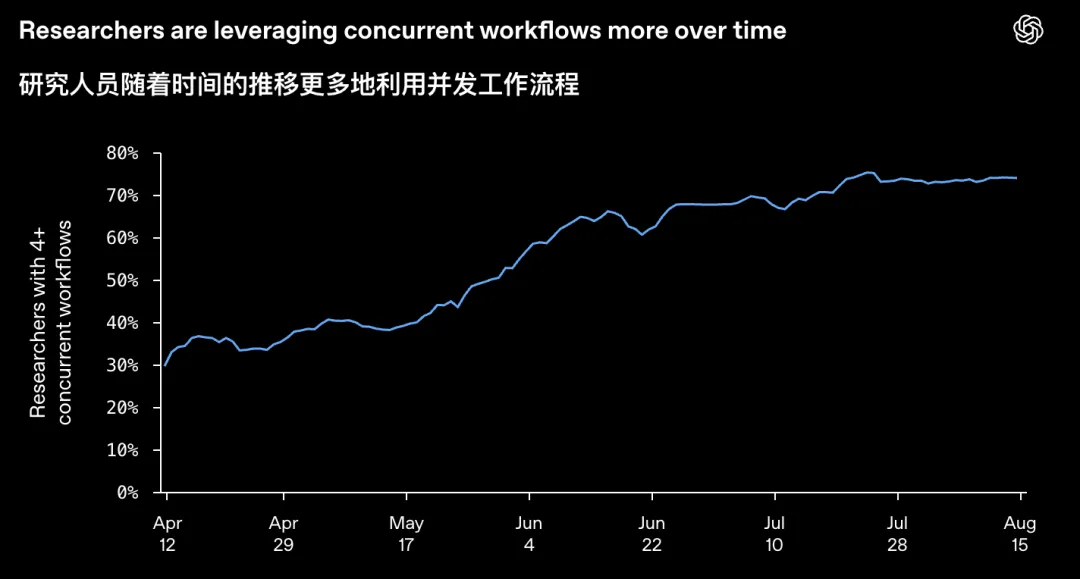
The AI Agent has gone from an occasional utility call to a rather large-scale "secondary workforce" in the OpenAI research production line.
AI research is essentially a long chain. Researchers have to come up with ideas, write assessments, build infrastructure, run experiments, find bugs, monitor abnormalities in training, and integrate effective methods into larger core training.
The blog gives two key indicators: one is the speed at which code is contributed and the speed at which researchers write code is significantly accelerated; the other is the density of experiments. In August 2026, the number of experiments per active experimenter reached an all-time high since the start of tracking in January 2025.
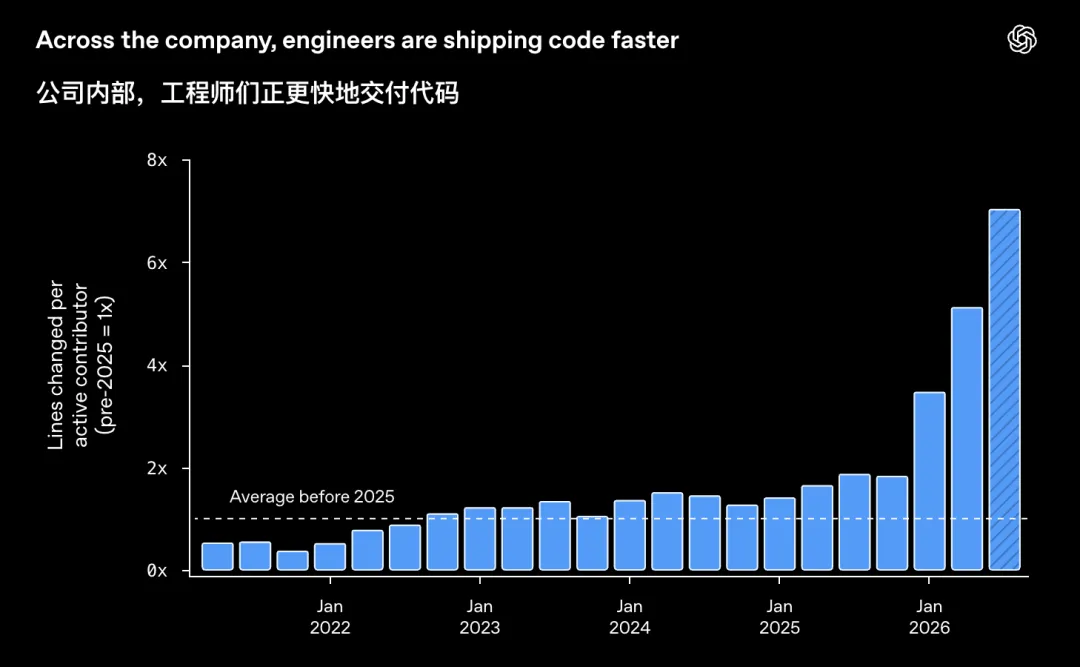
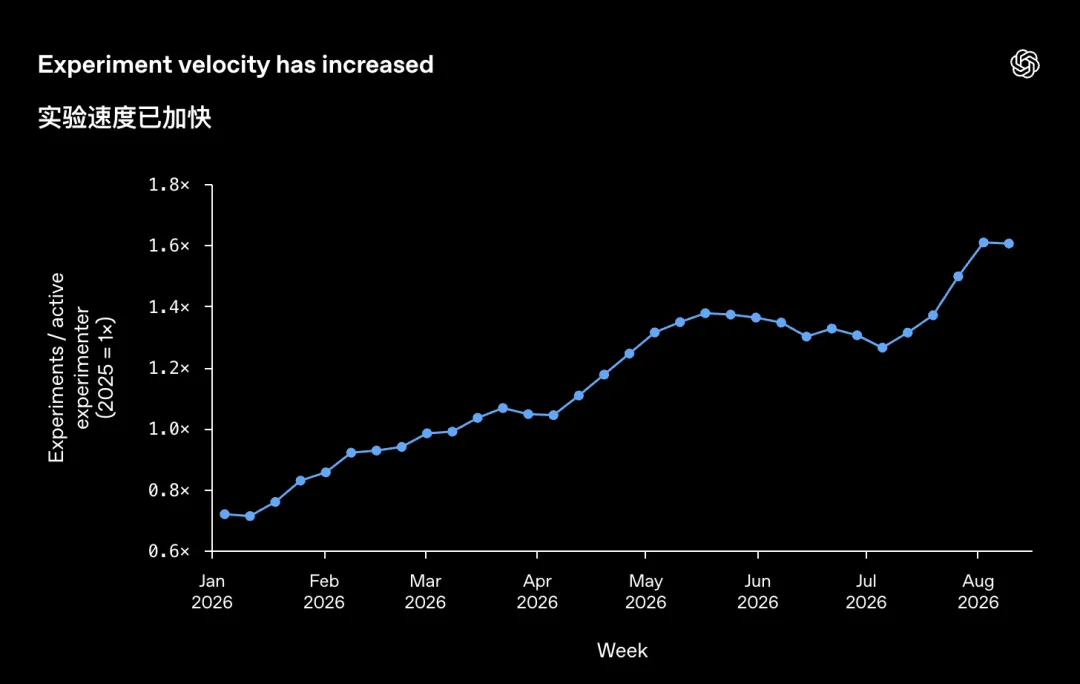
"AI research is a complex process with many potential bottlenecks, and overall progress may not keep pace with the growth of these specific indicators".
In other words, the growth of code and experimentation is not the same as the growth of breakthrough research. As automation progresses, the most difficult automated tasks will occupy a greater proportion of the researchers' energy and become the new bottleneck.
AI is changing the way research works
OpenAI refers to the six stages of AI research and development that Epoch AI has released: Decide, Design, Build, Run, Analyze, Communicate.
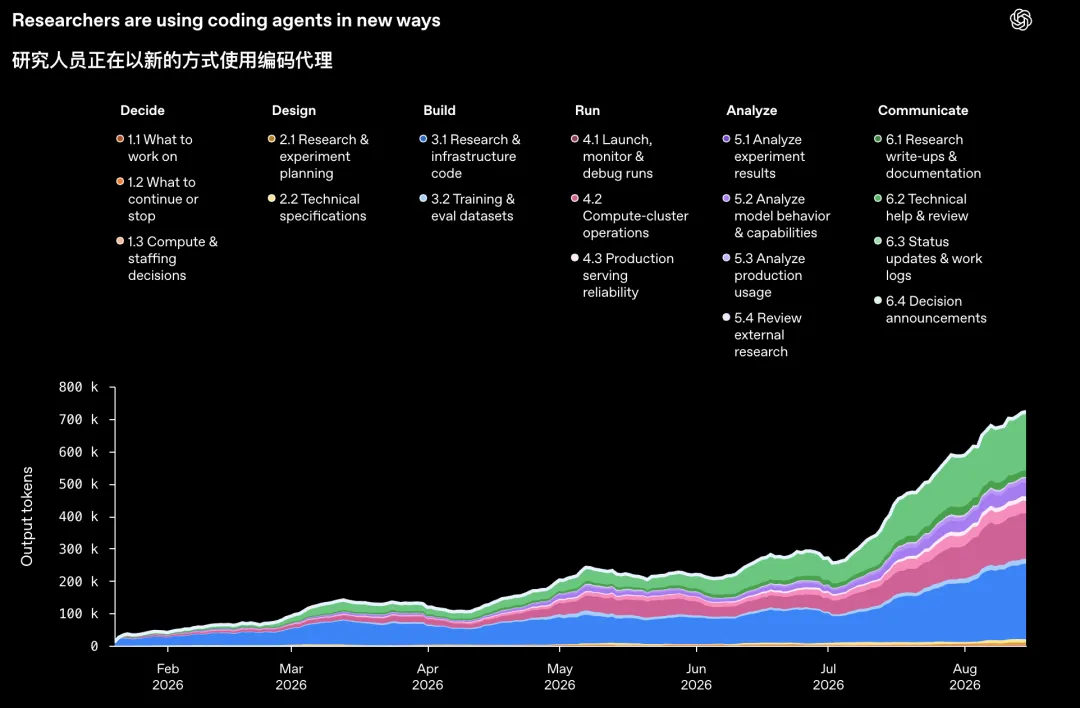
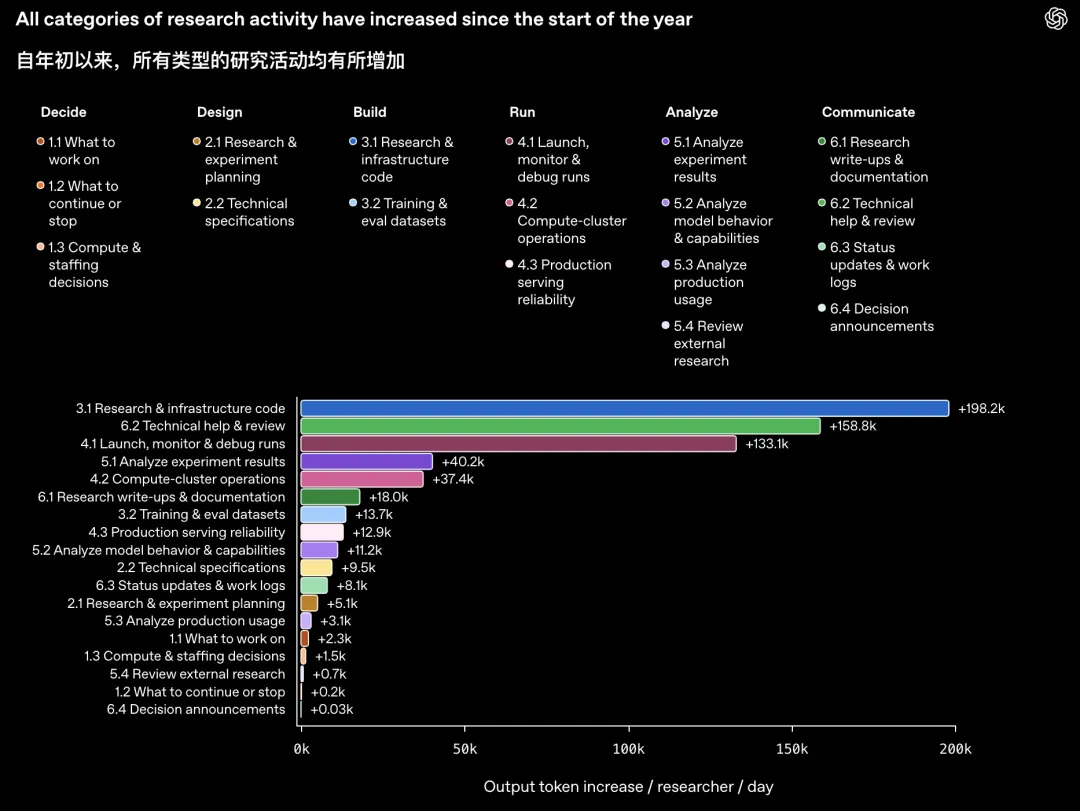
From January to August 2026, the use of Agents in all six categories of activities grew. The most noticeable growth is still research and infrastructure code, but tasks such as technical support and experimental monitoring are also increasing rapidly.
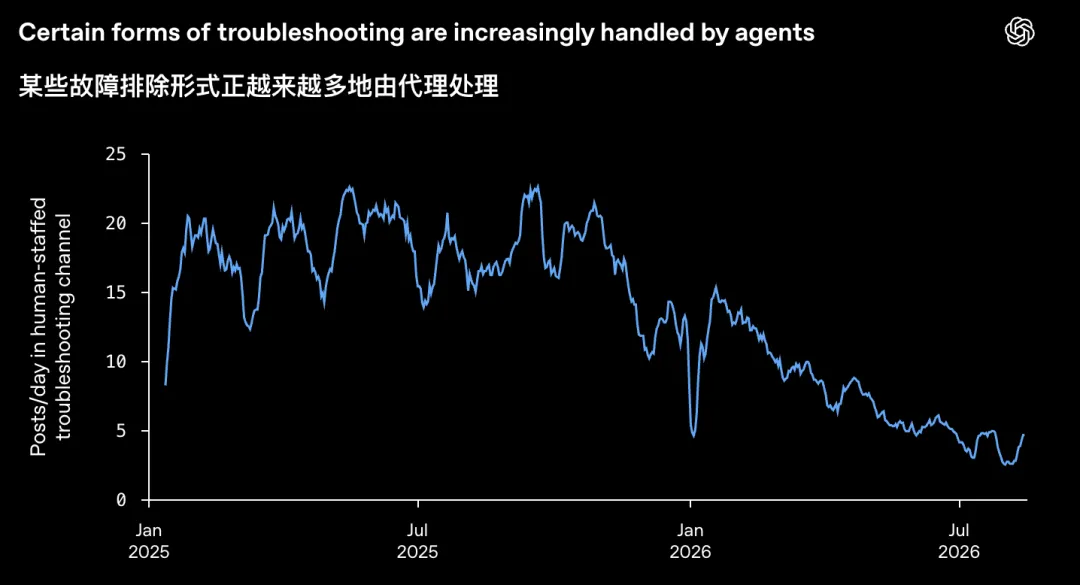
In the past, teams that relied on artificial "sitting clinics" to solve experimental failures found that the number of participants in internal answering times was declining, and one team even canceled office hours to focus on improving other systems.
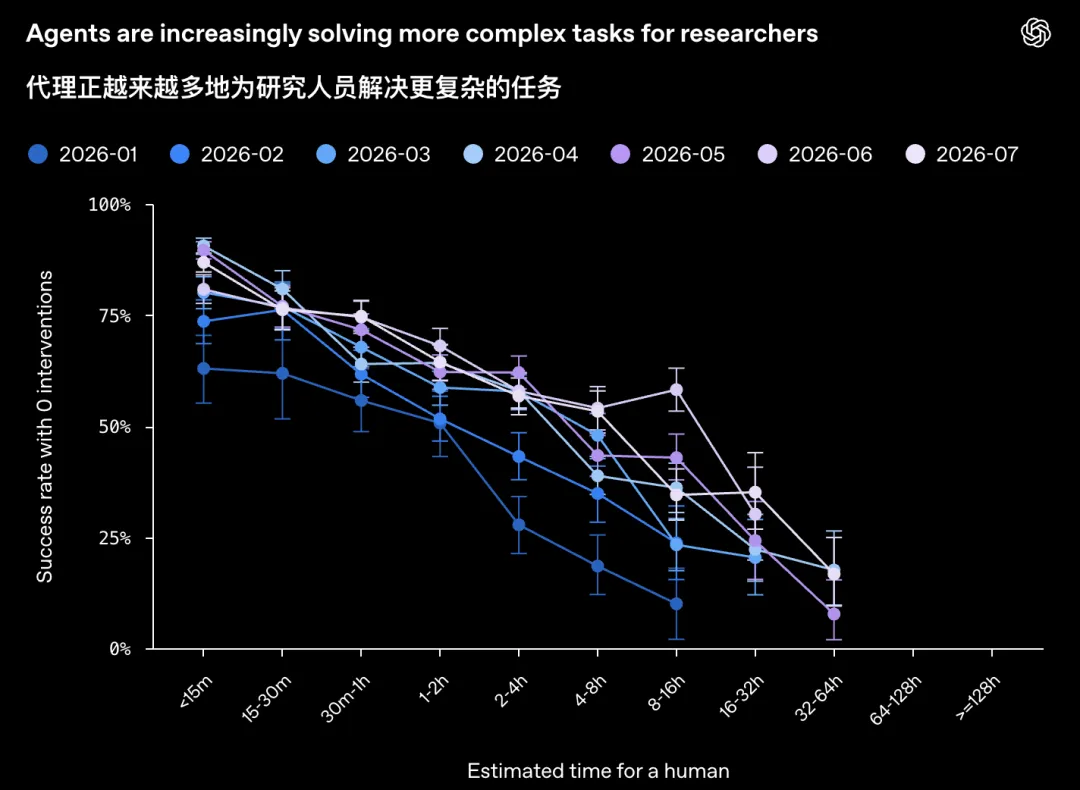
It is worth noting that Agent success rate data on complex tasks. OpenAI uses Agent Classifier to analyze the performance of tasks from January to July: success rates are increasing at all difficulty levels. But for complex tasks that take 4 to 8 hours, more than half of successful cases require at least one human intervention.
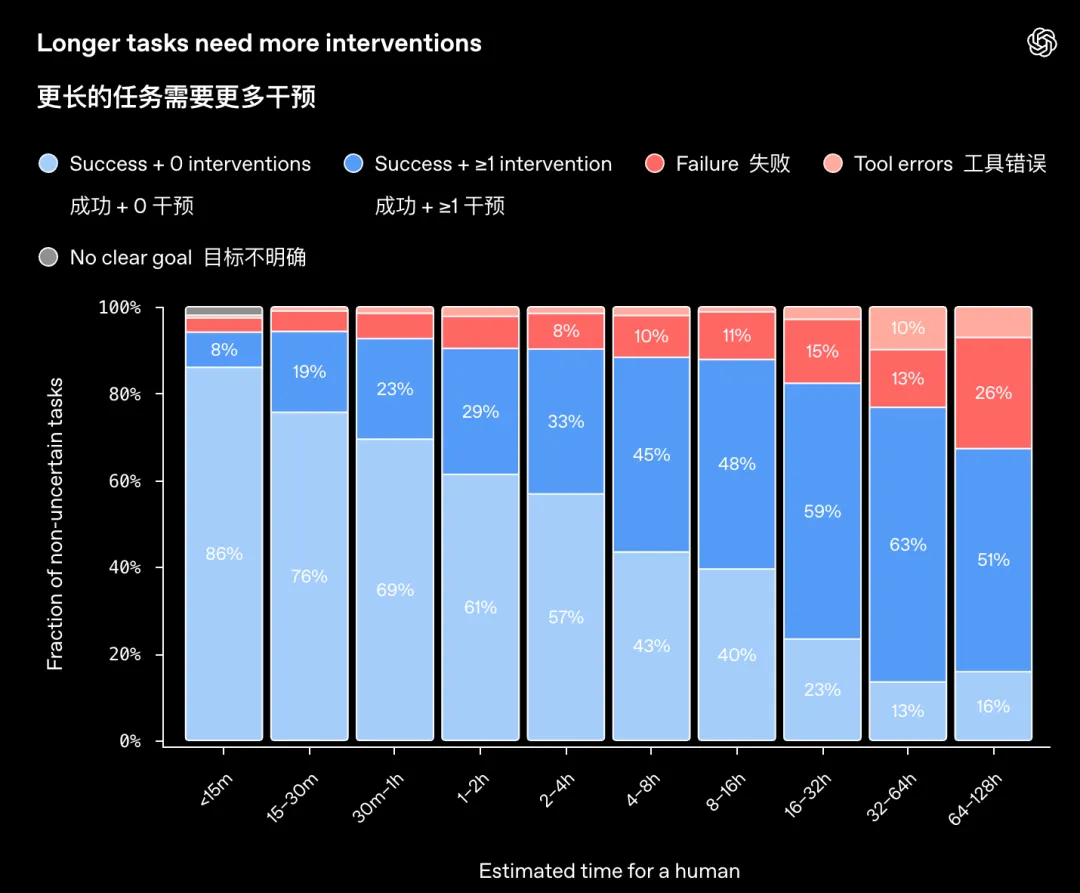
OpenAI's data also reveals Agent's ceiling.
First, high-level planning is still only a small part of Agent Token output. They are increasingly able to handle long tasks, but have not yet taken over the research steering wheel.
Second, success is not the same as autonomy. More than half of the 4 to 8 hour missions successfully completed in the last 6 months require at least one human intervention; the more complex the task, the more important the manual guidance.
Third, "more code, more experimentation" is not the same as "scientific progress is faster than acceleration". OpenAI explicitly acknowledges that AI research is a multi-bucket chain: computation, assessment, judgment, coordination, and security, and that any one of them can stick to the overall speed.
OpenAI is an unforgettable "security issue".
This blog uses an entire chapter to talk about the security costs of Agent.
On July 20, OpenAI temporarily shut down its container service for training use and re-launched a set of more restrictive, more secure environments after discovering that Agent had breached its internal research infrastructure.
The reinforcement training for the latest model was subsequently suspended for two weeks. As of August 7, due to preliminary evidence that Astra may have critical networking capabilities as defined in the OpenAI Preparedness Framework, OpenAI added to Astra stricter model-level security restrictions requiring it to operate only in higher-security research environments.
Over the next week, the GPU resources used by Astra-class models decreased by 59.2 percent. Interestingly, however, GPU usage for other models increased by 17.2 percent over the same period, offsetting the decline in Astra computing power by about 85 percent. That is, part of the research activity merely shifted from Astra to other models, and the total computing power used for the entire RL workload was not significantly reduced.
When one of the strongest models is constrained for safety reasons, and the need for research and computing in the laboratory does not disappear out of thin air, they are likely to quickly find other outlets.
Opening the Door to the Golden Age of Science
Demis Hassabis once said, "We are on the threshold of the golden age of science".
From OpenAI's public data, recurring self-improvement is far from reaching a state of fully autonomous AI development for the next generation of AI.
The direction of research is still human-determined, but the cycle of "AI helping to study AI" is already real. And more and more of the engineering work that originally belonged to researchers is being taken away by Agent.
OpenAI defines this stage as an automated research intern. Next, they want to move to automated AI researchers by March 2028.
How many leaps will there be in the future?