This article is part of the PRO Members Communication, and follows "PRO Members of Machine Heart" at the end of the article to read more on the topic.

Since 2025, verifiable reward reinforcement learning (RLVR) has become an important route for post-model training with "clear signals that directly determine what is wrong with rules, standard answers or unit tests". However, verifiers are only good at "things with standard answers", and the current industry is increasingly looking to expand RLVR's verifiable signals from closed-topics to open areas, with research routes around this goal, such as process verification, signal mixing, and self-verification standard compilation, generating widespread attention, as well as new problems in signal construction and rating standards.
Directory
01. How does the verifier stick to the RLVR upper limit?
Why is a validator the limit of RLVR's capabilities and how do binary signals and open missions limit the landing of RLVR?...
How does the mixing of signals and self-authentication complement the rewarding grain and get out of the standard answer?...
03. In addition to the verifier, what other links are being modified in the RLVR?What other breakthroughs are there outside the verifier, the signal structure and the problems?...
How does the verifier stick to the RLVR limit?
1 In 2025, DeepSeek-R1 and OpenAI o3 followed with the release of representative reasoning models, further expanding the application of reinforcement learning in post-model training, and replacing the "certainty verifier" learning reward model with the "RLVR" to allow post-model training to shift from learning human preferences to further relying on clear rules to provide reward signals.
1 In RLVR, the verifier directly determines the correct answer by means of rule checks, unit tests, etc., without relying on a learning type scorer.
2 In contrast, conventional reward models typically require raters specific to train for different tasks, and not only are reward signals susceptible to noise interference, but also "reward speculation" ("reward hacking") may emerge from the use of the model. The certainty feedback provided by validators reduces these risks to some extent.[1-1]
Since the second half of 2025, a number of works have been undertaken to address the limitations of RLVR verifiers on signal granularity and task coverage. On the one hand, only the output of "yes or wrong" binary signals makes it impossible to distinguish between the correctness of the answer and the precise steps that are rewarding. Many tasks have partially correct or formally different alternative answers, and verifiers systematically underestimate these effective solutions; on the other hand, open-source tasks such as writing and dialogue lack a single answer, making it difficult to directly construct stable, executable verifiers.[1-2][1-3][1-4]
In terms of coverage, open-source writing, conversations, and medical questionnaires do not have standard answers, nor are existing validators available, and the RLVR cannot land directly.
2 In feedback particles, binary signals can only distinguish between right and wrong, cannot reflect partial correctness, approximate correctness, or respond to subtle differences in quality. In addition, binary rewards are also likely to cause training signal scarcity.
3 As an example of the GRPO commonly used in RLVR, when the same group responds completely correctly or completely incorrectly, there is no difference in the reward within the group, and the relative advantage will be reduced to zero, so that the group sample cannot provide an effective tactical gradient.[1-2]
3 Around the limits of signal granularity and mission coverage, recent industry explorations have focused on two goals: how to extend reliable verification mechanisms to tasks where more standard responses are lacking; and how to break the limits of binary feedback to provide models with richer, more efficient learning signals to match the limits of signal granularity.
1 In recent months, related research has gradually formed the process of verification, mixed signals, self-validation and standard compilation of four types of exploration directions, ranging from the dimensions of verification objects, signal sources, verification subjects and mission forms respectively, in an attempt to expand the scope and feedback capabilities of verifiers.
How can the boundaries drawn by the verifier extend outward?
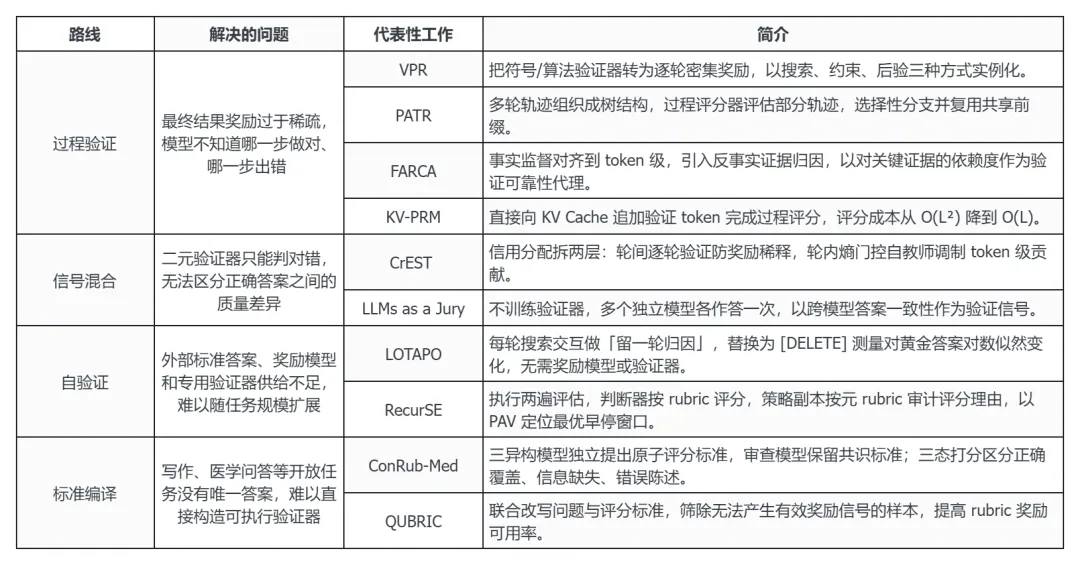
1. In 2026, the industry's focus on research on RLVR has shifted from "expanding reinforcement learning scale" to "expanding verification capabilities", with further research on intermediate processes, mixed rewards, model self-assessment and open task scoring criteria, and the progressive formation of process verification, signal mixing, self-validation and standard compilation.
Table 1:2026 Exploration routes and representative work on the boundaries of the capabilities of RLVR verifiers[1-3]-[1-18]
 Follow the link to "Machine's Heart PRO Members" and go to "Inbox" to see the full explanation.

For more up-to-date content, follow the "PRO Members of Machine Heart" service and click on the "Inbox" menu.