At the 2026 World Robotics Congress, a team of swimmers and open-source geniuses created by the team of the ORCA, the five-fingered genius pulsed the pulse in a manner similar to that of an old Chinese doctor.
The company is a reliable provider of touch solutions that focuses on touch rather than clever hands.Founder and CEO Zhang ZhenThe researchers pointed out that the diagnosis was the most difficult puzzle they had ever solved to verify that their sensory technology had actually reached the level of human beauty.
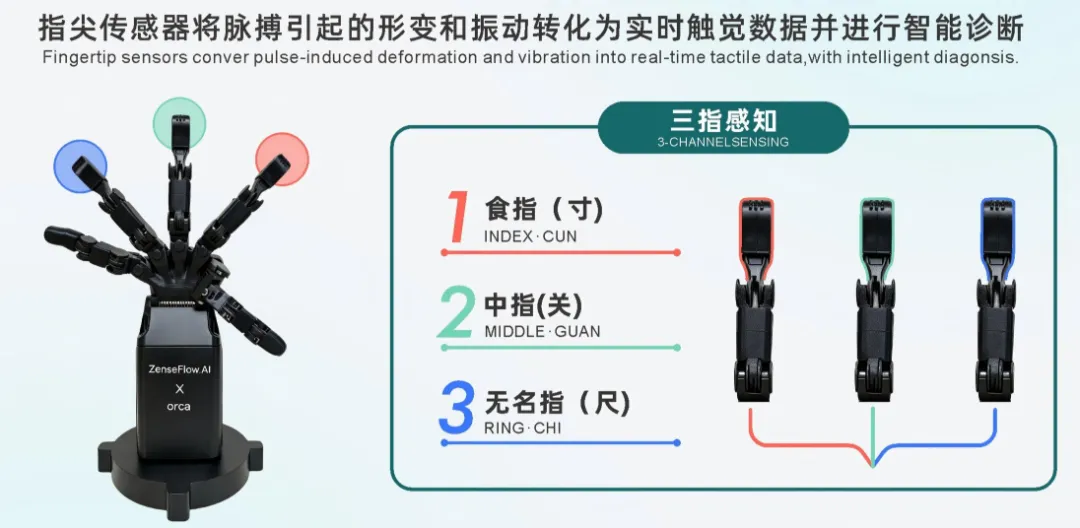
Why is there a pulse?
Where is the limit of human touch? This is a proposition that has been proposed since its inception.Clinical trialsThat's right.It's the most comprehensive and top-notch call to human touch.
Zhang Zheng pointed out that human fingerprint touch is a complex system of four types of sensor synergies, covering rapid adaptation and slow adaptation, low-level and deep perception. The three nine-hour approaches and twenty-eight pulse recognition responses to pulse diagnosis are integral calls to this system.
The core breakthrough of floating-point intelligence is the free-form printing technology of multi-material integration, which integrates multiple sensitivity mechanics such as capacitance, compressive resistance, and compressive electrical systems, integrating multidimensional physical quantities such as force, shape change, vibration, and vibration in the same system.
Let's see.Tactile data“It's incredible.”
The industry generally believes that touch data is too little, so it is increasingly used as computing equipment.The real problem isn't the amount of data, it's the data.“Unbelievable”。
The T-REX paper published by Lifeifei's team notes that after the VLA model added touch data, the operating performance did not improve but instead deteriorated. The underlying reason is the lack of touch standards and the ambiguity of the model calling strategy.
The more fundamental paradox is:The touch is“The crossroads”The sensors,Both are low-frequency sensing domains and must be involved in high-frequency power control domains.As an example of visual touch, signal transmission needs to go through elastic body transformation and optical capture, from the perspective of the force transfer function, the response of elastic body links has been limited by the physical properties of the material. Soft materials have a high sensitivity but respond slowly, hard materials respond fast but poor sensitivity. A single technical route is bound to be inconsistent, an engineering root problem that the industry is not yet fully aware of.
Based on the above insights, Vanguard Intel launched the Creditac framework for trusted touch solutions, with the goal being clear:It provides at least 99.9% confidence in tactile data.
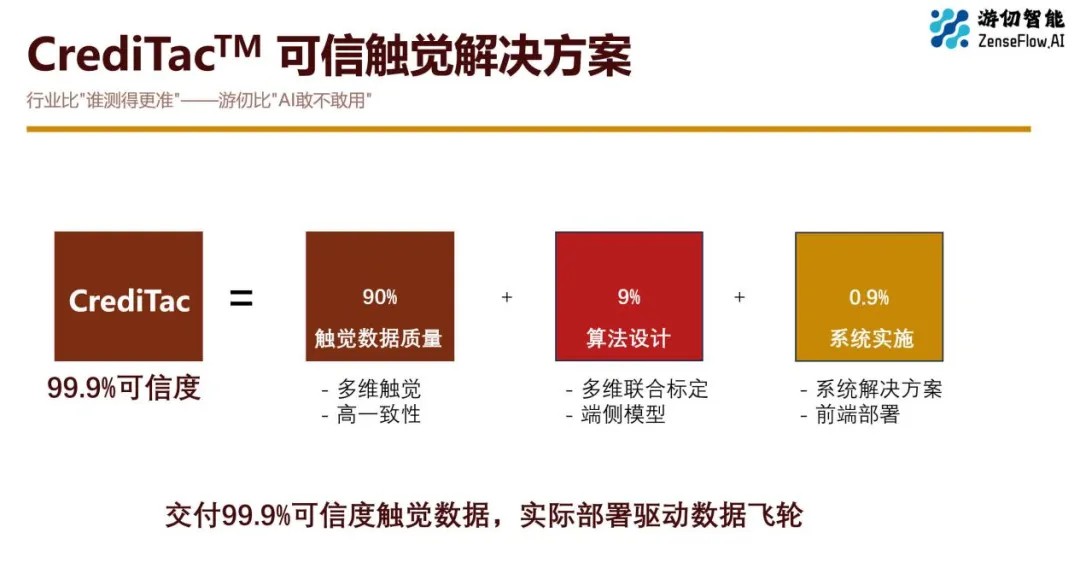
The credibility contribution is precisely broken down: 90% comes from the sensors themselves; 90% comes from the multi-dimensional perception without loss + high consistency; 9% comes from the algorithm design; 0.9% comes from the system implementation. This framework will elevate competition from a single hardware parameter to the full-fledged engineering level of the data-algorithm-system interface.
It's the last inch of being smart.“Suppliers”
It is positioned as a reliable tactile solutions company focused on physical AI, with three scenarios: physical intelligence (control-level program), AI hardware (intention-level program, full-body electronic skin) and health monitoring (diagnostic-level program).
In data strategy, floating intelligence has a differentiated path. The floating industry believes in breaking the Scaling Law through numerical adoption, but we believe that actual deployment is another path. In a Tesla FSD analogy, unmanned aerial vehicles do not rely on numerical adoption and deployment, but on the deployment of continuous, feedback, and replaceable data driven aircraft.
In the face of the current state of war in the field of touch, Zhang Zhen believes,The key barriers are the ability of process platforms and systems engineering.The team owns the industrialised gene for mass production of flexible sensing technology in the field of consumer electronics, an engineered accumulation of aluminum derived from devices that is missing from many academic background teams.
Touch is considered to be the last centimeter of physical intelligence. The fundamental question to be answered first is: What kind of touch data does AI really dare to use?
Starting with the most difficult puzzles of this series, using free-form printing technology in a multi-mechanical fusion as a spear, using the credible framework of CréditTac as a shield, delivering lithium rather than empowering, deploying lithium rather than counting as a strategy, and finding its own intersection between the grand narrative and engineering reality, the journey towards a more credible touch of lithium is just beginning.