How can a blind man go out of his own door and come back to himself?
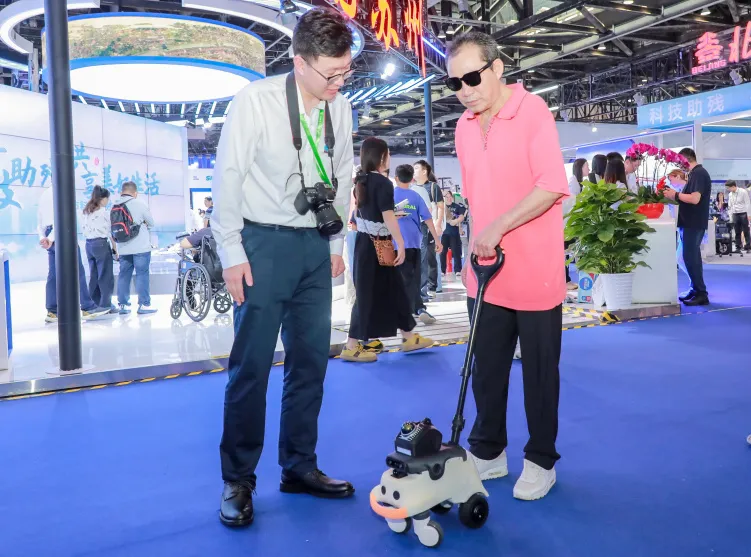
On September 3, at the National Convention Center in Beijing, he gave an answer to this question. At the opening ceremony of the 2026 China International Wellness Exhibition, the two-eyed, light-sensitive company's chairman, led by a robot, walked alone on stage, lectured, and walked down alone.
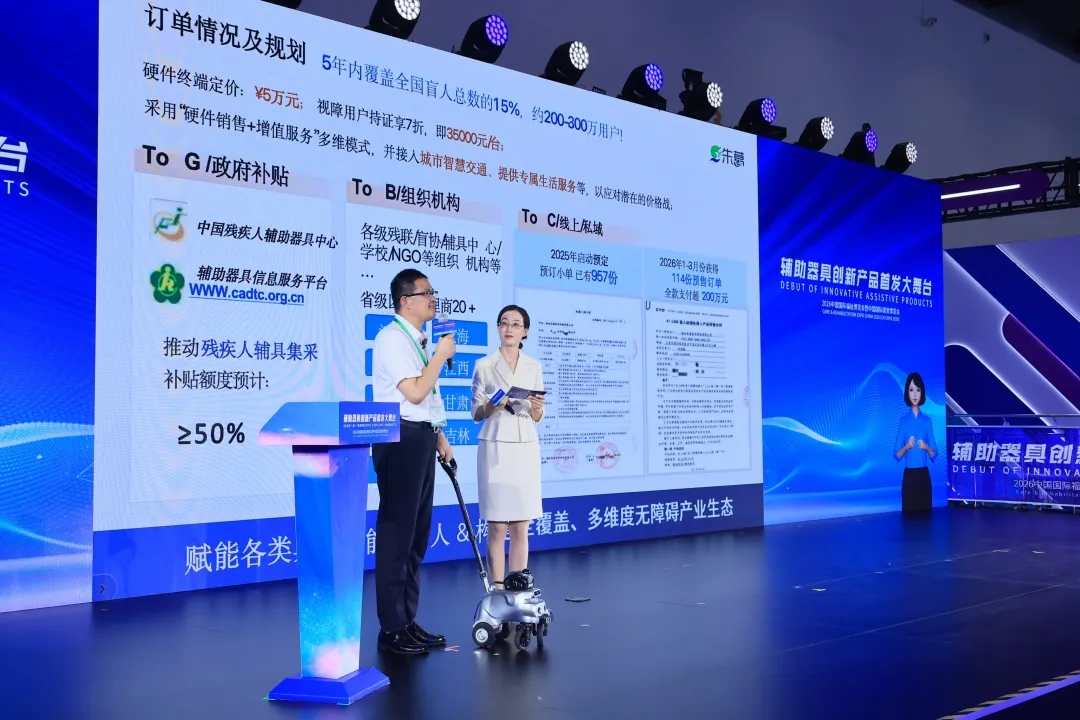
There is no support, no rope, no remote control.
A four-wheeled robot weighing about 12 kilograms, named AI LOOK, which comes from Zhuge Robotics Ltd. in Shandong (formerly Zhuge Software Technology Co., Ltd.), founded by Zhuge Chen, a blind software engineer for over thirty years.
It took six years for the robot to make its debut on stage.
01.
Don't scan the map, don't use remote controls, the switch is off.
The majority of mobile robots on the market are directly judged: they can't go anywhere using SLAM instead of a stranger's house, and they have to scan the space first; the method of operation is either at the point on the phone's map, or with the handle controlled from front to back.
"We don't scan maps, we don't use remote controls, and we can go without a switch".
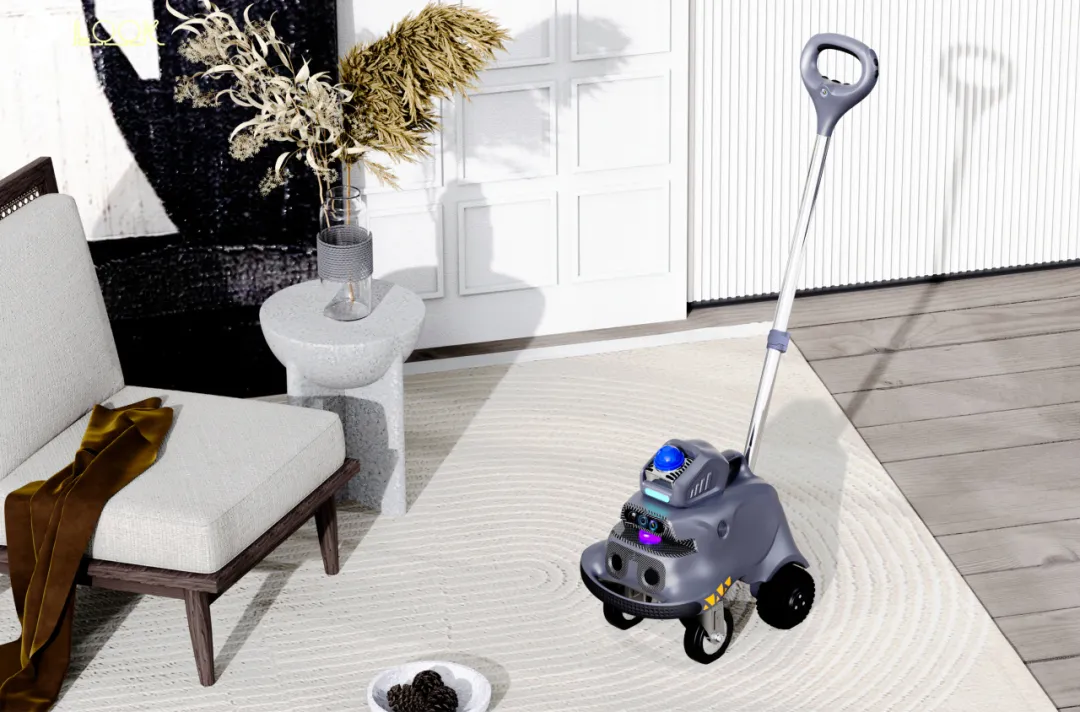
He said that many robots also have laser radars, vision, ultrasound and millimeter waves, but the data of each path is separated by a function, which is based on the laser radar, and the rest is used as a reference. Zieg put the data of several paths together in the same function, and after visualization, clouds, video, ultrasound are superimposed on a chart, the distance, size, whether the ground is flat.
SLAM (synchronous positioning with map construction) has an insurmountable dilemma: robots have to go around creating maps, edge positioning, a process that naturally involves cumulative errors, the farther they go, the more severe they are. It usually relies on back-circle detection (re-calibration when they go back to the position they went through) correction, guideline blindness is linear progression, very few back-circle scenarios, and errors only get worse.
Even more tricky is that it is sensitive to environmental changes. Mobile pedestrian vehicles and lighting changes significantly affect the positioning accuracy of SLAM. Blind travel is precisely the high dynamics, lighting changes in the environment, traffic flow, indoor and outdoor lighting switching, and SLAM is a "disturbance signal" that can cause instantaneous loss of positioning.
AI LOOK abandoned pre-built charts, replacing a fundamental algorithm: instead of pursuing the global coordinates of "where am I", focusing only on the real-time judgement of "can't walk, where can I go" with 0.5 meters of obstacles in front of the wheel, 1.2 meters on the left.
They are not going to let the machine know everything. The logic is simple: see if it can pass, if the cat is a dog or a human, as long as the road turns; if the front is a human, if it is the only way, the robot opens the door and says "please borrow". The function is to avoid obstacles, navigate, pull three things.
Some of the details only the blind person wants to get: the machine pulls people away, not the man pushing the machine; the deviation within 5 meters is not wrong, reversing the two-stroke stop and re-down directions, similar to self-driving start the steering wheel unmoving but can exit at any time; the pace can be adjusted, people are afraid of slowing down a bit; supporting glasses are responsible for things beyond the perspective of the robot, sitting on a high-speed train twisted head at a button, and can read "3A, 4C".
According to the company's public disclosure, the project has acquired a total of 31 software patents and five invention patents, and achieved 360-degree environmental modeling in collaboration with seven types of sensors, including laser radars, depth cameras, and the company has named this multi-sensor integration system a "neural sensing network".
02.
The first-generation prototype was a cardboard box.
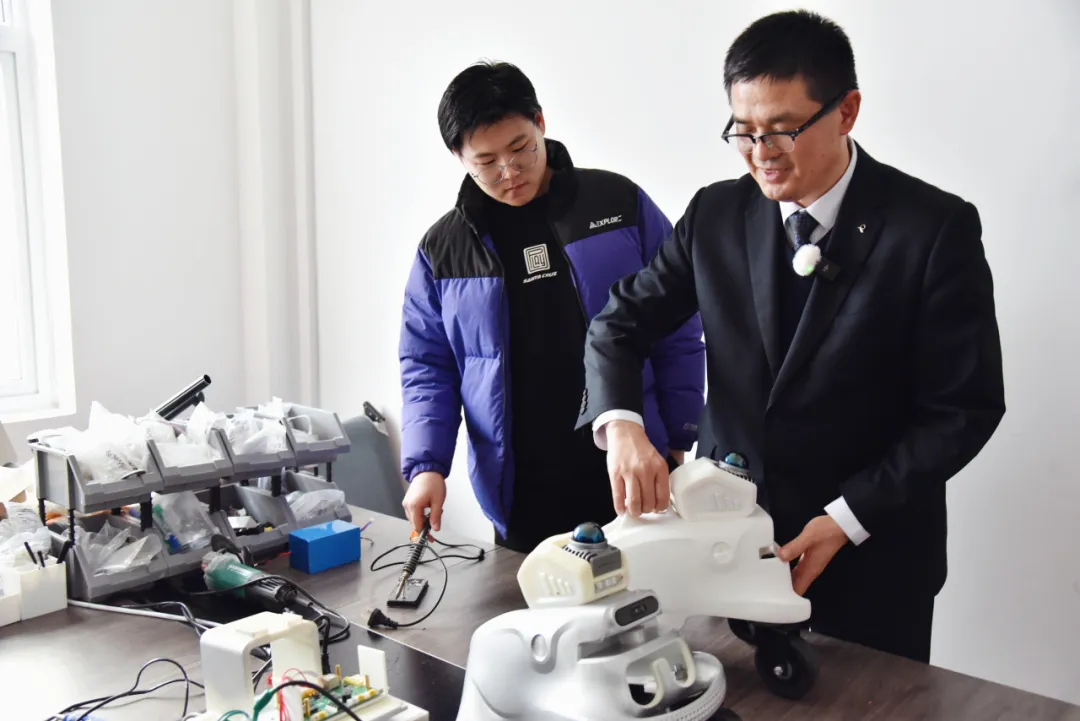
The earliest AI LOOK didn't look as simple as a product: the mobile tray of a computer's host was a tray with a cardboard box on it, digging a few holes, gluing one of the sensors purchased online, and adding a hand. It didn't take anyone away, only pushed it, pushed the data, and judged whether the machine had "understood".
The body as a whole is a magnetic field, 4G cards installed in the bottom of the house without a signal, then moved to the top of the handle to solve. The chip heating can burn the outside of the handle to more than 150 degrees, the heat will open holes, and the holes are not waterproof, this contradiction was finally solved by its own design structure, applied for a patent.
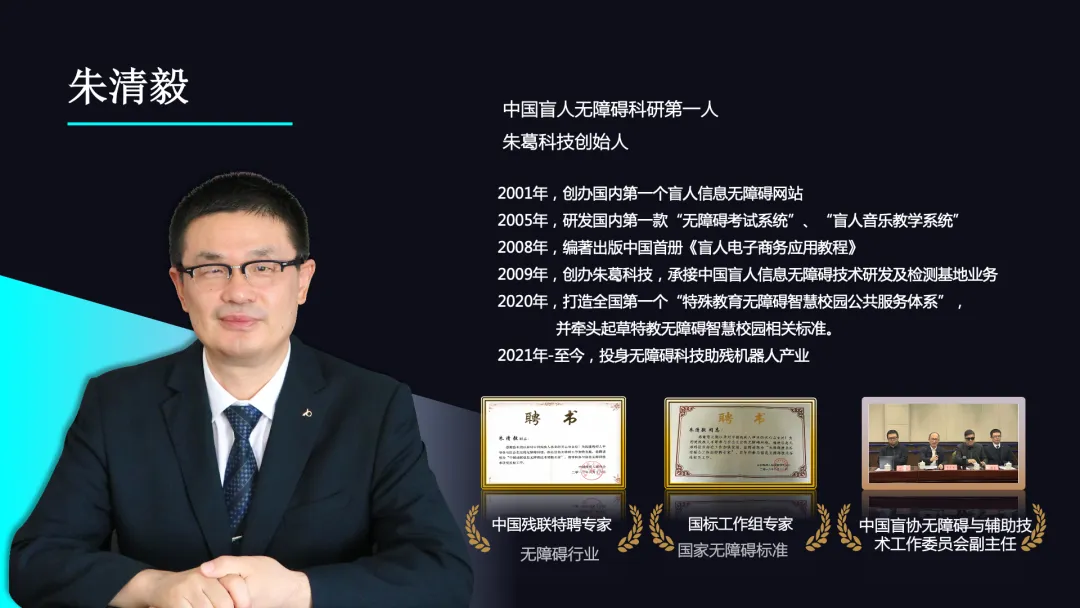
He was born in 1975 in the city of Shandong, at the age of 15 he was diagnosed with retinal pigment variation, and at the age of 18 he studied at home. He was pulled out by a radio: an advertisement before the book was released said that the school for blind children teaches massage, and students can take high school exams.
After graduating, he went to a massage clinic in Shenzhen to practice his craft, returned to the workshop in 2000 and bought his first computer at the end of that year for 7999 yuan, based on self-learning software. In 2001 he created China's first blind website, "Clear Blind Network", in 2005 he self-learned C++ and developed the first blind-free test system in the country, in 2006 he compiled 240,000 words of instruction, in 2009 he founded Zhu Ge Software Technologies, after which he was hired by China Disability as an information technology specialist. These projects have one thing in common: all the needs come from his own problems, and he was the first user.
After 2010, his eyesight continued to decline, and he was unable to get out independently. He said that the biggest constraint was bothering others. Some reporters asked the blind person if he didn't like going out, and he said it was a lie. It was like a person with two legs saying he didn't like walking, did you believe it. He also didn't like using a wand and thought it was a label.
In 2020, he listened to a round of robot-related discussions at the China Disability Federation "144-5" Preparatory Meeting and went back to the company. He later explained why he quit: most of the people who make products are healthy people, it's hard to really touch the pain points; he himself is a visually impaired person, he doesn't really work, and a group of visually impaired friends around him can be a product manager.
As for the name "Juge", many people think it's a pun on "Geek", but it's actually a combination of the surnames of him and his wife, Ms. Geek. Both are visually impaired and are classmates at Springsteen University.
Every time he encounters difficulties, when he thinks about the support of his wife, the expectations of his children, he is full of strength. The team is influenced by him.
03.
Helping the Blind"See", or "take him away".
The guide-blind robotics industry is answering a more fundamental question than what the technology can do: should products be prioritized - whether the robot sees the robot or whether the robot walks the path?
Over the past decade, the vast majority of assisted walking products have chosen the former: using sensors to identify obstacles, voice or vibration to tell users that there is something in front of them. But after testing all these products, Zhu Qing concluded: Even if it says there is an obstacle, I still can't walk.
Common ancillary travel equipment is roughly divided into three categories: smart blinds with sensors, wearable devices (including glasses, seatbelts) and guided blinds with robots. The enhanced blinds, published by the Stanford team on the Science Robotics website, are among the most cited achievements of the previous path, which uses laser radars and inertial sensors to detect and identify obstacles, navigate along indoor and outdoor routes, push prices to hundreds of dollars, but it still requires users to make their own decisions.
Most products stop at the "informational" level: telling a blind person what obstacles are in front of them, how far away they are, and what the blind person really needs is something to carry him around.
According to the Chinese Association of People with Disabilities, there are more than 17 million people with visual impairments in the country, while only about 400 people with visual impairments have one, and an average of more than 40,000 people with visual impairments can have one. A dog's training cycle lasts for two years, and the cost of training alone is about 200,000 yuan, with a success rate of about 55%.
It's also because of this gap that players from different backgrounds have been crowded over the past year. In April this year, Alibaba-owned GoDaddy released the four-legged robot dog "Way Path", officially calling it the world's first fully autonomous robot that can operate in an open environment, navigate without a preset route or manual remote control, with a back-powered feedback lever, steady power when turned, and braking after an accident.
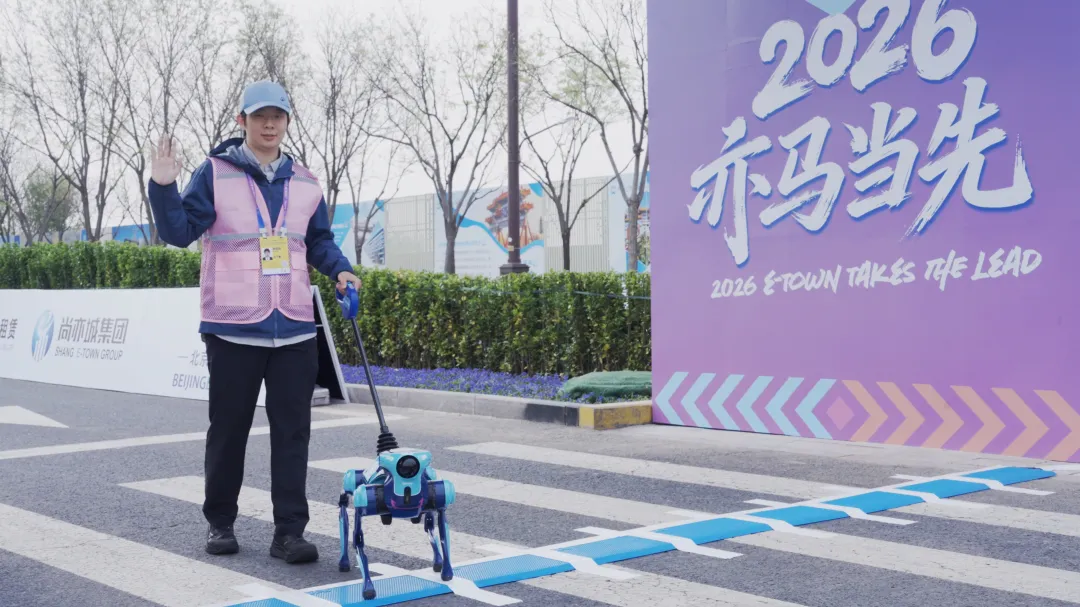
On September 4, the day after the launch of AI LOOK, the Chinese weapons industry group's Hangzhou Chiyo Institute of Technology launched the wheel-footed guided robot "Small Far" at the same well-being exhibition: sliding on flat wheels, encountering stairs to automatically switch off four-footed crawlers, detecting suspended obstacles such as low-hanging branches, an outdoor positioning error of no more than 30 cm, a success rate of 99% of indoor obstacles, 96% of outdoor obstacles, has been tested on subways and commercial sites.
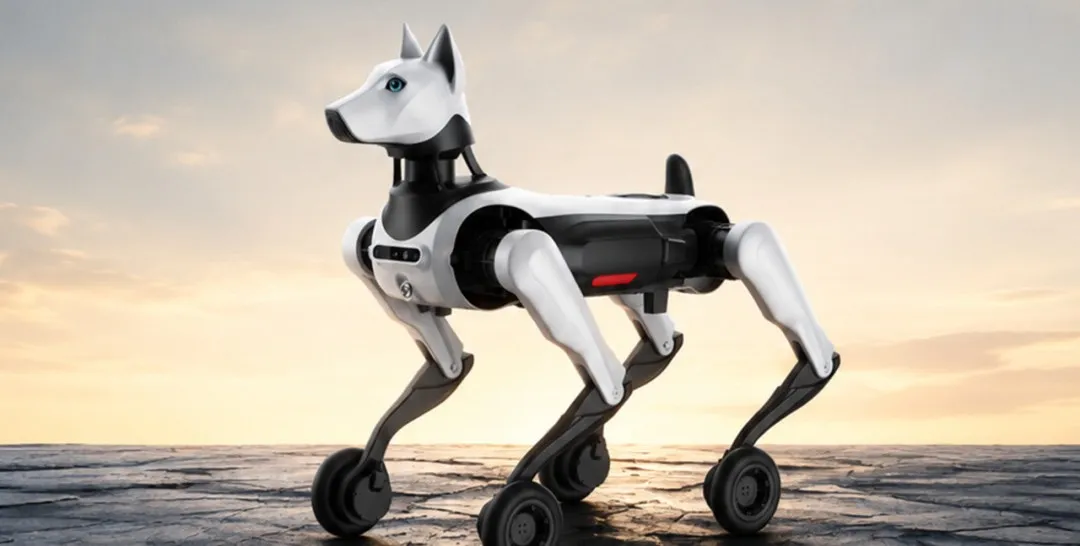
On the issue of climbing the stairs, Zhuqing's plan is to allow people to walk independently, and the machine only completes the staircase information broadcast. He calculated this bill: four-legged machine dogs weigh 30-80 kg, wait 2-3 hours, sell for 8-150,000 yuan, climb down stairs often need to close the barrier, in a complex staircase this situation is easy to fall, and can cause risk to the pedestrians around him. His answer is: what kind of people have to rely on the staircase?
04.
It's hard not only to create, but to use.
According to public reports, AI LOOK started pre-sales in January of this year, when there were more than 200 complete orders; around 1200 units were pre-sold at the beginning of August, with the first batch delivered as planned in September, at a scale of two to three thousand units.
Although the price of 3 to 50,000 yuan is already lower than the cost of raising a live guide dog, it is still not a small number for a family of visually impaired people.Currently, guided-blind robots have not been included in the national unified list of subsidies for the adaptation of accessories for people with disabilities, and the deeper obstacle is that these new categories do not yet have specific national testing and performance evaluation standards as a unified assessment benchmark, which is an important obstacle to defining qualified products, entering the national unified list of subsidies. Whether or not they are included, subsidy ratios, purchasing patterns are in local pilot status, and the industry has not yet formed a stable payment guarantee mechanism.
Second, the identity and responsibilities of public scenes. The current Law on Building a Barrier-Free Environment guarantees the right of guide-blind dogs to enter public spaces, but there are no clear rules on whether autonomous mobile guide-blind robots can travel underground, enter shopping malls, and allocate liability for accidents at the national level.
Three are real road tests. Blind tracks are shared by bicycle occupation, traffic jams, temporary construction fences, rain and snow weather, these are common problems for all guided blind equipment. The high accuracy measured in the laboratory is not equal to the actual performance of city streets.
The company plans to launch an online developer platform by 2028, open voice interaction, route planning, and other interfaces.
He also has two unrelated wishes: to include equality of treatment for people with disabilities in basic education curricula, and to set up a special research and innovation fund to help disabled technology companies.
Six years ago, he set a very small goal for himself to get out of the house independently. Now the robot is going to be delivered to two or three thousand strangers.