The robot VLA is still rolling data wildly, and the StarVLA team is now focusing on another question: Can we learn more about each data in addition to continuing to scale the data?
They recently released VLAct, the VLM undercarriage for the VLA.
VLAct continued pre-training using only open-source data and 16 GPUs, but it was quite successful: RoboTwin 2.0 had a 92.5% success rate; it outperformed all the models explicitly labeled as World Action Model (WAM) in the RoboDojo list; it used only 20% of the RoboCasa-GR1 downloadable data in front of the GR-1 robots that had never been seen before in the pre-training phase, surpassing the total data baseline of the NVIDIA GR00T N1.6.
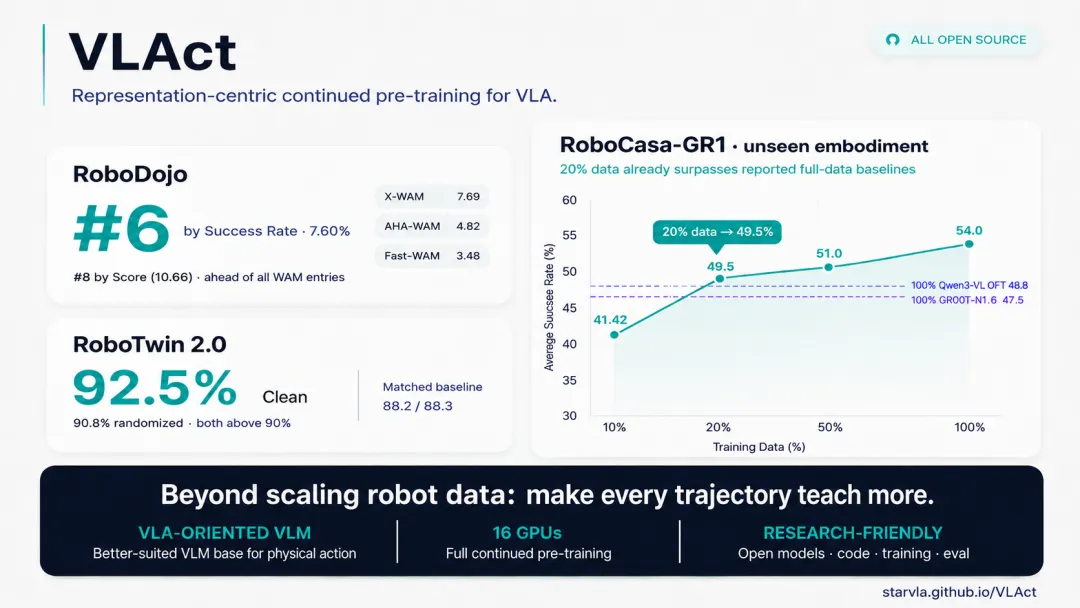
The main results of VLAct: RoboDojo, RoboTwin 2.0, RoboCasa-GR1, and 16 GPUs with full open source.
Robot data
You can't crawl like Internet data.
Over the past few years, the big model has proven a very effective path: more data, bigger models, stronger calculations, and more and more capabilities.
However, there is an undeniable reality in the field of robotics: robot trajectories are not web data and cannot be crawled directly from the Internet. Each data requires a robot to actually perform operations in the physical world, often behind remote operations, data collection and hardware costs. What is even more troubling is that robots end up facing an almost limitless combination of scenarios, objects, tasks and robotic formats.
So VLAct isn't trying to deny Data Scaling, it's adding to another question: Under the same data budget, can the robot trajectory be left in the Backbone with more knowledge that can cross-task, cross-Action Head, or even cross-robot migration?
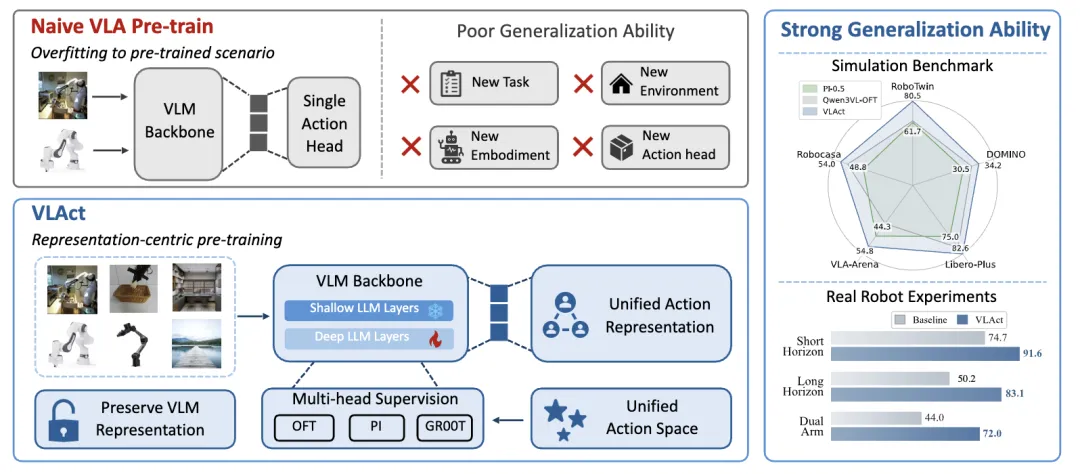
Figure 2.Naive VLA pre-training Easily bind pre-training scenarios; VLAct moves targets to more mobile Action-aware Representation.
A slightly uncommon finding:
Action learns better, but backbone doesn't have to be better.
VLAct is the real starting point, a very interesting phenomenon from the team's previous experiments. Many VLAs now start from a VLM, hang on to the Action Head, and then continue training with robot data.
However, the experiment found that this was not necessarily the case. Following continued pre-training with the OFT Head in RoboTwin, the success rate increased from 61.7% to 75.8% if the downstream continued to use the OFT; but switching the same Backbone to the PI Head, the downstream dropped from 60.5% to 55.1%; switching the GR00T Head even dropped from 51.2% to 28.9%.
In other words, the policy has become stronger on the original Head, not that Backbone has become more universal.
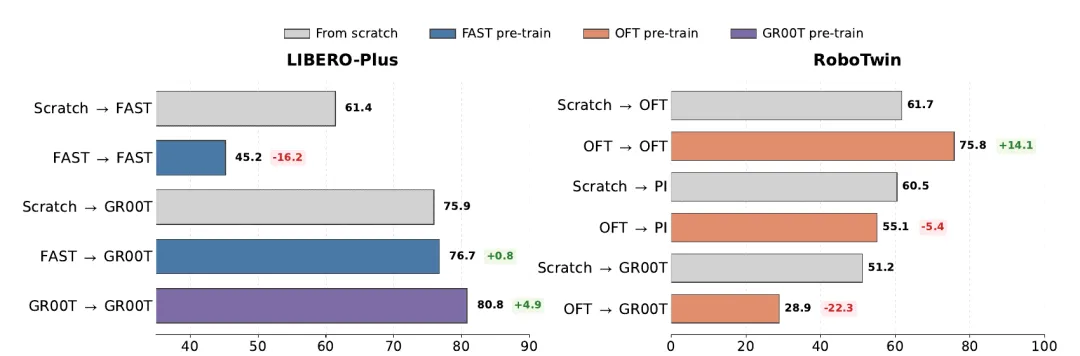
Action supervision directly shapes Backbone: improves performance with Head and does not automatically convert to Cross-head migration capabilities.
The reason is also intuitive. Action Head and Backbone are trained together, and with only one Head, Backbone can easily learn a Feature Geometry that is convenient for the Head to read. For the current Policy, of course, this is good; but after changing an Action Head, tasks and even robots, these Representations may not continue to be repeated. The paper calls this phenomenon head-specific representation collapse.
So VLAct redefined the purpose of continued pre-training: not to train a fixed Policy Initialization that already does a lot of action, but to train a VLM Backbone that can continue to be used by different Action Heads, different tasks, different robots.
So how do you prevent Backbone from being biased?
To achieve this goal, VLAct did not reinvent the complex Policy Architecture, but did three things in the continuous pre-training phase.
First, don't forget what VLM originally learned. VLAct protects the Vision Encoder and the shallower LLM layers, while blending Caption data to allow the model to retain its original visual language priorities while learning Action.
Second, don't let an Action Head do the math. VLAct hangs three consecutive Action Heads on OFT, PI, and GR00T at the same time, letting them read a Backbone together, predict the same set of moves. So Backbone wants to serve different Decoders at the same time and can't just organize information into one of the Head's favorite formats.
Third, this shared physical meaning is shared between different robots. For example, the opening/closing of the clutch is highly similar in physical meaning on different robots, but the freedom of the different mechanical arms and the kinetic structure cannot be roughly unified. Therefore, the VLAct only unifies the truly consistent Action dimension, while the rest remains embodiment-specific.
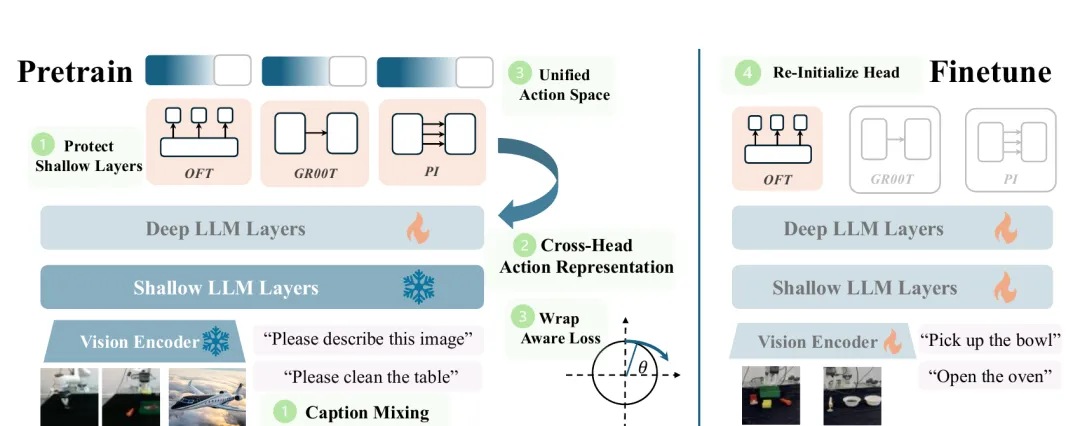
Full training framework: Preserve VLM Prior, Multi-head Continuous Supervision, Partially Unified Action Space, downstream restarting Action Head.
RoboTwin 92.5%
Robo Dojo is above all WAM
At the end of the day, this representation can't be migrated, or the results can be seen. On LIBERO-Plus, VLAct reaches 82.6%; on RoboTwin 2.0 with two-arms operation, the Clean Scaling success rate further reaches 92.5%, and the Random setting reaches 90.8%.
On RoboDojo, VLAct achieved a 10.66 Score and a 7.60% Success Rate, and outperformed all competitive models explicitly labeled as WAM. That is, this set of pre-trainings is not only effective on a particular robot, a particular benchmark.
The paper also covers single-arms short sequences, long sequences, two-arms synchronization, and OOD settings such as Novel Object and Full Substitution on the Franka machine.
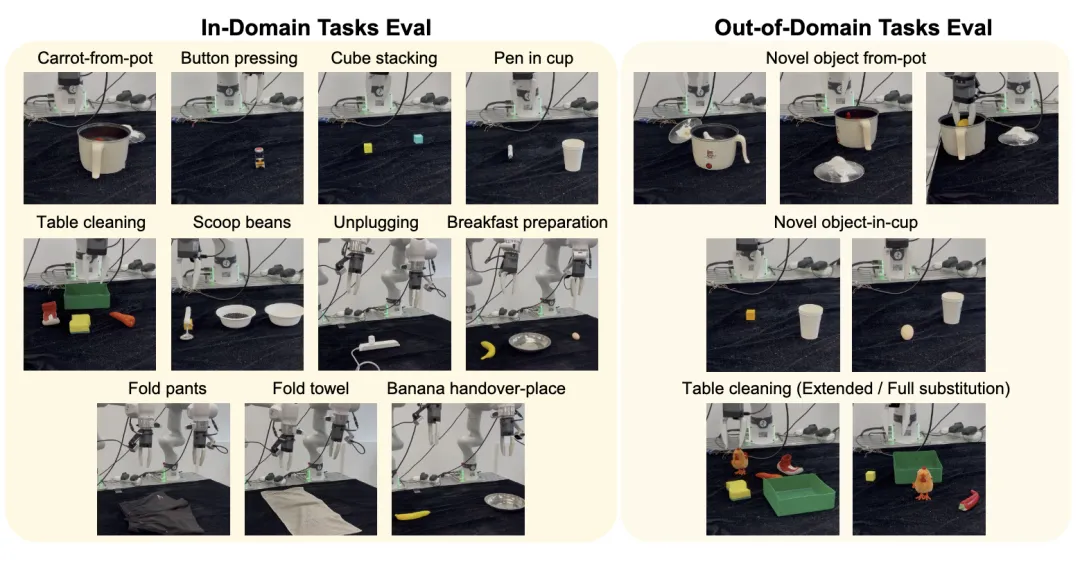
Figure 5 Real robot evaluation tasks: including In-domain and Out-of-domain, short time sequences, long time sequences and arm operations.
20% data
Over 100% of the GR00T N1.6
The best demonstration of the migration capability comes from RoboCasa-GR1. GR-1 has never appeared in the VLAct continued pre-training data: Pre-training models see robots like Franka, AgileX, and then take the Backbone to the GR-1 for downstream fine-tuning.
With only 20% of the RoboCasa-GR1 trajectory, VLAct has a 49.5% success rate, exceeding the GR00T N1.6 and Qwen3VL-OFT total data baselines; VLAct reaches a further 54.0% when the data is upgraded to 100%.
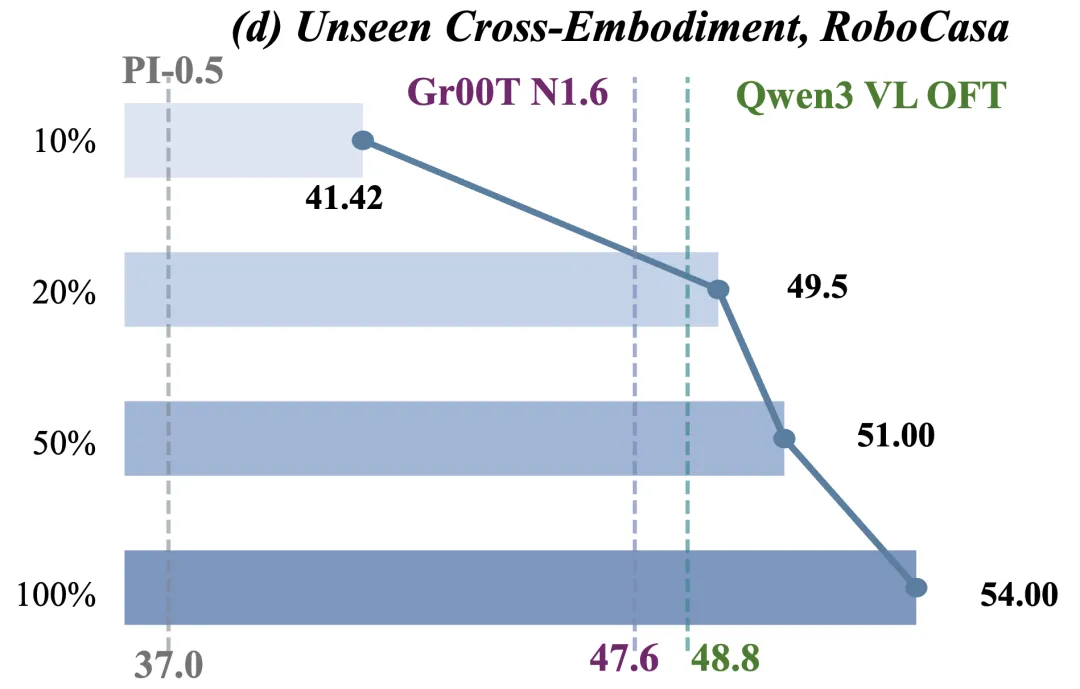
Figure 5: Single-arms/long sequences/two-arms results, and cross-body migration of RoboCasa-GR1; 20% of downstream data has exceeded public full-data baselines.
Beyond Data Scaling
Let's make every robot's data more valuable
VLAct is not trying to prove that data is not important. Robot data, of course, needs to continue to scale, but because robot data is expensive, scarce, and difficult to fully cover the real physical world, Representation Quality itself should be a separate axis of VLA Scaling.
In the past, people have asked more often: How much more robot data can VLAct collect? VLAct wants to ask one more question at the same time: How much of the same robot data can models learn that can be migrated?
The entire VLAct continued pre-training based on Qwen3-VL-4B, using only open robot data and 16 GPUs. Currently, the Model Weight, Checkpoint, Data Processing and Training Pipeline is open, hoping to deliver a more physically-friendly and research-friendly VLM Backbone to the VLA community.
The main page of the project:https://starvla.github.io/VLAct/
Beyond Data Scaling: Representation-Centric Continued Pre-training for Vision-Language-Action Models
Address of the paper:https://arxiv.org/abs/2608.27550
GitHub:
Hugging Face:
X: