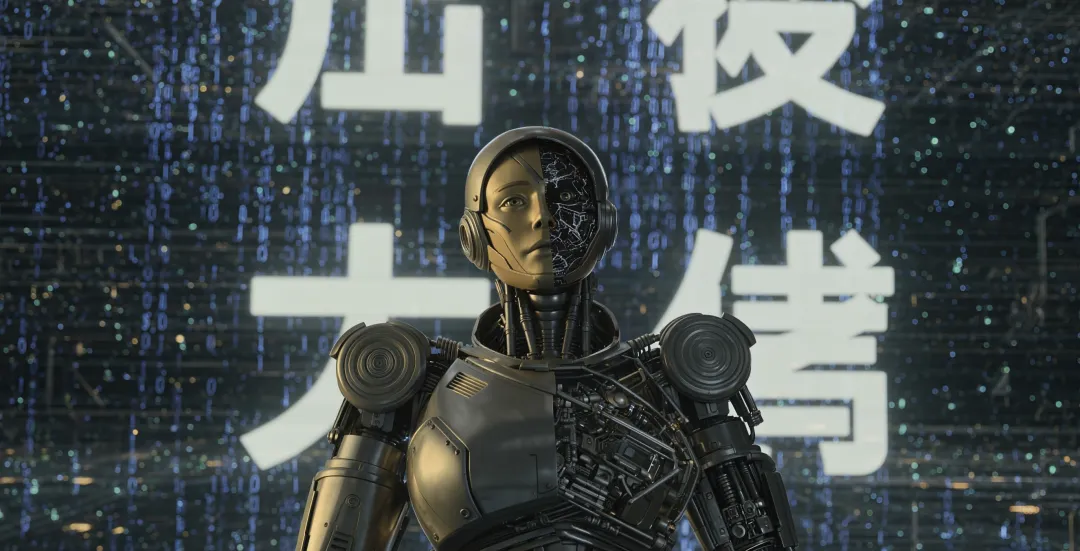
“ When the Iron Age encountered the reality of the iron curtain.
At two o'clock in the morning, in an office in Shenzhen, an entrepreneur just turned off the road show PPT. On the screen is the last page, smart, the next trillionth race. His coffee has cooled down, but the WeChat crowd is still jumping.It's the best half of the year for being physically intelligent.
At the end of the 2026 half-year, A shares had more than 500 companies that wrote four words in Chinese. Almost at the same time, the first half of the year's financing data was released, 322.935 billion yuan, half a year more money than the previous year. Capital, policies, publicly traded companies, newly registered enterprises, all are squeezing in the same direction.
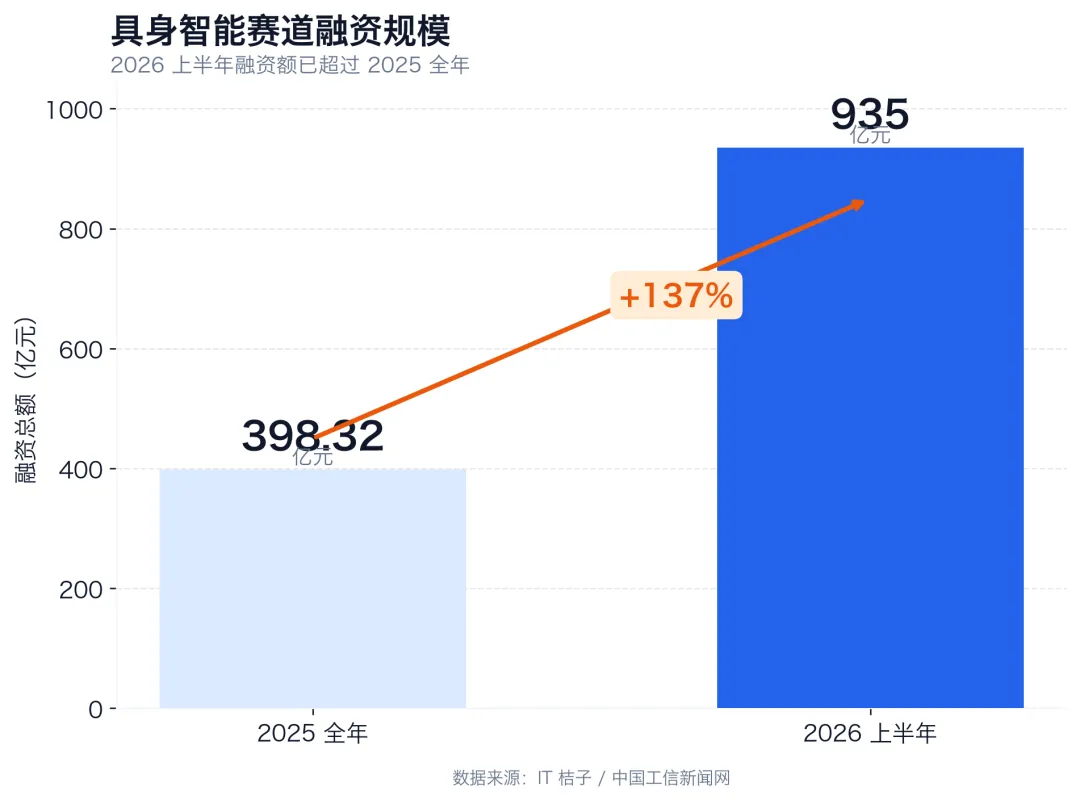
Figure 1 Fitted Smart Track Financing Scale
If you only look at the financing, smart people are in the best summer possible. But where there is no sunlight, more companies are losing their heat.
Of the more than 500 companies that wrote the word, only 23 have actually spoken of it more than 10 times; they are actually getting the corresponding revenue in the semi-annual papers, only one figure. And in the $93.5 billion financing, the first 20 companies took about $55 billion, close to 60 percent.
So this isn't an industry-wide boom story, it's a raffle. $935 billion isn't spring raining on everyone's heads, it's redrawing a line. Online companies get capital, get exposure, get policy dividends.
01.
Smart capital
Capital has never been an averageist, but in this race to be physically intelligent, the concentration of 2026 still exceeds many people's expectations.
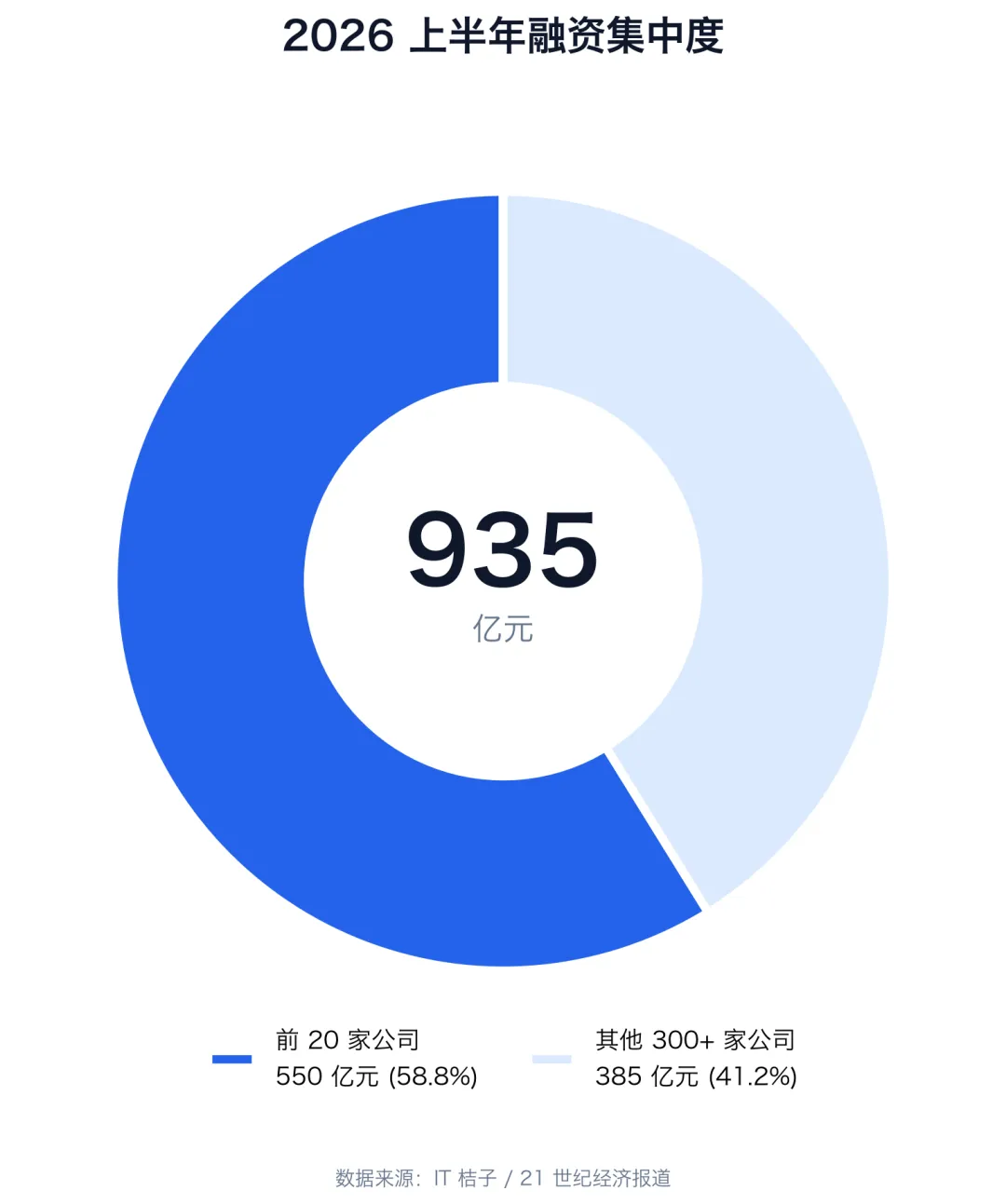
In the first half of 2026, US$93.5 billion of financing will be distributed
In the first half of 2026, a total of $93.5 billion was invested in smart racetrack financing in the first half of 2026, which is over $398.32 billion for all of 2025. This is a surprising growth in itself, showing that the enthusiasm for this direction has not waned. But if you pull down the financing list, you will find that $93.5 billion is not the equivalent of more than 300 companies.
Behind this focus, the technological and business routes of physical intelligence are not yet intertwined.Human robots, four-legged robotsLogistics robots, big smart models, betting in almost every direction, but not one direction has run a steady profit pattern.What would capital do in such a situation? It would choose the highest standards of certainty. The highest standards of certainty are usually companies that already have products, have orders, have a reputation.
That's not to say that the top companies are technically the best, but that they are the least likely to keep investors awake. When the circuit as a whole is in a period of high risk, the safety effects of the headers will be amplified indefinitely. So we see that after the completion of the B-Round financing in February, the value of Stereotype is estimated at about 10 billion yuan, and after the April B+ round, another 20 billion yuan; the engine robot completed the $200 million B-Round in April, with a valuation of over 1 billion yuan; the Stereotype era relies on logistics orders from Shenzhen, with a cumulative order of 500 million yuan, and financing of nearly 2.5 billion within half a year.
These companies have one thing in common:They are no longer merely a team that tells technical stories, but that pulls out verifiable delivery records.“The next round of financing is still underway.”The expectations.
This also means that startups in the waist and tail are finding it increasingly difficult to make big money. In the first half of 2026, funding was concentrated heavily on angels, Pre-A, A, A+ rounds, B rounds and beyond, accounting for only 19.4%.The B-Round was supposed to be a point of view, a point of view, a point of view, a point of view, a point of commercial verification, but now, at this point, capital is beginning to hesitate.。
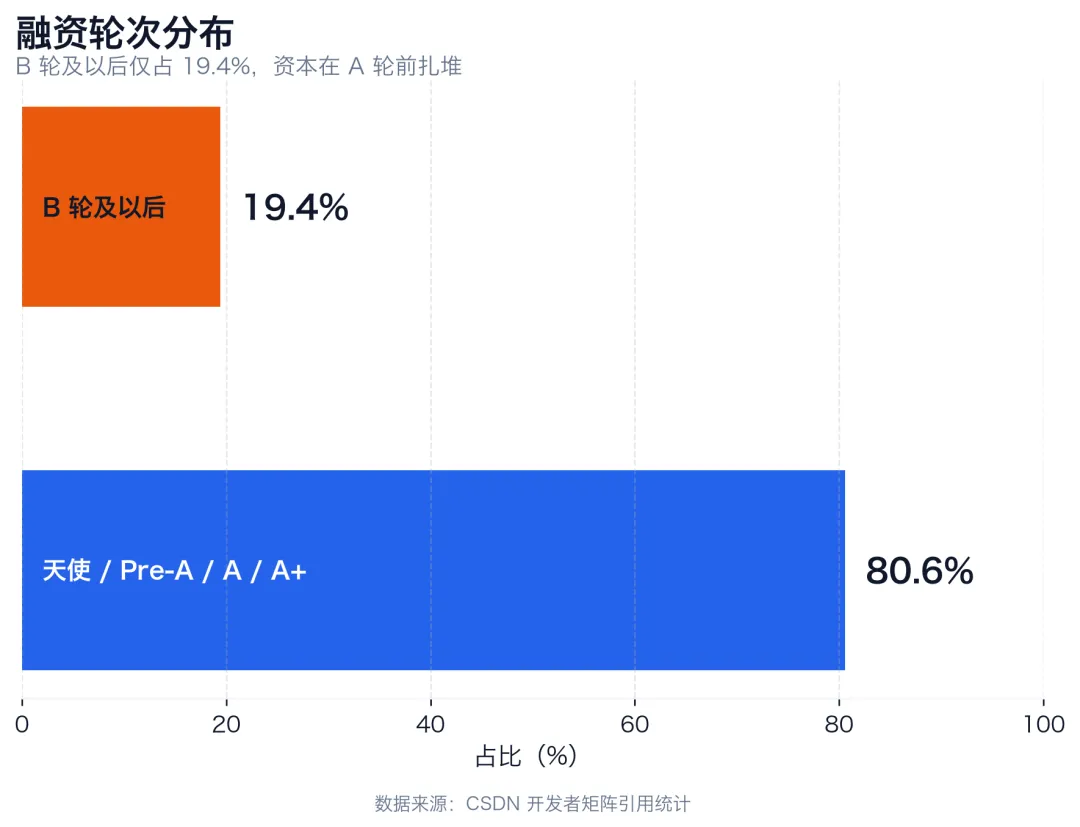
Distribution of rounds of financing in the first half of 2026
Round A can build a team and a demo, Round B must build a business. Most companies have yet to prove themselves as a business.
More importantly, the threshold for early financing is rising steadily.Seed Wheel and Angel Wheel combined for just 73, amounting to less than 1.3 billion yuan, accounting for only 3% of the entire race.The founder of Intelligent Data, Dr. Mashiyuki, is a PhD student at UCLA and has worked at Google Robotics and NVIDIAResearch, completing six rounds of financing within six months of its founding, the latest of which is the nearly 500 million yuan angel+ rounds.
These cases, of course, show that top talent is pouring into the race track, but they are also releasing another signal.An early team without a top track record is losing the chance to get their first money. The technological threshold is being replaced by the track record threshold. This is not a good phenomenon, because it means that innovation may no longer come from the garage, but from people who already have the resources.
02.
It's a dream come true.
When big money flows to the head, small companies are basically digging their own pits if they want to compete on the whole plant route.
The logic of the factory looks sexy, making a robot that looks like a human being, selling it to the factory, selling it to the family, selling it to the hospital, and millions of families will have one in the future. But the problem is that the future is far away and the competition is fierce.
For small businesses, the more realistic option is three narrow paths.
The first is the supply chain, the wrong machinery factory.
The most serious, the most expensive, the most difficult to verify, but the decelerators, the motors, the smart hands, the sensors - these are the core parts - have real orders and raw materials. In the first half of the year, the robot intelligent drive system of Shinsuke Electric earned 606 million yuan, an increase of 114.7 percent. The business does not look like a humanoid robot, but it has customers, repurchases and cash flow.
The second is to break down the scenes and use the data to change lives.
Instead of being humanoid robots, it's better to explore these specific scenarios in storage logistics, automotive production lines, and 3C detection.
What they have in common is that they don't tell investors how powerful my robot is, but how many days my robot has been running on a customer's product line and the customer has already paid the second money.
These delivery data are more convincing than at any conference. For small businesses, the most important indicators are not the volume of shipments, but three things: the continuous running time of the unit, customer repurchase rate, second orders. These three indicators are more honest than the amount of funding and valuation.
Third, binding large customers from POCs to long-term suppliers.
Small companies don't have a brand premium, but they can be a scene verifier and customizable supplier to large factories or large customers. This route is unsexy, even somewhat clumsy, but it can survive.
Of course, mergers and acquisitions are also a way out, but this is not a good idea. For many companies in the waistline, instead of sticking to capital in the cold winter, rather than being acquired by a head or public company, it becomes someone else's business department. This is not a failure, but the necessity of industrial integration.
03.
Some 500 families are making real money.
I'm going to talk about a startup company, and I'm going to look at A-shares.
In the first half of 2026, more than 500 companies mentioned "physical intelligence" in the official language.The term has evolved from a technical concept into a capital market language. When a word is used simultaneously by 500 companies, it usually deviates from its original meaning.
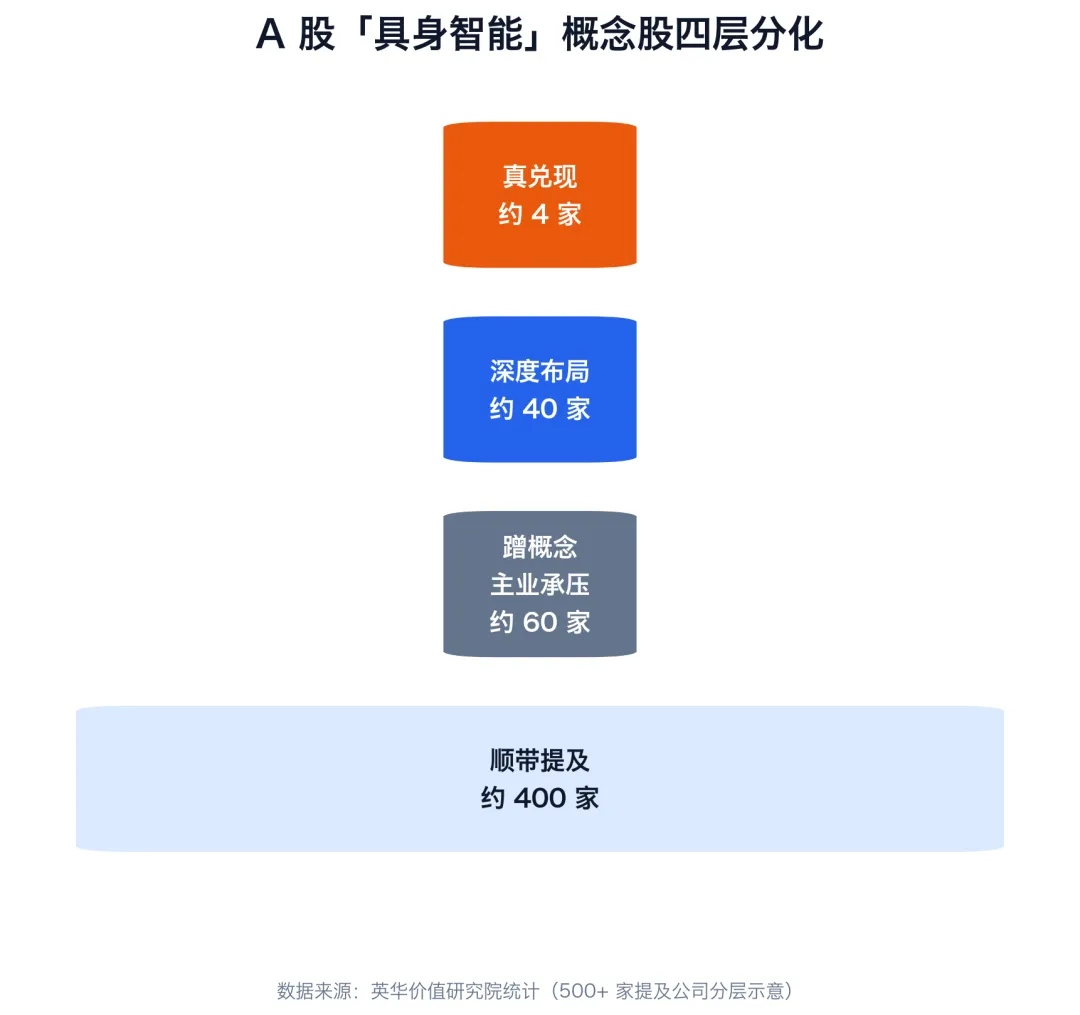
The more than 500 companies can see four faces if they are layered.
The first floor is really productive companies, very few in number.。
Xinjiang Electric's robot intelligent drive control system revenue was ¥60 million, an increase of 114.7%; Vietnam Xinjiang Technology had a physical intelligent business revenue of ¥45.23 million in the first half of the year, an increase of more than 20 times, accounting for 14.3% of total revenue. The common point between the two companies is that the main industry and robots have a natural connection point.
The second floor is a company with a deep layout, not much.
In the first half of the year, Toyota made a net profit of 104 million yuan, an increase of 262.99%; Koje made a net profit of 733 million yuan, a net profit of 5650 yuan, an increase of 251.57%; Smart made a net profit of 305 million yuan, a net profit of 388 million yuan, an increase of 281.9%; Koje made a net profit of 733 million yuan, a net profit of 5650 yuan, a growth of 251.57%; and Koje made a net profit of 305 million yuan, a net profit of 388 million yuan, a growth of 281.9%.
The wording of these companies is new, the workmanship is old. For them, physical intelligence is not a transition, but the next version of the old one. Their advantage is that they have manufacturing capabilities, a customer base, cash flow, and can slowly build new businesses.
On the third floor, the number of companies with the silicon concept is significantly higher.。
Housson Smart lost $425 million in the first half of the year, with revenues falling by 13.5%, but the half-year paper frequently mentions "smart in body".
It's hard to say that they're completely out of order, but at least from the financial statements, it's not clear that physical intelligence has become their second growth curve.In more cases, physical intelligence is a narrative export that is used to hedge the decline of the mainstream industry, giving investors a space to imagine the future.
The fourth floor is the companies mentioned in the sequence, which is the majority.
They're only mentioned one to three times in the context of the industry, with no products, no revenue, no strategy. They're not doing it, they're just saying.
04.
POC heat pumps, buy-back and cooling
More than 500 companies are saying the same thing, but with so few orders and revenue, what's the problem?
The first problem is narrative before products. Policy gives wording, capital gives heat, semantics gives expression. Many companies with physical intelligence are still stuck in the keyword embedding stage. They may be doing a robot sampling, may have signed a strategic cooperation agreement, may have attended several exhibitions, but these distances are far from commercial closure.
The second problem is that the technical routes are not intersected, the scenes are fragmented. Humans, quadriplegics, collaborative arms, logistics robots go their separate ways; hardware, models, data, scenes do not have uniform standards.The result is that everyone is doing POC, but it's hard to scale it up. One project is done and the next project is almost done over and over again.。
The third problem is re-manufacturing, light value. Manufacturers with the largest volume of shipments tend to make the least profit. It is the manufacturing industry's easiest trap to bet on scarce resources.
The fourth problem is capital overvalues, but not delivery capabilities. When someone buys a company with a valuation of 20 billion yuan that does not yet have stable income, the next round of financing starts, not the customers. This game of anticipated subsidies can be played for a while, but once the financing environment tightens, companies without real income will collapse first.
The fifth problem is that the actual available scenarios are still limited. The Ministry of Industry and Finance and the State Finance Commission launched in June 2026's Human Robot and Body-Smart Real-Scenario Special Action, which explicitly portrays warehouse logistics as the golden scenario. The phrase itself illustrates an embarrassing reality that in addition to warehouse logistics, automotive production lines, specific industrial inspections, most of the scenarios are still in the verification phase. Most companies are looking busy, but customers are not willing to pay a second penny.
In a concept buzz, there are about three characteristics of a company that is truly capable of transforming its physical intelligence into a business.
First, the mainstream industry and robots have a natural connection point.These companies are not moving, but upgrading. They have customers, they have channels, they have manufacturing processes, and new businesses can grow out of old business.
Second, there is real production line data and buybacks.It's not a demo video, it's a customer-on-site continuous run; it's not the first order, it's the second one, it's the third one.
Third, from selling the whole machine to selling the effect.This transition is difficult, but once completed, it means that the company is no longer just a supplier of equipment, but a solution provider. Customers pay for the result, and the company has the ability to negotiate prices continuously.
05.
The money is still burning and people are tired.
At two o'clock in the morning, a humanoid robot fell for the 37th time. Its joints were still hot, and the team no longer wanted to film the video.
At the launch half a year ago, the robot and its founders stood under the spotlight together. Dozens of funds sat on the platform, and the last page of the PPT wrote: "Define the next decade".
Every day there are new companies registered, every day there are new financing announcements, every day a new scene is redefined.But the faster the money burns, the more people get tired, because most teams aren't solving a real problem, they're catching up with a timetable that's fueled by capital.。
Investors are also tired. Looking at 20 projects on the same track, BP's technical route, landing scene, team history are becoming more and more similar. Everyone knows that there are actually so many people who can invest, but no one is willing to stop first.
Entrepreneurs are more tired. Companies that make integrated systems are hard at work, companies that make supply chains are pressing prices, companies that make POC are waiting for a second order.
It's not the worst moment in the industry, it's the worst moment when no one wants to talk about it anymore, at least now someone is talking about it, there's money coming in, and the company is booming. But it's not the best moment.
So six months later, we look back, and this $93.5 billion may not leave a lot of product, but it will leave a collective feeling - a fatigue after a heat wave, a wake-up call after a rave.
It's not who gets the most money, it's not who gets the most headlines, it's the robot that runs the production line for more than a day, who makes customers willingly pay for the second one, who survives a seemingly unsexy split scene.
It takes a little less performance, a little more delivery; a little less conception, a little more patience; a little less defining the ambitions of the next decade, a little more humility to get this machine running.
Otherwise, in the next half-year, we'll see more companies that are full of body-smart, but we won't find a few industries that have really been changed by it.