The user simulator is entering the AI agent training process. In customer service, e-commerce, medical consultations, web operations, and other scenarios, researchers construct a user simulation that allows agents to experience more interaction, testing strategies, rhetoric, and rudeness before they go online.
The educational landscape also requires such a user simulation, but here the "user", or "student", is more difficult to simulate: a student has relatively stable knowledge boundaries, erroneous habits, and learning trajectories; student simulation emphasizes the reliability of student cognitive dynamics, the same guidelines that may allow one student to correct a mistake or allow another student to learn only the correct answers.
That's it too.Number of students bornReasons for concern. AI teachers need to learn personalized guidance, need to see students' responses to teaching content and teaching strategies. Real student feedback can provide these signals, which are often costly to obtain through student participation in human testing.
If you tell it, "You're a weak-ass elementary school student", the model can instantly change into an elementary school's catchphrase, but it can also show hesitation and uncertainty.
But the tone of the character and the level of cognition are not the same thing. One model can answer "I don't know much" with the tone of a younger student, while the next one gives a mathematical grade-level reasoning. It looks like it is playing a student, and the actual feedback is still influenced by the model's own knowledge reserves.
In AI teacher training, this bias is problematic. AI teachers are not responding to a student's response below the current capacity limit, but to a high-performance model that has been packaged by humans.
A recent collaborative study by Microsoft and UIUC, StudentSim, is the starting point for this issue. In education, an evaluation of the effectiveness of instruction is based not only on how students respond independently, but also on how far they can go after receiving help. Vygotsky's "Recent Development Zone" discusses what students can accomplish independently and what they can accomplish with teacher support, and the gap between reflects the space for teaching to intervene.
Putting it on a student simulator, this idea corresponds to two types of abilities.First, the simulator should be able to reproduce a student's state of independent response, including boundaries of ability, erroneous habits and common choices. Second, the simulator should be able to produce corresponding changes after reading instruction from the teacher, showing updates to the student's cognitive state that may arise with the help of the teacher.
StudentSim defines these capabilities as behavioral fidelity and guidance responsiveness, respectively, and trains a personalized student simulator with real-life student records. This way, AI students not only output a "student-like" response, but also make predictable responses to instructional guidance.
StudentSim: Training LLM-based Student Simulators
Link to the paper:https://arxiv.org/abs/2609.01591
Project code:https://github.com/microsoft/StudentSim
The main page of the project:https://microsoft.github.io/StudentSim/
Hugging Face Paper The following pages link to Hugging Face Paper:
AI teachers are becoming more and more talkative. But a more difficult question is: how does it know if it's useful?
In real classrooms, teachers can't just come up with answers. After listening, students will correct mistakes, expose new errors, skip thinking because the suggestion is too direct, which is the key signal that teaching works. For AI teachers, this feedback is particularly expensive. Every time a teaching strategy changes, it requires real students to participate, wait for them to complete their studies, and then validate the results with human study. This process often takes weeks, much slower than today's big models and AI teachers.
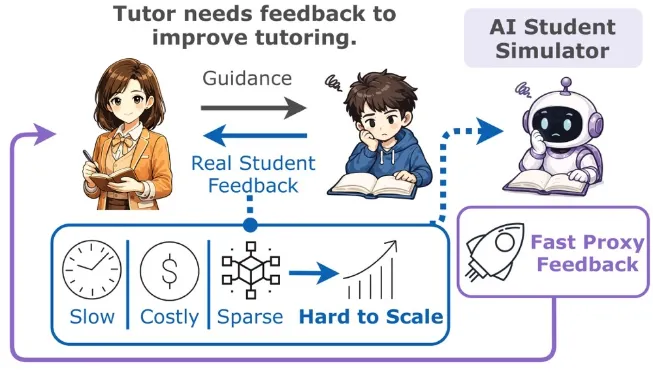
This is exactly the problem StudentSim is trying to solve: it is a personalized student simulator framework based on real student data training that aims to train a corresponding simulator for each student so that it can both recreate the student's mistakes and limitations of ability and generate reasonable updates after reading instruction from the teacher.
The team also proposed StudentSimEval, which uses a unified protocol to assess the two core capabilities of the student simulator: behavioral fidelity and guidance responsiveness. The first measures whether the simulator is like the target student and the second measures whether it can be updated in the right direction following instruction from the teacher.
These two indicators correspond to two types of signals that are most needed in AI teacher training: a personalized starting point and a learning dynamic that can be influenced by teaching intervention.
Why is it not enough to prompt an LLM?
There are two main types of student modeling in the past.
One class is knowledge tracking and behaviour prediction models. They are based on real learning trajectories, usually post-documenting student status. But these methods lack natural language-guided input channels. In other words, they can trace more accurately what students have done in the past, but it is difficult to answer, "If teachers say that, students will not change".
The other category is LLM role-playing. Giving a large model a full portrait of the student, allowing it to play a certain level of student, and then letting it be read by the teacher to explain and respond. This method can be used fluently to handle natural language instruction, but the problem is that the cognitive level is unreliable. An LLM can speak in kindergarten tone, but still with the knowledge and reasoning skills of students far beyond the target.
StudentSim tries to solve two big problems: train simulators directly from student data.
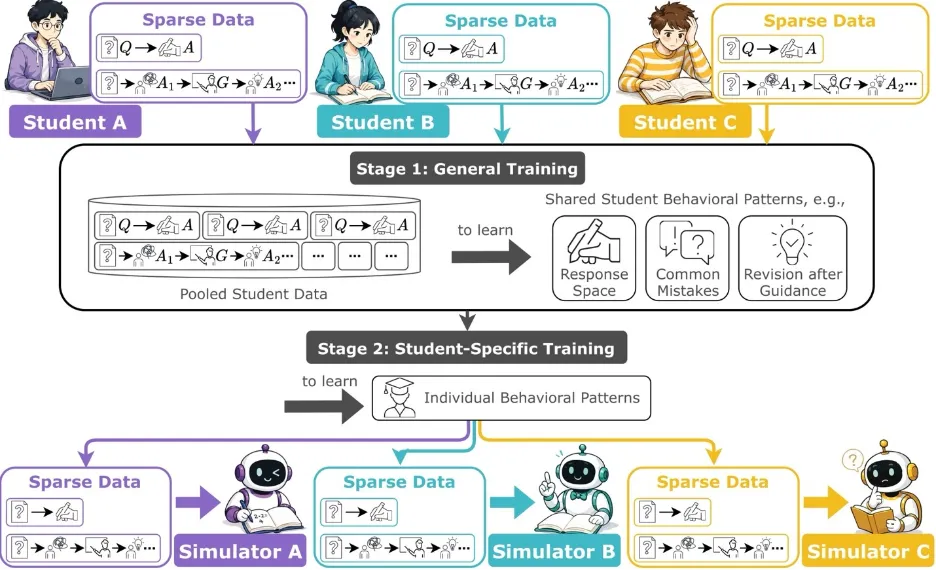
The framework uses two stages of training. The first stage, which summarizes the records of multiple students in the same field, trains a domain-level base simulator, enables the model to learn common error patterns in the field, responds to formatting and guided correction paths.
This design addresses a common problem in real-world education data: data from individual students is often scarce, but there is a large number of structural laws shared between students in the same field. StudentSim first learns group priorities and then learns individual differences.
60 students in three fields
To avoid verification on a single task, the research team built StudentSimEval, covering three areas of chess, second-language English writing and basic mathematics, with a total of 60 students.
In chess, the simulator needs to predict a player's next move on the board and update the move after reading the instruction of a natural language instructor. In bilingual writing, the simulator needs to generate an English text that corresponds to a specific learner's erroneous distribution, and modify the script according to the instructor's recommendation. In mathematics, the simulator needs to predict which answers students will give and correct them after reading the instructor's instructions.
All methods fit on the same per-student training records and are evaluated on the same held-out records.
The results showed that StudentSim surpassed the strongest available baseline in fidelity and responsiveness in three areas.
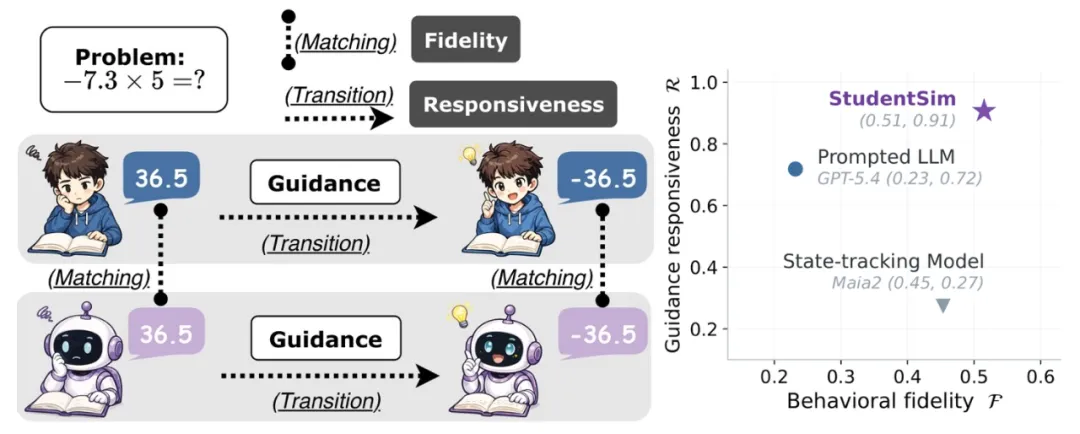
For example, in chess tasks, StudentSim's behavioral fidelity is 0.5150, higher than Maia2's 0.4535, and significantly higher than GPT-5.4's 0.2316; guidance responsiveness is 0.9067, higher than GPT-5.4's 0.7186 and Maia2's 0.2721.[3]
This result also presents a typical shortcut for two types of baselines. Maia2 can better predict the move distribution of human chess players, but without natural language-guided input channels, so it is less responsive. GPT-5.4 can read instructions and respond, but cannot stabilize the ability, habits and errors of specific students, so fidelity is lower.
From student simulators to AI teachers reinforcing learning
The paper also further validates whether StudentSim can serve as a feedback signal in AI teacher training.
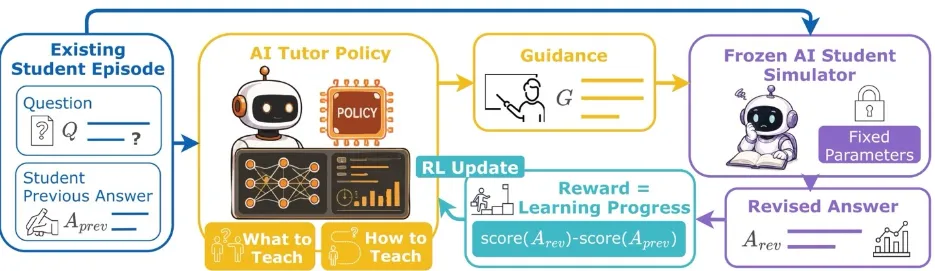
The research team constructed an RL proof of concept for a trained teacher model in a chess teaching scenario. During the training process, AI teachers generated instructions based on the error walk from real student records; frozen student simulators read the instructions and output corrected moves; and the reward function improved the quality of Stockfish to update the teacher model based on corrected moves relative to the original errors.
The control group includes SFT teacher models that are not RLs, and RL teacher models that use GPT-5.4 as a student simulator reward. The three groups share the same tutor policy, the same SFT starting point and the same GRPO settings, with only the difference in reward source.
AI teachers trained by StudentSim reward were the highest on three indicators: accuracy 90.5%, guidance quality 3.31, personalization 3.93. In contrast, No RL accuracy was 75.7%, GPT-5.4 reward was 71.6%.
The team emphasized that this was not a "strongest AI teacher" statement, but to verify a more basic question: whether a student simulator with both fidelity and responsiveness can provide useful proxy feedback to optimize AI teachers. The results showed that StudentSim as a reward source is more effective than a simple prompt frontier LLM and is better suited for deployment and customization locally.
For AI education systems, this means a new training loop: real student data can not only be used to evaluate AI teachers, but can also be used to train replicable student simulators that provide high-volume feedback for AI teachers to optimize their strategies.
Author's note
He is a fourth-year PhD student in computer science at UIUC, where he teaches as an adjunct professor with an undergraduate degree from Tsinghua University. His research focuses on AI agents, language models, information retrieval and multimodal base models, while focusing on issues of bias and discrimination in AI systems.https://empathyang.github.io