Early signs of the emergence of intelligence have emerged.
The robot took a packet of popcorn and was preparing to put it in a microwave oven, when the experimenters closed the microwave oven door. Several miners had never collected such data. The robot continued to keep the target in hand, reopened the microwave oven door, and then completed the original task.
Similarly, in another experiment, the microwave oven door left only a narrow gap. The robot did not return to the hand-operated process learned in training, pushing the door directly with the packaging in his hand.
Both demonstrations are from the latest release of the Deep Leap World Action Model DELE-w0.5. Its technical report calls this a "rearrangement of behaviour under target conditions", meaning that when the environment deviates from the training trajectory, the robot can retain the original mission goal and adjust the movements according to the new state.
Deep Leap is a company focused on the continuous evolution from real-world missions to cross-bodied-brain platforms that has completed angel rounds of financing invested exclusively by Centaur. The core team has long researched generative strategies, reinforced learning and artificial intelligence, and independently developed the DELE series of artificial brain models around real-world robotic missions.
The main page of the project:
Link to the paper:https://arxiv.org/pdf/2608.22067
Currently, a type of world action model is based on a video generation model in which robots must simultaneously predict movements and future visual trajectories before performing movements. This method can provide rich time-space information, but consumes a large amount of computational resources. In order to produce a set of low-dimensional operations, the model needs to process high-dimensional visual content such as mechanical arm movements, object appearance and optical shadow changes.
DELE-w0.5 abandoned this link. In training, the model combines future world representations of robot movements and actions after completion; in reasoning, the future world representation branch is removed and the robot directly generates movements based on language and current visual information.
In 640 real-machine experiments, DELE-w0.5 achieved a 62.5% complete mission success rate and an average stage progression of 81.3%. Both indicators were well above the strongest baseline.
Without producing future videos, how do models learn the relationship between action and world change? How do they translate this future world representation into real-world execution capability?
Why is video generation a burden of control?
The current basic model of robots has roughly two routes.
The first is the Visual Linguistic Linguistic Linguistic Linguistic Action Model, or VLA. It receives language instructions, current multipoint observation and the entity's own state, and then directly output the action. The entire process can be divided into three steps: input language instructions and current observation, followed by task planning by the Visual Linguistic Model (VLM), and finally by the Action Expert (Action Expert) who will program decoding as a control signal that can be executed by the robot.
The link is relatively straightforward. The model is able to learn the mapping relationship between current observations and movements, so much so that these movements will cause changes to the environment, and the relevant information is often implicitly encoded in the model parameters.
The second route is the World Action Model, or WAM.
Video-based WAM can simultaneously predict robot movements and future visual trajectories, and models learn object movements, spatial changes, and contact relationships through future images, thus gaining richer space-time precedents. The problem is that for robot operations, the purpose of world models is not to reproduce the visual information of the real world at each intermediate moment, but to predict the world characteristics achieved after the execution of the action.
To open the door, for example, what a robot really needs to accomplish is to hold its hand steadily, rotate its hand steadily, push the door open, and keep the door at a designated angle, so that the mechanical arm changes in appearance in each hole, and the control system does not need to be restored one by one.
This difference is directly reflected in the cost of computation. Multi-channel video latency is usually much larger than the corresponding sequence of movements, which increases the sequence length, storage occupancy, and training burden of the model. At the reasoning stage, the model also requires multiple rounds of de-noise between high-dimensional video and latent movements, and the control cycle of the robot is therefore limited by the speed at which video is generated.
In recent years, some studies have begun to reduce costs by using small video skeletons, rare video tokens, and slow-motion scattering. These methods can reduce computational stress, and video trajectories remain within the core modeling goal.
DELE-w0.5 further proposes: What do world models really need to predict for robotic control? Deep jump focuses on the world characterization after the action is completed.
In the opening mission, the key outcome is whether the door is open and stability is maintained; in the task of adding ice to the cup, the goal is for the ice to enter a vertical cup, with the relevant tools returning to a designated location; in the refrigerator takeover mission, the robot needs to retain the target beverage and complete the refrigerator closure.
As a result, the three types of models form different predictive targets. VLA predicts movements under current conditions, video-based WAM predicts joint movements and complete future vision trajectories, DELE-w0.5 predicts joint movements and future world representations after the end of movements.
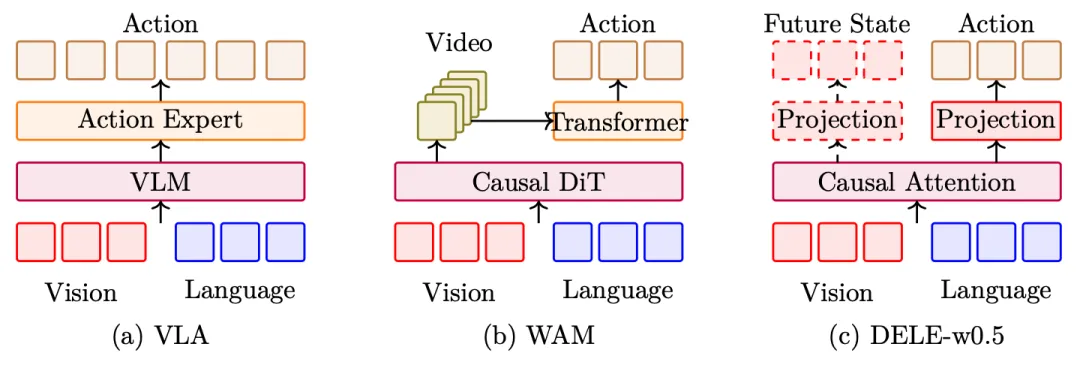
Models are still learning the future, and the future information that needs to be processed is becoming more compact and closer to the goal of robot control.
The future of the world is about training, not reasoning.
DELE-w0.5 uses a two-stroke Transformer architecture.
The model first receives language instructions, the robot's current multi-point image and body state, language instructions encoded by Qwen3, and visual information encoded by DINO-v3, including a head point of view and two wrist points of view. On the action side, the model predicts a sequence of movements of 60 lengths at a time, for the Astribot S1 arm robot, each time step contains 14 dimensional movements, covering the two mechanical arms' position changes, posture changes and claw states.
The model contains conditional flow and noise flow. Conditional flow processes language and current vision and combines the two types of information into a unified conditional representation.
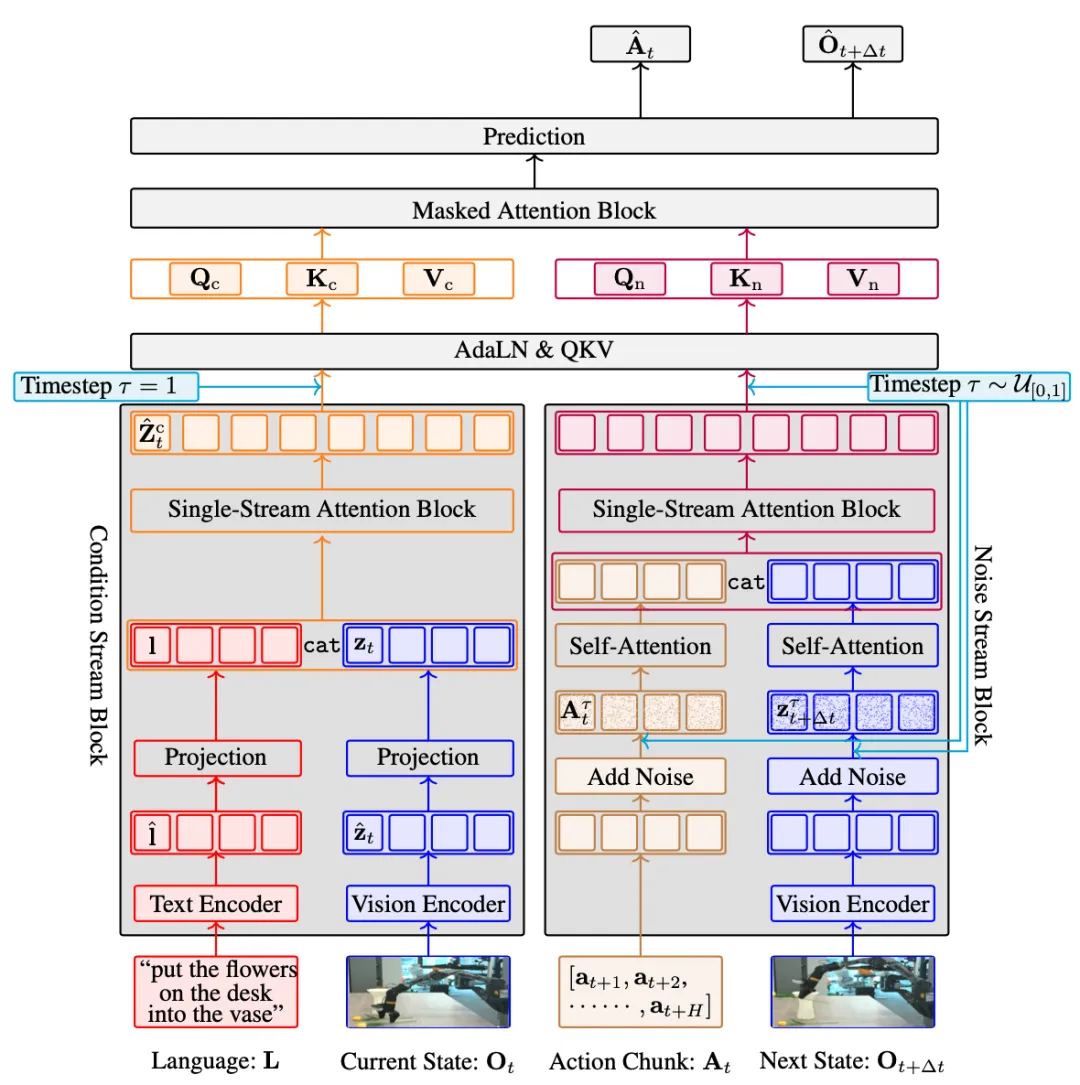
DELE-w0.5 architecture overview
The description of the future world is not a generated image. It is derived from the DINO-v3 code for future observations, which is used to represent information such as the position of objects, the state of the mechanical arm, and spatial relationships. The model only needs to learn this state change in latent space, without the need to restore a complete visual image, and without the need to generate an intermediate video array.
DELE-w0.5 also designed a non-symmetrical attention mechanism. During training, the action token can read language, current observations and information within the action sequence, and cannot read future state goals, thus preventing the action from predicting and seeing future answers in advance.
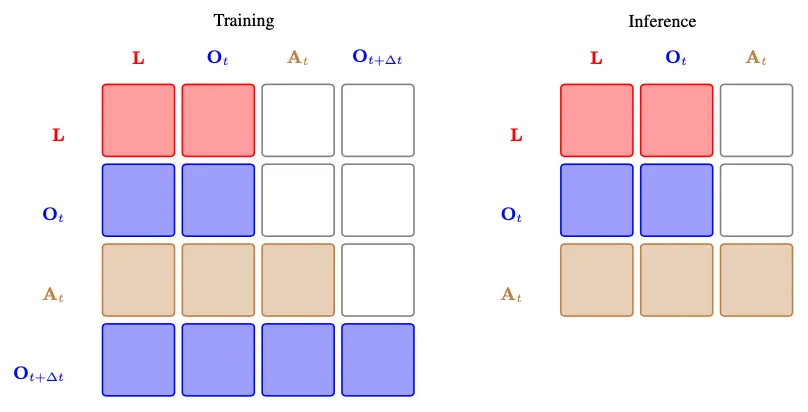
It's a disguise of the training and reasoning stages.
The future world token can read language, current observations and actions. It needs to learn a specific question: what will the environment be like after performing this set of actions?
The loss of future world representation will be involved in model training by sharing parameters, and although the path of action generation does not read the future world representation token, its underlying representation will still be influenced by action consequence learning. This means that future world representation takes on the role of training supervision in DELE-w0.5, which helps the model establish a link between action and environmental change, rather than becoming the explicit steps that robots must go through before each action.
After entering the reasoning stage, the future world symbol token is completely removed, the model retains only the language, current observation and movement, the robot does not need a master to be the future image, nor does it need to wait for a future video to make noise, so the control link becomes shorter.
DELE-w0.5 does not use open-source robotic base models, VLAs, or video-generation models that are already authorized for secondary packaging, and its core focus is on the design of real-world missions from underlying self-development, model structure, actionable state-of-the-art, physical data formulas, and intrinsic adaptations.
The data shows that DELE-w0.5 has a median reasoning delay of 87.5 milliseconds on the Invidia RTX 4090. Its reasoning speeds are faster than GWP 0.5π 0.5π 0.5π, LingBot-VLA2 and HY-VLA, close to Spirit-v1.5 while achieving higher complete mission success rates.
From a physical intelligence point of view
What has DELE-w0.5 really changed?
The difference between DELE-w0.5 and video WAM is that not only does the number of generators change from less to less, but also the model-dependence relationship changes fundamentally:
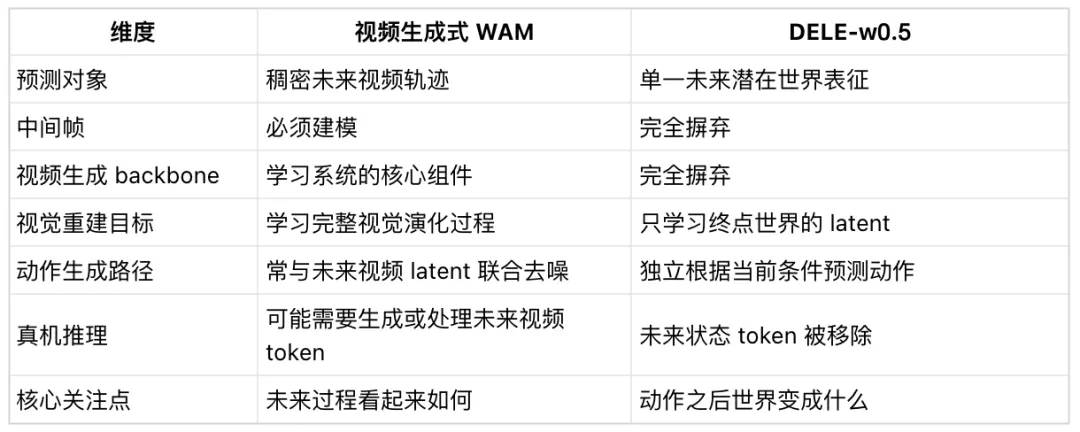
Video generation focuses on observing continuous changes in space, while robot control focuses on executable outcomes in the physical world. For tasks such as "opening the refrigerator and taking drinks out", the robot really needs to maintain:
Whether the refrigerator door is open;
whether the beverage has been removed;
where the object is currently in possession;
Whether previously completed status has been compromised in subsequent actions;
In the end, "drinking is in hand and the fridge is closed".
It does not need to recreate every visual moment in the process of opening the refrigerator door before making a decision. Therefore, the value of the future world representation branch does not only provide additional supervision but also forces the strategy to learn a result-oriented state-transfer representation: whether an action is correct depends not only on whether it is like a demonstration, but also on whether it is able to advance the environment to a future state consistent with the objectives of the task.
Authentic testing
In the future, it will be necessary to test whether the world's presentation actually improves robot movements and ultimately to go back to the actual mission.
The team set up four long-range missions on the Astribot S1 two-armed robot: opening a hand-held door, extracting a coke from the refrigerator, adding ice to the cup, and putting the popcorn packaging into the microwave and starting the heating. These missions covered contact operations, target extraction, hand-connection, tool use, limited space placement and final status confirmation.
The experiments compared DELE-w0.5 with GWP0.5, XR0, π0.5, LingBot-VLA2, HY-VLA, Spirit-v1.5 and GR00T-N1.7 in seven representative strategies. All methods used the same task data completion equivalency mitigation, and adopted consistent task instructions, scenario reset modes, 180-second execution budgets and success standards.
In order to more accurately measure long-range performance, the technical report uses two indicators.
The first is the success rate of complete missions. The robot must meet the final physical conditions for the entire mission to be recorded as successful.
The second is the sequential phase progression. It records which steps the robot has completed in succession, and if the prior steps are not completed, subsequent random moves will not be counted as progression. This indicator can show exactly at what stage the model fails, and can also prevent a successfully grabbed cover-up of subsequent execution problems.
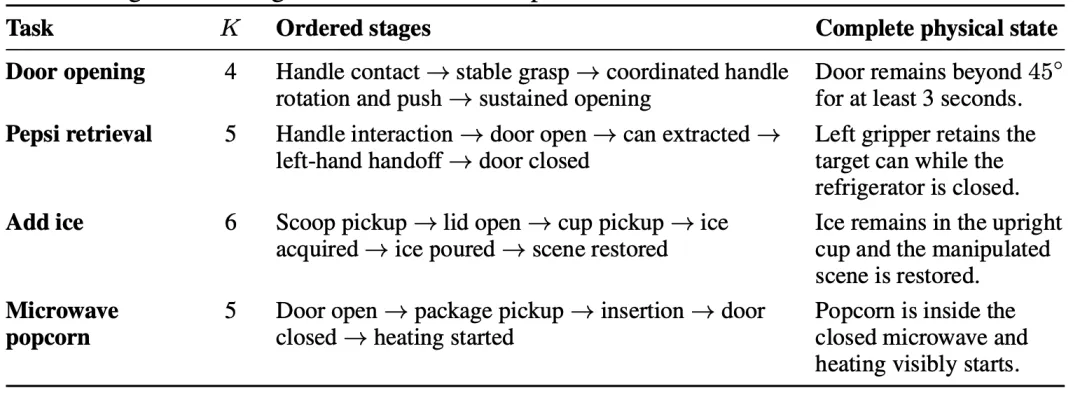
Stage 0 indicates that no effective progress has been made, and reaching the final stage indicates complete completion of the task.
The results showed that DELE-w0.5 successfully completed 50 of its 80 tests, with a complete mission success rate of 62.5%. The strongest baseline XR0 completed 24 times, with a success rate of 30.0%, and DELE-w0.5 scored 32.5 percentage points, about 2.1 times that.
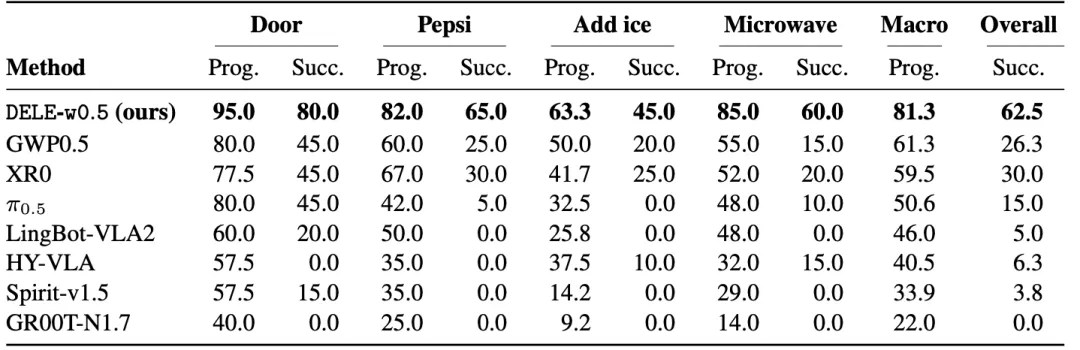
The actual test results of 20 tests per task. Average progress is calculated for four tasks; overall success rate is calculated on the basis of all 80 tests for each method.
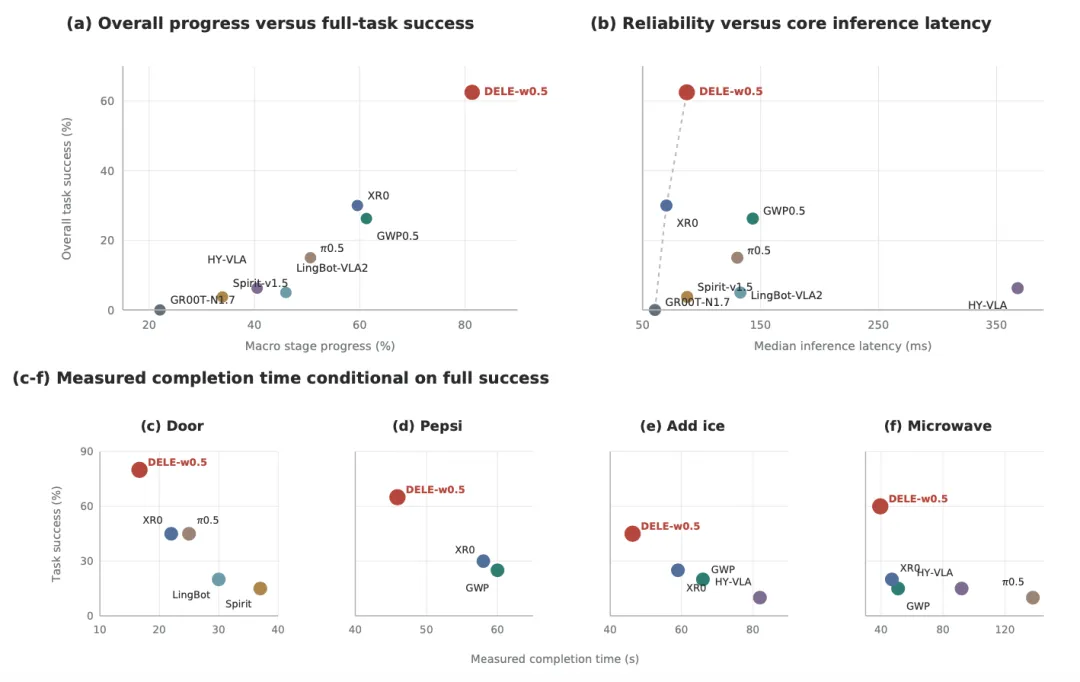
Overview of performance and efficiency. (a) Average orderly phase progress and overall completion of the task success rate. (b) Overall success rate with the core model reasoning latency median on the INVEDA RTX 4090. (cf) Success rate of the various tasks and running time at successful completion of the task.
The DELE-w0.5 opened with a success rate of 80%, the refrigerator took 65% of the coke, the cup added 45% of the ice, and the microwave burst of corn with 60% of the success rate.
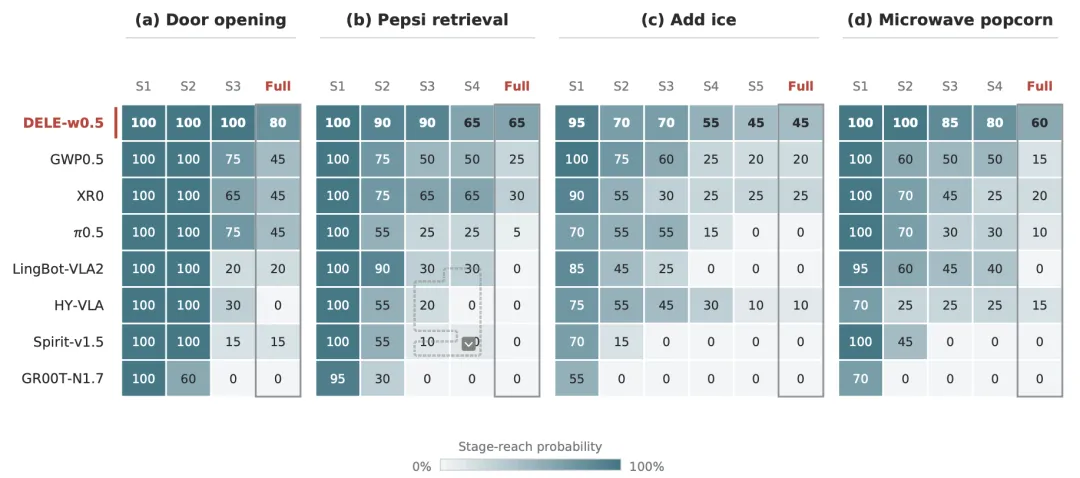
Stage-long-range task analysis. Each unit indicates that in 20 tests, the ordered forward score reaches or exceeds the test ratio of the corresponding stage. Each task block uses the same model coordinate axis and probability scales; Full indicates the success rate of the complete task.
This is where the real gap is, mainly in the second half of the mission.
In the opening mission, DELE-w0.5 reached all of the rotation and thrust phases in 20 tests, eventually completing 16 rounds. Most of the baselines were able to reach and grab the hand, and subsequently easily failed in rotation and thrust coordination.
DELE-w0.5 successfully withdrew the target barrel 18 times and completed the entire mission 13 times, with the remaining failures occurring mainly in hand-to-hand and final shutdown.
DELE-w0.5 had 19 ice pick-ups, 14 in the cup grabbing phase, 11 successfully obtaining ice blocks, and ended up completing 9 rolls and recovering scenes.
In the microwave boiler mission, DELE-w0.5 was able to open the microwave boiler each time and pick up the packaging, completing the shutdown 16 times, and successfully starting the heating 12 times.
This set of data shows that the difficulty of long-range operations often occurs in the connections between skills. After the robot catches an object, it must also maintain the previously achieved task state, switch executing arms and interacting objects, and advance the process to final conditions. DELE-w0.5 is more frequent in reaching the second half of the task, and it is also easier to convert phased progression into complete success.
According to the study's assessment, 62.5% is a prominent result, which significantly exceeds the representative baseline under the same data, the same protocol, and demonstrates the potential of this technological route.
The researchers also tested the zero-shot cross-background capabilities of DELE-w0.5.
From cluttered office space to open conference room scenes, DELE-w0.5 is still able to accomplish microwave and cup-freezing operations in a dramatically changing environment of desktop materials, spatial layout, lighting and visual backgrounds.
DELE-w0.5 does not rely on fixed scenarios, does not remember specific contexts, and has the ability to be generalized across contexts.
What is the meaning of this verse?
The value of a world model is ultimately to be tested by a robot to see if it can complete a task, generate images that are more realistic, represent the model's ability to restore the visual process, move around the target task, take the next step, and push the environment to the correct terminal, closer to the requirements of real deployment.
For physically intelligent people, the most useful future information is not necessarily a video that can be viewed, but it can also be a video that does not pursue a complete visual reproduction, but it is enough to integrate real physical space information into a world characterized by constraints of action.
DELE-w0.5 has taken a step in this direction. Its purpose is not to end the race ahead of time, but to provide a new way of thinking for the world model: no longer focused on generating visual processes, but on the results of robot action. Next, DELE-w0.5 will provide a whole new way of thinking about tasks such as trans-object, trans-scene and trans-body, and the results of real machine deployment will test how far this path can go.