"Write a haiku about being in space".
A few days ago, an engineer at Google sent a message through a ground station to a satellite operating in Earth orbit.
Upon receipt of the instructions, the satellite-based TPU was launched, and the previously deployed Gemma 4 began carrying out the reasoning mission. Subsequently, the ground station finally received a response from space as the satellite flew through nearby Norway's Valparaiso Islands.
Blue marble below (the blue planet below)
Data streams in silent grace
Starlight feeds my core.
Recently, Google CEO Sundar Pichai excitedly shared the news, calling it Project Suncatcher's "Hello World" moment. This is the first time a data center-level TPU has generated and retransmitted a complete AI response in orbit.
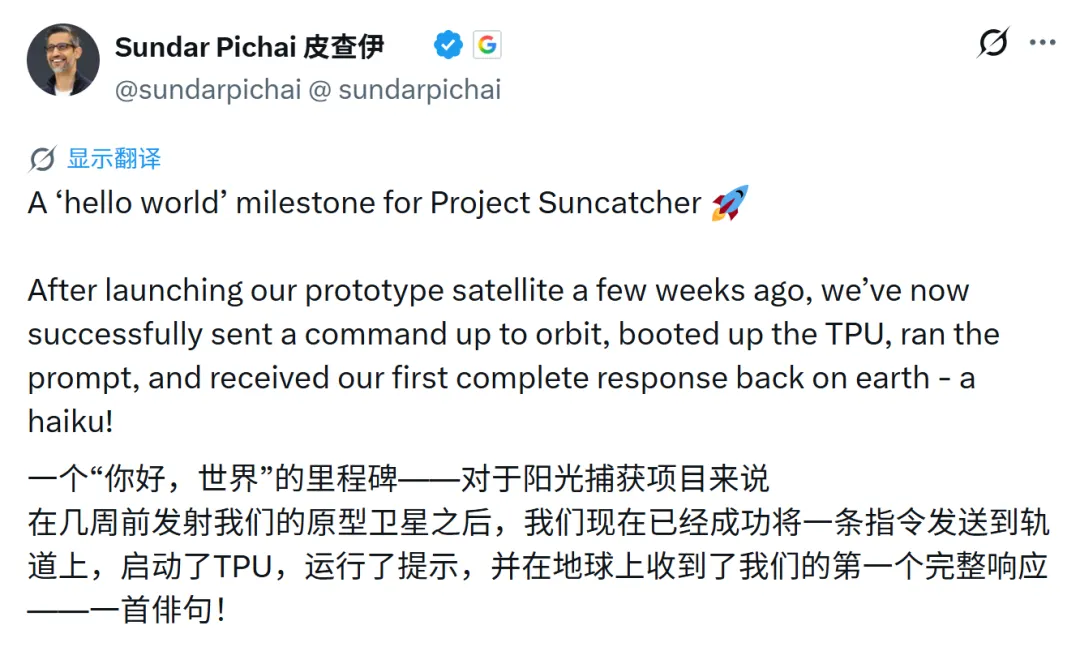
Since last year's announcement that AI is going to be sent into space, a poem actually coming out of orbit, Google's Space Data Center program, has finally taken a step in the right direction.
Google TPU, it's really running in space.
The start of this experiment was a month ago.
On October 1, Project Suncatcher, a prototype satellite developed by Google in collaboration with Planet, entered Earth orbit aboard SpaceX's Transporter-18 spacecraft.
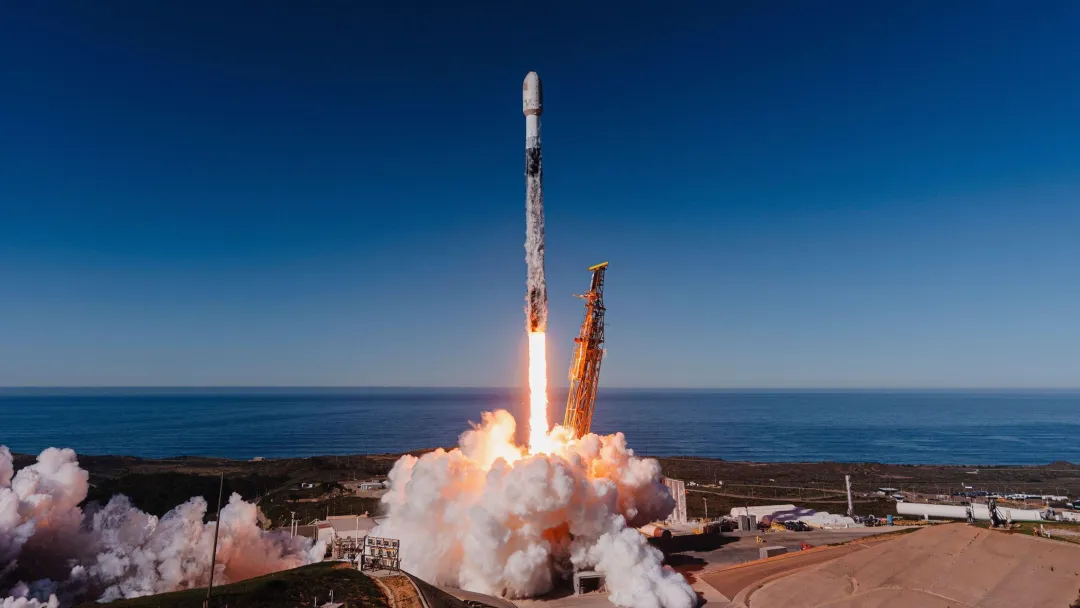
Over the next few weeks, the engineering team continued to moderate the satellite's systems, launching the host and TPU computing devices, and conducting early machine learning tests.
It wasn't until this week that the team finally tried to get the satellite to perform a real generated AI mission.
After completing the first response, the team also attempted to get the model to generate other forms of space-themed poetry and to query the technical state of the computed loads using natural language cues. Google said that subsequent experiments would gradually shift to more practical systematic testing to observe TPU performance in orbital thermal stress and radiation environments.
According to TechCrunch, the prototype satellite is equipped with four Google TPUs, capable of delivering about 1kW of electricity at most, but due to the current system's power limitations, only one of the TPUs can be activated at a time, running for about 20 minutes.
This is also reminiscent of a year ago, when Google had just introduced the plan.
In November 2025, we competed in the AI Space Race? Invidia H100 just yesterday, and Google's Project Suncatcher was about to launch the TPU into space.
According to the initial announcement, Google plans to launch two prototype satellites in early 2027 in partnership with Planet to test key technologies such as orbital operation of TPUs and interstellar light communication. After that, Google further adjusted the experimental progress, using Planet's satellite platform for early phase 1 verification, and successfully put the TPU into orbit in October this year.
Google is not the first company to bring large models into space.
Last November, Starcloud launched a Starcloud-1 satellite with a H100 GPU, and subsequently completed large language model operations and small model training experiments based on nanoGPT.
In August, SpaceX announced a partnership with Ingrid to develop Starmind AI1 and plans to build larger satellite computing loads using the Rubin GPU and Vera CPU.
From Invidia GPUs to Google TPUs, space AI computing is attracting more and more tech companies to participate.
From a TPU to a real space data center
Why is it so expensive to send AI chips into space?
Over the past year, this issue has appeared repeatedly in the comments section of companies.
In fact, the answer is simple: power supply.
According to Google's previously published findings, under proper orbital conditions, the maximum power output of space solar panels can reach about eight times that of the ground conditions. If the satellite operates in synchronous orbit with the sun at dawn, it can also get close to continuous sunlight, even without relying too much on large batteries.
The idea behind Project Suncatcher was not to build a large space station-like data center, but to have a large number of relatively small satellites in close clusters, each equipped with solar panels and TPUs, and then to connect them using free-space optical communication technology.
In a research paper previously published by Google, which has now been published in Joule Joule, the team showed an example of a cluster design consisting of 81 satellites. These satellites operate in near-Earth orbit at an average altitude of about 650 km, the entire cluster has a radius of about 1 km, and the distance between some of the adjacent satellites varies between about 100 and 200 meters.
The following is a link to the paper: (26) 00362-4?_returnURL=https%3A%2F%2Flinkinghub.elsevier.com%2Fretrieve%2Fpii%2FS2542435126003624%3Fshowall%3Dtrue
Why are satellites flying so close? Simply put, it's easy to communicate.
In ground data centers, large-scale model training typically requires assigning tasks to multiple accelerators together, and intercomputing between different chips is frequent. If the communication bandwidth is insufficient or the latency is too high, the performance of the entire system can be severely limited even with enough computing chips.
Google wants to move similar distributed computing to space, so it needs to build bandwidth connections between satellites that are much higher than traditional satellite communication needs. According to the team's research, the interstellar link's transmission rate will need to reach 10 Tbps in the future to achieve computing capabilities close to ground data centers.
To this end, Google is studying using intensive wave-division replication and spatial replication technologies to improve the bandwidth of laser communication while allowing satellites to operate in a relatively tight array.
In previous ground experiments, the team has achieved a single-way transmission rate of 800Gbps with a combined bidirectional transmission rate of 1.6Tbps using a pair of optical communications transmitters.
This is a considerable number, but the interstellar communication capabilities required for distances in the future remain gaps, and communication between ground-based devices, and stability of communication with multiple satellites while continuing high-speed motion in orbit, are not exactly the same engineering difficulty.
In order for dozens or even hundreds of satellites to remain in the right relative position for the long term, Google also needs to take into account factors such as the Earth's non-spherical gravitational field, atmospheric resistance, and orbital decay, and control the cluster using physical models and machine learning methods.
At the same time, data exchange between satellites is only part of the problem, and data transmission between ground and satellites is more difficult to solve.
Particularly for tasks that require frequent reading of large amounts of ground data, updating model parameters or responding to user requests, how to balance communication windows, transmission bandwidth and latency will also affect actual operational efficiency.
On the other hand, the data generated by Earth observation satellites in orbit can be relayed back to the ground if the image analysis can be done directly in orbit and the results instead of all the original data can be transmitted. This is the most advantageous area of space computing.
However, Google's goal is clearly more than that. It wants to verify whether the future will allow for a truly scalable AI computing cluster in space.
This idea has been questioned by many netizens.
Previously on Reddit's r/space community, someone specifically asked a question: Since building and maintaining space data centers is so difficult, why not put them under the sea?
Microsoft's previous Project Natick has verified the feasibility of operating underwater data centers, while building data centers in cold regions such as Iceland and Northern Europe has been a realistic option to reduce part of the cooling burden.
The question in space is, is it really worth the expense of providing computing power even if you can get more solar power in space?
The answer is obviously not that simple.
Heat dissipation, space radiation, costs?
Following the announcement of the Oct. 30 news, discussions about the feasibility of space data centers on X resurfaced.
The user, Luke Leisher, said ironically: "How is this possible? Didn't the smartest person on the Internet tell me that the laws of physics have decided that orbital data centers are absolutely impossible to achieve?"

Another user, Robert de Negro, poses a more specific question: The real difficulty may be in scale. If a satellite ends up with a large number of computing devices, managing the heat generated by dozens or even hundreds of chips and managing a small number of chips are two things.

After all, the heat dissipation in space is an inevitable problem.
On Earth, computing devices can carry heat through air flow, liquid cooling, and heat ultimately to the surrounding environment through the corresponding facilities. However, in near-empty space, there is no available airflow, and the waste heat generated by the chip is ultimately largely dependent on heat radiation being released outward.
This means that the space data center must pass the heat generated by the computing equipment through conductive heat structures and cooling masses to a space heat exchanger of sufficient area and then discharge it via electromagnetic radiation.
Google has previously introduced a cooling scheme that combines heat pipes and heat exchangers, and has been tested in a hot vacuum experimental chamber that simulates a space-heat environment. While this technology is not unfamiliar in the space field, it has to be redesigned as computing equipment increases in power, surface area, quality, and structural relationships with other satellite devices.
Project Suncatcher's prototype satellite, which currently has four TPUs and can only launch one TPU at a time, runs for about 20 minutes, indicating that power and heat management capabilities at this stage still have a lot of room for improvement from large-scale continuous computing.
And the issue of heat dissipation will eventually come back to cost.
In a related discussion in Hacker News, some netizens argued that the issue was not whether humans knew how to dissipate heat through thermal radiation, but how much more heat exchangers, conduit heat pipes, and other supporting equipment would be needed to produce enough heat. Once these extra weights were calculated, the cost of launching satellites would go up as well.
Another problem that needs to be verified for a long time is space radiation.
For satellites that rely on solar power, sunlight is an important source of energy, but radiation environments such as solar high-energy particles and galactic cosmic rays can also affect electronic devices. Interactions between high-energy particles and sensitive areas in the chip can cause data bits in the storage to overturn, causing the original 0 to become 1, or causing some computational errors.
For this reason, Google has previously carried out specific ground experiments.
The team tested the sixth generation Trillium TPU using a 67 MeV proton beam to observe the total ionization dose and single-particle effect on the chip. The results showed that the high-bandwidth memory system was a more sensitive part, but the associated abnormalities did not begin to appear until the cumulative dose reached about 2 krad (Si) and nearly tripled the dose expected for five years under shielding conditions.
At a test dose of up to 15 krad (Si) per chip, the team did not observe a permanent hard failure that could be attributed to the total ionization dose.
These results made Google more optimistic about the space adaptation of existing TPUs, but ground particle beam experiments were unable to fully simulate long-term radiation, heat cycles and other complex factors in real orbital environments, so one of the important goals of this satellite mission was to further verify the chip's performance in real environments.
Even if the problems of heat dissipation and radiation can be solved by engineering, Google will still have to deal with the long-term maintenance and updating of its computing equipment.
Ground data centers can continue to be used as AI chip performance improves and older equipment is gradually replaced, while the power supply, networking and cooling infrastructure can continue to be used. But for satellites, chips, solar panels, heat exchangers and communication systems are often highly integrated, and it becomes a complicated question how to continue using the rest of the infrastructure after equipment fails or computing chips are gradually lagging behind.
In particular, Hacker News notes that space computing facilities may face a different depreciation logic than ground-based data centers: if the GPU or TPU on a satellite has lost its competitiveness, it may not be easy to continue to play its original value even if its solar panels and thermal cooling systems are still in use.

This did not take into account the additional problems that the spacecraft might encounter, such as orbital debris, small pebbles, and the need for regular orbital maintenance and eventual displacement.
As a result, the debate over space data centers often ends up in the same question: cost.
In a previously published research paper, Google specifically analyzed future launch costs and gave an important reference figure of $200 per kilogram of uranium.
Under this assumption, depending on the service life of the equipment and the power supply, the cost of the launch may correspond to about $810 per kilowatt per year.
In contrast, the U.S. ground data center energy expenditure cited in the paper is about $570 to $3,000 per kilowatt per year.
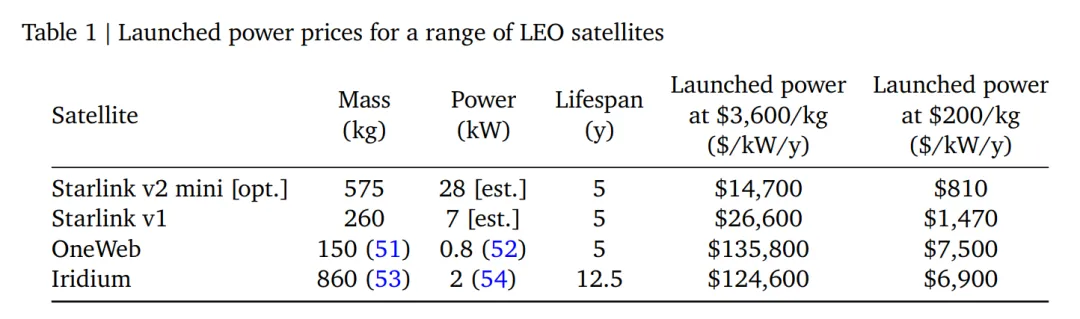
So it looks like the space data center has some feasibility. But Google's calculations are very rough, and there are netizens on Reddit who see the problem at first glance.
"The launch cost is $200 per kilogram?"
Google's calculation has the assumption that future rockets will continue to improve their reusable capability and launch scale and will be able to sustain the historically observed cost decline trend.
According to the paper's estimates, it may be necessary to achieve the scale of about 180 Starship launches per year in order to follow this trend to the cost level of $200 per kilogram before 2035.
It's obviously a bit of an optimistic estimate.
In fact, Google itself isn't too shy and doesn't look forward to the short-term commercialization of space data centers.
In an interview with NPR on October 1, Travis Beals, Project Suncatcher project manager, said he did not believe that space data centers could become cheaper than on the ground in the next five years, and that it could take longer to truly build economic competitiveness.
Google defines Project Suncatcher as a long-term "moon landing project" and, according to the current announced route, plans to launch two satellites with high-speed light communication capabilities in 2027, further verifying interstellar connectivity and the technical conditions required for distributed machine learning missions.
Further expansion of the system into a truly commercially competitive space data center requires longer technical build-up and joint advances in various aspects such as launch costs, hardware reliability and system architecture.
This little poem is just the first response to the AI computing network that Google is trying to build.
The link is as follows:
© THE