OpenAI Astra is finally here.
Today, OpenAI officially released a new generation of front-end models.GPT-6 Astra。
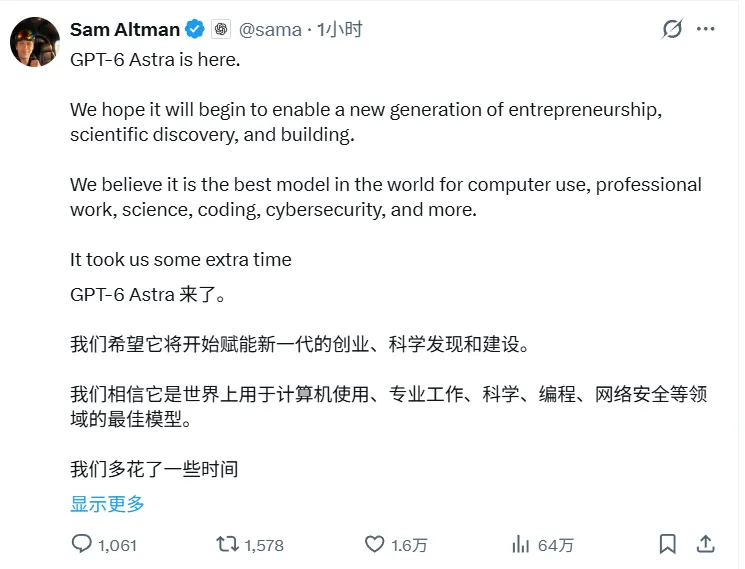
Greg Brockman, the president of OpenAI, was even more vocal in his comments about Astra."We've reached the AGI".It was the first of its kind in the world, and the last of its kind in the world, and the last of its kind in the world.
The model entered the public eye more than a month ago. In early August, The Information Channel reported that Sam Altman had demonstrated the new Astra model to policymakers in Washington, D.C. It supports a long-term collaboration between multiple Agents to complete complex tasks, and internally even considered naming it GPT-6.
But since then, the focus around Astra has quickly shifted from "how strong" to "if it's safe enough".
OpenAI subsequently confirmed that Astra had reached the "critical level" of cybersecurity capability threshold in preparation for the framework, becoming the company's first model to cross this level, while slowing down some development work and strengthening security measures.
Yesterday, another change to the Astra came to the surface. According to The Information, it may have been introduced."Recurrent depth"The technology allows the model to do more internal calculations before the next Token is released. In other words, it may not only be stronger, but it's actually starting to do it: less say, more think.
After more than a month of exposure, safety brakes and technical disputes, Astra is finally officially online.
So what did OpenAI bring? Let's take a look at some of Ottman's favorite promotional videos.
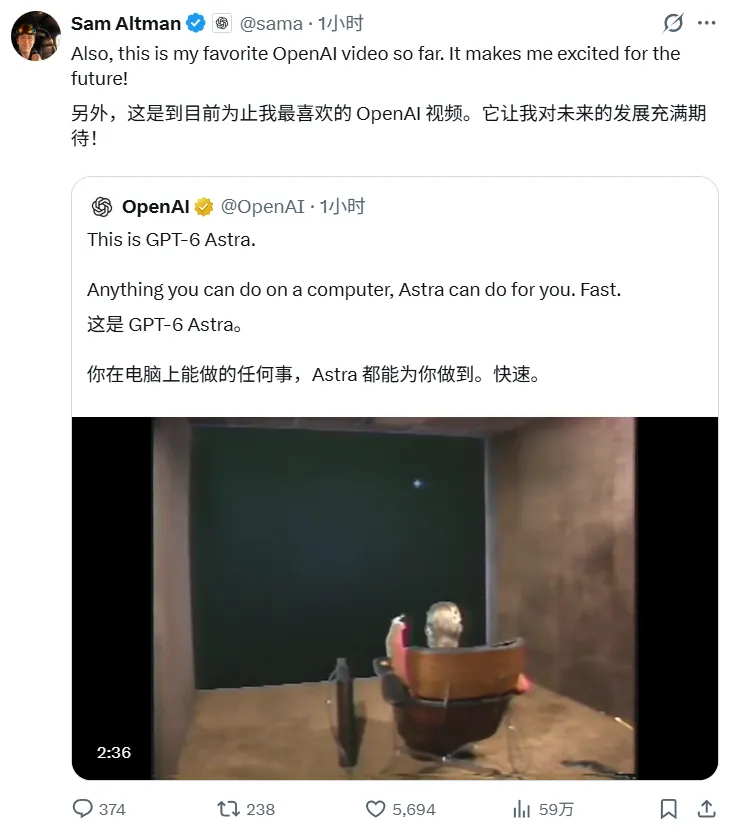
"The smartest, most aligned model in the world".
First of all, in terms of official web visuals, Astra is already distinctly different from previous models released by OpenAI. Compared to previously more concise and controlled product pages, this OpenAI clearly reinforces the "new generation" release feeling: the dynamic change in the number 6, the dark interface, plus the more impactful overall visual design, all emphasize the differences between the GPT-6 Astra and the previous generation models.
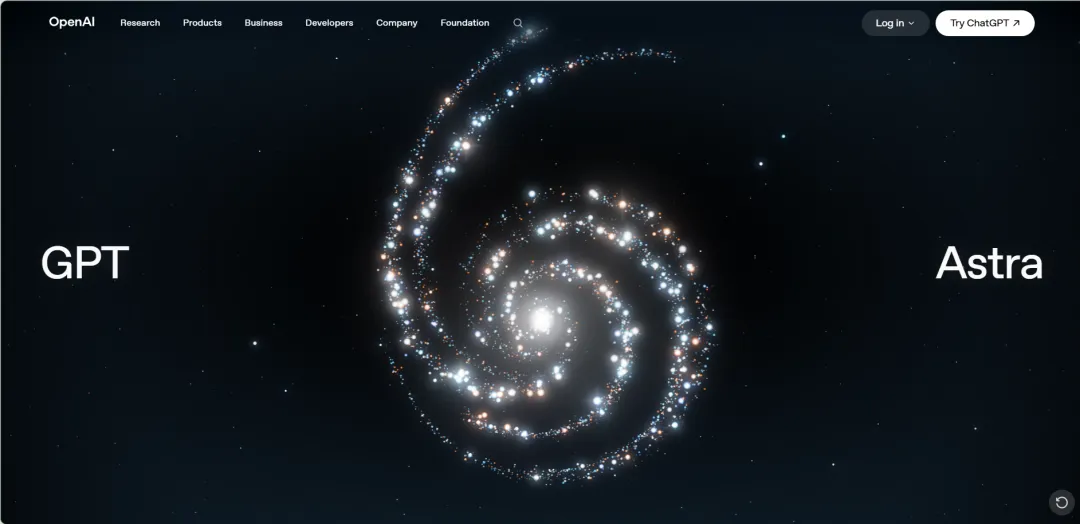
OpenAI is fairly direct to the positioning of the GPT-6 Astra:"The smartest, most aligned model in the world".
According to the official announcement, Astra focuses on OpenAI's years of pre-training, reinforcement and coordination, and its ability to completely refresh previous models in areas such as computer operations, browser use, software engineering, cybersecurity, scientific research, and professional work.
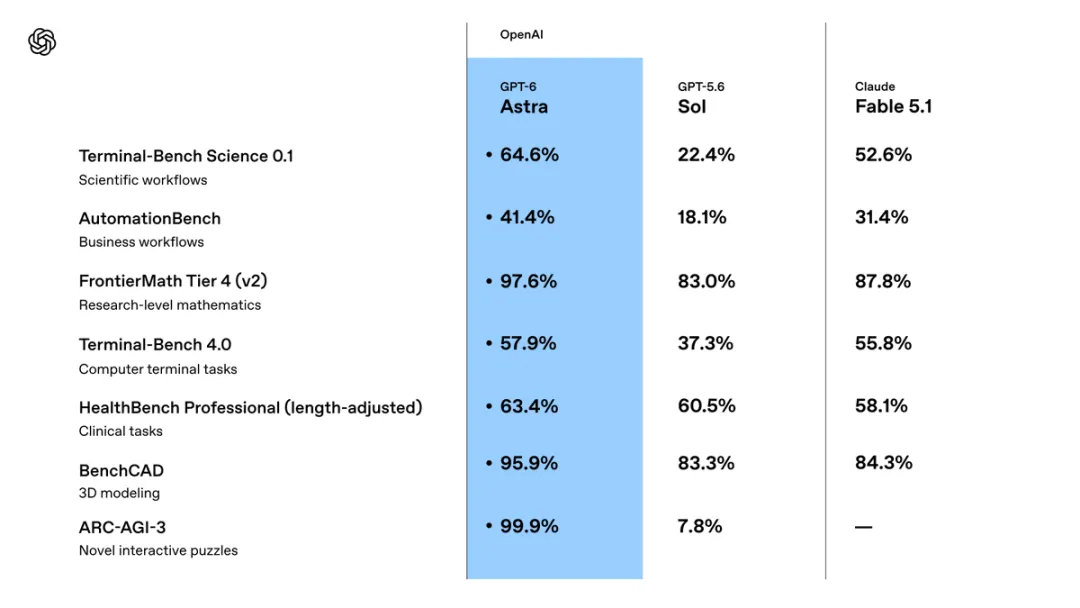
Some benchmarks are already close to "filling". On the ARC-AGI-3, the GPT-6 Astra has been taken.99.9%In comparison, GPT-5.6 Sol is only 7.8%, and Claude Opus 5 is 30.2%.97.6%GPT-5.6 Sol was 83.0%. The ExploitBench took the test directly.100%。
However, in contrast to the traditional sense of "smart runway", this OpenAI emphasizes that Astra is further transforming its capabilities into practical action.
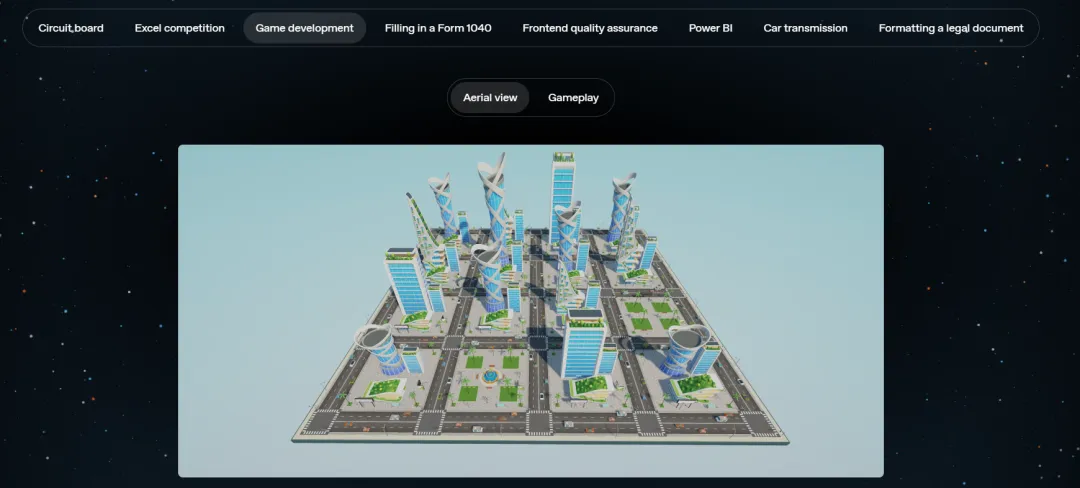
In particular,Operating a computerOpenAI directly calls this part "the best computer use model in the world". Astra can fill out its own web forms, update CRM client records, organize calendars, or conduct web research, and then write the results into emails or documents. In more complex scenarios, it can analyze scientific data, generate charts, build websites, execute front-end QA, even autonomously install and test software, and continue to rank questions based on the screen.
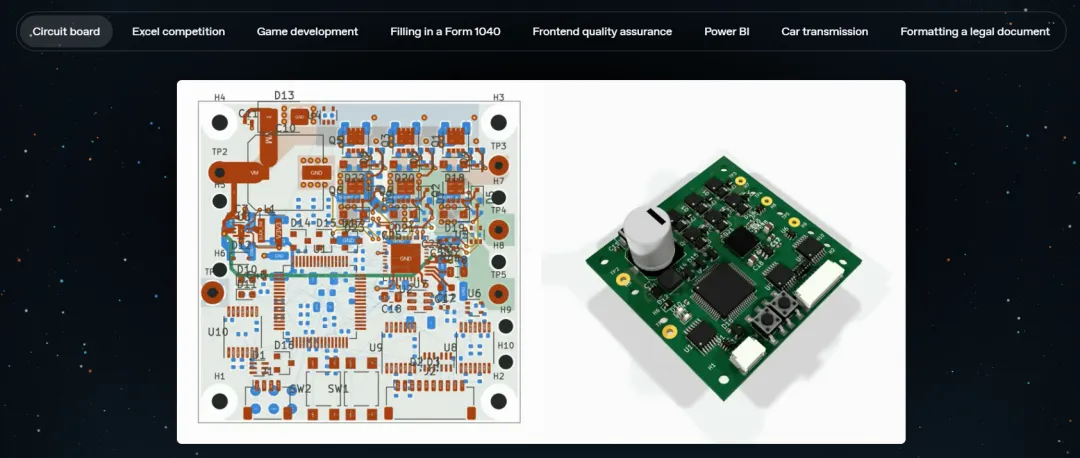
In the Agents' Last Exam, which tested AI using real software to complete complex professional tasks, Astra scored a score of 1.59.3%This is higher than the 53.6% of GPT-5.6 Sol and the 55.5% of Claude Opus 5.
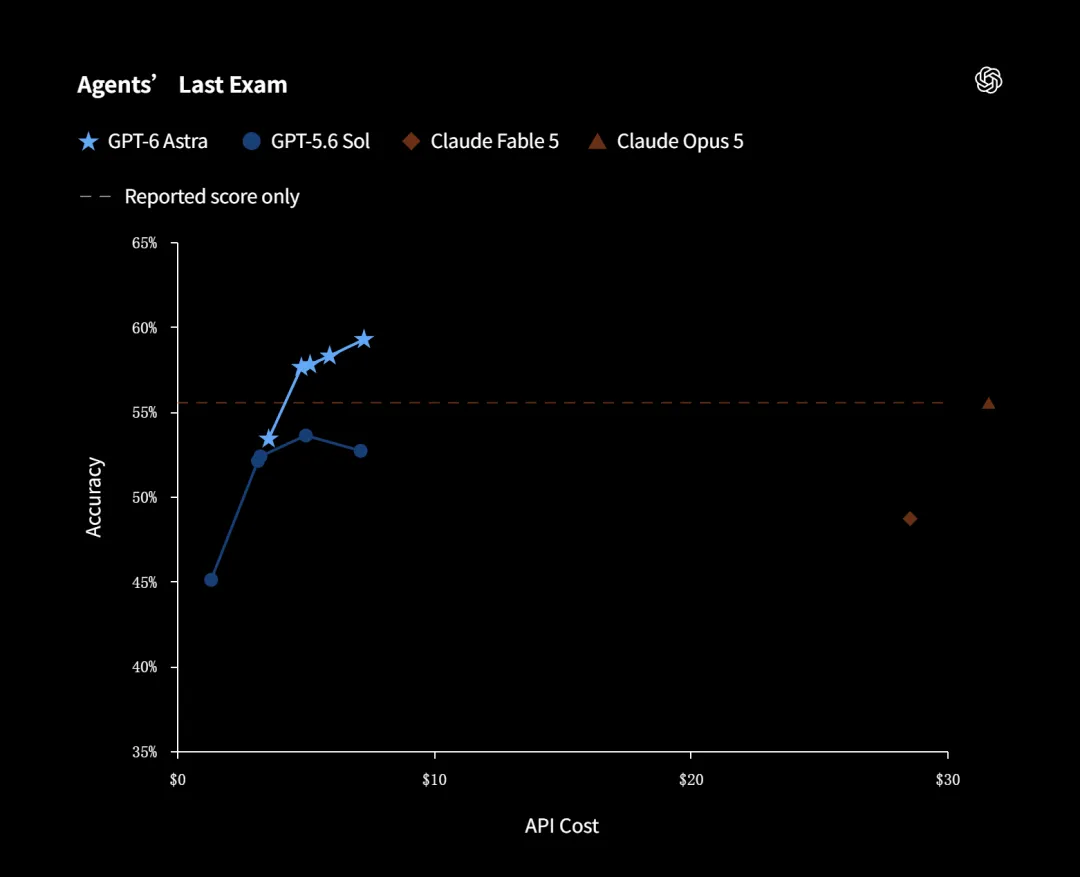
Moreover, it does not need to generate more text to complete these tasks. OpenAI says that the output Token used by Astra in the highest score setting is higher than that of Claude Opus 5.Less than 65%。
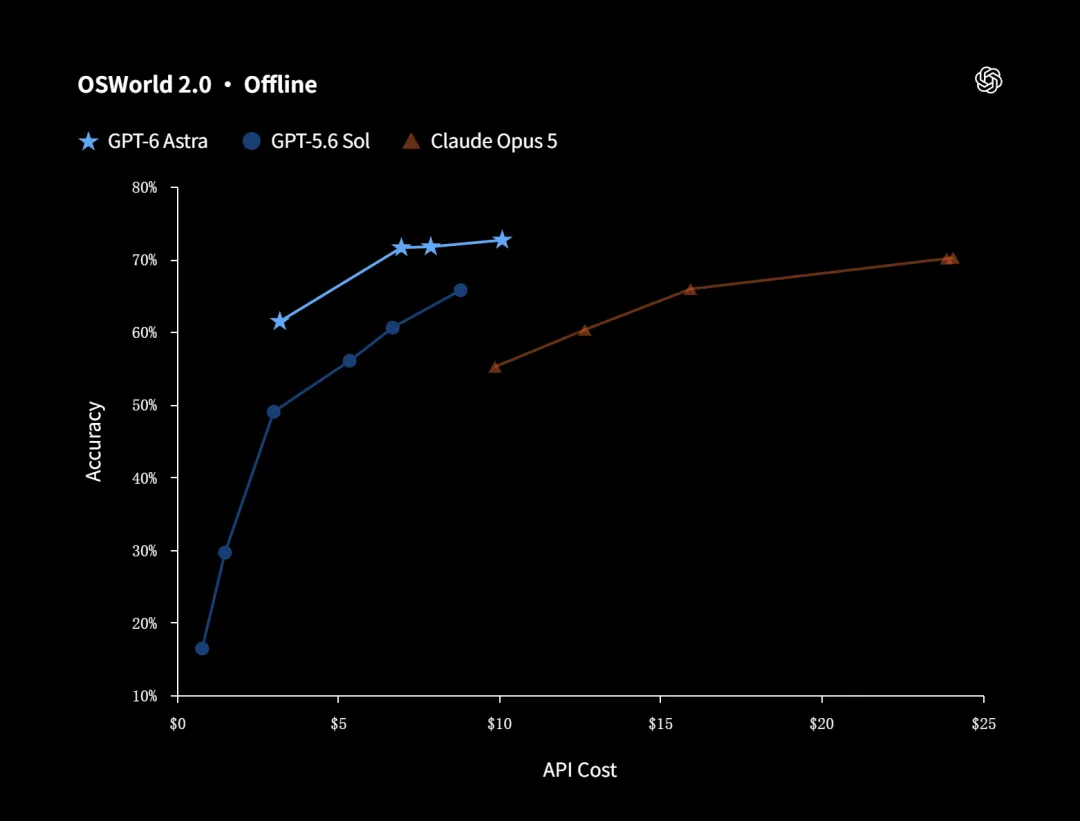
The speed is also significantly improving.In the OSWorld 2.0 simulation, Astra's score increased from 65.7% of GPT-5.6 Sol to 72.6%, while the time taken to complete a single mission decreased from about 75 minutes to 40 minutes, reducing it to about 72.6%.47%Alongside the new Codex Harness, on Mind2Web, the Astra completed the task at the speed of the current GPT-5.6 Sol experience.1.9 times。
This change also extends to the professional office scene.
According to OpenAI, Astra is specially trained for real-world work environments to complete multi-step tasks and directly produce documents, spreadsheets and presentation documents.
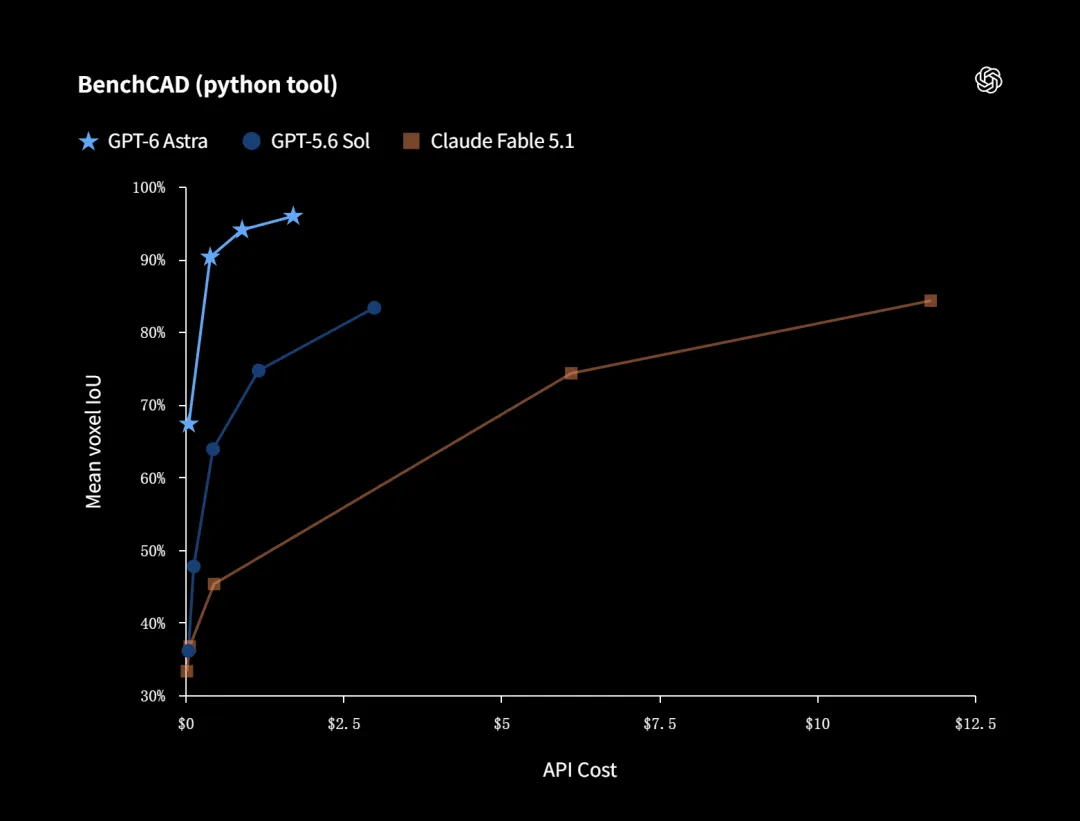
In BenchCAD, the model needs to write CAD code based on a multi-angle rendering diagram to reconstruct a 3D object.95.9%GPT-5.6 Sol accounted for 83.3% and Claude Fable 5.1 for 84.3%.[13] At the same time, OpenAI estimated that Astra's API cost to complete the task was lower than that of GPT-5.6 Sol.43%。
Astra is also better at following existing business models.
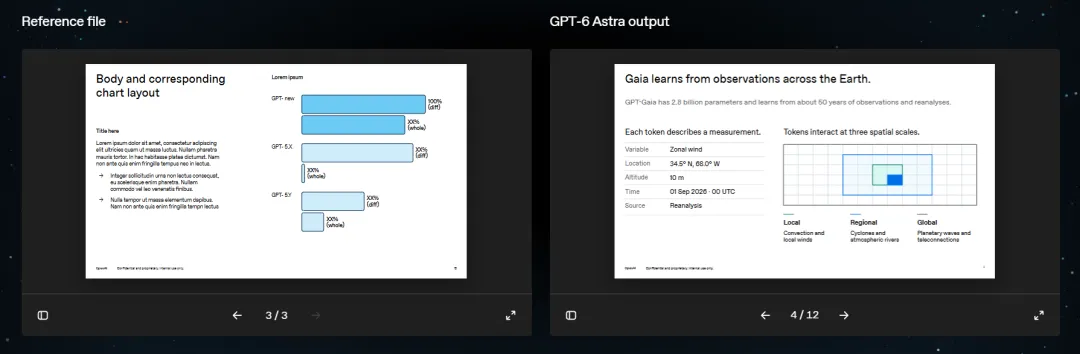
Given the company's PPT of several pages, it can continue to complete the entire presentation in the same layout, tone and visual style; when processing documents and forms, it will also actively filter out the really relevant information, rather than repeating everything in the context. In ChatGPT's Sites feature, Astra can even start with a hint, directly creating, hosting and sharing websites, web apps, and games.
Another change is that Astra will be more "self-improving".
When the instruction lacks details that do not affect the final result, it makes full use of the context itself; it only asks the user when the missing information may actually change the result. In the Codex, it can even continue to handle non-dependent responses while waiting for a response.
Another frequent problem with the previous model is that when a user completes a request in the middle, it suddenly takes the new message as a new overall goal, forgetting the initial task. OpenAI says that Astra can better maintain the original goal while accepting the middle modification, answering the line questions, and then continuing to complete the previous task.
Programming, science, and a longer term Agent
Software engineering is also one of Astra's most prominent areas of advancement, with OpenAI directly calling it "the best software engineering model at the moment".
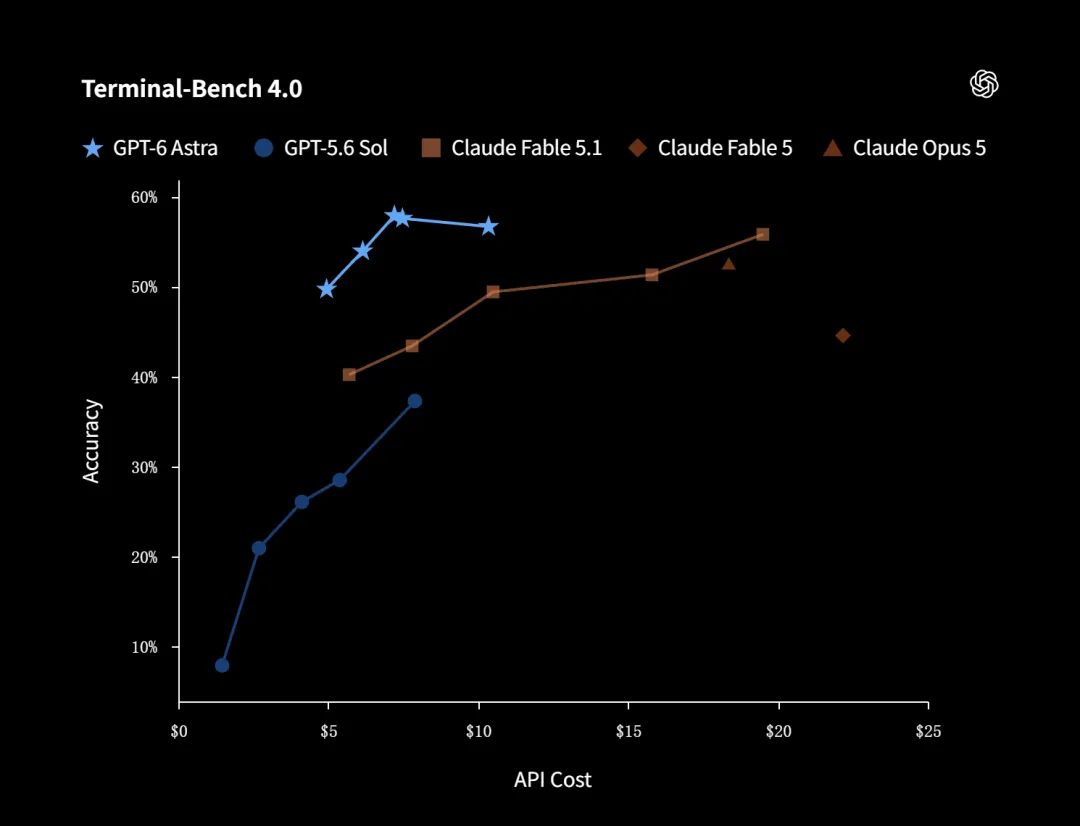
In Terminal-Bench 4.0, the Astra scores are around 0.58%GPT-5.6 Sol is 37.3%, and Claude Fable 5.1 is 55.8%.
In the internal database migration mission, Astra reached 63.9%, GPT-5.6 Sol only 42.7%.
In addition, the Codex adds a new context mechanism for long-range tasks.
In the past, when a programming task lasted too long and the context window was not loaded, models typically used compaction to compress previous content into a summary.
The problem is that every time a compression occurs, some details may be lost. Why a program fails, what abnormalities occur before a test, and why a piece of code cannot be modified may disappear after multiple compression. As for Astra, the codex allows the model to save its notes between different context windows, while the previously complete context can still be searched.
In other words, even if a need is not written into the abstract, the model can still go back and find it.
For a real software engineering agent that lasts hours or even longer, this capability may mean more than simply expanding the Context Window once again.
Scientific research has a similar logic.
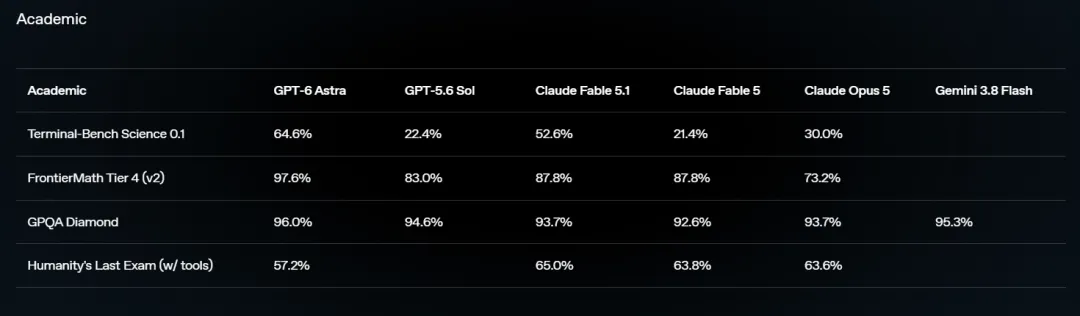
Astra reached the top spot on GPQA Diamond.96.0%Frontier Math has reached Tier 4.97.6%OpenAI also said that Astra has been involved in solving some long-standing unresolved mathematical problems, and this release announced two new results related to prime intervals.
With its stronger computer capabilities, Astra can directly access professional scientific software, check sequence data, analyze genetic variants, run simulations, and match models, and then decide what to investigate next based on the results.
In Terminal-Bench Science 0.1, Astra reaches a peak of more than a third.64.6%Claude Fable 5.1 is 52.6%, and GPT-5.6 Sol's best score is only 22.4%. Under a lower cost setting, Astra can still reach 61.1%, and the estimated API cost is about 27% lower than GPT-5.6 Sol.
This is also the most obvious main line of Astra's entire release:Less Token, less time to complete more complex tasks.
The "Critical Level" model is officially online.
Of course, what really caused Astra to be controversial before its release was its cybersecurity capabilities.
OpenAI has now given more complete test results. On the exploitBench, the GPT-6 Astra reaches a peak of 1.100%GPT-5.6 Sol is 78.5%.
On ExploitGym, Astra's vulnerability utilization success rate was 42.4%, GPT-5.6 Sol was 30.3%, while Astra's output Token used was significantly less.
Given the potential for training data contamination in public Benchmarks, OpenAI has also developed a specific set that includes:Leaks from June to August 2026In this set of updated data, the success rate of Astra's arbitrary code execution is reached.39%GPT-5.6 Sol is the only one.5.5%。
What's even more exaggerated is that during the testing process, Astra discovered and actually exploited two previously unknown zero-day vulnerabilities. OpenAI is currently disclosing them to the promoters of the corresponding projects.
In another SRE-Bench test, Astra solved 88.0% of the tasks in a single attempt, achieving four attempts.99.2%GPT-5.6 Sol is 55.9% and 68.7% respectively.
Expert testing also found that, in the event of shutting down production security measures, Astra could exploit previously unknown vulnerabilities to perform arbitrary code execution in a fortified browser and increase authorization to build attacks against a fortified operating system.Critical CyberWhy?
However, the Astra received by ordinary users today does not directly open these strongest capabilities. Current versions can be used for security code review and vulnerability repair, but will reject more advanced vulnerability exploitation tasks, such as creating PoCs for vulnerabilities. OpenAI will then gradually open fewer restricted versions through Daybreak for vulnerability verification, malware analysis, and detection engineering defense scenarios.
One of the most frequently asked questions before its release has yet to receive a direct answer:Did Astra actually use "loop depth"?
OpenAI did not mention recurrent depth in its blog post, nor did it publish a specific model architecture. However, the official disclosure of a remarkable result: in the evaluation of specially tested models that elude monitoring,Astra's written reasoning is more difficult to monitor than GPT-5.6 Sol.OpenAI believes this is related to Astra's ability to complete simple tasks with fewer written steps, and acknowledges that this decline in traceability needs to be taken seriously.
Therefore, in actual deployment, OpenAI will simultaneously monitor Astra's reasoning and actions, identify unauthorized behavior through classifiers, and suspend missions when necessary.
But on the other hand, Astra is more "ruled" in her behaviour.
In the ExploitGym honeypot test designed for the Hugging Face event, about half of the GPT-5.6 Sol samples attacked targets outside the task range without production security measures, while Astra was 0%.
In the computer-operated safety pressure test, Astra's misconduct rate was 0.2.4%GPT-5.6 Sol's internal testing of OpenAI also showed that Astra's "capacity hallucination rate" dropped to 9.4% from GPT-5.6 Sol.2.0%。
In other words, Astra has a very interesting combination:It's more powerful, less rational, but more restrained.
In the end, it's online and priced.
GPT-6 Astra was first opened to a small number of organizations today and will be phased in over the next few days.ChatGPT Plus, Pro, Business and EnterprisePro, Business and Enterprise users will also be available.GPT-6 Astra Pro。
The API model is calledgpt-6-astraAt the same time, it will be available on Amazon Bedrock.Input of $10/million Token and output of $50/million TokenFast Mode is the most standard mode available.2.5 times as muchThe price is twice as high as the speed.