The team of authors came from Qingdao University, Hong Kong University, Beijing Weiju Laboratory and Qingdao Technology, Fusion Electrical Chemistry, Physical Modeling and Artificial Intelligence Research. Prof. Zhang Zheng is a co-author of the communication with Zhang Wei.
AI has progressed rapidly in tasks based on formalized reasoning, such as mathematics and programming, and has been able to answer highly complex questions. But when vision has shifted from numbers and symbols to the micro-physical world on which material research and device design depend, AI seems to have lost focus. The question is: Is making inferences based on phenomena equivalent to understanding how the system works?
Physical models are bridges connecting external phenomena to internal mechanisms. Transmission, reaction, energy exchange, and other processes are written into state variables and equations so that predictions have questionable, verifiable bases. The difficulty is that real systems often interact with multiple physical fields, and critical internal states are difficult to directly measure. When models conflict with experiments, AI must track: are parameters incorrect, solve problems, or do the original equations miss key physical relationships?
In order to solve these problems, a team of Chinese University of Chemistry professor Zhang Zheng, together with institutions such as Peking University of Chongqing Technology, Hong Kong University, Beijing Weiju Laboratory, has proposed EvoSim, aimed at the field of micro-physical modeling. The core breakthrough of EvoSim is that it allows AI to move from a given equation to a sequencing mechanism from an experimental deviation, modifying the equation, improving the method of modeling errors. The same round of testing yields both more accurate models and reproducible modeling capabilities.
EvoSim: Learning to Model, Modeling to Learn
Link to the paper:https://arxiv.org/abs/2610.11344
Models and experiments are incompatible: AI tracking, where to go wrong
For many applications in materials science, computational chemistry, and finite metric simulation, AI Scientist is good at finding parameters, running simulations, and modifying code under given equations. If the group of equations omits key processes, the parameters are fine-tuned, and systemic biases are difficult to explain. EvoSim turns solving the hypothesis of predictive error into a research problem: at the same time, it poses several possible reasons for parameter identification, physical mechanisms, geometry, boundary conditions, and decides how to modify and verify them.
Different interpretations are translated into parallel candidates: some change reaction mechanisms, some change status updates or equation combinations. Each candidate route is subjected to the same set of questions: does the introduced equation conform to the basic laws of physics? is the solution numerically reliable? is the prediction closer to the measurement? is the mechanism identifiable? These checks determine the remainder of the candidate model, while leaving evidence about the research steps themselves.
For example, even if a candidate model is not adopted, under what conditions and at what steps the failure occurs, it is still recorded by the system. The system thus proposes modifications to the modeling process and demonstrates the effectiveness of the modifications by controlling experiments. It is only by confirming the expected effect that it is retained as a replicable method.
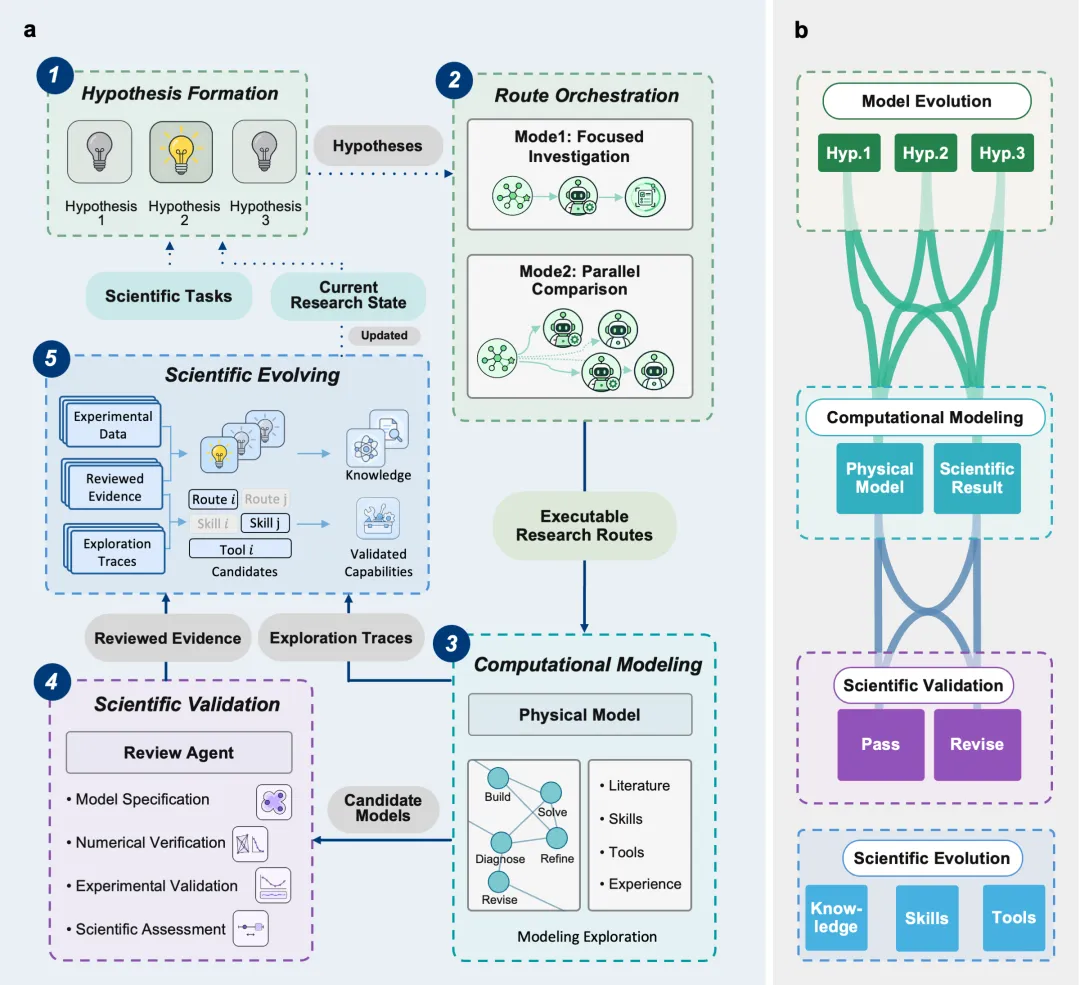
Figure 1 The same round of experimental feedback both promoted revision of physical models and provided evidence for AI refinement, testing and modeling methods; updated methods continue to guide subsequent model exploration.
Key boundaries of fast charging: When do batteries start decaying?
Fast charging shortened the battery's charging time, but also pushed the battery to stricter working conditions. When the charging frequency increases, some of the lithium may not reach the graphite negative pole, but instead deposits into metallic lithium, consuming the recyclable lithium and affecting the battery life and safety. Therefore, the design fast charging strategy can not only ask how fast the lithium is charged, but also to know under what conditions the lithium begins to dilate. But the starting point is influenced by many factors such as the internal temperature of the battery, electrode design, charging protocol, many of which states are difficult to test online; using an external voltage curve alone, it is difficult to give a direct answer.
EvoSim started with the establishment of a basic electrochemical model, which combined dialysis and detachment reactions. However, there is still a regular deviation under different frequency rates, which points to a deeper hypothesis: deposited lithium is not always irreversibly lost at a fixed rate. The system rewrites this relationship as a random frequency change, so that the equation reflects the time scale of the accelerated charging process. The study uses 20 dialysis start-point conditions from 61 test cells, covering two graphite designs, 25 to 45 degrees Celsius and multiple charging rates. In the test set, EvoSim built a model with an average absolute error of 1.79% in dialysis of the start-point electrical state, superior to the predicted accuracy of models constructed by historical human experts in the field.
There are about 110,000 samples:
Can the voltage model keep up with real driving?
Analysis of the starting point determines the fast charging boundary; while the change in the voltage in the vehicle is related to whether the battery can supply power when accelerating, receive energy when braking, and remain within operating limits. Dynamic voltage prediction is also an important basis for battery management systems for state estimation, power prediction and control. Real driving electricity frequently changes, electrode state, electrolyte transmission and interface charging respond at different speeds. To predict the complete trajectory, the model must explain how these processes affect the voltage.
To verify the two types of load curves at 8 temperatures, a total of 16 complete trajectories, 109,746 second-rate sampling points, were analyzed. EcoSim's power-average root error at 30°C DST trajectories was 7.62 mV, 20°C US06 to 8.97 mV, which is below the historical best of the motion models built by human experts on the corresponding data set.
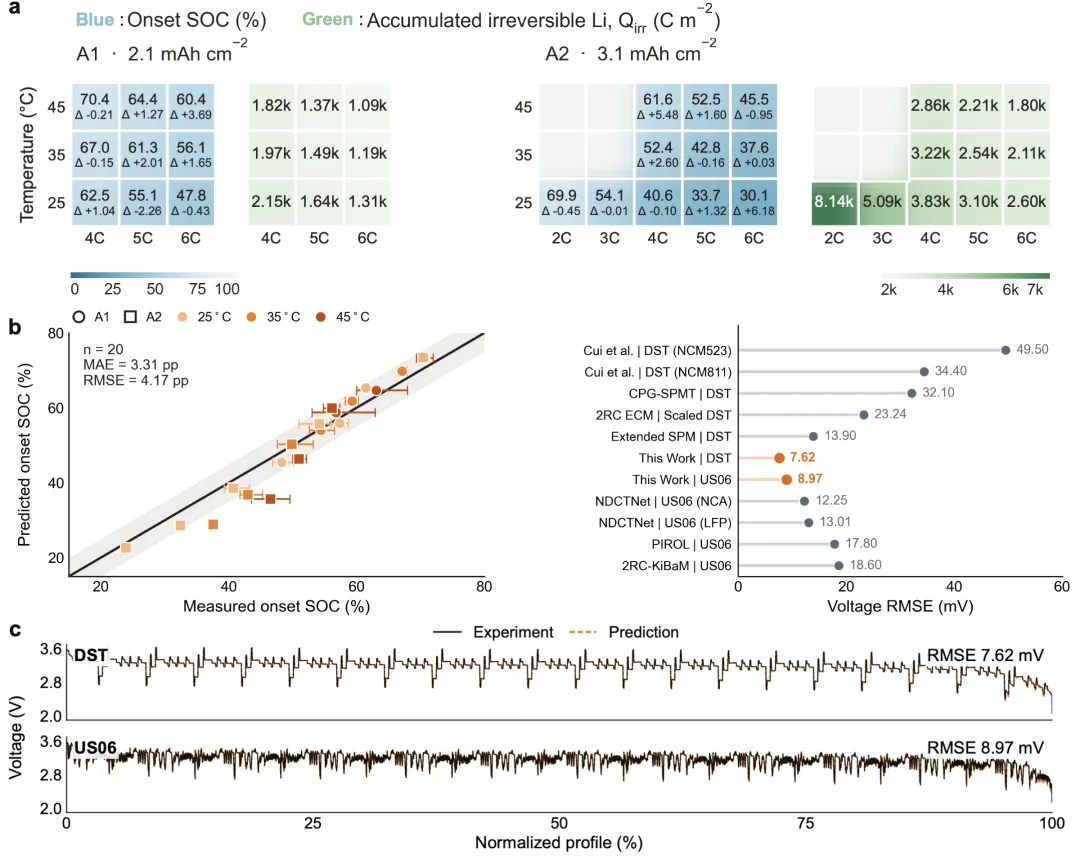
Figure 2 of the paper shows the full voltage trajectory of the rise and fall predictions, as well as the observed and predicted voltage trajectories under dynamic loads.
The same round of trial and error
How can models and AI evolve together?
The dynamic voltage task clearly demonstrates the interaction between the model and the modeling method. Although early dynamic voltage models were able to solve the convergence, the internal electrode state was not consistent with the reference calculation. EvoSim not only adjusted the parameters, but tracked the state updates in a discrete way. Between failed corrections and successful modeling, the system continued to evolve, changing the sequence of checks and decisions when the system subsequently handles similar problems. The improvement of the model generated the method and the method accelerated the next model improvement, which achieved recursive self-improvement.
For the accumulated effect of the test method, the team set up three sets of controls on the same dynamic voltage task: the first group kept the complete history, the second group kept the summary of the attempts only, and the third group, EvoSim. Under the unified submission budget, the best effective error for EvoSim was 75.4% lower than the first group, and the second group was closer to the first group.
In electrochemical lithium-ion thermal fusion modeling, the system chooses to simultaneously explore physical mechanisms and modify the model, reducing the number of successive model modifications from 10 to 1 times. In 45 group assignments covering 11 tasks, there was a 36.4% reduction in the occurrence of model construction or failure of physical mechanisms; the cumulative execution time of the operation was reduced by 42.6%.
Starting from batteries
What kind of scientific research does EvoSim refer to?
EvoSim demonstrates a way in which language models continue to understand the physical world: experiments point out that where physical models cannot be explained, language models modify the model accordingly, give new interpretations, and the process of modification in turn improves its research methods.
Battery-related tasks provide a quantifiable starting point for this path. The next step is for researchers to select systems with experimental data in more fields such as materials science, chemical engineering, and bioengineering to test whether this synergistic evolution can continue to work. Along this path, AI's understanding of the physical world is not only reflected in one prediction, but also in whether it can come up with better models and better research methods from every collision with reality.
© THE