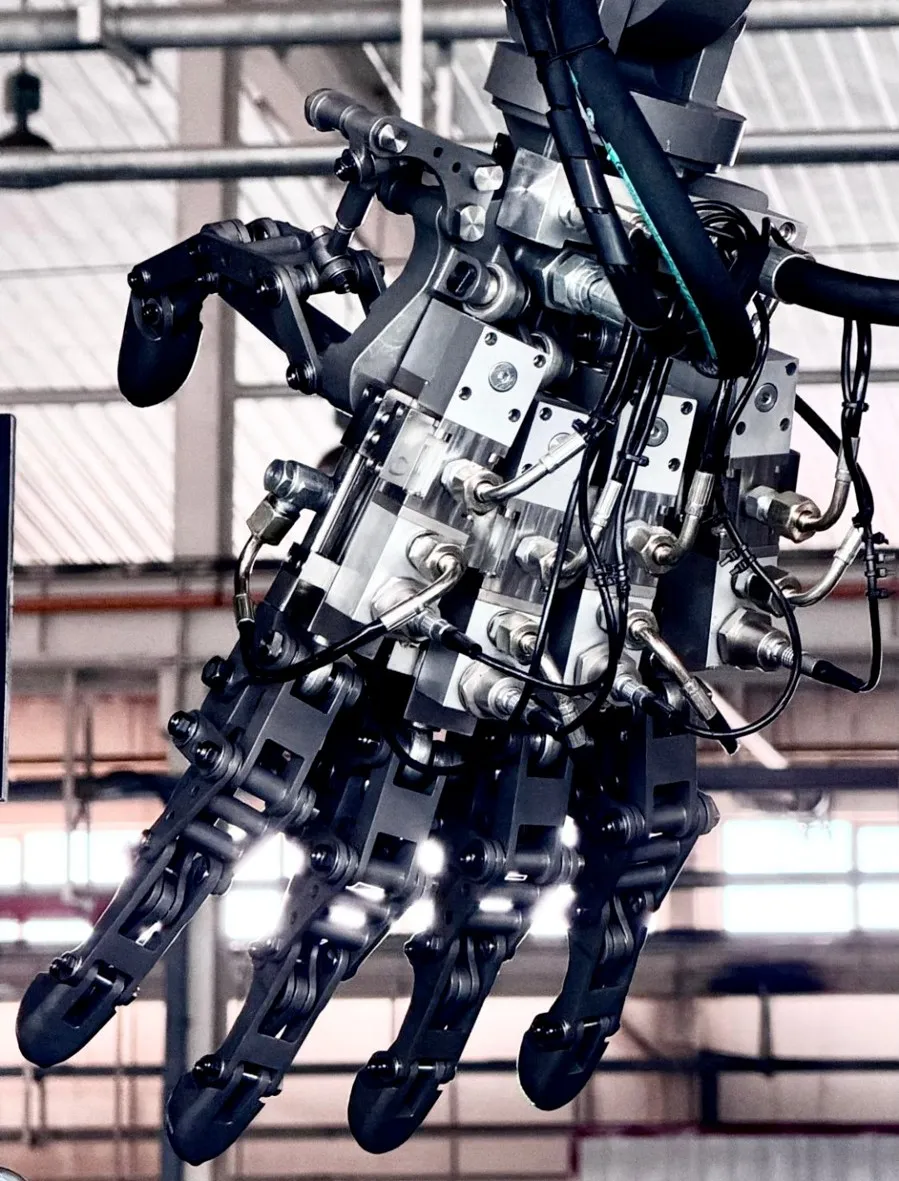
“ Hydraulics is the future of the man-made monster!
Human beings may be just the beginning of a robot's entry into the real world rather than the end of a robot's body. A central paradox in the human robot industry today is that the more it seeks universality, the more special forces are needed.
Tesla Optimus folded after its factory demonstration, Figure AI was tested at BMW's factory, Digit from Agility Robotics was deployed at Amazon warehouses. These demos showed remarkable improvements in operational control and model levels, but without exception exposed structural shortcomings at the execution level.
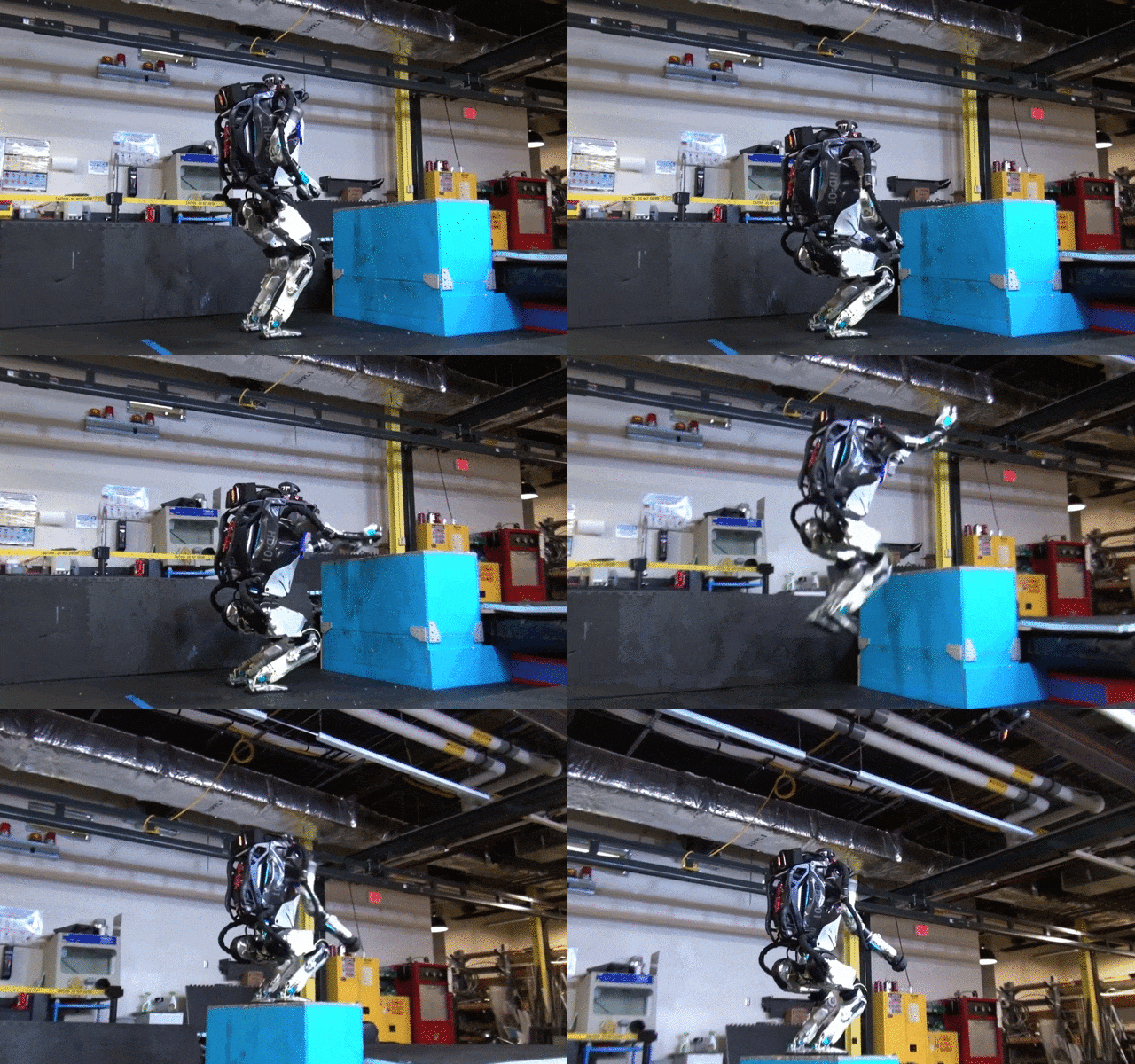
If anyone can solve the basic problems of hydraulics, I believe that hydraulics will certainly dominate the executive sphere. Zhang Jiwei, a foreign academician at the Chinese Academy of Engineering, said a judgment made three years ago at the annual meeting of the robotics industry in China, pointing to a physics reality that has long been ignored by the industry:
The energy density of hydraulics is essentially more than ten times that of a motor, which means a difference in the energy density index.
The root of the problem lies in the fundamental nature of material physics. The motor relies on electromagnetic sensations, the core materials are copper, zinc, rare earths, expensive and energy conversion efficiency is limited to the thermal and magnetic fields of the wire.
Hydraulics rely on uncompressed liquids, the core material being steel.
Well, it's not that we're stronger than the motor, it's that the motor shouldn't have taken on this role.
This is also the core belief of the founding team of Clean Dynamics: they are not following in the footsteps of the electric drive program, but are trying to redefine the physical boundaries of the executor.
01.
A delayed technological revolution
Traditional hydraulics were once called non-scientific hydraulics, not because of their poor performance, but because of their complexity beyond the acceptable range of engineering practice.
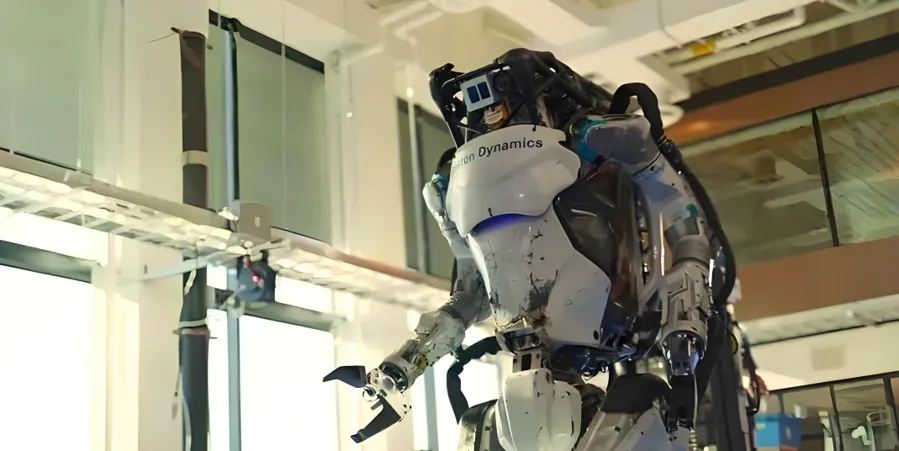
Behind the $1 million sale of the Boston Power Atlas, the cost of system integration requiring two professor-level engineers for each robot sold, still reveals the economic paradox of traditional robot executives.
High performance equals high complexity and high complexity equals high maintenance costs.
The growth of China's robotics industry over the past two decades has largely been based on this system that continues to evolve. After the outbreak of today's humanoid robots, the industry inherited this path almost naturally.
This is not because the electric drive solves all the problems; it is because it is already an extremely high level of industrialization.
A robot company can buy motors, accelerators, drivers and controllers and put them together into their own bodies.
In contrast, hydraulics is almost like a technology from the previous industrial era.
It has power but also a heavy historical background. Complexity, difficulty in controlling, system size, high operating and maintenance costs, temperature changes affecting fluid viscosity, load and pressure fluctuation testing algorithms and parametric ranges, mechanical wear leads to performance degradation, modularity uncertainty, and increased uncertainty. Multidimensional variables combine to make traditional hydraulic systems require dozens of sensors, complex control networks, and continuous parameter recognition and complex algorithms.
In the past, hydraulics were more like an engineering system rather than a component that could be installed directly into a robot's joints.
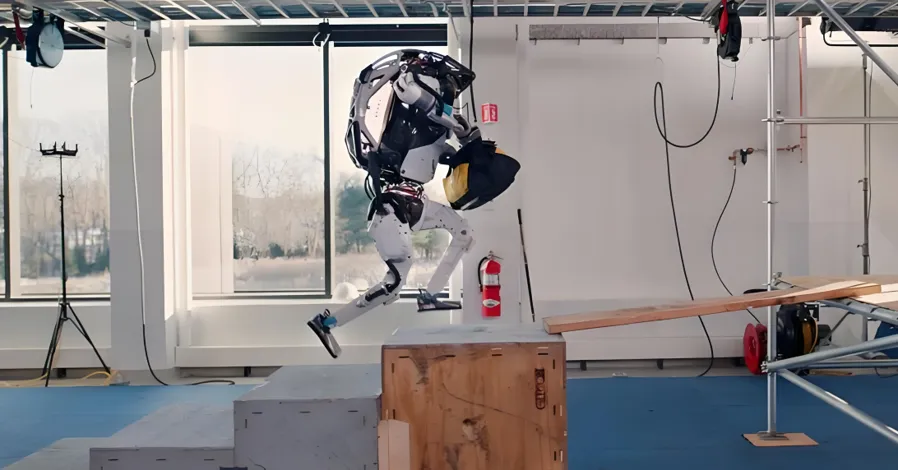
So the real problem is never whether hydraulics have power; it's the power of hydraulics, which can be simply summoned by robots.
As a representative of the hydraulic system, Boston Power's one-time solution is the stack of Professor Liu, which is essentially the complexity of the human-power compensation system.
The idea behind digital hydraulics is to fundamentally eliminate complexity rather than manage complexity.
We don't rely on external sensors, we don't rely on complex algorithms, we don't rely on real-time parameter recognition. We let hydraulic pumps remember where they are.
The specific mechanism is a mechanical positioning feedback device with pulse-quantitative characteristics. A pure mechanical structure is integrated inside the oil tank, achieving a one-to-one correspondence between the displacement and the pulse. A pulse corresponds to a one-micrometer course, continuously moving back and forth to achieve precise control of any position, without electrical sensing, without cameras, without parameter recognition and complex control software hardware.
It's like digital electronics beat analogue electronics at the time. Using a cross-disciplinary analogy, analogue age, amplifiers need to be constantly deflected, compensating for temperature drift.
The essence of digital hydraulics is the transformation of the analogue properties of hydraulics into digital properties, the establishment of more precise mechanical motion relationships within the executor, and the encapsulation of complex control problems within the executing unit as much as possible.
The result was the reductionism of components. The original robotics company may have had to understand pump stations, assemblies, pipelines, sensors, control systems, and self-control algorithms and parameters to gain hydraulic capacity.
Today, all it needs is an execution module - an oil pump, a high-pressure oil pipe, a return oil pipe, and a control line - so the complexity of the system is compressed from 100 times that of conventional hydraulics to almost zero.
It is a similar system to a motor, from the old way of the system, to the old way of the parts. Traditional hydraulic components 10,000 units, to the application end sold 100,000, the entire life of the investment can be up to tens or even millions of yuan.
This cost gap is not a quantitative one, it is two worlds.
02.
Power density, tolerability and efficiency
The value of digital hydraulics is based on three-dimensional physical advantages.
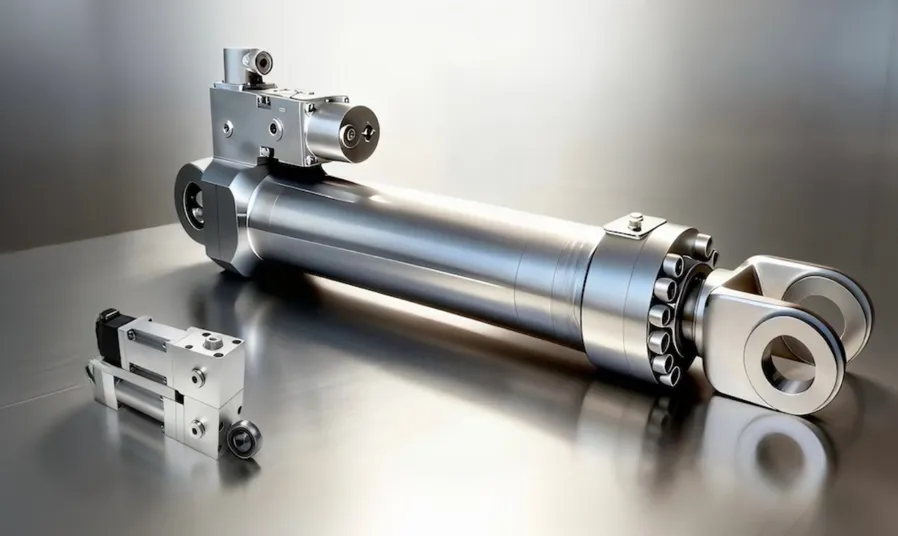
First, power density. The team demonstrated a set of digital hydraulic actuators, weighing about 1 kg, but capable of achieving lithium-scale thrust. This is a quantity that the electric drive system cannot physically handle. For humanoid robots, this means that the full weight of the 300 kg loaded arm can be controlled at 150 kg, whereas the conventional system requires 3 tons.
Second, environmental resistance. Under high sea pressure, the engine structure shrinks. In a nuclear radiation environment, electronic devices are immediately damaged. In the field of high-low temperature difference, the engine performance decreases sharply. This is why the field of deep sea detection, maintenance of nuclear facilities, space equipment, etc. depends on hydraulics for a long time rather than electric drives. Hydraulics itself is a high pressure system, deep sea pressure is not a challenge for it, it is normal. It is known that digital hydraulics can be used directly to the reactor's intense radiation environment, the width temperature covers 40 to 250 degrees Celsius.
Third, system efficiency. In traditional cognition, hydraulic efficiency is lower than that of a motor, but this is due to the loss of system complexity. Valve pressure decrease, pipeline obstruction, internal and external leakage, etc. These are inevitable in traditional hydraulic systems.
However, the digital hydraulic system has begun to shrink, with fewer intermediate links and low natural losses. According to the team, the combined energy efficiency of the hydraulic system is higher than that of its counterparts, especially in the case of large load-to-repeat motion scenarios, and the gap reaches a quantitative level. In addition, the power sharing of the hydraulic system leads to a further optimization of the energy weight, less heat, and relatively higher natural efficiency.
This threefold advantage determines the applicable boundaries of digital hydraulics. It is not intended to replace the application of motors in all scenarios, but to effectively fill in the gaps that cannot be filled by motors. Recharging logistics, industrial installation, mining and deep-sea equipment, and nuclear facility operation, these scenarios tend to exceed the requirements for strength, climate resilience, and reliability. Digital hydraulics in these areas are not an option, but are beginning to become essential.
Because if the purpose of a robot is not to imitate humans, but to replace them with jobs that people don't want to do, can't do, or aren't doing well enough, why does it have to have the same power as humans?
Why can't a robot move 20 kilograms? Why can't a robot move 20 kilograms? Why can't a robot go into the deep sea, why does a robot have to abide by this boundary? Why can't a person tolerate high radiation, high temperatures and high-risk environments for a long time?
Perhaps the robotics industry is entering a new phase. Robot intelligence needs to be more like a human, but the body of a robot, which may need to be more different from a human, needs a more powerful source of power, digital hydraulics.
03.
A team of ten, a path from the edge to the center
According to the Robotics Workshop, there are currently only 10 people in the team.
This figure is unprecedented in the human-robot industry. It competes with hundreds of teams of people and moves hundreds of millions of R&D investments. But Liu is not worried. On the one hand, its founding team is strong, not only Wangjian, who has long been deeply engaged in robot-service-driven farming, but also academicians who have long been engaged in AI and robotics research, as well as core developers of digital hydraulic technology.
On the other hand, Liu believes that digital hydraulic products are essentially an infrastructure-level technology. He said that the hydraulic power plant industry is growing rapidly in China, with the accumulation of decades of foundations in the industrial sector, and hydraulics are also going through this process.
The engineering difficulty of digital hydraulics is not low. Precision machining and sealing circuits are two traditional problems, and the choice of the Dynamics team is to jump directly from the first principle innovation to the difficulty. Through the principle level innovation, engineering iterative improvement and modular design, the hydraulic executor is made into a single-use component, the user does not have to worry about the internal assembly and sealing details.
No pumps, no complex controls, the only straight line of hydraulics and the two executors that rotate are digitally digitized directly (digital hydraulic pumps, digital hydraulic modules). The user only needs to take three pipes, high-pressure oil, return oil pipes, control lines.
Through this modular design, it can be said that hydraulic power transforms the hydraulic actuator into an instantaneous component, without the user having to worry about internal assembly and sealing details. This de-professional design philosophy is consistent with the core technology of digital hydraulics.
We're not making a smarter machine, we want to redefine driving.
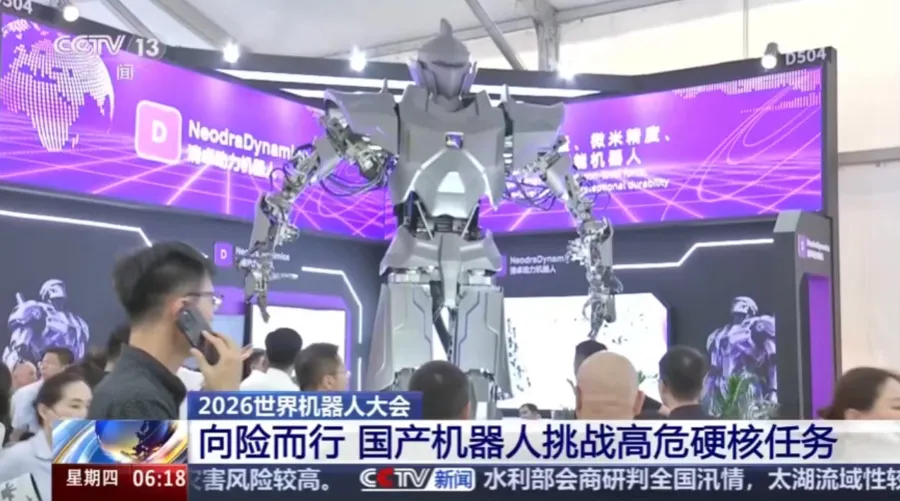
Currently, the technology has entered the engineering verification stage. The world's largest liquid-electric-powered robotic prototype is currently being unveiled at the WRC exhibition, with all joint operations completing the entire course of movement in one second. The team's goal is to allow the robot to walk freely and establish a commercial presence in harsh hazardous rubber applications such as ports and mines.
Liu explained that the ultimate destination of digital hydraulics is humanoid robots, but the path to improved accuracy is quite different from current mainstream motor accelerators. Their design logic is split into two steps. They first use digital hydraulics to solve the power demands of the industrial scene and establish a commercial closure; in the process, the technology is gradually transferred to humanoid robots, completing the transition from industrial to general use.
This judgment is based on a deep insight into industrial economics. Any commercialization of executor technology requires a scale-up scenario in the form of an industrial mother machine to mitigate costs. The engine finds machinery, automobiles, home appliances, and hydraulic industrial mother machines are industrial manufacturing. The cost of hydraulic executors will decrease exponentially when these fields form a million-scale batch application.
04.
Physical anxiety and neglected underlying abilities
Returning to big industry trends, today the human-robot industry is experiencing a period of intense physical anxiety. The brain is making rapid progress, but physical progress is not keeping pace. These progresses remain largely at the demonstration level, with real productivity tools still at a distance, especially the operational capabilities of super-large scenarios.
In essence, power is the first bottleneck. Robots without enough power cannot bear the real load in industrial production. Precision is the second bottleneck, micro-level control is a prerequisite for agility. Reliability is the third bottleneck, and the adaptability of extreme environments determines the application of boundaries.
Today's robots, in many cases, are still performance-oriented. The presentation is fantastic, but it's not working, it's not powerful enough, it's not accurate enough, it's not durable enough. This is the traditional advantage of hydraulics. This judgment points to a deeper industrial problem.
The purpose of being physically intelligent is to change the physical world, and power is the most basic ability. Morgan Stanley data shows that China controls 63% of the global human-robot critical supply chain enterprises, mainly in the drivers and rare earth processing sector. This ratio is behind the structural advantages of China's electrical drives, but also suggests a risk. When the physical limits of electrical drives are reached, the advantages of the supply chain will be re-priced.
Digital hydraulics is trying to answer this question. It uses lower cost, higher power density, stronger environmental resistance, and redefines the body of the robot. This is not a replacement for the motor scheme, but a critical infrastructure when man-made robots enter the industry scene that really needs power.
Because the demand for data with physical intelligence could be thousands of times greater than that of autonomous driving, millions of times greater than that of big-language models. Data, or the lack of high-quality physical interaction data, is still the biggest obstacle.
Traditional models rely on Internet text, autonomous driving relies on road video, and what does physical intelligence require? High-reliability data for physical interaction: touch feedback, power control signals, environmental perception, operational trajectories, which are not only large in size, but also highly heterogeneous, and cannot be completely replaced by synthesis.
This means that it is inherently difficult for adults to form a downstream application of anti-inflammatory research and development.
But the meaning of digital hydraulics is that it makes people think that when a robot's brain is getting closer and closer to universal, should its body be redesigned as well?
Because big models solve cognitive uncertainty, but robots ultimately have to pay for the physical world. Perhaps only when robots have real power, precision and resilience, and data can be directly used to train more powerful models, will we be able to see a surge in the mobility of super-sized humanoid robots, and the possibility that humans can actually have giant aircraft carriers in the Pacific.

05.
Endings and Physical Essence
You can't use human form to bind robots, but you should use robots to empower people.
This is a phrase that Liu used in an interview with the Robotics Conference and is the philosophical underpinning of the entire digital hydraulics project.
It's a marketing concept, not an engineering constraint. What really matters is what robots can do, and how well they do it.
Strength, accuracy, resilience, cost, these four dimensions determine the limits of robotics' applications. The current industry has a clear shortcut to the first three, and digital hydraulics is trying to build new breakthroughs on these foundations to empower the intelligent industry.
It's not an easy road to go. Hydraulic technology has accumulated in China, but commercial successes are scarce. The human-robot track is crowded, with giant forestry. The transition from the industrial scene to the general scene requires a long technological transition.
But you don't seem to be in a hurry to prove anything.
Because he firmly believes that everyone is trying to get robots to have a brain that is closer to humans.
The next stage of the robot may be doing something else:
Re-engineering a body that transcends human physical limits.