What do the next generation of robots need when the brains responsible for understanding and thinking are getting smarter?
An increasingly clear answer is that a truly engaged intellectual mind is a physical mind.
In recent years, large-scale models have given machines increasingly strong language, vision and reasoning skills. At the same time, robots are moving from traditional rigid mechanical systems to more flexible, flexible, and perceptually rich forms.
So there is an interesting intersection: Physical AI × Soft Robotics.
This is exactly what is happening to software robots.
In the past, the field has focused more on how to make robots softer, more flexible, and more secure; now, the question is moving one step further: can materials, structures, mechanics, and perceptual systems themselves be part of the robot's intelligence?
In 2026, 37 scientists from different backgrounds from the world's top academic journals - including the South China University of Technology, the Hebrew University of Jerusalem, the Massachusetts Institute of Technology, the Swiss Federal Institute of Technology, Tsinghua University, Cornell University, Northwestern University, etc. - published an article on the future of technology from smart machines to physical intelligence.


Some authors of this paper
The article brings together research perspectives in various fields such as robotics, materials, mechanics, nanotechnology, artificial intelligence, bioengineering, and more. The system addresses the paradigm shift that software robots are undergoing and further poses critical scientific and technological challenges for the future.
What this article describes is not just a map of soft robot technology. It actually points to a broader future of soft machines moving from embodied physical intelligence to the realm of soft institutions and simulation to a broader one.I'm not sure what I'm saying.。
In other words, robots of the future may no longer just be AI-powered to control the body. The body itself is also beginning to be part of intelligence.
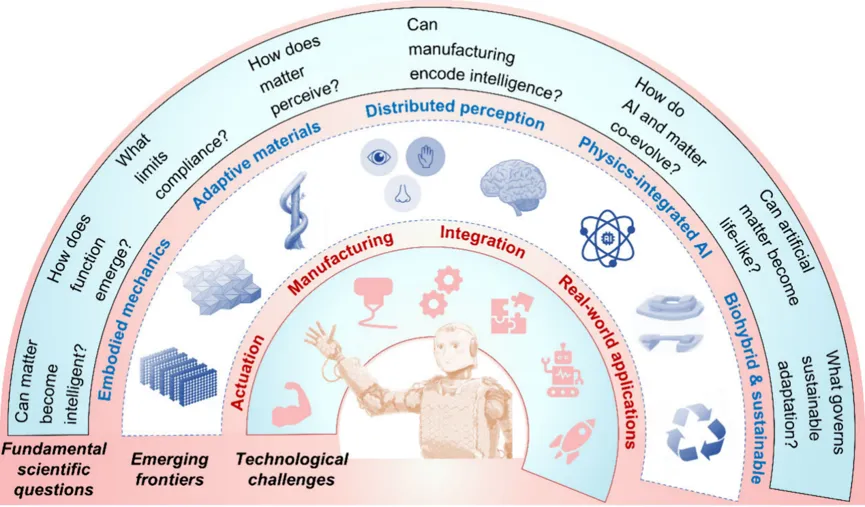
Figure 1 presents a framework of three levels of basic science, emerging research directions and technological development that link basic science issues with the cutting-edge research and technological realization of software robots. The outer focus is on basic science issues related to intelligence, perception, functionality, adaptability, and the relationship between matter, computing and life. These fundamental issues drive a range of emerging research fronts, including physics, adaptive materials, distributed perception, physical integration of AI (physics-integrated AI) and bio-hybrid and sustainable systems.
01.
Software robots: from soft-source to smart-source
The problem that software robots initially solved was a fundamental contradiction that was difficult for traditional rigid robots to solve: the real world was not rigid.
The human body is deformed, the fruit is damaged, the underwater environment is changing, the agricultural environment is complex and unpredictable, and the human body is full of soft, narrow and dynamically changing tissues.
Nature has long developed a very effective set of solutions - the tentacles of octopuses, the nostrils of elephants, worms, sea stars, and the skeletal musculoskeletal system of the human body - that do not rely on a large number of precise rigid joints to accomplish complex movements. They rely on soft materials + distributed perception + shape adaptation + environmental coupling.
Therefore, early software robots focused on flexibility, large deformation, safety interaction, environmental adaptation and bio-inspiration. Deformable bodies could actively fit into uncertain environments, simplify grip and movement, and reduce the risk of contact with humans and vulnerable objects.
But today, things have changed.
In the past, we've asked: Can robots become soft? Now we're starting to ask: Can robots involve their bodies in perception, computation and decision making?
On the development of software robots, the paper provides a clear development path: Soft Machines→ Integrated Soft Systems→ Embodied Physical Intelligence.
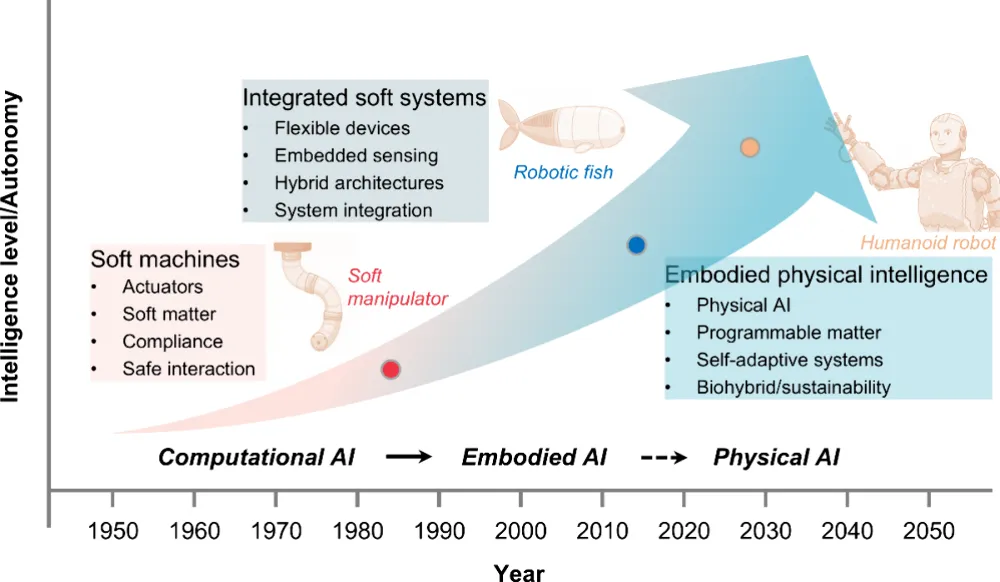
The roadmap for the development of software robots shows the progressive evolution of software robots from material-centered software machines to physically intelligent systems. Such systems are able to adapt and interact autonomously in complex environments, reflecting the trend of software robots from material-structural flexibility to highly integrated, intelligent and autonomous directions.
Specifically, the first phase involves robots solving smooth, driven, and secure interactions; the second phase involves integrating flexible devices, embedded perceptions, and hybrid structures into the body; and the next phase involves physical AI, programmable matter, adaptive systems, and biological hybrid robots.
So the key changes that software robots are undergoing can be summed up in one sentence: the body is moving from being controlled to being part of an intelligent system.
02.
The most important change: The body begins to calculate calories
Traditional robots typically follow a clear information chain: sensors → data → CPU/GPU → algorithms → controllers → executors.
The robotic body itself performs mainly mechanical functions. Physical intelligence suggests another possibility: allowing the body itself to participate in computation.
For example, when a flexible structure undergoes a specific deformation after an external force, the deformation itself can carry information. If the material and structure are properly designed, mechanical systems can even complete filtering, magnification, memory, state transformation, and pattern recognition.
These are: form computing (Morphological Computation) and physical reservoir computing (Physical Reservoir Computing). The common problem behind them is simple: why does all computation have to happen on an electronic chip?
For example, a software clutch faces unknown objects. Traditional robots may need visual recognition → modeling → path planning → control → force feedback. While highly-physical software robots can use material responses + shape adaptation + distributed touch + mechanical feedback, directly completing a portion of the puzzle calculation.
In other words, robots are not the first to understand how the world works, but they do some of the calculations in the process of physical interaction with the environment.
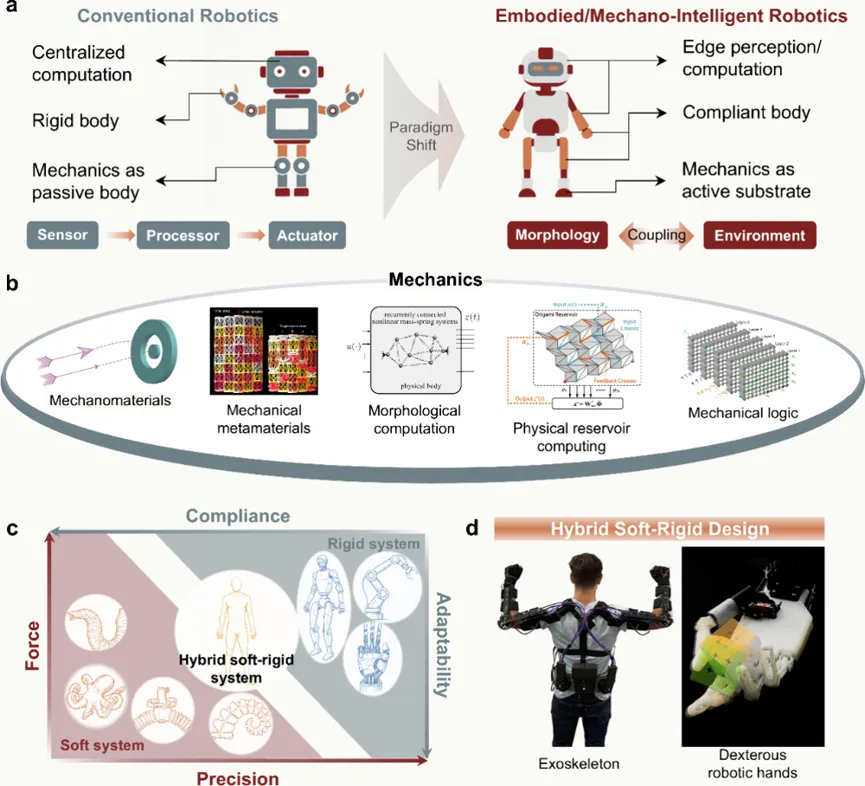
Figure 3 The emerging scientific perspective on mechanics, personality and physical intelligence (a) The transition from traditional robots to concepts of personality robots or mechanical-intelligence fusion robots. In traditional robots, perception, computation and control are mainly focused on central systems, with mechanical structures primarily as passive physical carriers; while in personality robots or mechanical-intelligence robots, soft-sophisticated structures are actively involved in the process of perception, computation, drive and adaptation through continuous alignment with the environment. (b) The realization of power-based representative models of intelligence, including mechanical materials, mechanical metamaterials, mechanical supermaterials, statistical computation, physical reservoir computation, and mechanical logic. (d) Softly blended robotic systems serve as a potential direction for future robotic development by combining the environmental adaptability of soft materials with the strength-transmission capability of rigid structures, precision of movement and structural robustness to achieve a synergy of the two advantages. For example, outbone robots and agile robotic hands reflect this development direction.
But that doesn't mean that computing, algorithms or AI will disappear. Instead, the paper poses a more difficult question: How should computing be redistributed between form, material, perception, and digital computing in the future?
At the same time, the body is not as soft as it gets. The advantages and limitations of soft robots often come from the same physical characteristic: flexibility.
Soft can lead to environmental adaptation, safety interaction and large distortions, but it can also lead to difficulty in transmitting power, decreased structural stability, decreased positioning accuracy and limited load capacity.
Therefore, the direction of the future that is really important is not his choice, but Soft + Rigid, the fusion of soft and hard.
The human body itself is this structure. The bones are responsible for supporting, the muscles provide power, the muscles transmit power, the soft tissues are responsible for buffering and adapting, the nerves and skin are responsible for perception.
The paper also sees soft-hard hybrid architecture as an important direction for the next generation of robots: consciously allocating rigidity, flexibility and control capabilities in different regions, finding a balance between adaptability, power output, accuracy and stability.
So it's likely that the future of software robots isn't about making all robots soft, but about letting them know where they need to be soft and where they need to be hard.
03.
If the body wants to be involved in intelligence, it needs to be able to perceive the brain first.
If a robot's body becomes softer, a very important question arises: Does a robot know what its body is like now?
The motion of a rigid mechanical arm can be described by a limited number of joints, but a soft robot may have an almost continuous infinite freedom. Its body has been deforming and is also affected by material lag, corrosion elasticity, friction, contact, environmental disturbances, sensor drift, and other factors.
Therefore, one of the core scientific problems of software robots is: the body's own perception.
Not only do robots need to be able to see the outside world, but they also need to know: What am I like now?
This has led to an important trend that has shifted from a small handful of sensors to full-body perception. In the future, the robot body may distribute a large number of pressure sensors, stress sensors, temperature sensors, proximity sensors, touch sensors, optical sensors, chemical sensors, etc., forming a real sense of distributed perception.
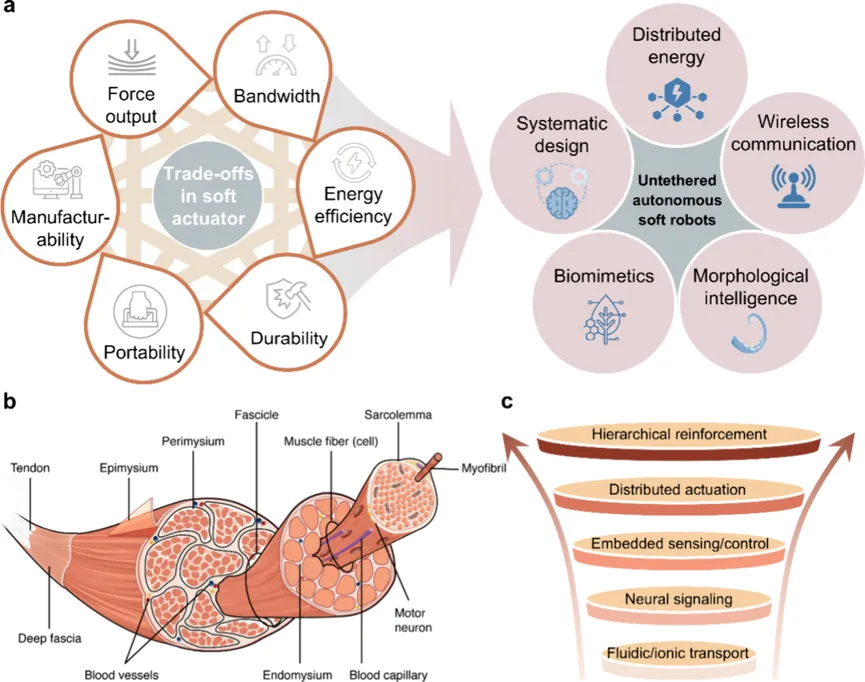
Moving towards multifunctional robotic materials and autonomous robotic systems (a) the fundamental performance weights faced by current software drivers, including power generation capacity, bandwidth, energy efficiency, durability, manufacturability and portability. These factors are mutually constraining and jointly limit the ability of software robots to truly operate autonomously. (b) Biomuscular layered structures that can serve as a typical biological model for integrating, sensing, driving energy transmission and structure. (c) The future of multifunctional software: drive, sensing, computing, control and energy management will be embedded physically in materials and structures at multiple scales.
This is why the paper places particular emphasis on multifunctional materials.
Traditional robots typically disconnect functions: materials are responsible for structure, performers are responsible for movement, sensors are responsible for perception, chips are responsible for computation, batteries are responsible for power supply.
Future software robots want to minimize this functional separation as much as possible. Self-perceived elasticities, conductive hydrogels, liquid crystal elasticities, multifunctional composite materials, etc. are making materials capable of simultaneous mechanical, electrical, optical, thermal or chemical responses.
But it's also not easy to understand how addiction finds an all-encompassing material.
Civilization does point out that embedding all functions such as perception, drive, and electrical conduction into a homogeneous material often results in interference between functions. A more realistic direction may be a layered, multi-scale multifunctional structure: different regions undertake different tasks but are ultimately integrated into a whole.
This is very close to the logic of organisms. Muscles, nerves, blood vessels, and connective tissue are separated, but they are not modules that come together later, but grow together into a body.
In these perceptual pathways, the paper focuses particularly on optical perception. For example, fiber bracket lighting can be induced by changes in wavelengths caused by local stresses, inferring the curvature, shape change and spatial state of the software structure; while visual touch systems can change images through flexible surfaces, further identifying contact geometry, pressure distribution, slippage and surface texture.
So what's really important is not why fluorescent light is so important. It's because software robots are sensing it from several sensors, going all over the body.
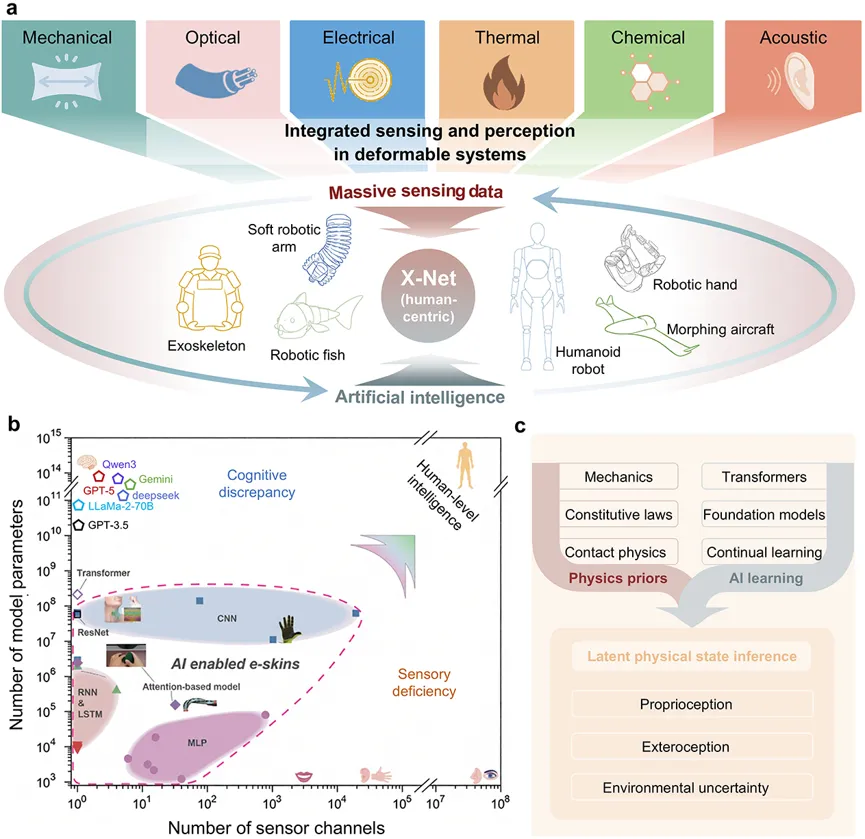
Figure 5: From perception to intelligence: Information processing in soft robots with physical intelligence (a) Distributed multi-modal perception is the foundation for the realization of environmental perception of variable robot systems, by integrating various information such as mechanical, optical, electrical, thermal, chemical and acoustic information throughout the robot body, to achieve a comprehensive perception of complex physical environments. In this way, optical sensors with high sensitivity, flexible and well-structured compatibility and the potential for large-scale distributed perception are becoming a particularly promising perception. (b) Thanks to machine learning, deep learning and basic model architectures, artificial intelligence can be used for high-dimensional information analysis and understanding, thereby gradually improving the interpretation of complex physical interactions.
04.
AI is an ever-changing body.
But with more and more sensors, the problem isn't over. In fact, new problems have just begun.
Data generated by software robots is very different from traditional rigid robots. They typically have several characteristics: high-dimensional, nonlinear, multi-modal, loud, and constantly drifting.
The same movement may produce different signals after material ageing; the same set of control algorithms, a new batch of robots, and the mechanical response may also change.
So the question of how to perceive software robots is not just about collecting more data, but also about how to judge a robot's true physical state from these ever-changing data.
Machine learning is coming in here.
The paper discusses methods such as self-monitored learning, multimodal integration, physical information neural networks, and basic models that hope robots can never infer hidden physical states from incomplete, noisy sensory information.
But the authors also point out that pure data-driven routes are not enough. Software robots' data sets are usually smaller, under-labelled, noisy, and material aging, manufacturing differences, and sensor drift reduce the ability of models to migrate between different platforms.
Models can easily fail after changes in physical conditions if they are only stored in a data bucket. Therefore, the paper suggests that the future is more likely to depend on a hybrid route: AI + physics. Methods such as physics-informed learning, continuous learning, self-supervised representative learning and simulation enhanced training include materials, mechanics, contact and environmental laws in the learning process.
To be more precise, for software robots, AI is not only looking for laws in data, but also understanding that data comes from a real, continually deforming physical body.
This is where Physical AI is really difficult. Physical AI deals with a real world where friction, collision, deformation, material lag, fatigue and error are always present.
05.
3D printing is moving from silicon making robots to silicon programming robots.
Another problem that is often overlooked by beautiful demos is that software robots are difficult to build.
It can take days or even weeks for a lab to make a sample by hand, but it's not the same thing to make a pump, and it's not the same thing to make 10,000 pumps.
The paper lists large-scale manufacturing as an important bottleneck that software robots have yet to solve. Soft materials must not only be soft enough, but also meet the requirements of durability, fatigue life, environmental stability and machinability; layers, residual stress accumulation and interface failure may occur between different materials. Many existing software robots still require a large amount of man-made assembly, post-hardening, calibration and alignment.
It was here that 3D printing and 4D printing began to take on different meanings than traditional manufacturing.
Traditional manufacturing is usually: design → processing → assembly → modeling. But software robots rely heavily on complex material distributions, microstructures, and multi-material interfaces.
3D printing thus offers a new possibility of directly incorporating structure, materials, and functions into printing. Further developing into 4D printing, robots can even continue to change their shape, rigidity, structure, and function after manufacture is complete.
Manufacturing began to have the meaning of programming fluid, writing some of the intelligence directly into the material and structure.
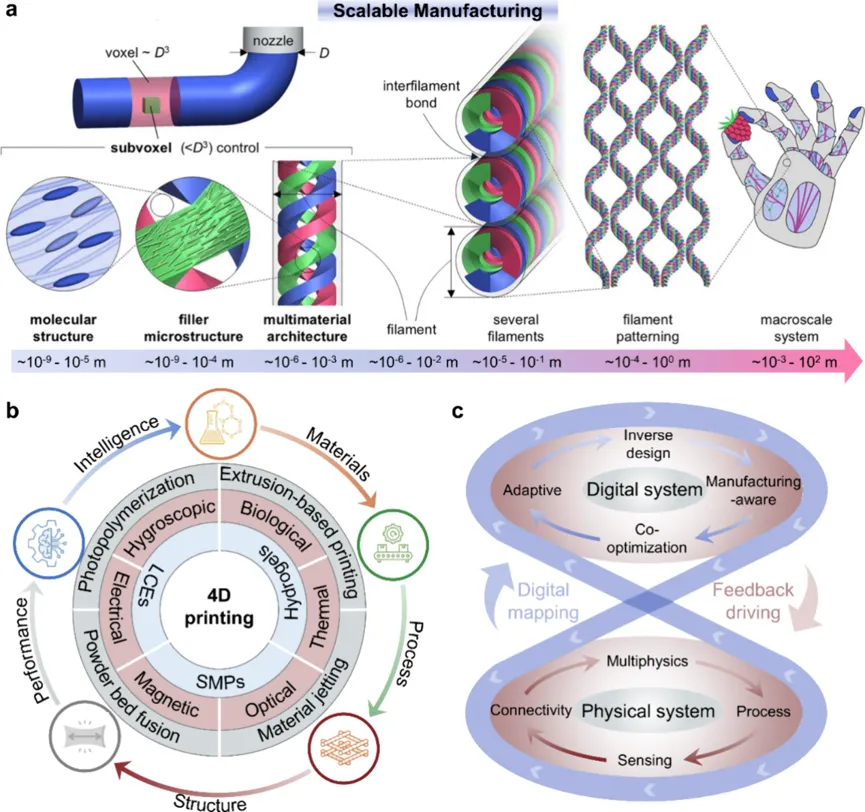
Manufacturing as a source of software robot functionality and intelligence (a) Scalable manufacturing remains one of the main bottlenecks facing software robot development. This is because the performance of software robots depends on multiple scales, closely interconnected structural characteristics, ranging from molecular-level tissue and interface binding to multi-material architecture and system-level integration. (b) 4D printing further expands additive manufacturing from static geometry to programmable materials, enabling robot structures to respond to external stimuli, dynamic shapes, rigidity and functionality.
Of course, this does not mean that 4D printing itself is a smart machine.
A more precise change is that in the past, robots were designed first and then manufactured; in the future, they could be further transformed into: materials, structures, manufacturing processes and robotic behavior combined.
Digital animation, reverse design, multi-physical field simulation and AI optimization can also be connected to design, manufacturing, testing, and feedback in a closed loop.
But even if the manufacturing problem is solved, there is still a long way to go to really get out of the lab.
Today, a large number of software robots still rely on air compressors, pumps, external power supplies, external computing equipment, motion capture systems, and even artificial supervision. Soft performers are difficult to achieve at the same time high output, efficiency, quick response, and portability; soft materials also experience fatigue, tearing, degeneration, drift, and aging; real robots also have to insert sensors, performers, power supplies, communications, computing, and AI into a continuously changing body.
So the paper finally drew the question back to a very realistic conclusion: the next generation of truly deployable software robots, determining that their value is not just how much software they have, but that they must also be perceptible, autonomous, wireless, durable, manufacturable, intelligent, and able to adapt to real environments in the long run.
This also means that the competition for software robots is moving from single-component innovation to system integration - materials, mechanics, manufacturing, energy, sensing, control, and AI - is becoming increasingly difficult to do.
06.
From the cotton machine to the cotton intelligent material cotton
Software robots are undergoing an important paradigm shift.
At first, people were concerned about whether robots could become soft; later, they began to study whether robots could perceive and adapt better to the environment; and now, a deeper question is emerging: can materials and structures themselves be involved in perception, computation, and control?
This is where software robots and physical AI really intersect.
The robots of the future are more likely to be a highly integrated set of physical systems with functional, computational structures, body perception, AI understanding of physics, and robots adapting to their interactions with the environment.
From this point of view, a really important contribution of software robots is to come up with a different robotic design logic: intelligence doesn't necessarily exist only in the cerebrospinal fluid, but it can also exist between the body, materials and the environment.
This is perhaps the next generation of Physical AI that deserves to be explored.
Link to the paper:https://doi.org/10.1021/acsnano.6c13106