In the field of coding, we have become increasingly accustomed to the term: Vibe Coding.
One suggestion is that Agents can write their own code, modify bugs, build web pages, or even independently complete an application. The code that originally needed to be written in sequence by developers is being reorganized by natural language.
So, will AI 3D bring its own Vibe Coding moment?
On the surface, this seems to have happened. It is not uncommon to enter a sentence or a picture and generate a complete 3D model in a matter of seconds.
But the real threshold comes after the creation.
When these models entered the video, game, animation development process, and even handed over to Agent operations, the structural quality beyond rendering effects began to become important: whether the mesh wiring was reasonable, whether the components could be properly disassembled, whether the model could continue to edit, tie the skeleton, and produce animation, all determined whether the result was a good-looking demo or a real 3D asset that could be developed further.
This is also the main problem to be solved by the latest release of Tripo P2.0 (abbreviated as P2.0) by VAST, the world's leading AI 3D base model company.
One of the core upgrades of P2.0 is to directly produce Native Quad Topology during the generation phase. The triangle currently supports a maximum of 50,000 faces and a maximum of 25,000 faces.
Compared to a large number of AI 3D models that rely on geometry and additional topological processing, P2.0 is turning "how-to" into a direct part of model generation capabilities.
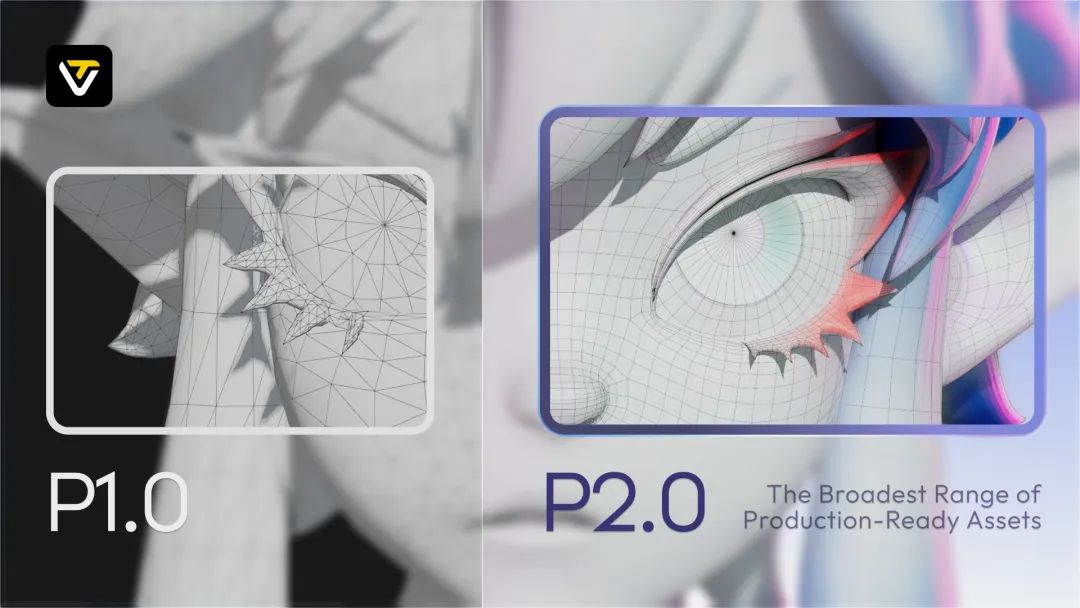
P1.0 (left) vs P2.0 (right) Note: P1.0 was released in March 2026
This change is not only reflected in the increase in the number of faces.
In practice, the effect of P2.0 is more refined, the wiring is more reasonable, the edge flow is clearer, the grid density is more distributed in the area of detail, while the large plane is kept as clean as possible; this is particularly evident in Hard Surface assets such as machinery, industrial props.
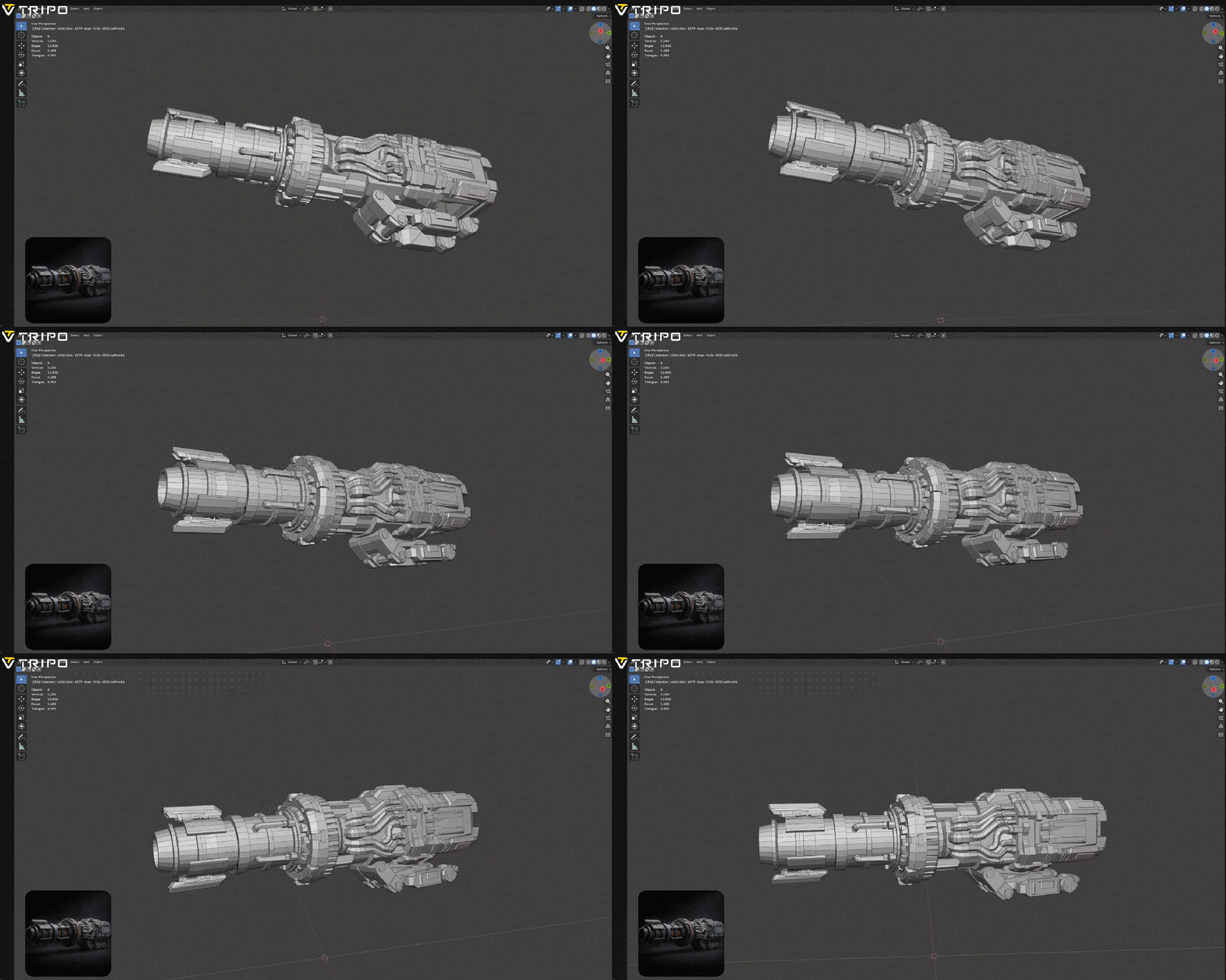
At the same time, the P2.0 natural partition was further improved, allowing different parts in the model to be broken down more rationally and structural relationships more clearly.
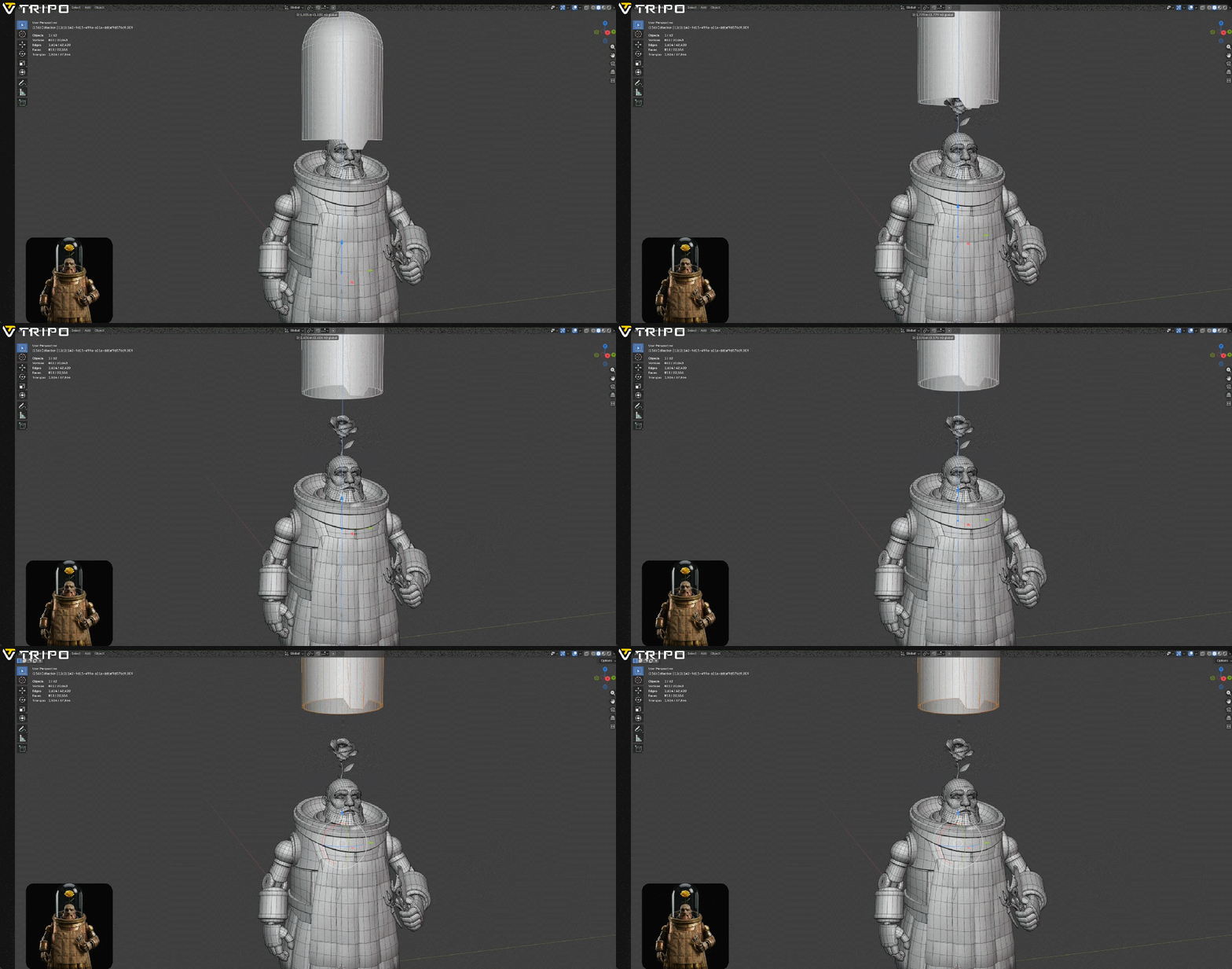
These changes will have a direct impact on subsequent use.
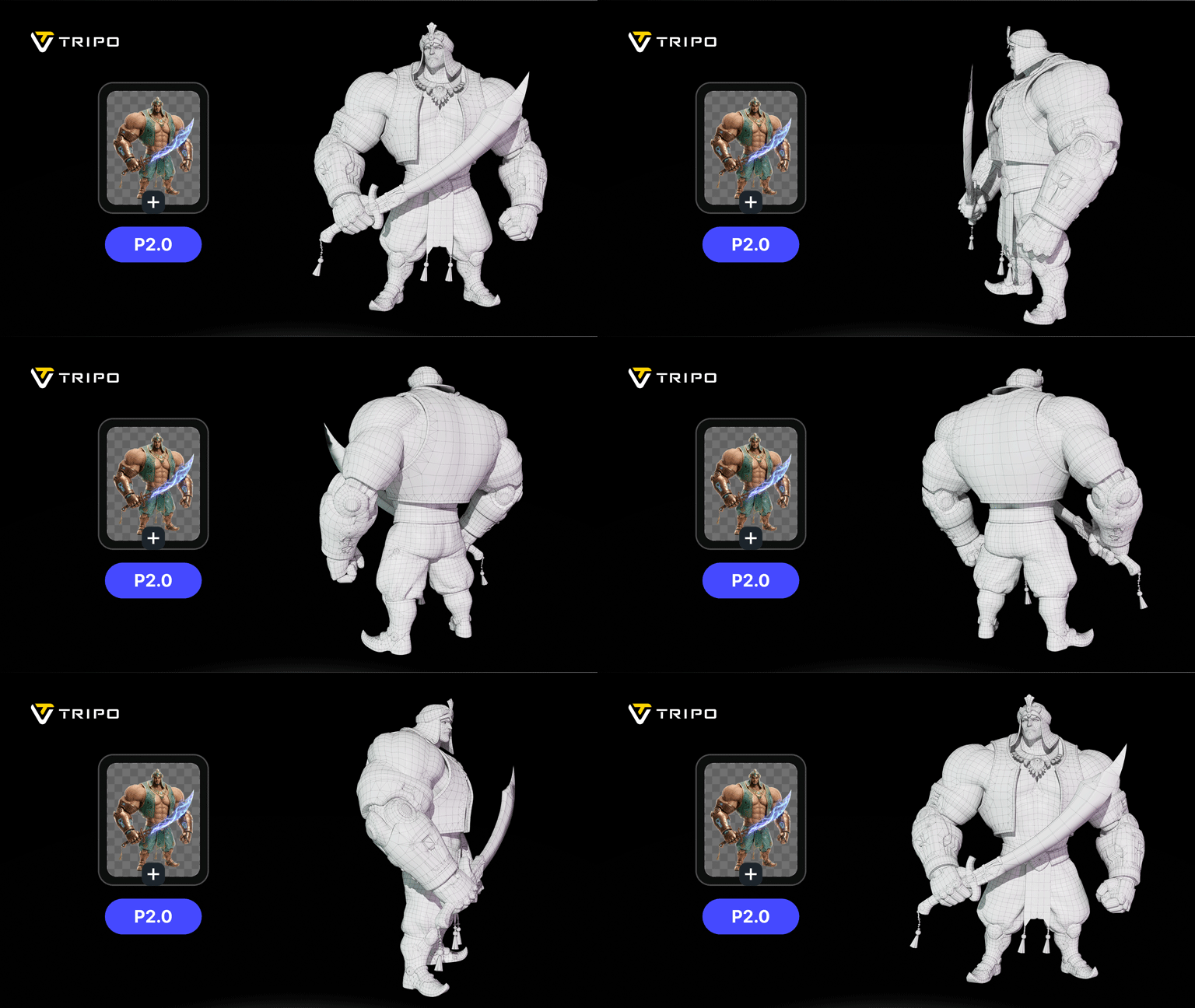
For 3D creators, a more streamlined quadrant means local adjustment along a continuous Edge Loop and better suited for subsequent bone binding and animation transformation; in the official version, P2.0 will also include local rebirth success, allowing users to modify only selected areas, while remaining unchanged, allowing one-time AI generation to become a continuously iterative creative process. Due to the high compatibility of the pipeline, P2.0 is also unlocking the new 3D Vibe Coding scene.
In other words, the value of P2.0 has been extended from "generation effect" to "follow-up availability": the 3D generated has actually begun to become an object that people and agents can continue to edit, understand and operate on.
Meanwhile, VAST also brought good news, announcing the completion of round B and round B+ financing, totaling about 3 billion yuan. In less than half a year, the company has accumulated about 5 billion yuan in financing, renewing the record for funding in the field of 3D native intelligence.
We tested it ourselves. P2.0 is so simple that just entering an image or a tip can directly generate a threaded layout, a structure-clear native all-round mesh, an overall outline and local details that are better preserved and easier to continue editing and processing.
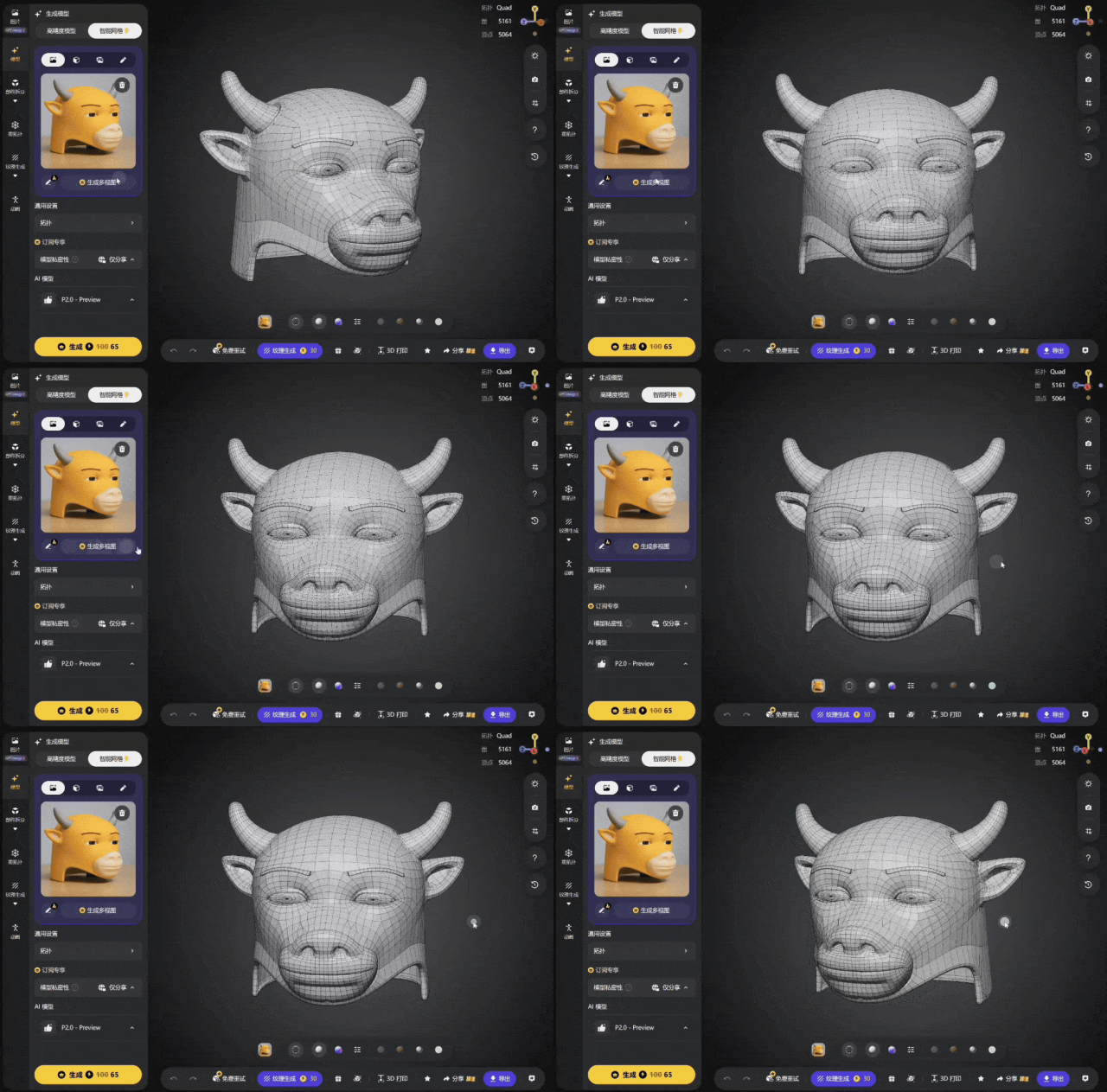
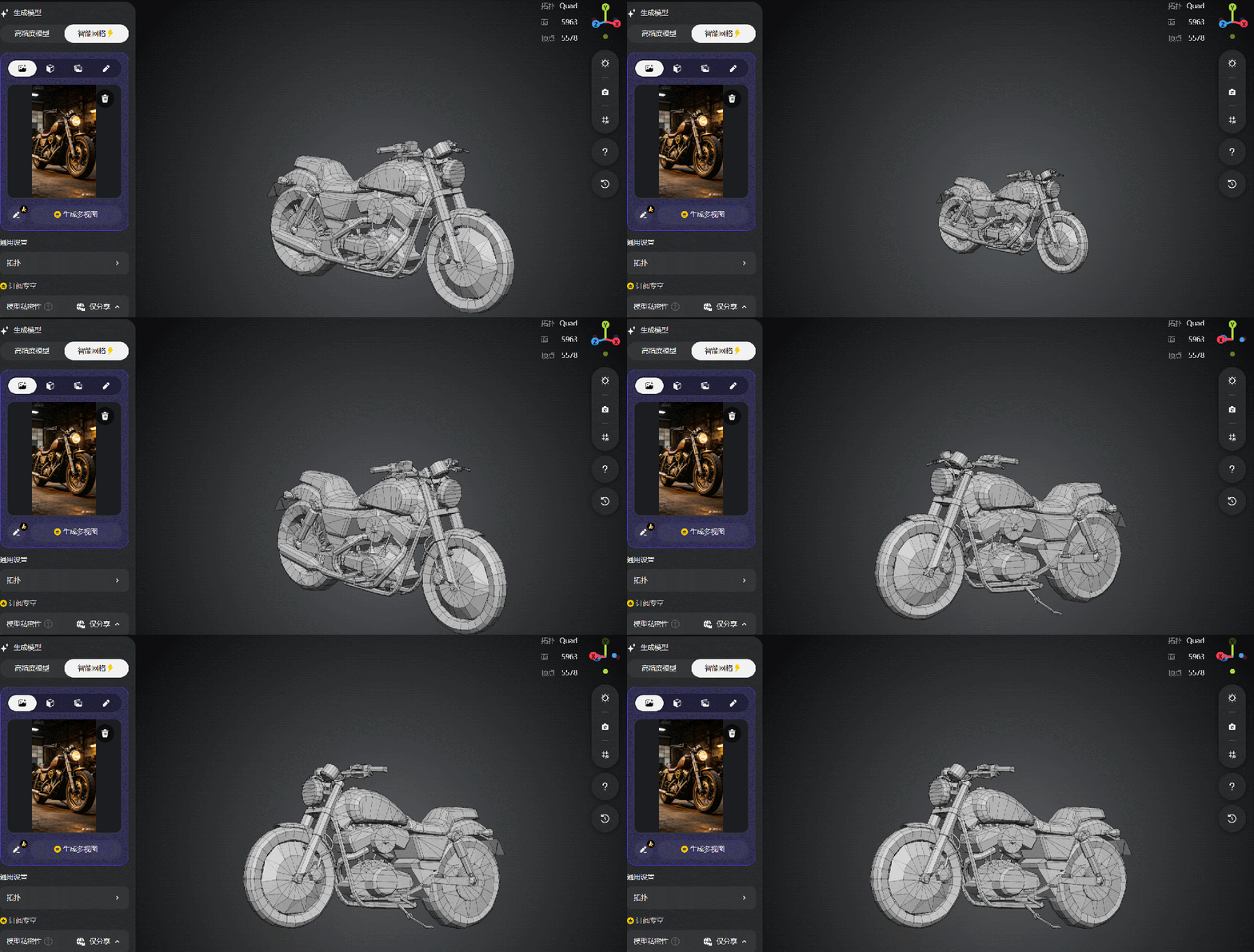
Try the address:
On an independent AI 3D assessment platform, the Tripo series models have long held the world's number one overall rating, based on blindness votes by more than 200,000 users. As of August 2026, Tripo ranks first in all four dimensions in geometry, low polygon, texture, and division. In low polygon dimensions, the P2.0 Preview version has over 70% blindness success rate, with the only one closest still being the previous generation Tripo P1.0.
AI 3D is already painting, but it's not modeling enough.
Understanding the changes in P2.0 requires an understanding of topology.
A 3D model, essentially made up of vertices, edges, and faces, is a topology of how they are connected and arranged along the surface of an object.
For ordinary users, the topology seems irrelevant as long as a model is finally rendered beautiful enough. But for game development, video animation and professional 3D creation, it almost decides whether to continue using the model afterwards.
For example, in a character's face, if the edges near the eyes, the corners of the mouth, and the edges near the corners of the eyes form a continuous loop line in the direction of the muscular movement, the character's face can change naturally when the eyes open. In contrast, if the wire is messy, even if the static image appears to be fine, once the bones are tied and the faces are driven, the model may appear stretched or even broken.
Similarly, hard-surface models, such as a car, require large flat surfaces and clear sharp edges. If facets are stacked meaninglessly in a flat area, where the exact location of the detail is needed, the structure becomes chaotic and subsequent editing becomes difficult.
As a result, the Edge Loop has long been one of the most important industry standards in video game and asset production, making it easier to form a continuous Edge Loop and more suitable for loop cutting, character transformation and local editing.
The problem is that AI 3D in the past has been difficult to do that.
A common practice is for AI to first produce a high-modeling or triangular model and then add the Retopology "retotope" step. This route is equivalent to breaking up generation and availability into two phases: the process is longer and geometric details may be lost during the conversion process.
The other route is simply to output triangles, the quality of the grid is relatively rough, and there are problems of overlapping surfaces, wiring disorder, and marginal flow ambiguity. These problems are quickly exposed once the model enters the production line of editing, binding, and animation.
In terms of gameplay and real-time workflow, generating is a core requirement. But there are deadly problems: AI can generate 3D models in a matter of seconds, and developers and artists spend hours cleaning up the topology, redirecting it. This not only reduces efficiency, but goes against the original intent of AI generating tools.
As "generation" gets faster, post-generation sorting and reworking becomes a new bottleneck for AI 3D to really get into the professional production pipeline.
P2.0 is doing something closer to traditional 3D modeling logic.
The choice of P2.0 is to top directly around the native surface.
The four sides of P2.0 are not "changed" by traditional algorithms after model generation is completed, but are produced directly during the production process of the distributed model.
At the same time that the model generates vertices and topologies, it has already completed the division of the quadrants. The quadrants are no longer a patch of external algorithms, but an internal output of the model, the ability of the model to carry itself.
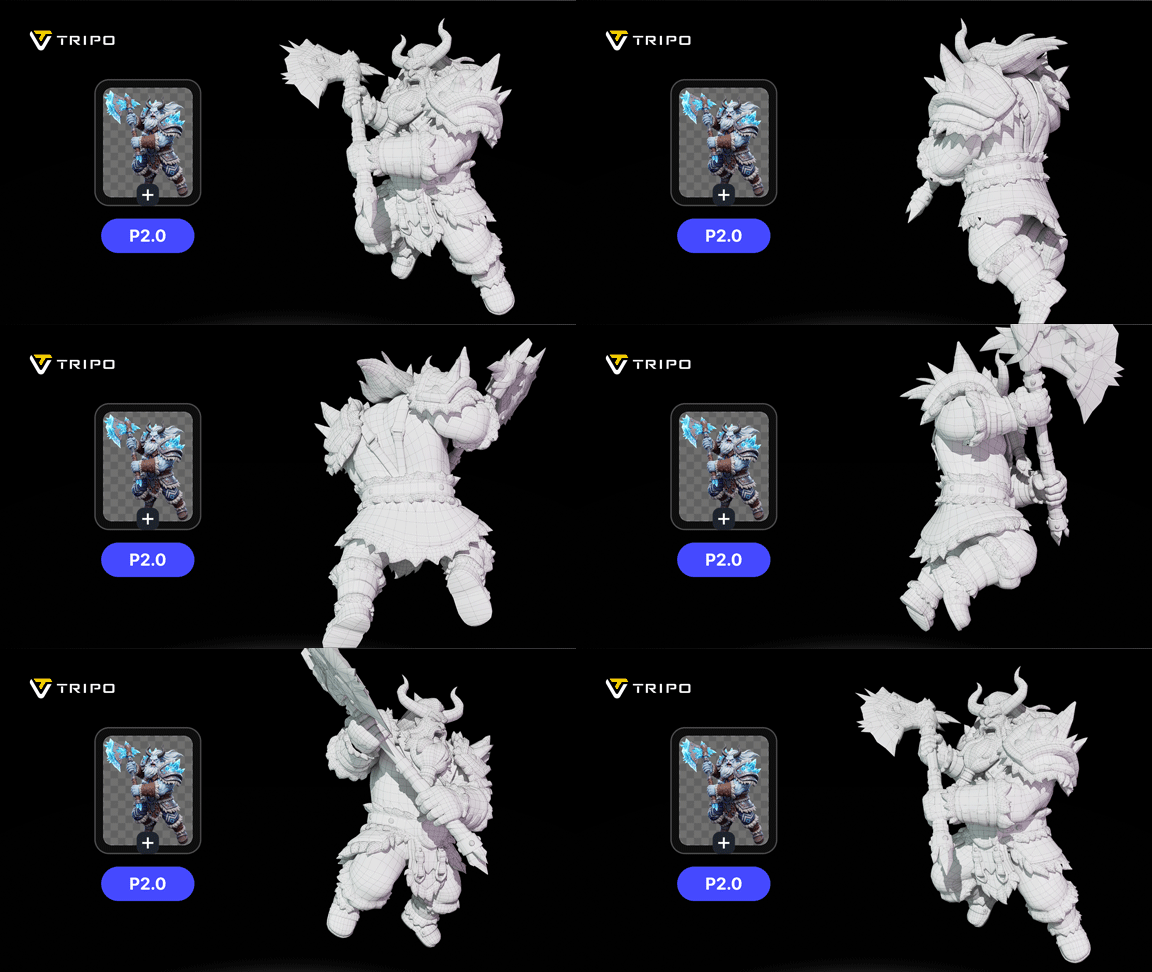
In other words, while the model determines the "size" of an object, it also begins to determine how the object should be "wired".
This change was first reflected in subsequent production.
For example, local editing. More streamlined quadrants can form a continuous Edge Loop and relatively uniform threads, allowing creators to perform loop cutting, selection zones and local adjustments along the loop line without having to spend a lot of time cleaning up the clutter topology.
In the binding and animation stages, the advantages are more apparent. Regions such as the character joints, the five senses require frequent stretching, bending and twisting during the movement, continuous and reasonable peripheral threads to make shapes more stable, reduce stretching and twisting problems, and more in line with the use of traditional animation production pipes.
At the same time, the distribution of grid density in P2.0 is more rational: areas that need to be kept as flat as possible are kept as clean as possible, complex details are concentrated and increased density, and edge flows are developed along the structure of objects. This difference is even more apparent, especially in Hard Surface assets, where models such as mechanical structures, industrial tools and other models often contain large planes with sharp edges and complex connections.
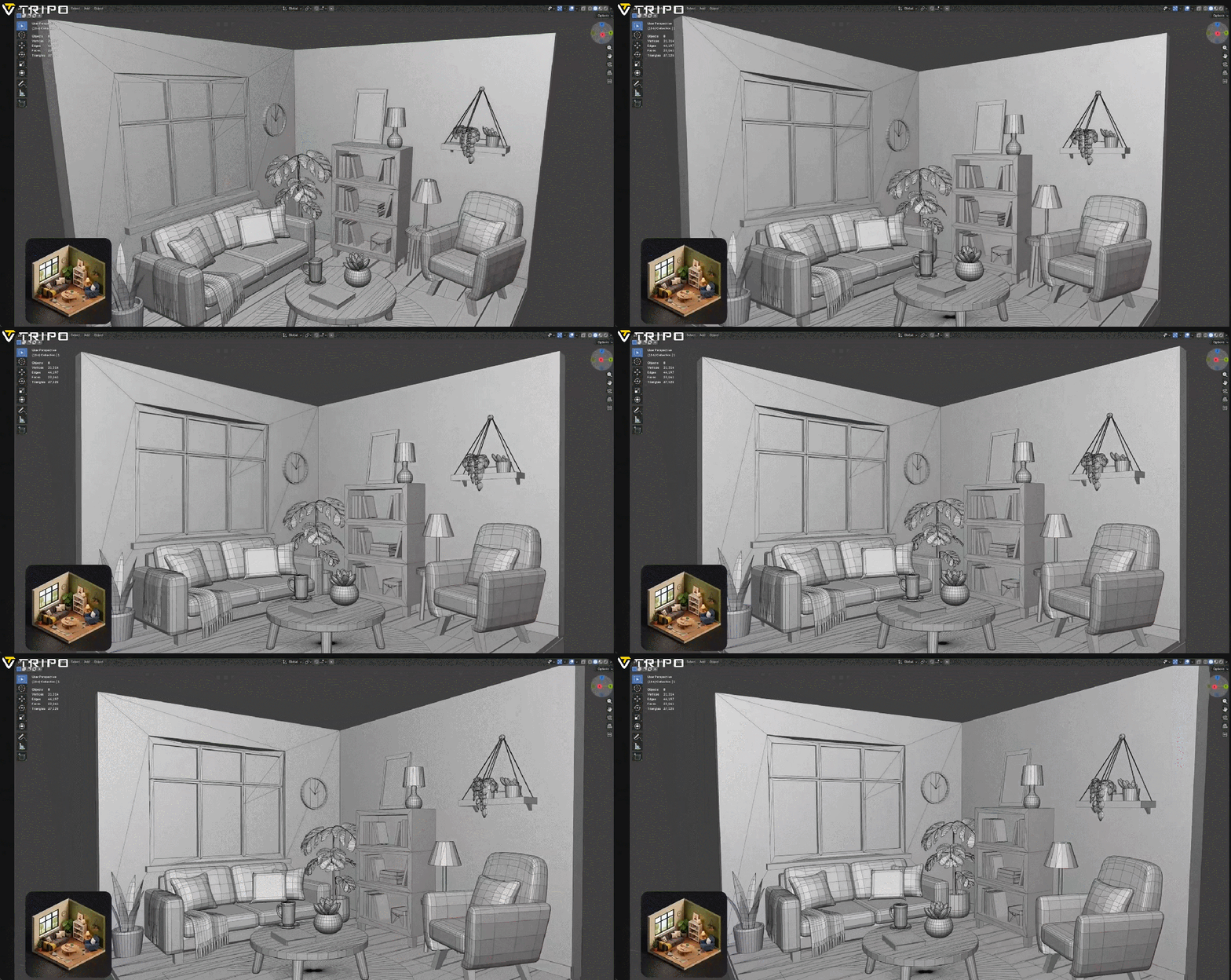
Along with topology, there are also natural components that are improved. The different Connected Components in the model are able to be disassembled more rationally according to structure, so that a complex 3D object is no longer merely connected to a set of geometric surfaces, but gradually presents a clearer component relationship.
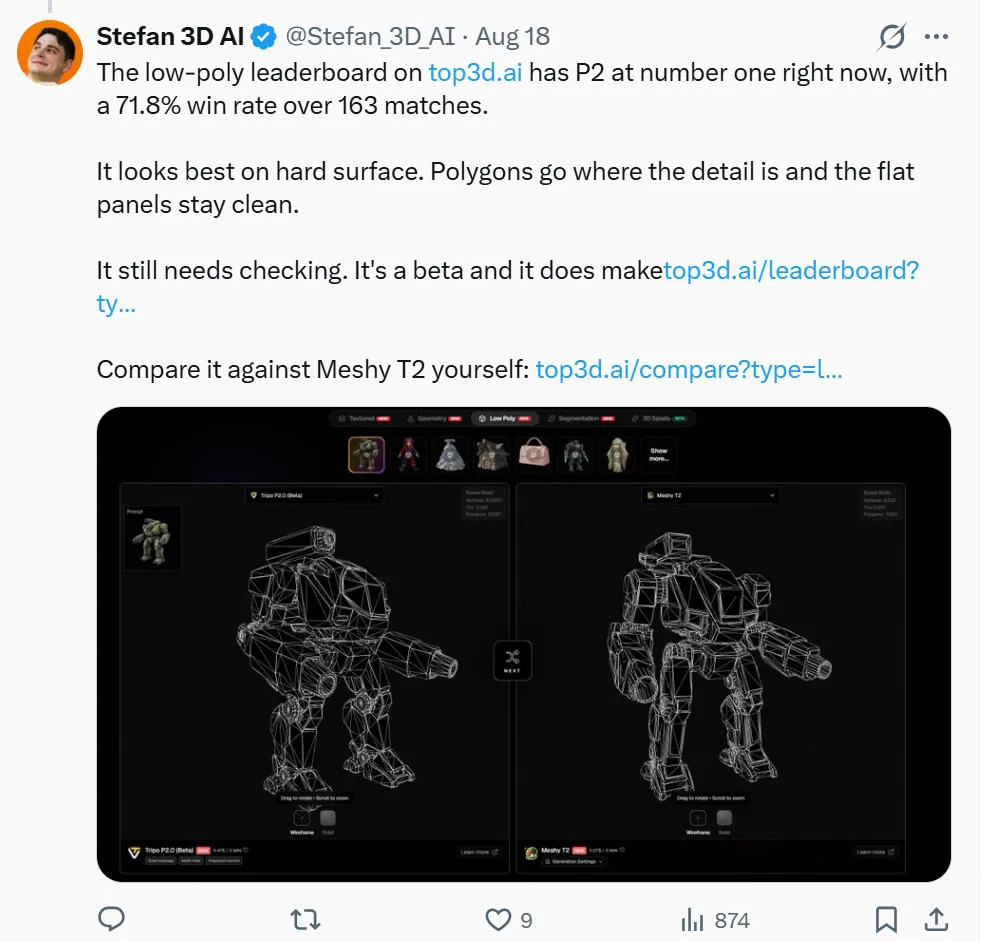
3D artist @Stefan_3D_AI specifically mentions hard surface assets after the experience. He argues that this category has previously been the more tricky direction for various 3D generators, and that a noticeable change in P2.0 is that grid density begins to really "go where it should go": the plane remains clean, the area of detail gets more density, and the edges can be maintained.
A more interesting change occurred after Agent took over 3D.
In fact, the real thing that makes this upgrade more imaginative is Agent.
Over the past year, Coding Agent has proven one thing: when a domain can be structured and the model has a good enough tool interface, natural language can become a new layer of operation.
However, AI 3D is much more difficult.
A high-precision model of hundreds of thousands of faces, for the Agent, is still largely a complex set of geometric data. If the model itself does not have a clean structure and no rational part, even if the Agent "sees" it, it does not have to know which part is the head, which part is the arm, which part should be rotated, which structure can be demolished.
So the key problem with 3D Vibe Coding is that AI-generated 3D isn't a data structure that's easy for Agent to understand and operate.
When a mechanical model is broken down into more semantically compatible Connected Components, the difficulty of deciding "who is who" is reduced when the topology is distributed along the real structure.
Once this is done, many of the operations that required professional 3D software will have the opportunity to move further into natural language.
This is the reason why P2.0 is naturally suited to Vibe Coding. The mesh it generates has more reasonable wiring, cleaner structure, and clearer component relationships, making it easier for Agents to understand the structural relationships between objects and continue to make calls, modifications, and interactions on this basis.
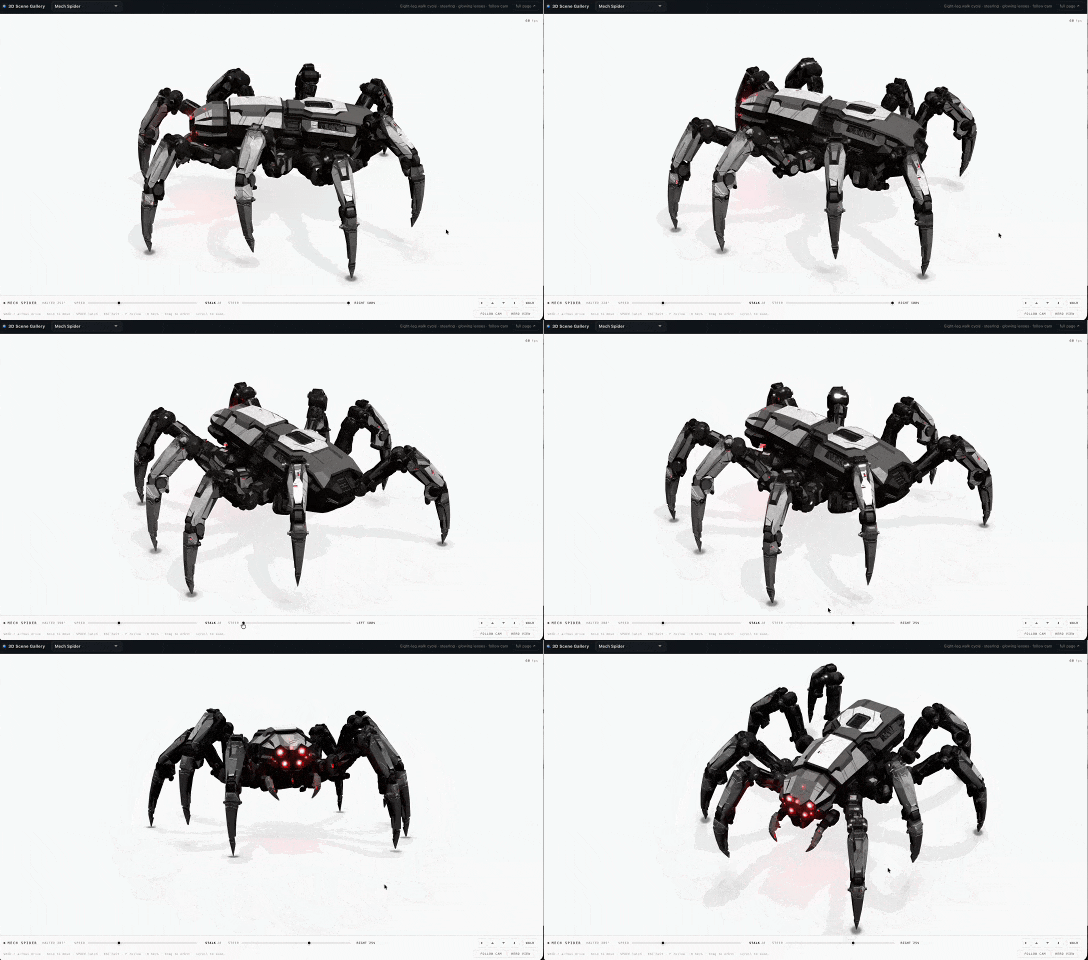
As VAST's chief scientist, Cao Cao was the first user and creator of P2.0. Below is a mechanical spider he produced using P2.0 and based on natural semantic partitioning, which enabled LLM to name, write, and modulate motion logic for independent parts, ultimately achieving component-level animation control of the entire mechanical spider.
In fact, before that, there were developers trying to hand over the 3D assets generated by Tripo to Agent to continue processing.
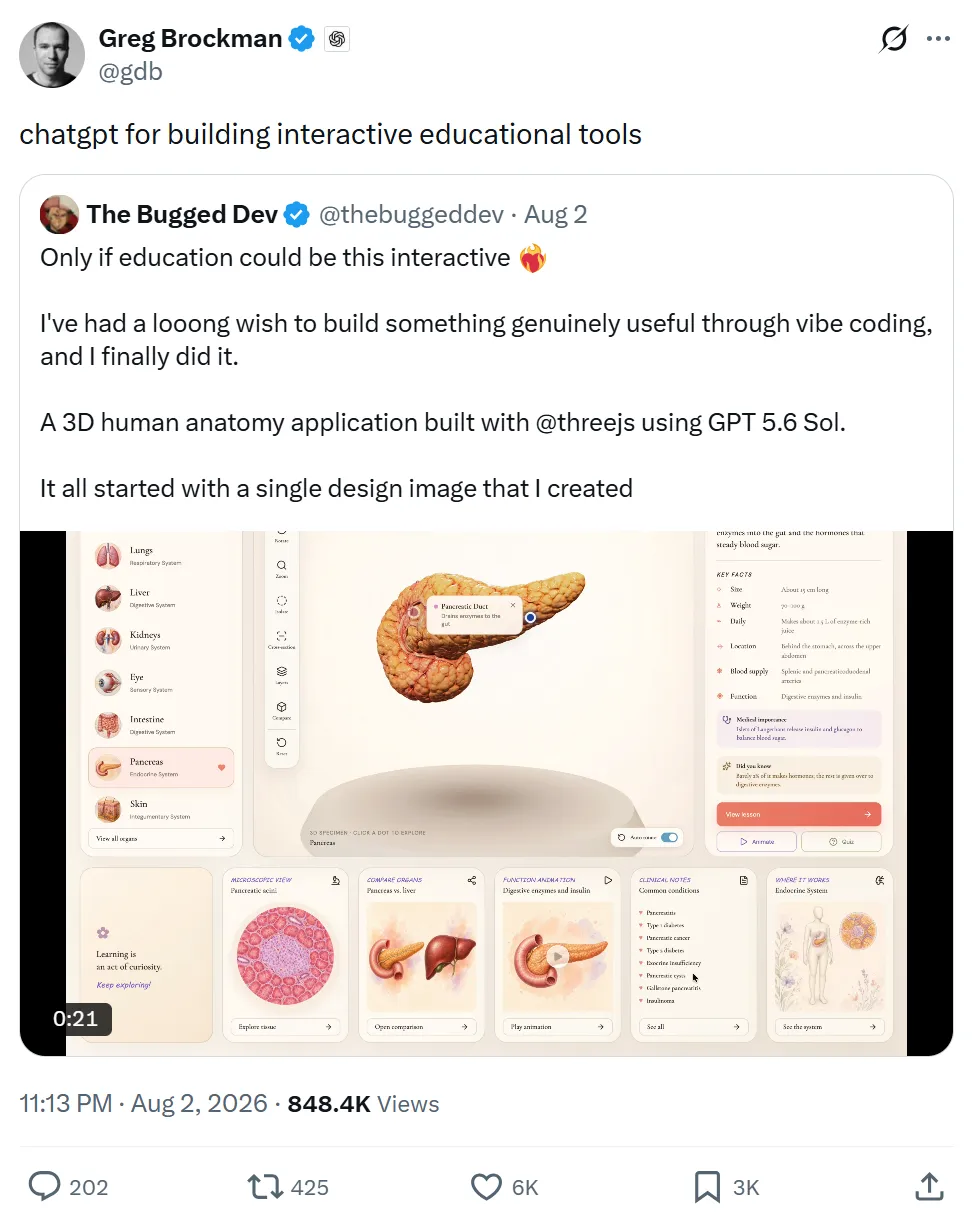
For example, the developer @thebuggeddev combined GPT, Codex and Tripo to create a set of 3D human anatomical interaction applications. The user can view and operate the organ model directly on the web page, which was later transferred by Greg Brockman, co-founder and president of OpenAI.
More interesting is another goldfish demo.
The user first used Tripo to create a championship with a clean topography, but initially only got a static Mesh: no Rig, no Bones, and no animation.