RhinovateTM, an AI New Materials R&D company, has recently completed its hundreds of million-dollar Pre-A round of financing, which is being funded by 100 million yuan, nine joint ventures, venture capital, Longchurch venture capital, Shenzhen Fund, and Guangzhou Village Capital.
Prior to this, Rinpoche has secured institutional investments such as Qinhua Capital, M&I, Shanghai Future Industry Fund, and Lin Thai Technologies, the third round of financing completed by the company in a year.
This round of funding will focus on RhinoMat material science baseline models and underlying technology research and development, multi-scenario AI intelligence and autonomous evolutionary laboratory system building, and enhanced verification of carbon-based high-performance materials to further aggregate core technologies and experimental data.
As big models enter materials science, the industry's focus is shifting from "whether to generate candidate materials" to "whether to complete verification in the real world": whether the structure and formula given by AI can be prepared, whether performance can be replicated, whether experimental data can be reversed to update the model, and whether the original conclusions are still valid after entering the mid-test and enlargement phase, all determine whether AI can actually enter the material research and development process.
This also means that AI Scientist's capabilities cannot be confined to the model side; it also needs further access to robots, experimental equipment and specific process processes to organize material research and development into a physical enclosure for executable, feedback, and sustainable generation.
Founded in 2025 and based on the strength of Beijing University's research, the core team members come from Beijing University, Tsinghua University, Cambridge University, Stanford University, Massachusetts Institute of Technology, and others.
The company chose a technological route closer to the physical world: RhinoAI's intelligent R&D platform attempts to connect AI Scientist, an autonomous experimentation system with a mid-test enlargement capability, with algorithms proposing hypotheses and experimental programs, robots running experiments, experimental data being fed back to models, and scientists being responsible for machine understanding and engineering decisions.
From scientific research to experimental execution,
How does AI Scientist get into the physical world?
New materials typically take five to ten years from design to mass production. Material structure, formulation, process preparation and macroscopic performance interact, and the R&D process spans computing, experimentation, and enlargement. Models are difficult to process, experimental data is difficult to retrieve, and laboratory performance fails in enlargement, constituting a continuous barrier to material AI entering the industry.
Rhino Physical AI is a self-developed platform driven by AI Scientist and the Self-Driving Lab: the former is responsible for understanding the goals of scientific research, summoning knowledge and material models, generating research programs and organizing tasks; the latter undertakes research strategies to complete the preparation, detection and data flow through robots, intelligent experimentation plants and high-traffic signalling equipment.
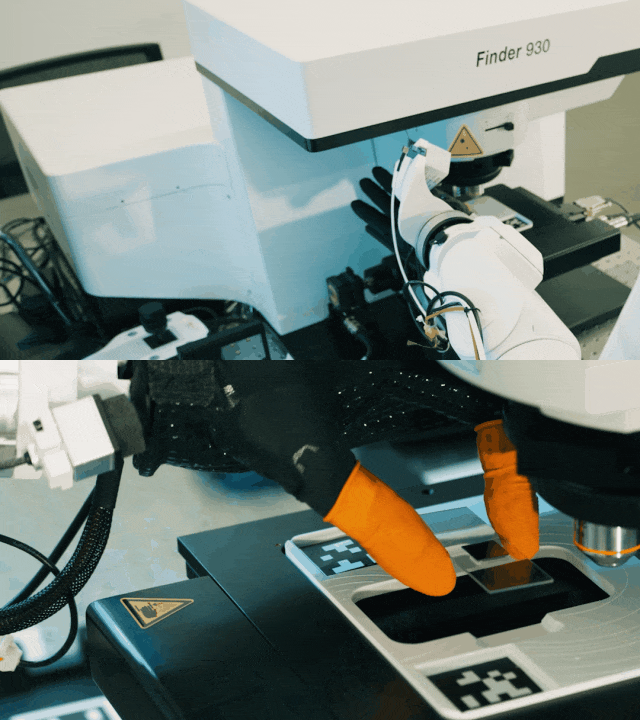
Rhino Lab performs automated preparation and identification tasks in a real-world experimental environment
Rhino Scientist can convert scientific problems into computational, experimental and engineering tasks, and arrange multiple intelligent objects according to different material scenarios; Rhino Lab can coordinate equipment, prepare samples, complete polymorphic representations, and adjust the next round of experiments according to the results.
AI Scientist proposes assumptions and strategies, robots perform high-volume experiments, and scientists are responsible for goal definition, machine understanding, and engineering decisions. The three work together in the closed loop of pump design, pump execution, pump expression, pump feedback, pump optimization. Each round of experiments completes, the system obtains new data and evidence, and the next round of decisions is updated as well.
After real experiments flowed backwards, models began to evolve.
Rhino is constructing a polymer-oriented model, RhinoMat, based on three-dimensional graphing neural networks and long-range modules, to unify the polymer structure. On this basis, the model can construct a field-simulated polymer system, combine the distributed model to reverse-produce targeted polymers, and optimize the structure to integrate into the proxy model, and continue to calibrate through experimental feedback.

Rhino model and algorithm engine: from structural representation, simulation to inverse generation and optimization
Rhino has accumulated more than 1.25 million multi-scale simulation data, 480,000 automated experimental data, and constructed a knowledge graph containing 214,000 entities and 626,000 physical relationships. Its collection of objects covers the aluminum process, aluminum structure, aluminum characteristics, aluminum performance throughout the process, and failed experiments have also been preserved; data quality control and cause-and-effect evidence chains are used to trace experimental processes, source of explanation.

Rhino Knowledge uses knowledge graphs to organize material entities, relationships and experimental information
After the actual experimental data flows back, the model generates and filters the next round of candidate formulas, and the results of the experiment are then reversed to adjust the equipment and process parameters, thus forming the Zinc Model, Zinc Formulation, Zinc Equipment Formation, and Zinc Third Level Enhancement Circuit. The technical significance of this flywheel is that each project simultaneously produces material results with training signals, proprietary data, and formula cognition and process experience continue to accumulate with the experiment.
41.2 cN/dtex:
4 days to make the strongest acrylic carbon/phosphates composite fiber in the industry
Whether a set of materials AI systems is effective is ultimately a matter of whether it can shorten the search process, make verifiable materials, and give the next step in experimental decisions that can be implemented.
In the field of composite materials, the Master's thesis group of the Institute of Materials at the University of North Rhine-Westphalia, based on the CarbonKylinTM synthesis of autonomous evolutionary fiber materials AI scientist's system matrix, encompasses the entire process of material unit design, process optimization, automated preparation and mechanical expression, linking models, formulations and preparation parameters. In the 10,000-level parameters space, the system will reduce the expected 2,000-day multi-target optimization to 4 days, shortening the development cycle by 99.8%; the tensile strength of carbon/phosphatidylserine composite fibers reaches 41.2 cN/dtex.

CarbonKylinTM encompasses the entire process of material design, automatic preparation and mechanical representation
Another result of this work came from the mechanical level. The system found that the strong interface layers formed by carbon materials and aromatic molecular chains can be used to suppress defects through the sealing effect, providing explanatory clues for performance improvement, and allowing the role of AI to extend further from formula screening to material mechanical discoveries. The related results won the first prize in the AI4S Science Intelligence Application Course at the 2026 World Congress of Artificial Intelligence, and were selected as the first example of AI empowering science research in Beijing.
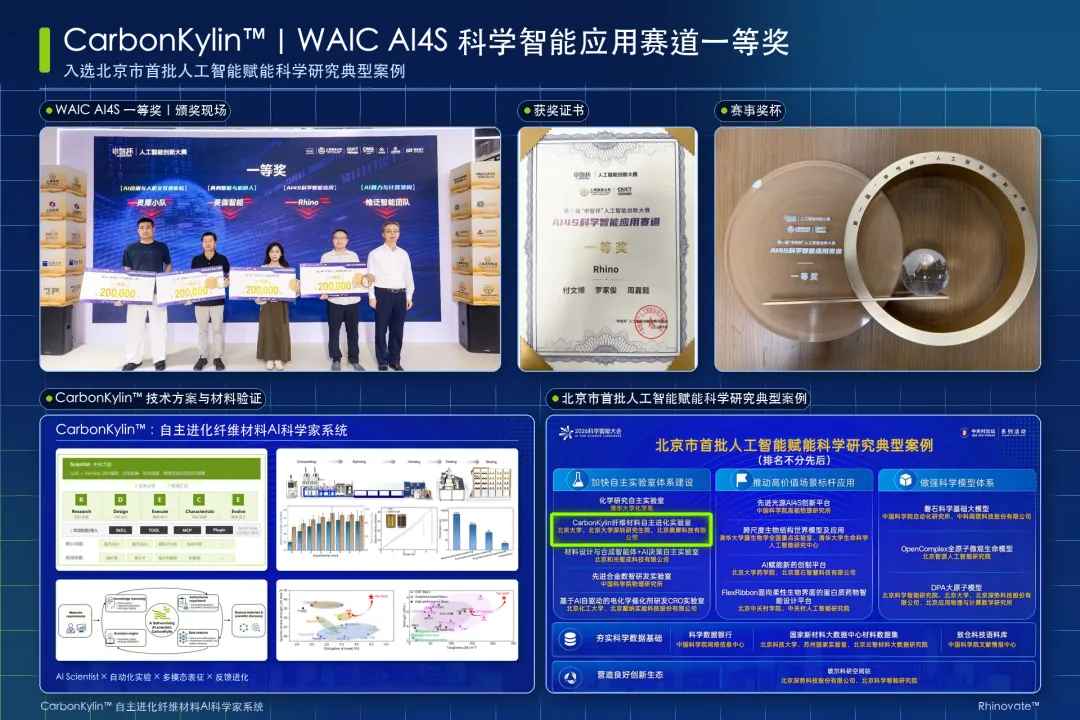
CarbonKylinTM Award winner and nominee for the first case of AI-enabled scientific research in Beijing
7 days of locking the direction of the formula of the electrolyte, reducing the experimental volume by 75%
In the field of new energy materials, Rhino Unified Northeastern team began to define the research space from knowledge graphs to optimize machine learning and Bayes to drive automated discharge, detection, coupler assembly and cycle testing. Through closed-loop iteration of models, formulations and experimental parameters, the system found a formula breakthrough direction in 7 days, shortening the research cycle from 180 days to 30 days, reducing the experimental capacity by 75% and breaking the battery's core efficiency by 99.5%.
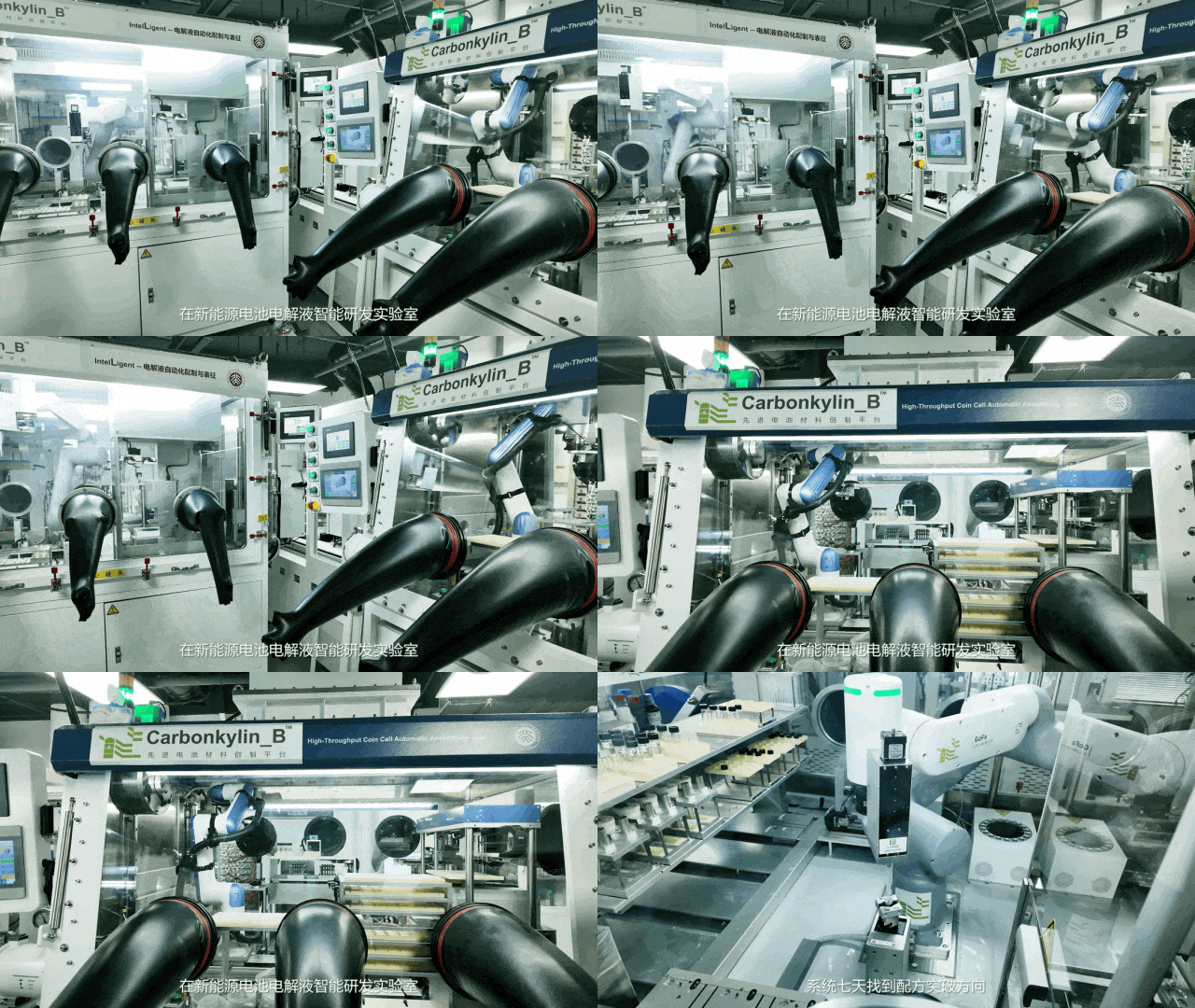
New Energy Battery Electrolyte Liquid Intelligent Research and Development Laboratory at the University of Beijing
Two cases focused on different materials, but validated the same set of system logic: models narrowed the search space, automated experiments completed the execution and representation, and real data flows driven the next round of decisions. After the material direction changes, tasks, models and devices can be rearranged, and the closed loop itself is consistent.
Moving from one-stop-shop to recyclable materials R&D infrastructure
The performance breakthrough of high-performance materials occurs in the laboratory, and the industrial value needs to be amplified after verification. After the preparation of the scale changes, the equipment conditions, process windows and material performance will be reconciled. Therefore, Rhinos will incorporate the medium-sized test into the AI Scientist system, so that the R&D closure continues to extend from computation and experimentation to engineering verification.
Working closely with a team of scientists at Peking University around the entire chain from scientific research to industry, and relying on the Beijing, Shenzhen, and Hong Kong three-dimensional layout to bring together cross-regional research and innovation resources; the company is also conducting joint research and development with industry leaders such as Huawei Chemical, Bentley, and Qingdao Innovation Energy.
The key variable for the next phase is whether this closed loop can be reused across materials and continue to constrain performance and process in the process of enlargement. RhinoTech will pioneer polymer modeling and continue to expand RhinoMat's capabilities with AI Scientist, allowing models, data, experimental skills and process knowledge to be embedded and reused in more material scenarios, and driving material research and development from single-point projects to platform infrastructure.