It's the first time in the history of the world.
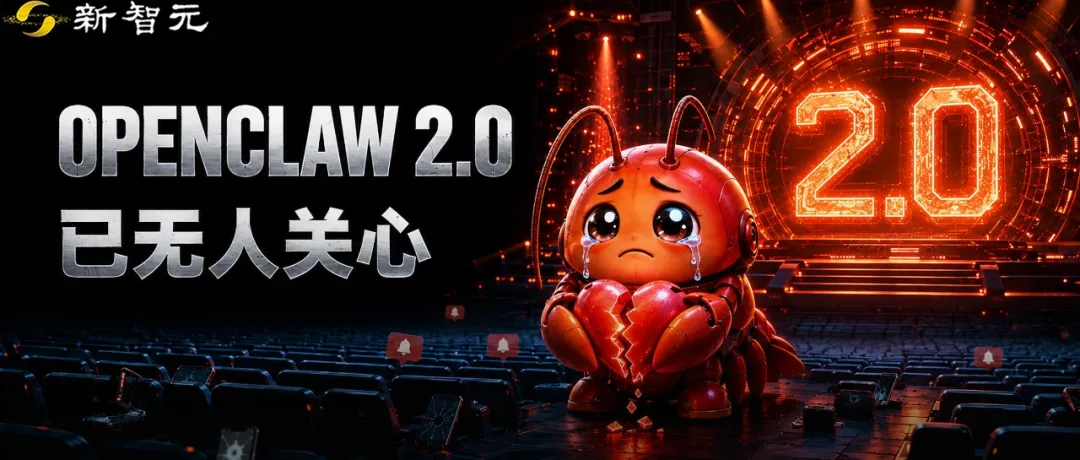
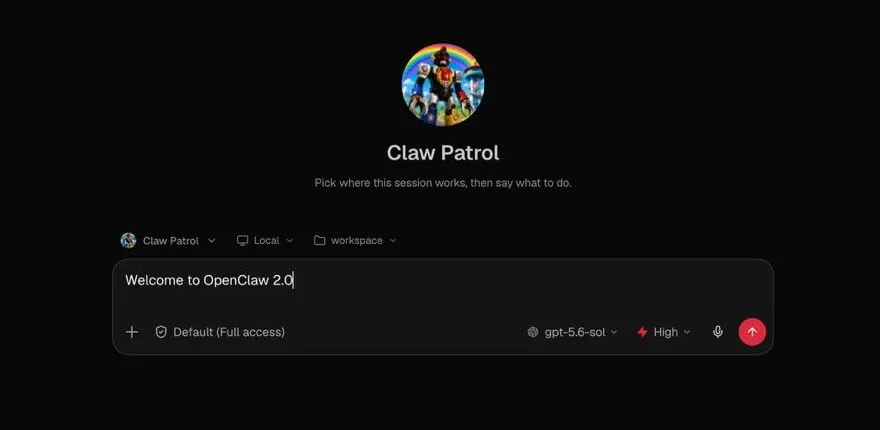
OpenClaw 2.0 is here.
933 contributors, 16,000 PRs, accounted for half of the total combined project history.
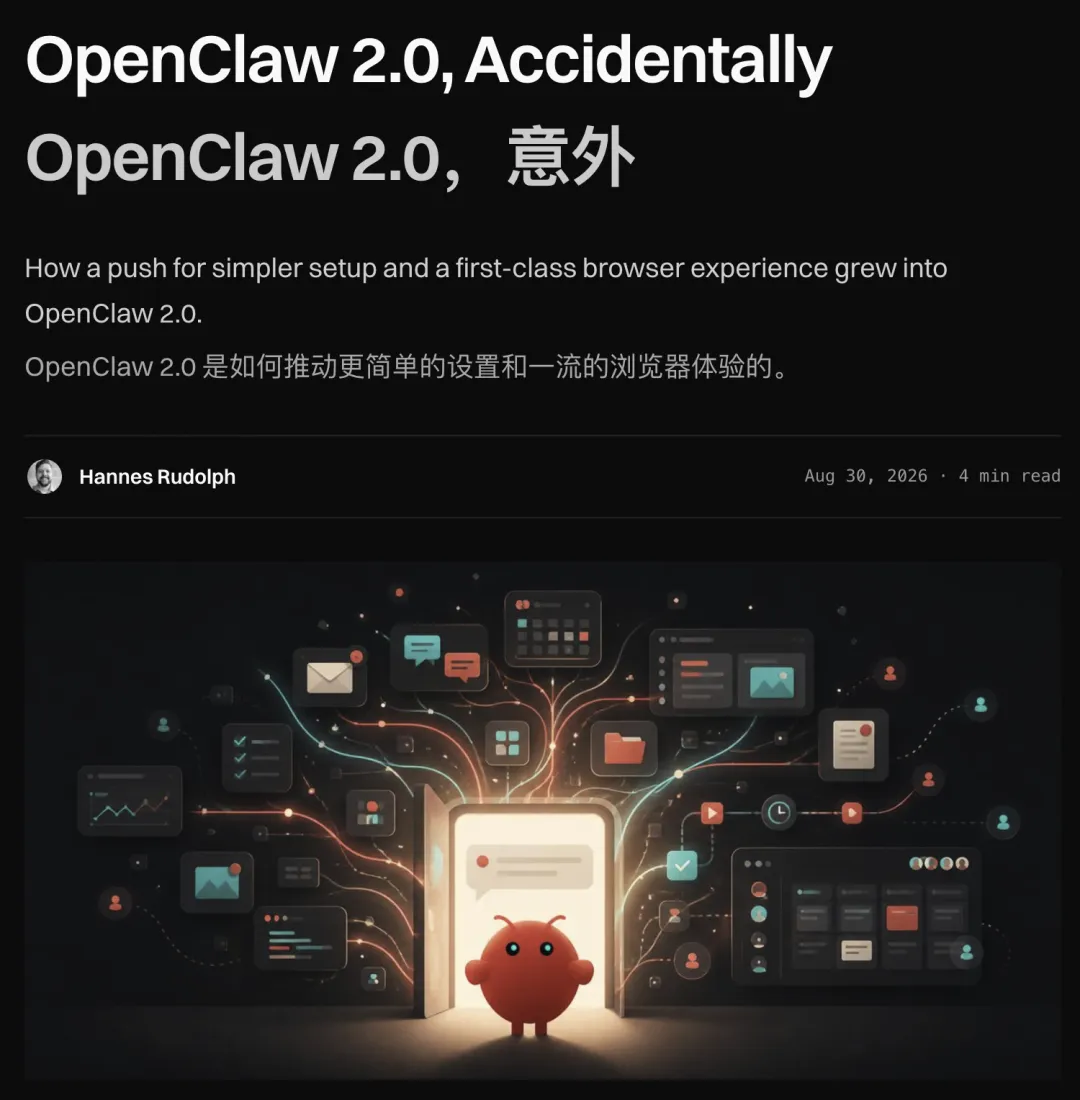
At the time the community was writing the announcement, it was launching the biggest update in the history of the project.
The results were impressive when the results were presented in March. At the end of August, it was amazing.
The people who walk are almost gone. The ones who are left without the need for 2.0 will also stay.
The Dragon Died in EconomicsOpenClaw's 250K star explosion was built on a vulnerability.
This vulnerability is called a "$20 Claude Pro subscription token worth thousands of dollars".
OpenClaw's early user portraits were highly unified: taking a monthly subscription to Anthropic, driving through OAuth, and allowing the dragon to burn Token for 24 hours on its own.
Some users subscribed to Claude Max for $200, which cost between $1000 and $5000 to use the API.
On April 4, 2026, Anthropic closed the mouth.
Third-party tools no longer allow access to Claude's OAuth subscription.
Read more: Overnight, Anthropic officially blocks OpenClaw!
Users will continue to use Claude, which will be priced according to the API: Sonnet 4.6 for $3 per million of token input, Opus 4.6 for $15 per million of input.
Overnight, the monthly bills of some users have been raised 50 times.
Once subsidies are withdrawn, the growth curve immediately reverses itself in the same way as every time the Internet burns money in the Great War.
The founder, Peter Steinberger, went to OpenAI in February and donated the project to the Foundation.
OpenClaw founder joined OpenAI: The Revolution of Intelligences, really coming
Security issues then intensified: Snyk Audit found that 36% of ClawHub skills contained hints of an attack, and Palo Alto Networks' Unit 42 continued to detect uninterrupted malicious skills between February and May.
"OpenClaw is dead" has gradually become the traffic code for global tech media.
The Harness Era: After the Fall of EverythingHarness is the hottest word in the Agent industry in 2026.
The meaning of the word is: the layer outside the larger model of the package, such as tool scheduling, authorization management, session memory, and execution sandboxes, are simply Harness except for parts outside the model.
The first sentence of Firecrawl's July review opens with "The front-end model is consistent, and Agent's experience is determined by Harness".
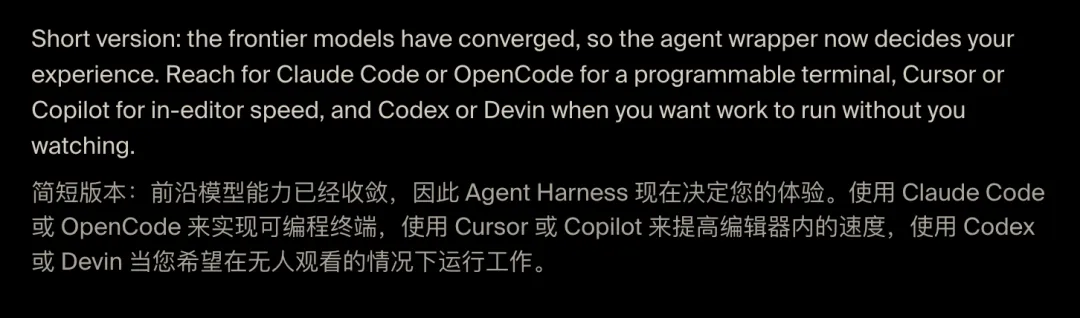
Claude Code, Codex, Cursor, OpenCode, and so on, the 2026 Programming Agent, each of which is this architecture.
Harness is responsible for tools, permissions, concurrency, interrupt recovery, and context management.
This is the architecture that the dragonfly ran in January.
What OpenClaw Gateway does and what Harness does today are highly intertwined: receiving instructions, scheduling tools, managing credentials, maintaining sessions, cross-platform routing.
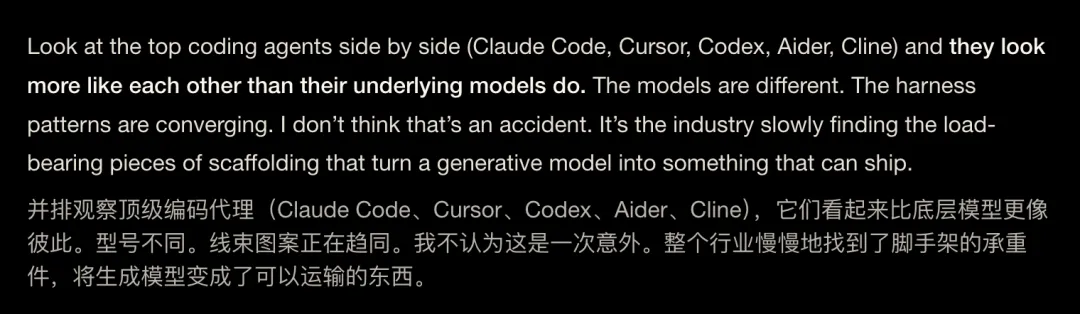
Google engineer Addy Osmani observed that the similarities between the Harnesses are far greater than the similarities between their underlying models.
In 2026, the Linux Foundation established the Agentic AI Foundation and accepted three things: the MCP protocol from Anthropic, the AGENTS.md specification from OpenAI, and the Goose project.
The MCP solving tool found that AGENTS.md solved the instruction specification and Goose solved the execution run.
The three puzzles combined form a standardized OpenClaw.

The dragons didn't win, but the race itself was drawn by the dragons.
It's like VisiCalc (you don't know it's normal) and it's the first product that lets everyone see that "e-shapes" can be created.
It is often not the same player who defines the track and who wins the track.
OpenClaw disobedient in Chinese watersThe main selling point of Dragonfly is one word: command AI in the chat software you're already using.
The idea is that flying CLI is cleaner.
On March 28, 2026, Flybook opened the official CLI tool, GitHub warehouse larksuite/cli, MIT protocol.
It covers 11 business areas, including instant messaging, cloud documentation, multi-dimensional spreadsheets, calendars, video conferencing, mailboxes, tasks, knowledge bases, more than 200 commands, and 23 Agent Skills.
After installing npm globally, two rows of commands entered the Claude Code, and in less than two months, it received over 8,000 stars.
It differs from OpenClaw in three main ways.
The first is:Flybook CLI is an embedded tool, with the ability for Agents to call flybooks through CLI, with permission to follow enterprise controls;
OpenClaw is an overarching framework that requires users to give the entire computer's file system and chat account to AI, online 24 hours a day.
Secondly,The CLI is backed by more than 2,500 APIs for the open platform, with an existing enterprise-level infrastructure for identification, auditing, and authorization recycling.
OpenClaw's security audit did not begin in a hurry until after Palo Alto issued a CVE.
Thirdly,For Chinese users, Flybook is the only office tool that is open every day after WeChat.
Discord and Telegram are the home of the Dragon, not the home of Chinese users.
The beginning of Corporate Agent is as follows:
The IM, documentation, knowledge base, and approval flows of the flying book are on the context network itself, and the agent should be working on this network, not building a new one from scratch.
This is exactly what OpenClaw can't do.
It gives users an empty framework to access their own APIs, permissions, and security.
CLI directly preinstalled the framework in the user's existing operating system.
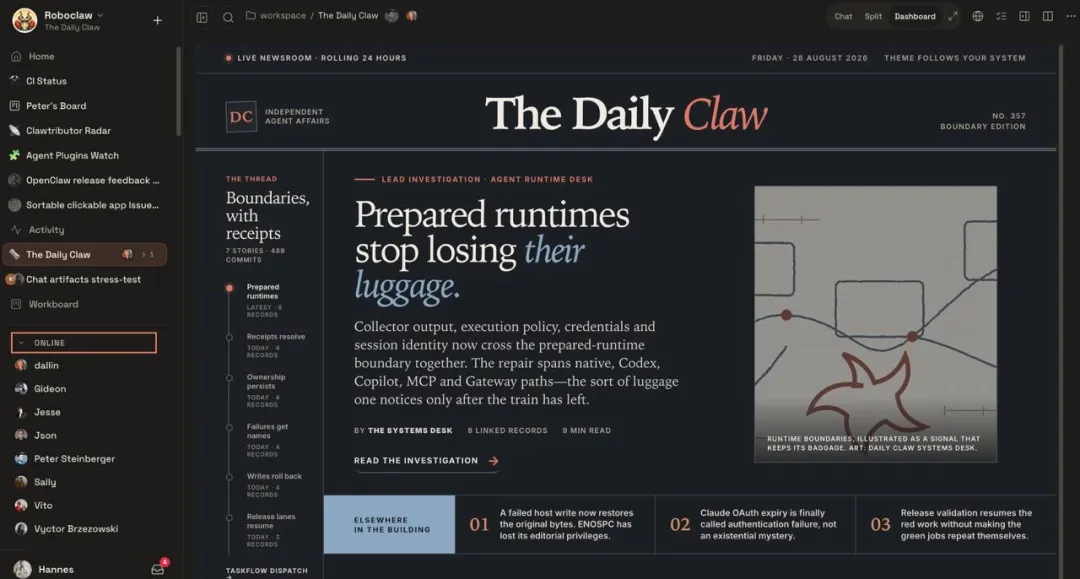
No one cares what 2.0 has changed.Back to OpenClaw 2.0 itself.
- Installation is simplified by scanning the existing Claude subscriptions, API keys and local models on the machine, automatically configuring and shortening the time from installation to the first conversation.
- The browser re-created the Control UI from 1.6 seconds to 575 milliseconds, and JS requested to cut from 140 to 45 milliseconds.
- Security has improved, external plugins have been installed that require verification of the source, ClawHub displays security audit information, and credential requests no longer enter the context and model inputs in the chat room.
- Shared Cloud sessions are the only new capability that a team can assign to another person a running task in conjunction with the context.
Everything has to be done, but it's too late. Too late.
The answers to these questions are "why can't users wear them" and "why can't users wear them".
The unanswered question is: Why don't users open it the next week after it's loaded?
The productivity returns of the programming agent are visible, and the code is there, running fast.
OpenClaw's "Life Assistant" runs through the day, looks back at the chat logs, and the dragon helps you forward three emails, summarizing a news story.
The time saved is not enough to configure the time spent.
Hermes Agent points to a possible way out: through the learning cycle, the more intelligent the task is, the more repeatable skills are automatically absorbed in the experience after completion.
By default, OpenClaw 2.0 enables Skill Workshop's self-learning functionality, which is the same direction, but at the beginning, the actual results are to be tested.
Hermes earned 240,000 stars during the OpenClaw downturn, with daily Token consumption on OpenRouter ranking first overall.
OpenClaw 2.0 is an engineering supplement.
569 new contributors have joined and the team has not failed.
But at the product level, the lobster window has been closed.
The programming scene was eaten up by Claude Code and Codex, the Chinese office scene was taken over by Flybook CLI, and the architectural idea of "back end All in One" was inherited by OpenCode and its 200,000-star open source Harness.
The tortoise's flesh was cut off, and all that remained was its flesh.
When it falls, everything comes to life.
OpenClaw's contribution to the Agent industry in 2026 lies in its experience.
It took nine months to tell everyone three things: Agent's interface is a chat window, Agent's value is in Harness, not the model itself, and Agent's security cannot be repaired.
The impact of these three lessons can be seen in the first architectural documentation of each of the later authors.
It is difficult to repeat the peak of the population's cultivation of salmon in March this year.