Pathological tremors are typical symptoms of movement disorders such as Parkinson's disease and acute tremors. For the upper limbs, especially the wrist, persistent and uncontrolled oscillations directly affect daily activities such as writing, eating, clutching. How to provide sufficient support only when tremors occur without sacrificing the normal flexibility of the joints is a key challenge facing wearable tremor suppressors.
Existing dynamic outer skeletons typically rely on motors for reverse-force torque, with strong suppression capabilities, but often accompanied by larger volumes and weights; passive impedance devices, although lighter, are difficult to adjust in real time according to vibration conditions. At the same time, commonly used inertial measurement units (IMUs) mainly reflect body surface movement, which may be influenced by external loads and drift, while the electromagnetic electromagnetic electromagnetic electromagnetic electromagnetic electromagnetic electromagnetic stimulation (EMS) is also vulnerable to apparent electrostatic pseudo-shadow interference when used in conjunction with electromagnetic electromagnetic stimulation.
To address these problems, a team of Prof. Wang Iwan of the South Pacific University of Technology, Singapore, and Prof. Ravi Vaidyanathan of the British Imperial Institute of Technology, United Kingdom, have developed a variable stiffness aid glove (VSG) driven by a muscle vibration signal (mechanomyography, MMG). The system combines 3D-printed locking A-shaped variable stiffness structures, MMG muscle vibration sensors, machine learning recognition and negative pressure modulation: maintaining softness during normal movement, detecting rapid stiffness after vibration, and forming a closed loop that detects and controls vibration.
The results of the study, titled the Mechanomyography-informed Variable Stiffness Assistive Glove for Tremor Suppression, have been accepted by IEEE Robotics and Automation Letters (RA-L).
01.
Variable stiffness gloves: MMG perception + lock and key adjustment
The core of the VSG consists of two parts: one part is responsible for the sensing of the viscosity and the other part is responsible for the curvature of the viscosity. Two customized MMG sensors are placed on the muscles associated with wrist bending and wrist stretching, respectively, to detect vibration by recording the mechanical vibration of the skin surface caused by muscle contraction. Compared to EMGs that rely on electrical signals, MMGs are less sensitive to the background electric fields produced by EMS, making them more suitable for future collaboration with electrical stimulation therapies.
The execution end uses a two-layer interlocked hollow octahedral cast iron cast iron structure. The cast iron is 3D printed with high-strength nylon integrated, and wrapped in a sealed film. After the internal negative pressure changes, the constraint between the particles is strengthened and the structural curvature hardness increases; after the negative pressure is released, the structure can be restored soft.
In the control process, the MMG signal is entered into the machine learning classifier after filtering waves and character extraction; once vibration is detected, the controller drives the valve and electromagnetic valve, making the lock A fast. The total weight of the wearable sensing valve, consisting of the glove subject, valve, valve and MMG sensor, is approximately 163 g.
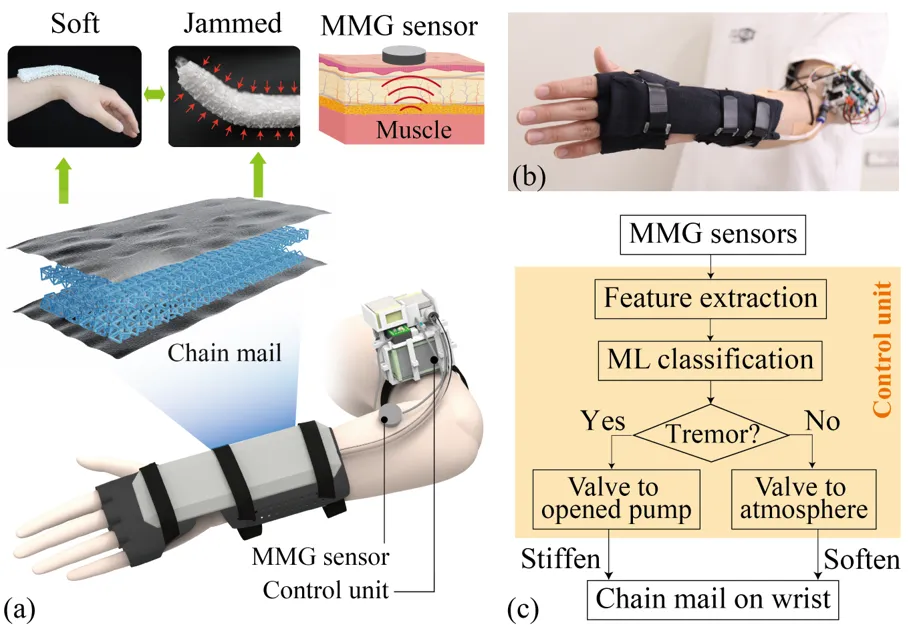
MMG-powered variable hardness shock suppressor gloves and closed loop control process
02.
Mechanical performance of the A-lock structure: more than eight times improved rigidity
In order to verify whether the locking structure was actually able to provide adequate wrist support, the team first systematically characterized the structure's curvature rigidity, visual curvature modules and inhibitory properties through three-point bending and free-vibration experiments.
When the negative pressure increases from 0 to 72 kPa, the surface curvature of the lock A is increased from 0.44 MPa to 3.69 MPa, an increase of more than eight times; the structural rigidity increases from 0.05 N/mm to 0.42 N/mm. In the typical deformation range, the structure produces a maximum tensile strength of about 0.24 N/m, providing a mechanical basis for resistance to wrist tremors.
Adjusting speed: 0.63 seconds to 90% hardness change
The variable rigidity structure is used for real-time suppression, and speed is equally critical. After starting the vacuum pump, it takes only about 0.63 s to achieve 90% of the maximum rigidity change; releasing negative pressure, restoring the soft state takes about 0.44 s. This rapid switch allows the device to maintain continuity during normal activity and to enter the support state in time after the shock occurs.
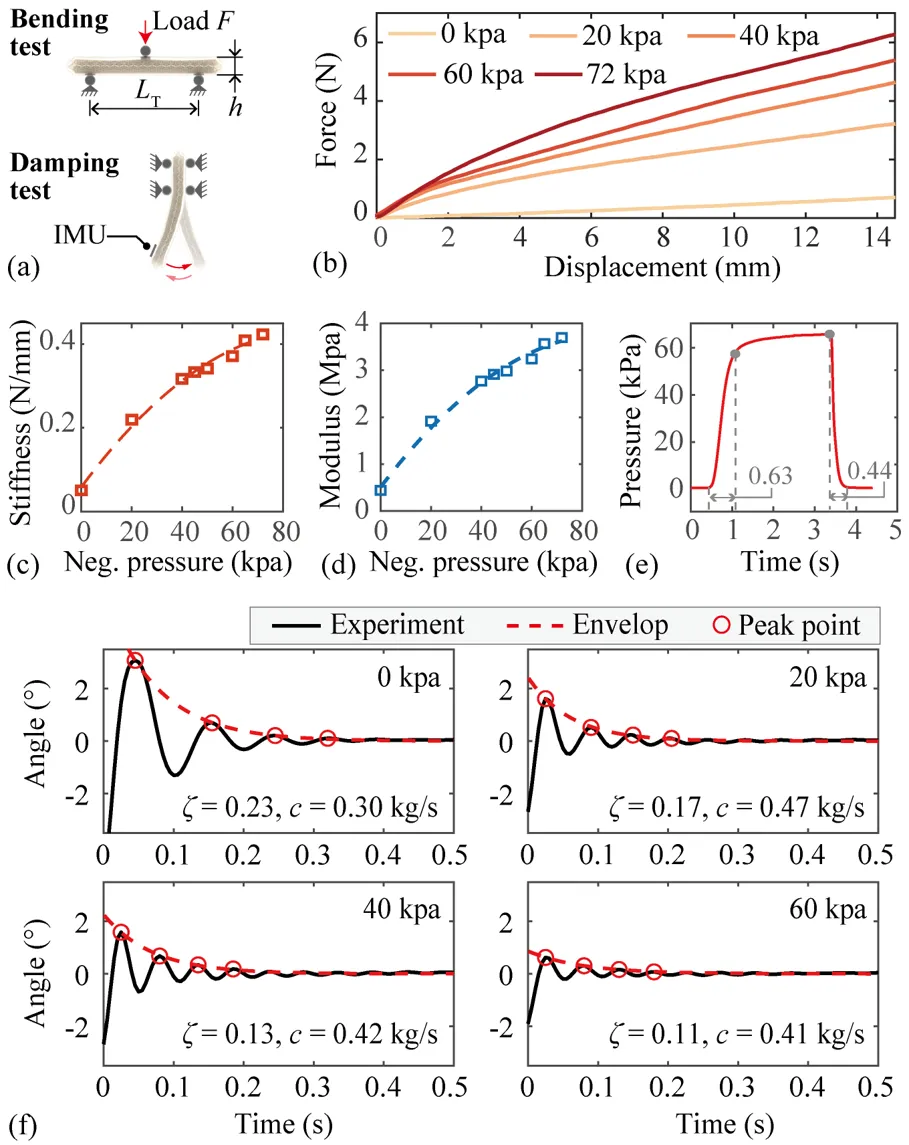
Mechanical characteristics of the A-lock structure and negative pressure response performance
Test platform verification: wrist swings down by 66%
To further match the material-level corrosion resistance to the actual vibration suppression effect, the research team built a 3D printed wrist grip test platform and installed a centrifugal motor inside the wrist to produce a cyclic vibration of about 9 Hz.
Experiments showed that under 0 kPa conditions, the average wrist peak fluctuation was about 4.1°; when the negative pressure increased to 72 kPa, the fluctuation decreased to about 1.4°, a reduction of 66%. Frequency analysis also showed a significant decrease in the power of the main vibration peak. Further tests found that the suppression effect increased most noticeably between 0 and 40 kPa and then gradually entered the platform zone.
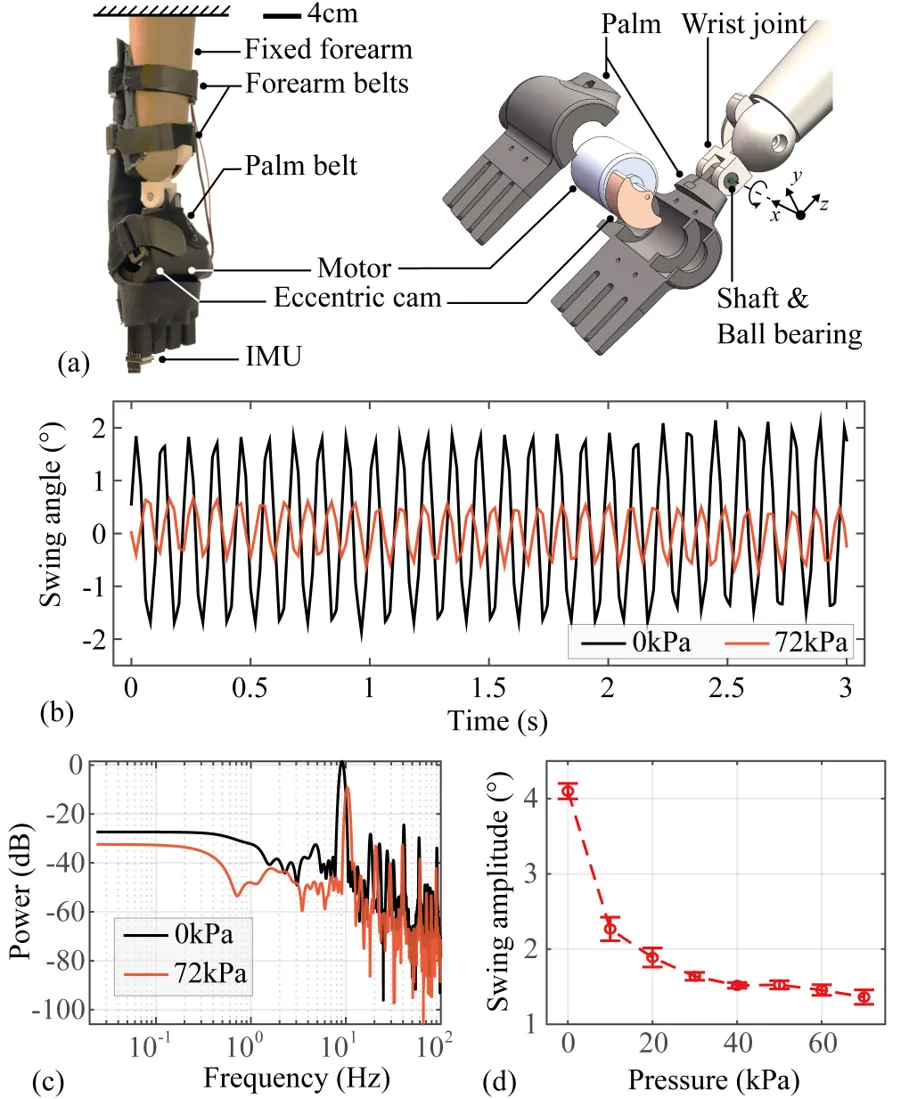
Confirmation of vibration suppression on the wristband test platform
03.
MMG recognition shock: 96.36% accuracy across subjects
Whether the gloves can be tightened in a timely manner depends first on whether the system can reliably judge whether or not a concussion has occurred. The research team experimented with 13 subjects with a history of non-pathological concussions and used EMS to induce controllable mild wrist tremors.
The MMG signal maintains a lower baseline when stationary, while the vibration amplitude increases significantly under active simulated vibration or higher EMS stimulation conditions. The system extracts the three characteristics of the mean value, mean root (RMS) and mean frequency (MF) from each 250 ms time window, and combines the two pathways of the tendon and tendon to form a 6-dimensional characteristic vector.
The team further compared five lightweight classification models supporting vector machines (SVMs), K neighbors (KNNs), Gross Simple Bayes (GNBs), logic regression (LRs) and secondary differentiation (QDs). The individual recognition accuracy of all models was not less than 99.11%, and the cross-subject accuracy of all models was not less than 94.37%.
The best performance of the SVM was 99.62% accuracy in individuals, 96.36% accuracy across subjects, and a single sample prediction time of about 1.2 ms. This indicates that the MMG is not only able to distinguish between static and vibrational states, but also has better trans-individual generalization capabilities.
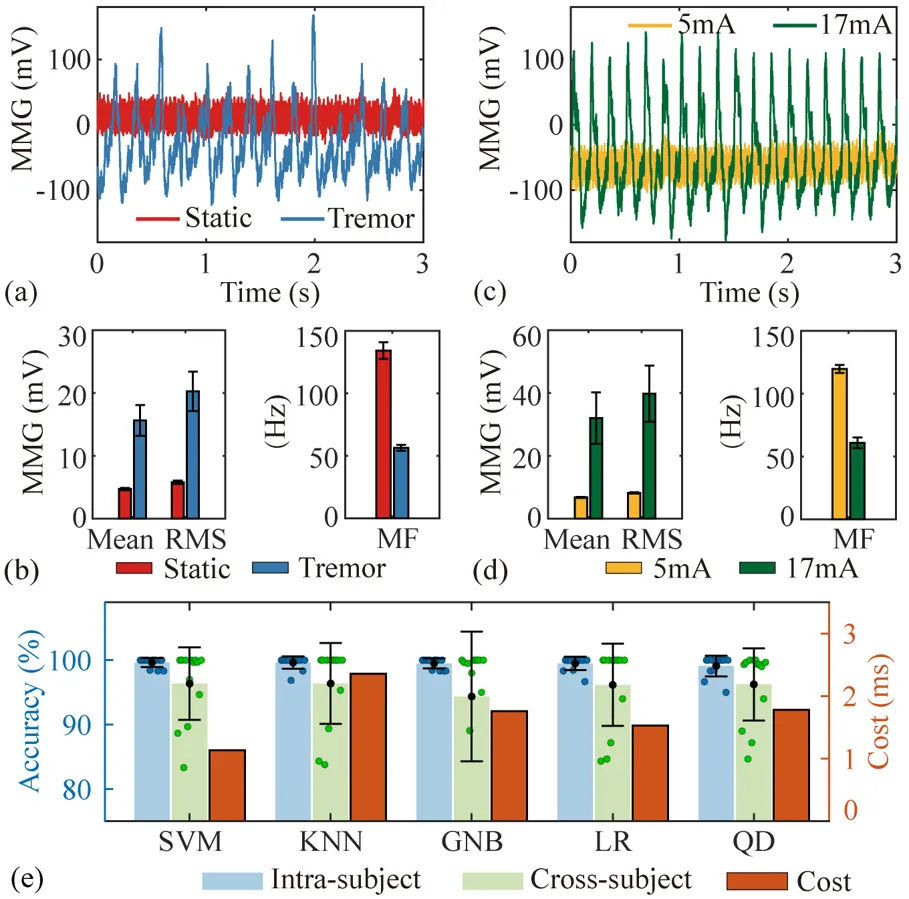
MMG Shock Signals, Character Change and Machine Learning Recognition Results
04.
Closed-loop human experiment: Shake trajectory fluctuations decreased by 58%
In the final closed-loop experiment, the subjects wore a VSG along the model to draw a pair of spirals, and the EMS was used to induce wrist vibration. The control system continued to read MMG signals; when the SVM model judged that there was a vibration, the vacuum valve was activated and the lock reinforced rapidly; and when the vibration disappeared, the system released negative pressure to restore the gloves to softness.
The key to this strategy is that the gloves provide additional mechanical restraint only during the shaking phase and minimize the impact on the autonomic movement during normal exercise.
Repeated experiments with 13 subjects showed that the fluctuation of the spiral trajectory relative to the model in the vibratory state was about 4.62 mm, decreasing to 1.92 mm after closure suppression, reducing overall by 58%. In eight state transitions in the sample experiment, the system adjusted the correct rigidity seven times.
The overall response delay of human experiments was about 3.2 s, which included vibration build-up with soft tissue response, a 250 ms MMG analysis window, data transmission, relays triggering, and vacuum tuning. In contrast, the locking material itself reached a 90% hardness change of only about 0.63 s, indicating that subsequent optimization space was more concentrated on end-to-end perception and control links.
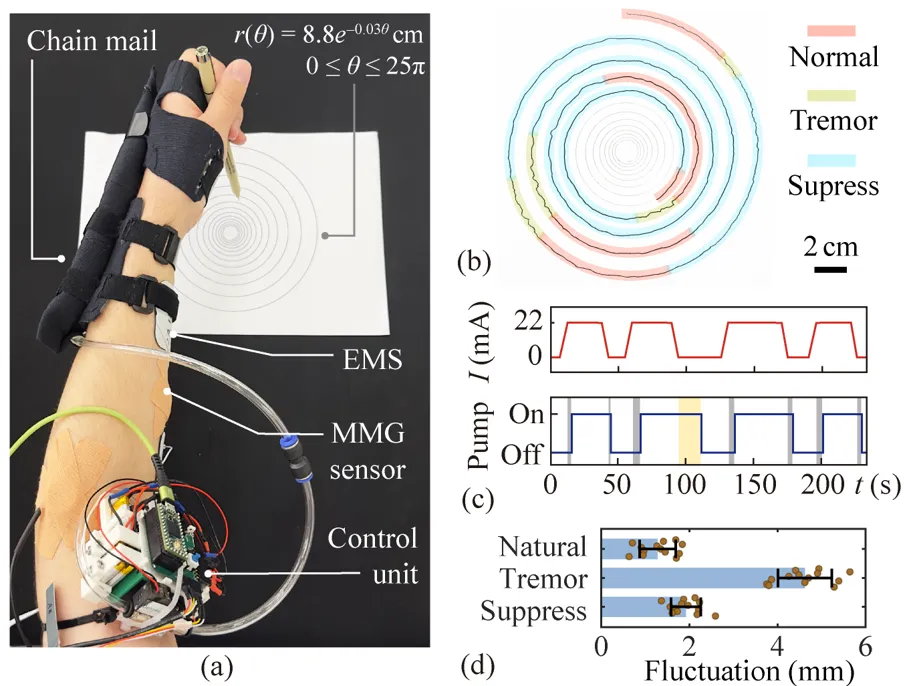
Closed-loop vibration triggers inhibitory experiments based on MMG detection
05.
From continuous copper resistance to demand-to-hardening
In contrast to the traditional process of continuously producing reactive external skeletons that rely on motors for reverse action, this work offered another idea: first using MMG to identify muscle tremors and then to change the mechanical rigidity of the flexible structure itself on demand.
At the same time, MMG is hypersensitive to electrostimulation, which has the potential to be combined with treatments such as EMS. The research team also noted that current human experiments still mainly use EMS induced tremors in healthy subjects, and that clinical verification in true pathological tremor patients will still be needed in the future to further optimize end-to-end response delays, long-term wear comfort, sensor stability and durability of locking structures.
In the future, if machine learning predictions can be deployed directly to wearable controllers and combined with gradient negative pressure or frequency selective adjustment, to distinguish more precisely between high-frequency vibration and low-frequency active movement, such devices that become hard-wired only when needed, software wearable devices are expected to be a new direction for lightweight vibration aids and rehabilitation systems.