It's the first time in the history of the world.
Fable 5.1 went off the air this week, but the A's released King Blast again.

Today is a day that deserves to be included in the history of big models.
AI is finally taking over the physical world!
The company first took Claude "water testing" from his home and let him actually operate the hardware in the lab.
The laser systems of mechanical arms, liquid processors, microscopes, cameras, and even quantum computers can all be handled directly.
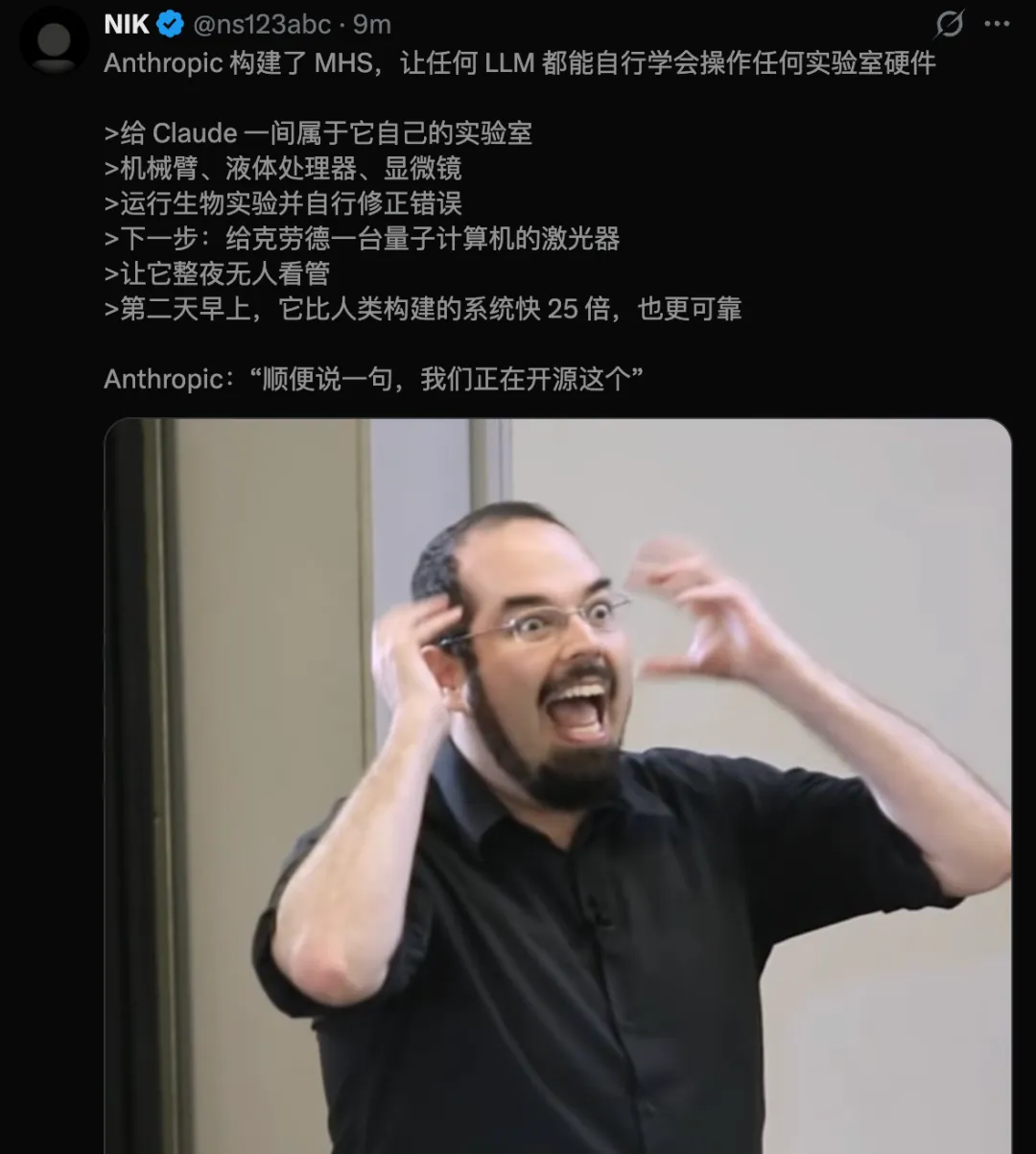
By continuously optimizing the settings of the displacer, Claude performed his own running experiments in drug discovery, correcting bugs.
What's even crazier is that an imaging experiment that would have taken weeks has been compressed into a single day by AI hardware.

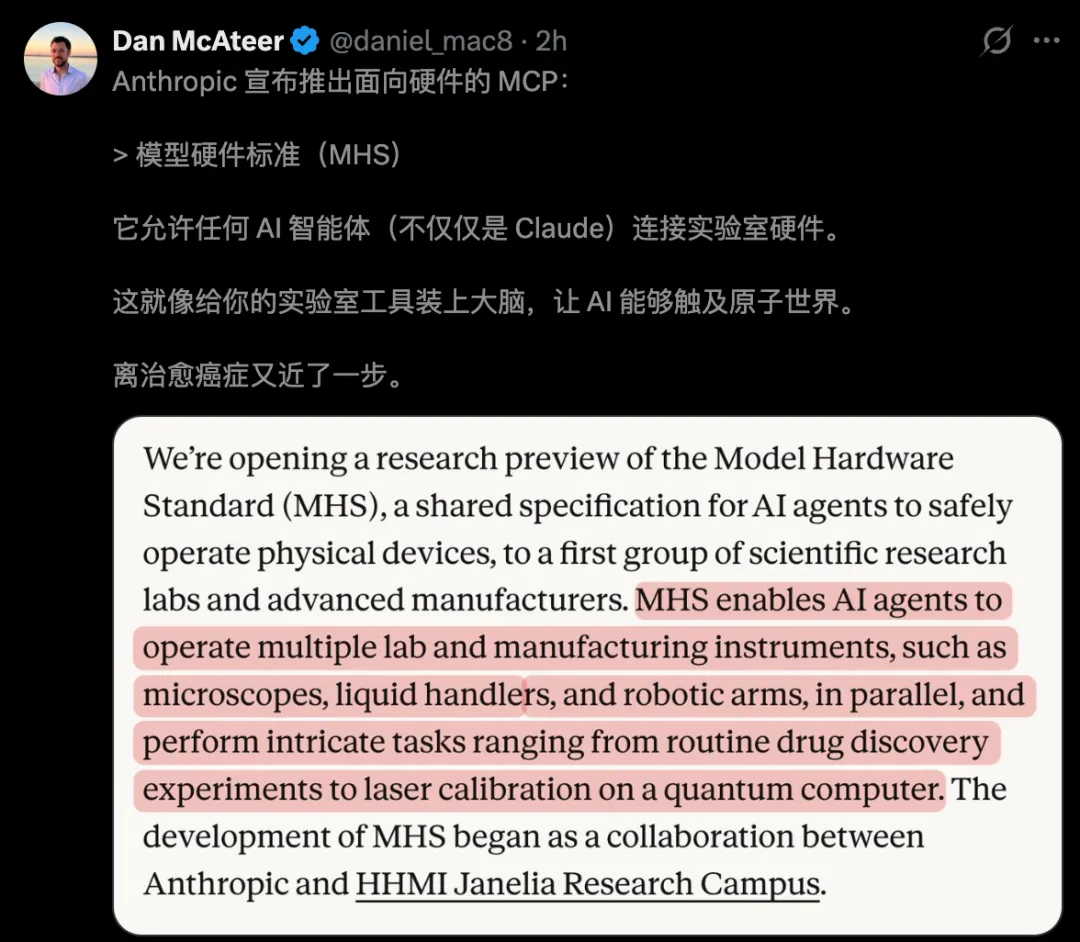
It was at this point that A.A. directly launched the "MHS Model Hardware Standard" for the first phase of research previews.

At one point, the whole internet exploded. Some thought this might be one of the most underrated releases today.
MHS, the equivalent of "hardware version of MCP", really gives AI its eyes and hands!

MCP, one of A's most important inventions, is unknown.
Its emergence connected databases, browsers, and various software tools to today's big model.
Today, A has taken this idea and moved it to the real world.

MHS (Model Hardware Standard) is a "password" that allows agents to directly manipulate real-world hardware.
This is different from the last half of the year's global "lobster fire", when it was only at the tool level, and this time it was AI really getting into the hardware!

What A wants is for all machines to be "read" by the big model.
After all, laboratory automation doesn't sound like something new.
In one laboratory, the microscope comes from one manufacturer, the mechanical arm comes from another, and the transfer station uses another interface.
Every time an engineer picks up a machine, he has to rewrite a "translation program".
Thus, a set of automated experimental processes, which often take weeks or even months, is a direct throwback to the MHS.
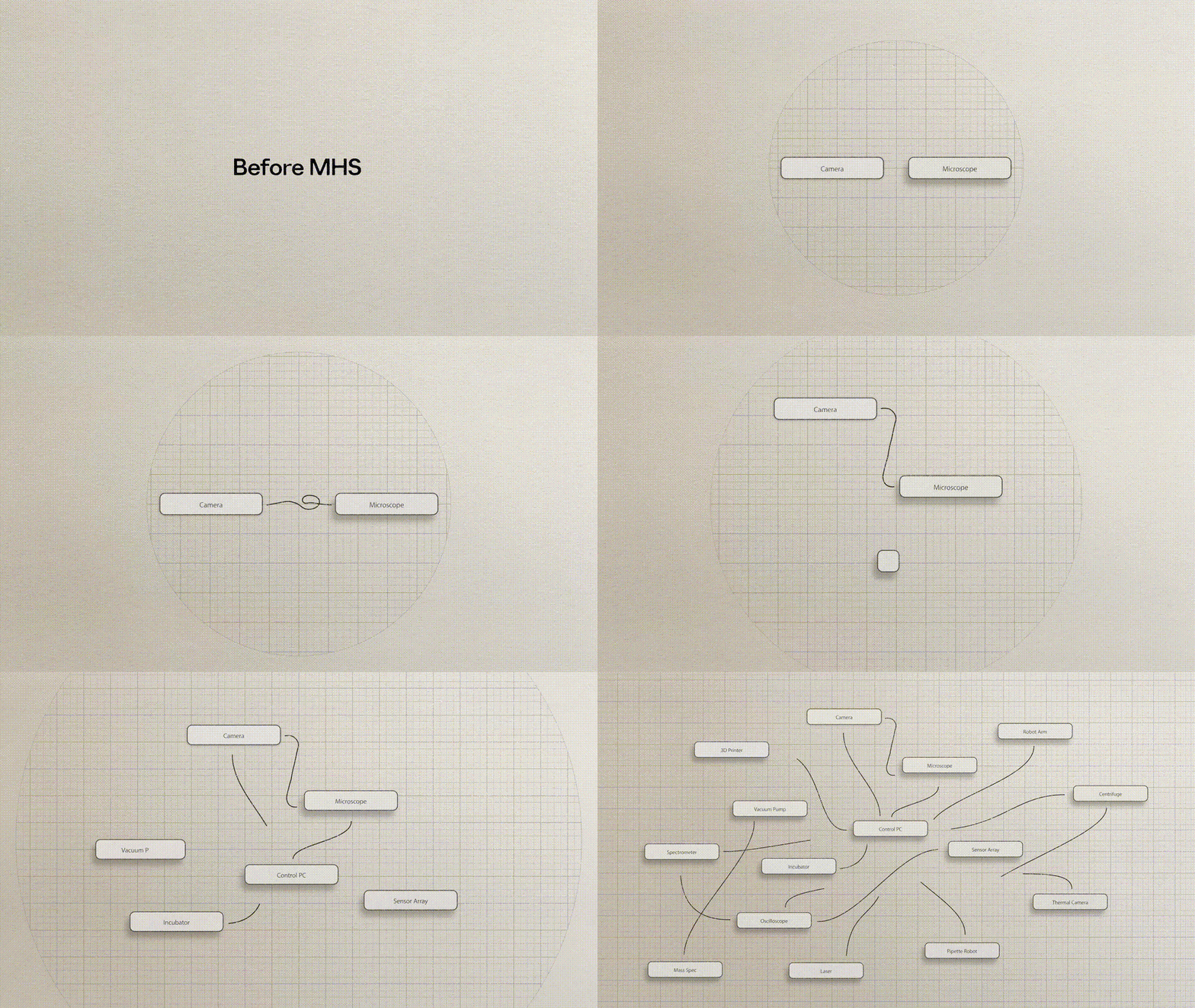
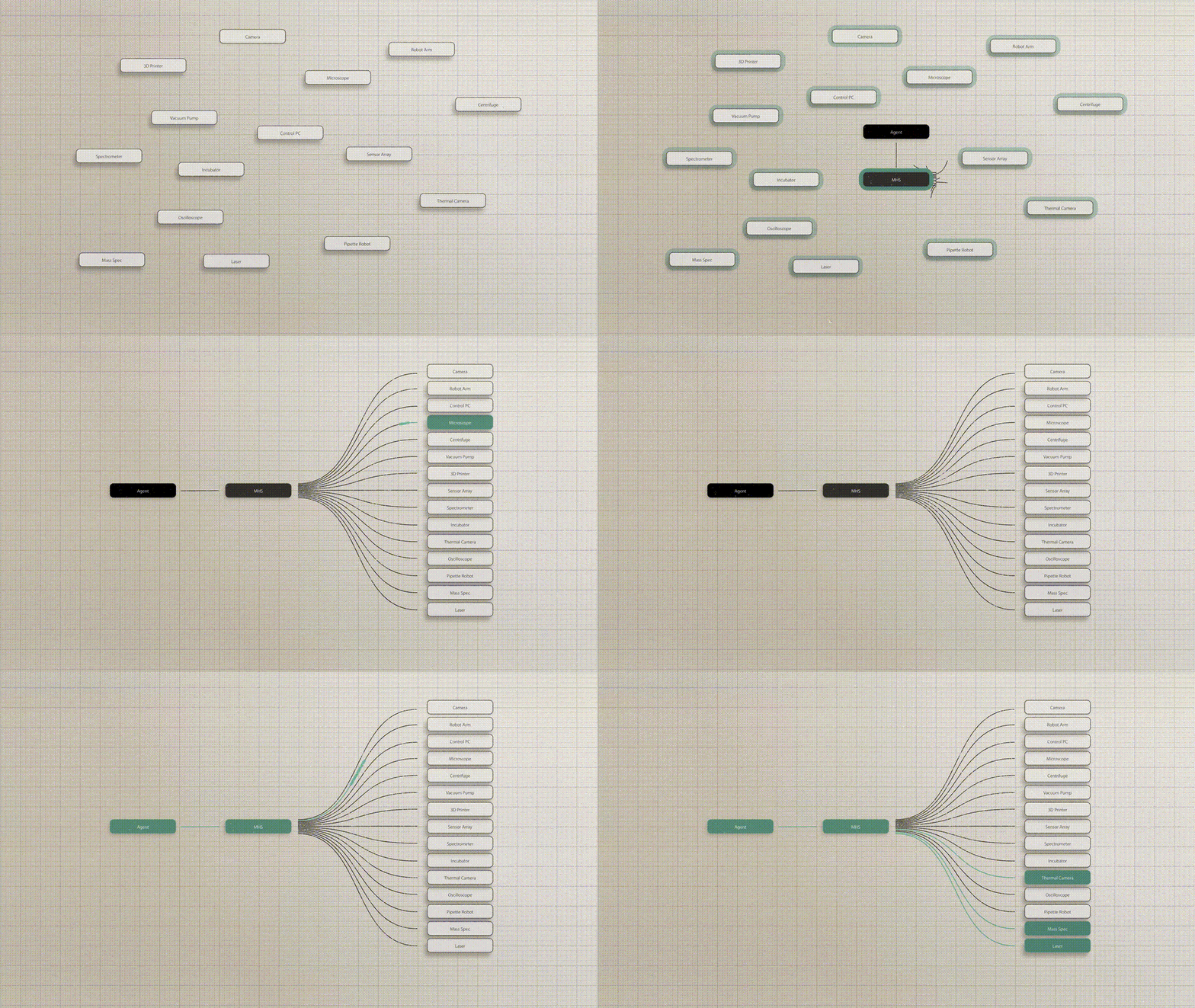
MHS is the MCP of the physical world and the USB-C of the era of AI devices.
As long as the device has a programming interface, the MHS can use shortcuts so that all the hardware can hear what the AI is saying.
The most disgraceful thing is that it carries a "big nonsense manual".
For example, when a new machine comes on, the only thing AI needs to do is read the hardware's self-developed language labels.
This instrument can be heated to a maximum of several degrees, with multiple mechanical arms, and a maximum speed of...
The whole world's AI can instantly take over a machine it's never seen before!
Once all the devices are up and running, the agent can coordinate through the MCP, command line or API unified.

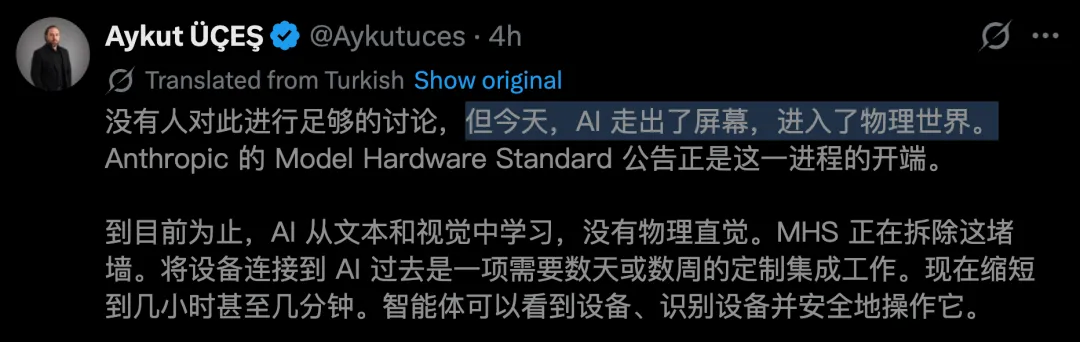
The MHS listened to maybe the abstract and saw Claude's results when he was thrown into the lab.
Claude is going to open the machine.Pressure on human expertsQuEra, a quantum company that uses atomic quantum computers, uses laser precision to control atomic qubits.
These lasers are so "expensive" that once the frequency moves, the machine may stop.
Some failures require 5-10 minutes for human experts to repair each time.
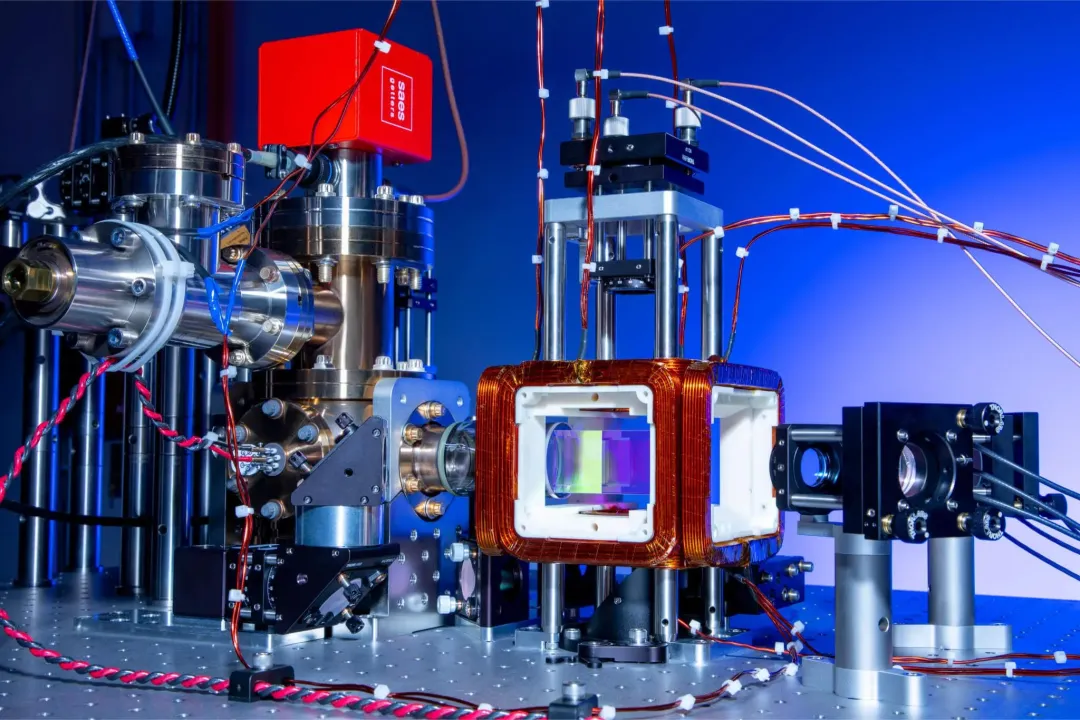
QuEra had four experts spin the shaft for two or three weeks and come up with a set of restored Python scripts.
They asked the same question again and threw it at Claude.
Through MHS, Claude read the state of the "laser system" directly, adjusting the parameters on a dedicated testbed, and then observing the beam back to the correct position with the camera.
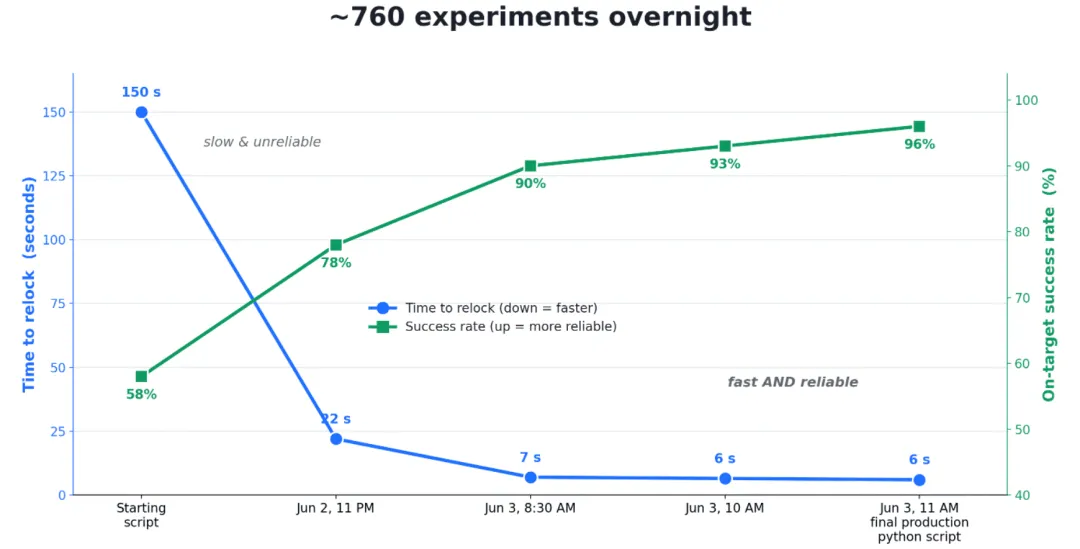
So Claude ran all night, actively manufacturing, identifying and repairing hundreds of malfunctions.
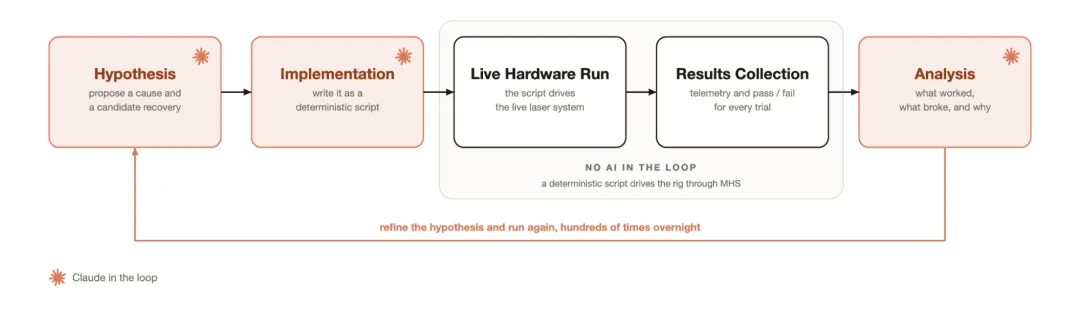
The final result was very prominent, with Claude directing the laser stability rate to 99.3%, whereas human experts only 58%.
What's shocking is that the same calibration takes 5 to 10 minutes, and Claude pushes straight to 6 seconds after training.
Another gene company, Genentech, also hired Claude to do drug discovery experiments.
I don't think Claude could have scored all his own points, but he could have optimized the settings to optimize the displacement, and he could have fixed the bugs himself in real time.
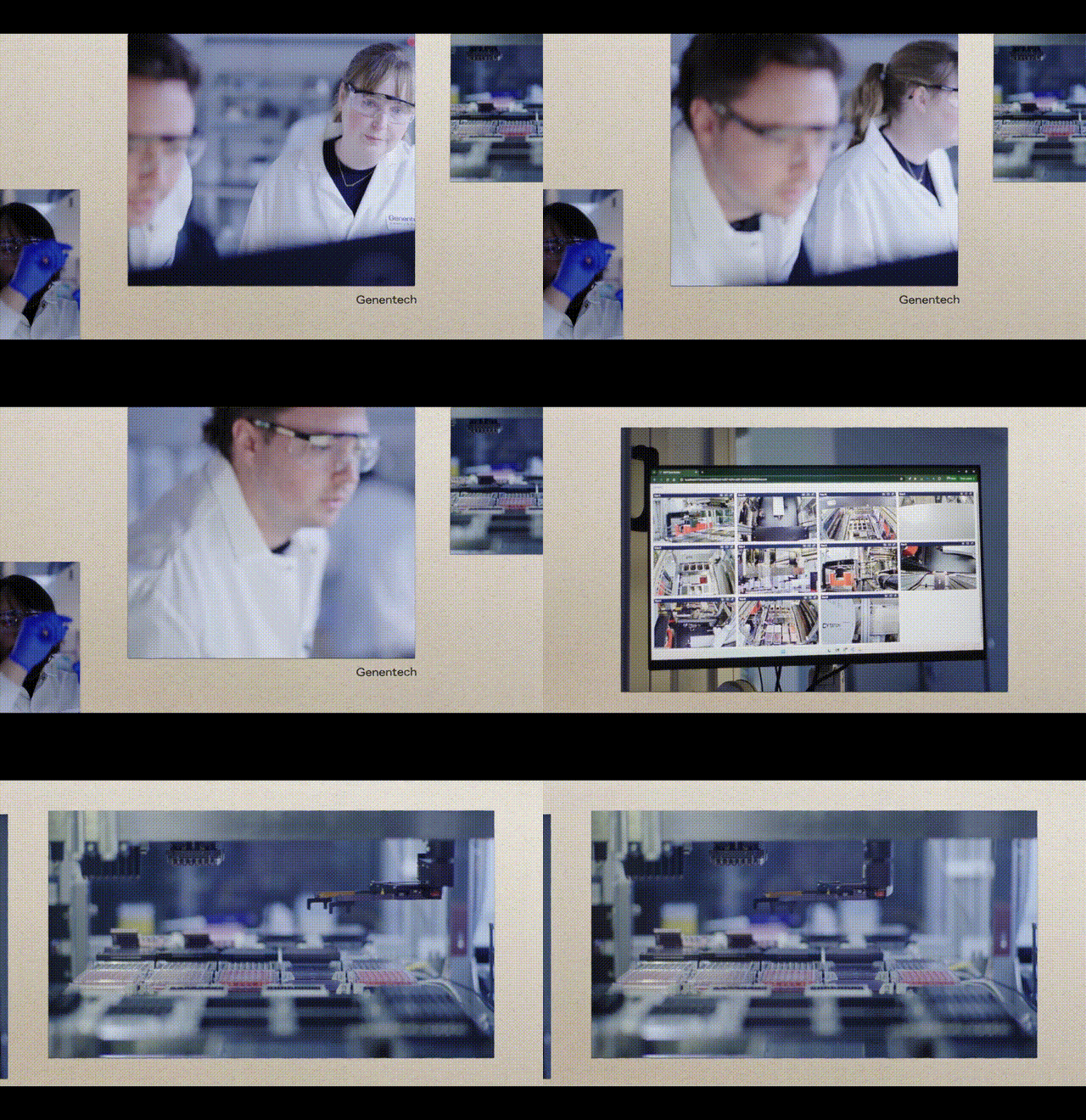
At the HMI Janelia Research Park, a highly complex "brain imaging" experiment took the team several weeks to complete.
After taking over several equipment, Claude took over the job the next day.
 |  |
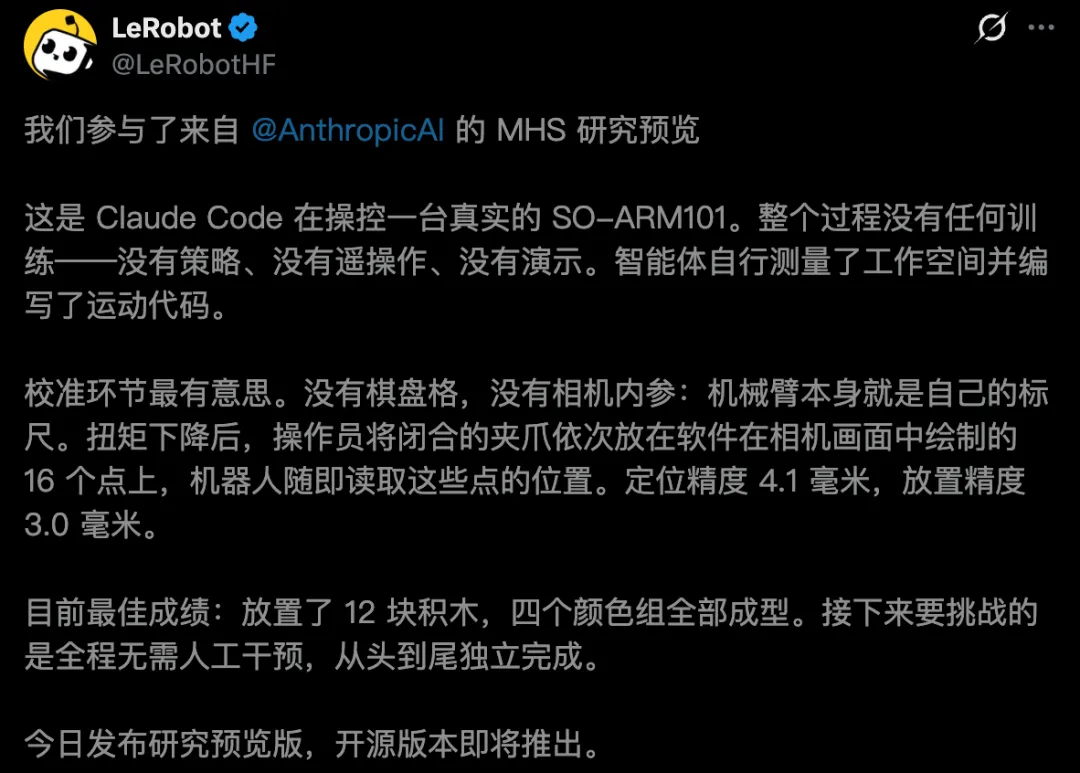
HuggingFace researcher LeRobot also predicted a preview of the MHS study.
What amazes him is that without any training, Claude Code directly controls a real mechanical arm, completing the task of classifying the colors of the blocks.
In the comments section, netizens said it was incredible where this generalization came from.

Of course, it's too early to announce that the "black light lab" is really coming.
ClaudeOr "plant" on the bubble.The results are striking, and in the experimental record we can also see the limitations visible to the naked eye.
When Genentech tested protein concentrations, the viscous protein solution bubbled up during the displacement process, causing the bubbles to squeeze into the tube space, and the actual displacement was low.
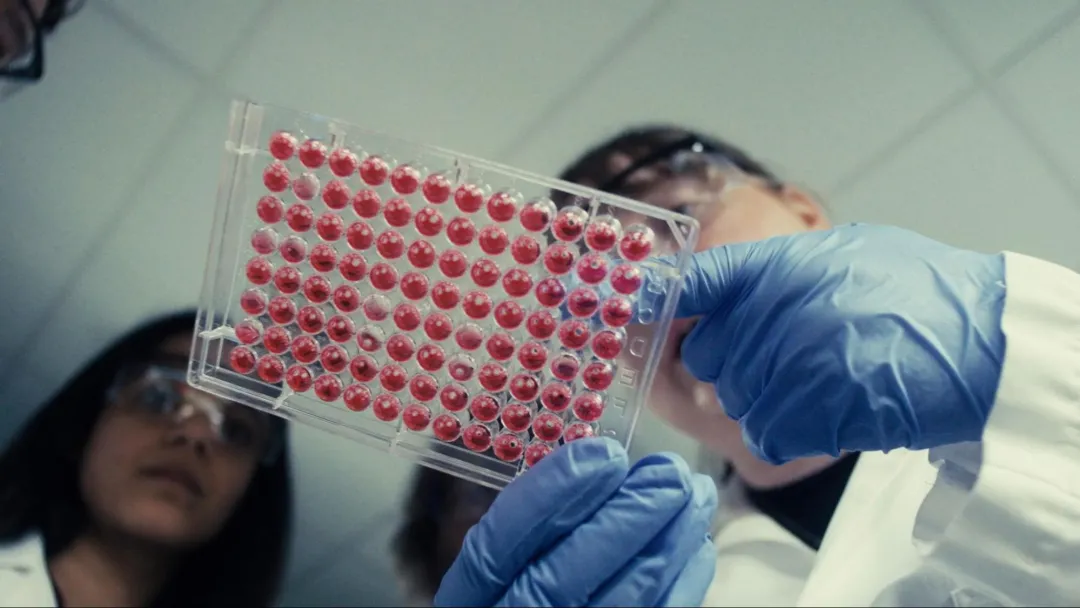
Claude's instinctive reaction was to retest the same hole, resulting in the more liquid the bubble...
The researchers had to tell it personally: "It's a physical problem, not an algorithm bug, you have to change a clean hole, you have to reduce the number of mixtures".
After hearing this, Claude maintained the correct operation, but he never thought of taking this step himself.
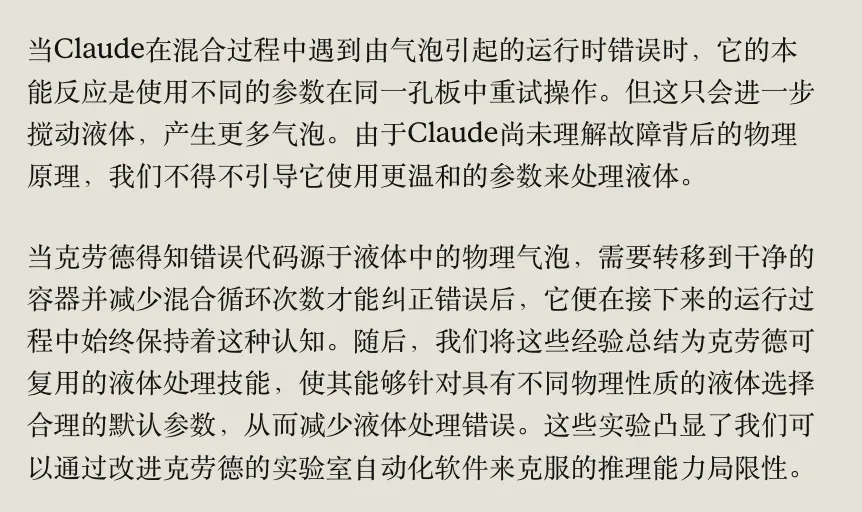
This is the most fundamental bottleneck of MHS today: Claude understands the world through text and images, without physical intuition.
In other words, we need a real world model!
QuEra's test also confirms this: Claude can run hundreds of laser calibrations overnight, but encounters a beam of light that is physically obscured, stops, and others confirm that the experiment may take several hours in the morning.
It seems silly to me.
Safety first, extra caution, inefficiency.
This is also a major problem faced by physically intelligent people today.
In addition to physical reasoning, there are three reality barriers:
First, the coverage of the equipment.
MHS can only handle hardware with a programming interface.
In CMU's case, with no tablet readers and no API, MHS can only simulate human clicks on a GUI to operate, which greatly limits the automation efficiency of a real landing in a global lab.
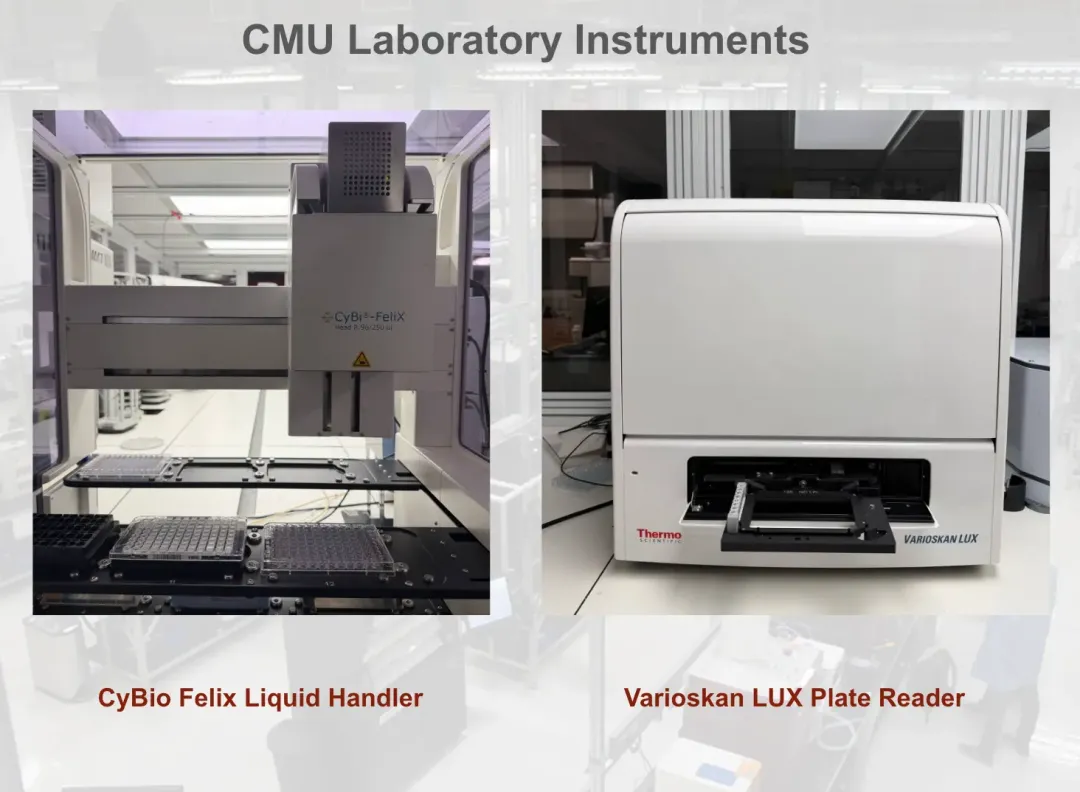
Most laboratories are equipped with ancestral equipment.
Second, the cost of calculation.
Keeping AI continuous online monitoring, calculating expenditure needs and saving research time balanced.
This is not a small number for academic laboratories that have budget constraints.
After all, for 2,000 dollars a month, you can get a super-highly educated, energetic, hardworking, and emotional value for a professor.
Price of the Claude API
Third, the regulatory vacuum.
The way MHS works is by clearly writing the security boundaries of a machine in a drive file.
For example, the machine arm can only rotate as fast as it can, the maximum angle, and the AI will know what moves it can't do.
The problem is that the document is essentially a safety net: it says yes, the mechanical arm won't hit a person, that's fine; it can be wrong, and who will bear the consequences?
It is important to have a large-scale real-world and clear legal responsibility, but it can also affect the implementation of technology in turn, partly by compromising on safety.
The Underground Interface of the WorldThis time, A wants to compete for AI's "interface" to the bottom of the physical world.
In this Age of Agents, it first used MCP to connect tools, and now uses MHS to open the door to AI into the real world.
In the past, the big model only told humans how to do it.