It's the first time in the history of the world.
This summer, the mathematical circle continues to vibrate
OpenAI's Astra model solves ten long-standing mathematical problems -- including the existence of non-sofic groups, new results of high-dimensional stacking, etc. -- and Claude Fable 5 finds a counterexample to the Jacobian conjecture of nearly a hundred years, which later greatly propels Liman's conjecture!
This made Sidharth Hariharan, a graduate student in mathematics at Carnegie Mellon University, more confused.
Earlier, after receiving an email from 2022 Fields Award winner Marina Viazovska, he learned that his research had been published early by the AI intelligence body "Guass".
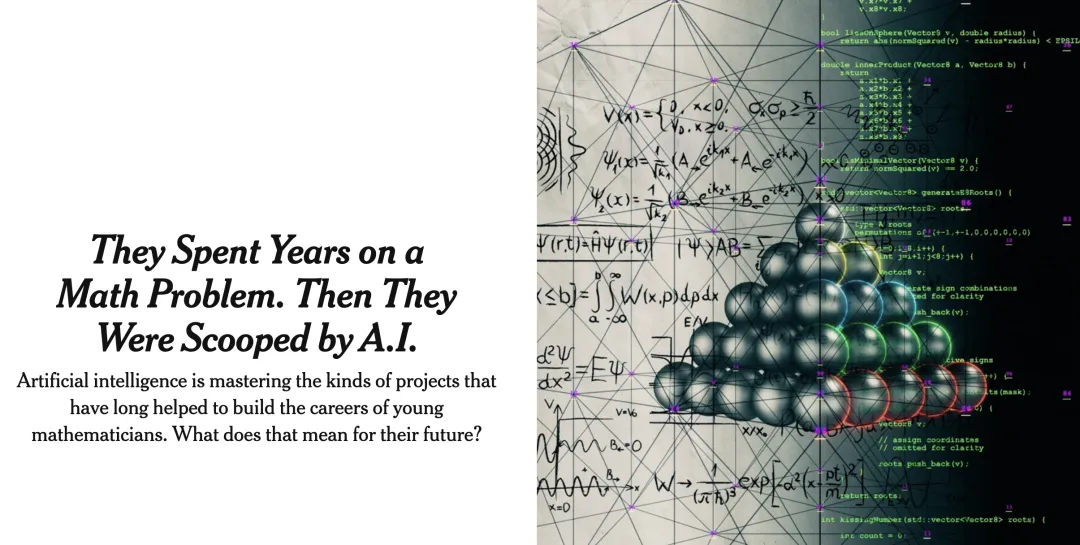
A year ago, you might have thought of this as "curiosity or exaggeration, it's no use", but things have changed.
Just as the rest of the mathematical circle was unbalanced, physicist Gavin E. Crooks threw an open problem at Claude, and the whole problem was solved in a matter of days. Even a physicist with a solid foundation in mathematics could take months to solve this problem.
In physics, humans are also being hit by AI!
In this context, one of the founders of unbalanced statistical mechanics asserts:
Physics will also step into the aftermath of mathematics.
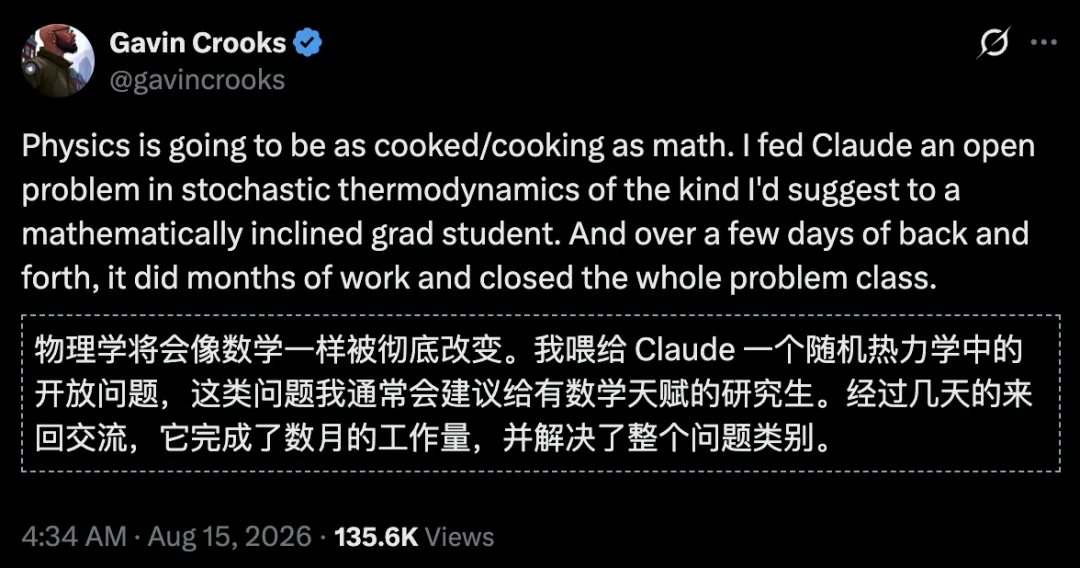
He confessed that the academic world is about to undergo a major change.
The academic community has two roles:Developing knowledgeandTeaching/training/guiding the next generation。
Science may be on the verge of developing at a pace that humans cannot keep up with.
So how do we teach and train students when any question I ask can be answered faster by Claude?
What is the problem?To understand the extent of this, it is necessary to go back to Crooks himself. Gavin E. Crooks is renowned for his work in unbalanced thermodynamics and statistical mechanics.
In 1998-1999, while he was a graduate student at Berkeley, he proposed the famous Crooks fall theorem, which accurately linked unbalanced functions to balanced free energies and became one of the cornerstones of random thermodynamics.
A single paper in 1999 alone has been cited thousands of times.
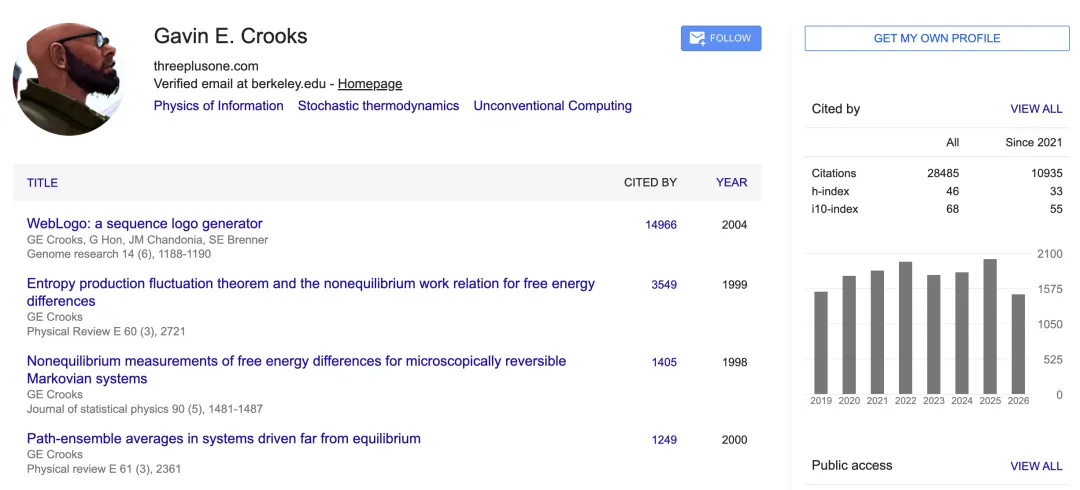
His research has long spanned the intersection between thermodynamics, information theory, and computational science, profoundly influencing nanoscale thermodynamics, free energy estimation methods, and later the formation of thermodynamic computational paradigms.
He is a recipient of the Presidential Early Career Award for Scientists and Engineers (PECASE), one of the highest honors given to early career scientists by the U.S. government, and was elected a Fellow of the American Physical Society (APS) in 2019.
Claude solves a problem of random thermodynamics given by Crooks.
In the microscopic world, systems can occasionally "go against the second law of thermodynamics" for a short time, but the probability of a reversal event versus a normal event is not random, but is precisely controlled by hydrogen and rapidly decreases by index.
This is described as a beautifully detailed symmetrical falling theorem (Detailed Fluctuation Theorem, DFT)
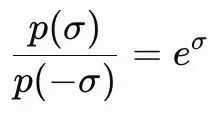
The question is: what constraint conditions are there for lithium to generate statistics under this function?
This has produced a lot of results.
Timpanaro et al. in 2019 exchanged the TUR (exchange thermodynamic uncertainty relation) from the exchange-fall theorem, giving a matrix form boundary that can be matched. Salazar's work continued to explore the boundaries of DFT's bias, tail probability, and information quantity.
The TUT of 2023 has elevated TUR to the "theorem" of never being unequal, clarifying the precise current to reach the minimum scaling differential, and emphasizing the impact of the high-voltage torque of lithium.
They were excavated one by one, but there was always a lack of a unified geometric image.
Claude identified all these local results as different projections of the same convexity and gave a complete rectangular-scale sculpture.
The paper begins with a summary, all written by Claude.
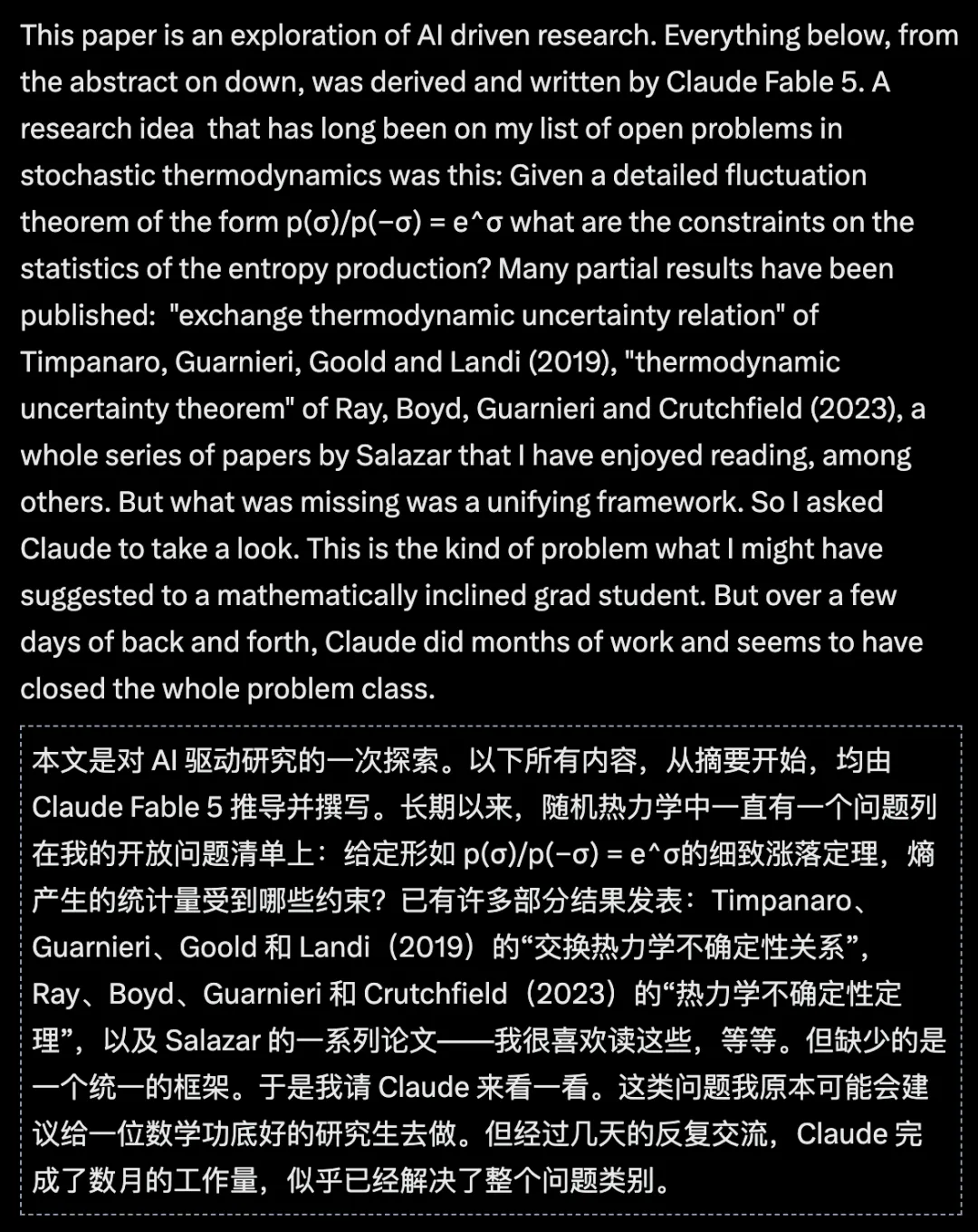
Claude's core insights are very clear:
Each distribution that satisfies the DFT is the only one that corresponds to a gap distribution.
For each fixed interval a, the distribution P_a has only two results ±a, and the weight is strictly fixed by e^σ.
Thus, the arbitrary DFT distribution is the only mixture of these two basic result distributions.
The combined area of statistics is therefore a moment body. More importantly, it is accurately carved at each step:
Given n−1 matrices, the second matrices can only take [some sharp lower boundary, +∞), with no upper boundary. The lower boundary is reached by a distribution of only a finite number of symmetrical result levels.
Every DFT community that has been published before can be restored to a unified convex region.Low-dimensional projection。
This also explains why the same distribution can almost simultaneously bring all of these states to equilibrium.
This theory can also be extended to the general dual distribution of the Crooks fall theorem.
The mechanism is derived from an overlooked structural fact: the median value function a;tanh (a/2) of DFT can be written as a positive-weighted simple sum of squares, the extreme being the odd-numbered square.
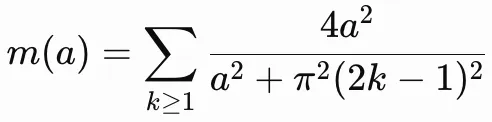
This mapped the entire problem directly to the classical matrix problem, where, using the exact equations of the Wronskian and Hankel sequences, all the optimizations fall into the distribution of a few atoms.
The result is that almost all of the published DFT boundaries have become low-dimensional projections of this uniform convexity. The distribution of the same two results is often simultaneous with multiple different boundaries because at a fixed average, it is the angle of the convexity.
For the general two-dimensional distribution Crooks falls under the theorem that the symmetrical channels (positive and inverse rectangles) inherit exactly the same set of layers, and that the symmetrical channels are almost unbounded. This explains precisely why a one-way free-energy estimator can vary arbitrarily, while a two-way estimate is essentially necessary.
New physicsThe thermodynamic uncertainty theorem itself is not Claude's newfound discovery. The basic version of the theorem was published by Kyle J. Ray, Alexander B. Boyd, Giacomo Guarnieri, and James P. Crutchfield in 2023.
Claude put all these "projections" back into the same geometric object and proved that the object can be fully described.
One of the newest attractions is the AI-driven research process.
Claude wasn't just asked to explain an existing physical concept.
It is used to explore difficult theoretical problems, connect existing ideas, and search for new mathematical structures.
This could be a bigger story than a single thermo-mechanical result:
AI is moving from solving problems that humans already know how to solve to helping scientists explore problems that we don't yet know how to solve.
Physics is entering its own era of AI acceleration.