It's the first time in the history of the world.
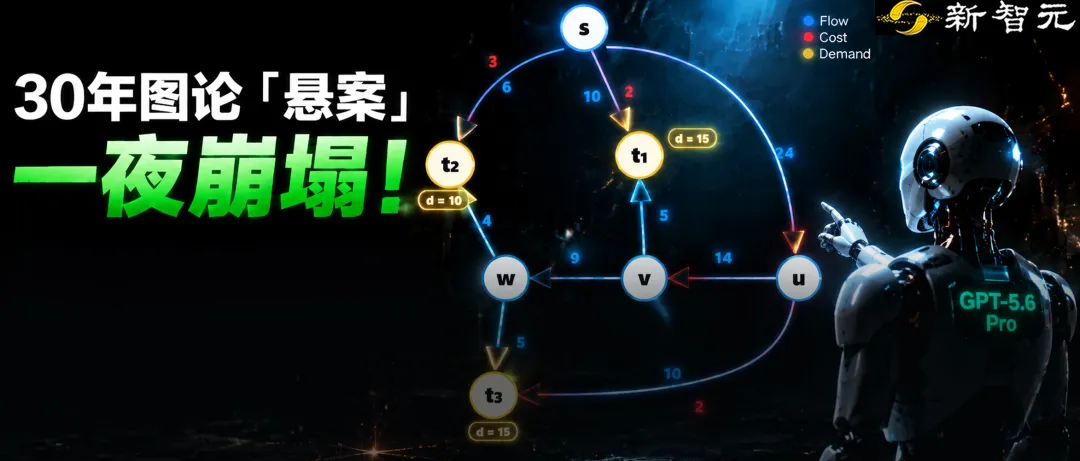
After 30 years of "suspension", it collapsed overnight.
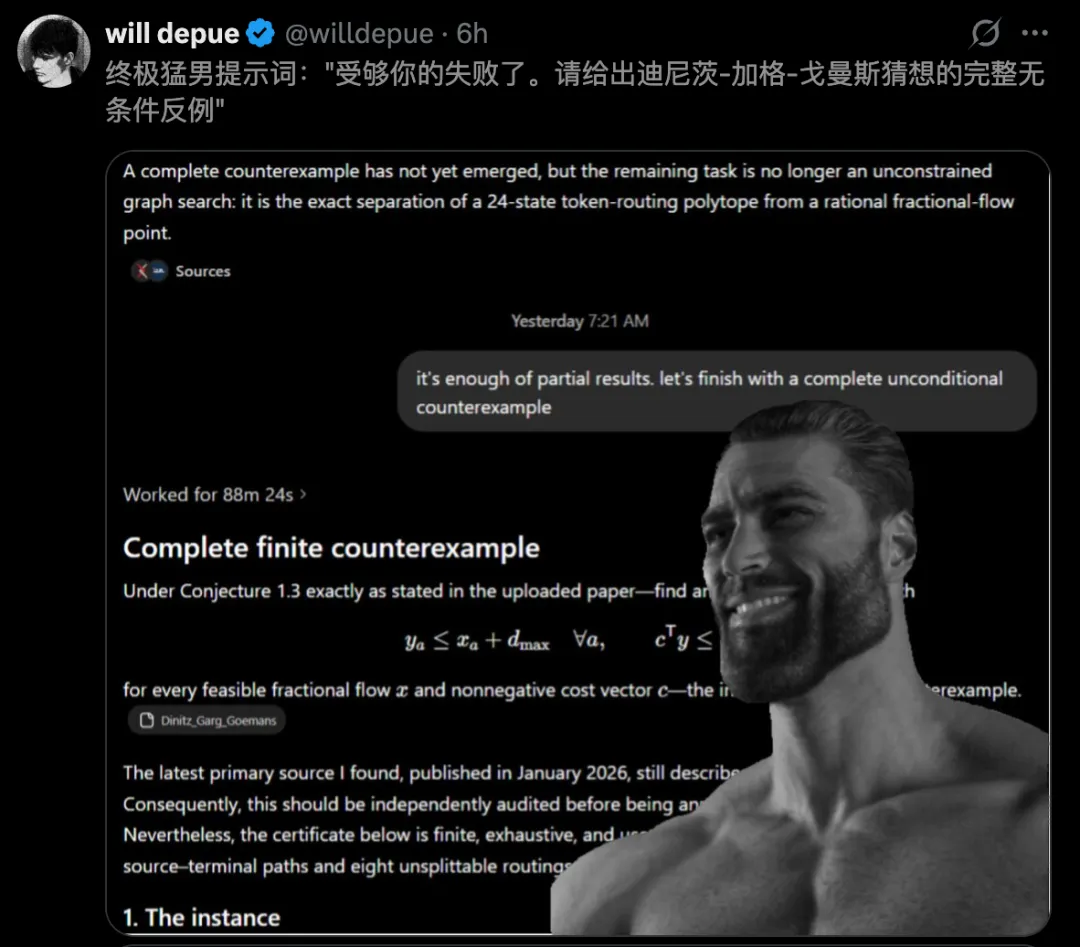
Just today, the GPT-5.6 Pro falsified three decades of speculation about Dinitz-Garg-Goemans in the field of graph theory.
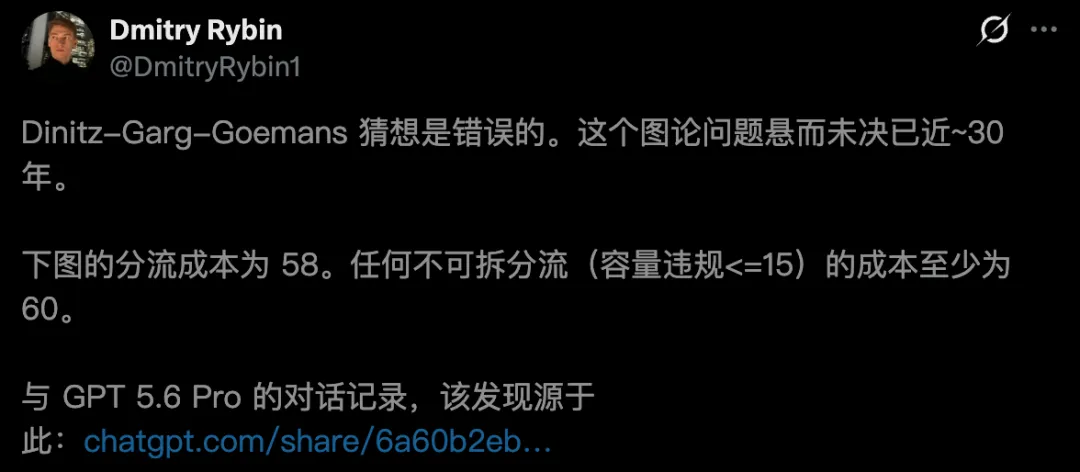
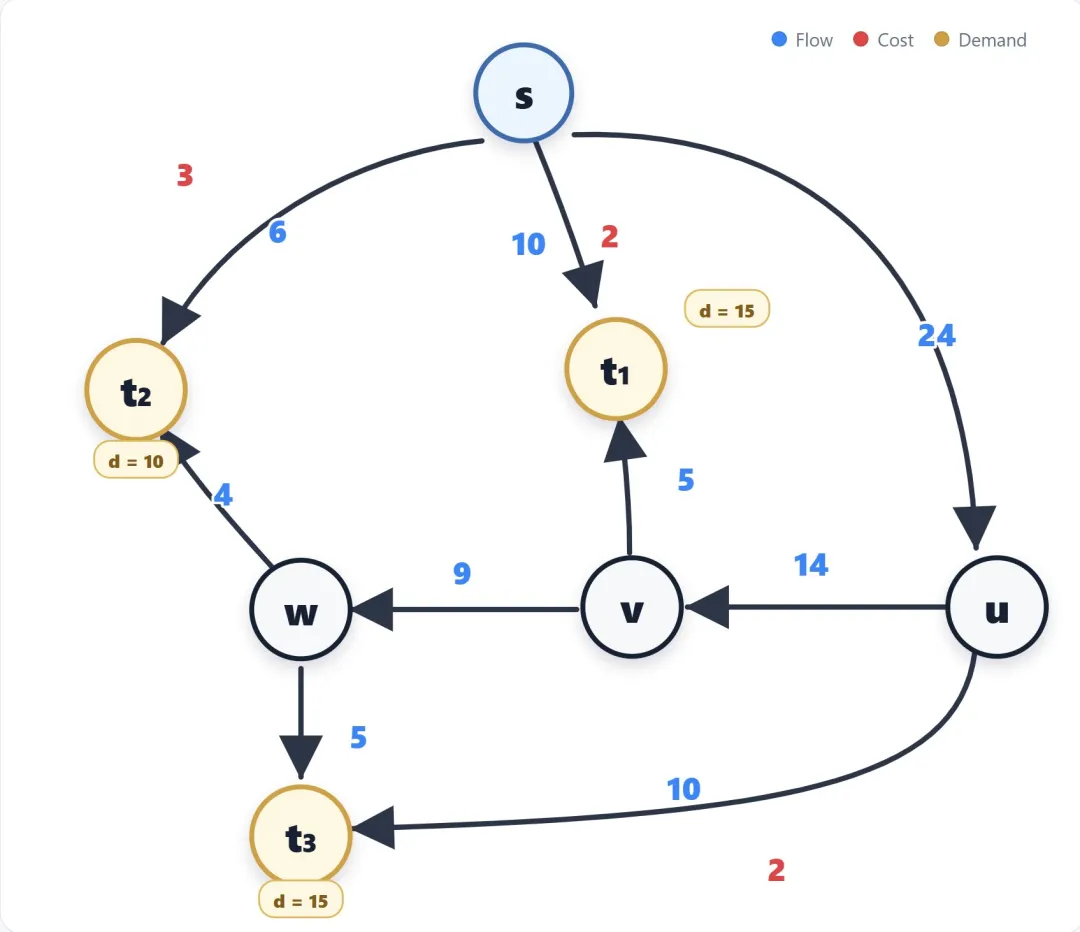
The evidence he gave was extremely concise: a graph, the cost of the numerical flow is 58.
Any capacity that does not exceed 15 non-divisible flows will cost at least 60.
58<60, a thirty-year-old graphing conjecture has collapsed.
On the same day, Senior Dr. Shouqiao Wang used GPT-5.6 Sol to work with the Codex workflow, solving six open Erdős problems in five days.

Last night, a new Fields Award was announced.
But now there's a crazy rumor in the circle that this could be the "Last Human" Fields Award.
A 30-year guessGPT-5.6 Pro counterfeitThis time, the full chat record with GPT-5.6 Pro has been released to the public.
Dmitry Rybin said that now "AI overthrows the old conjecture" is fast becoming a hot topic on the internet.
But he really cared about it and spent weeks thinking about both proof and falsification that year.
He also added that the human-machine conversation itself is a deadly mess.
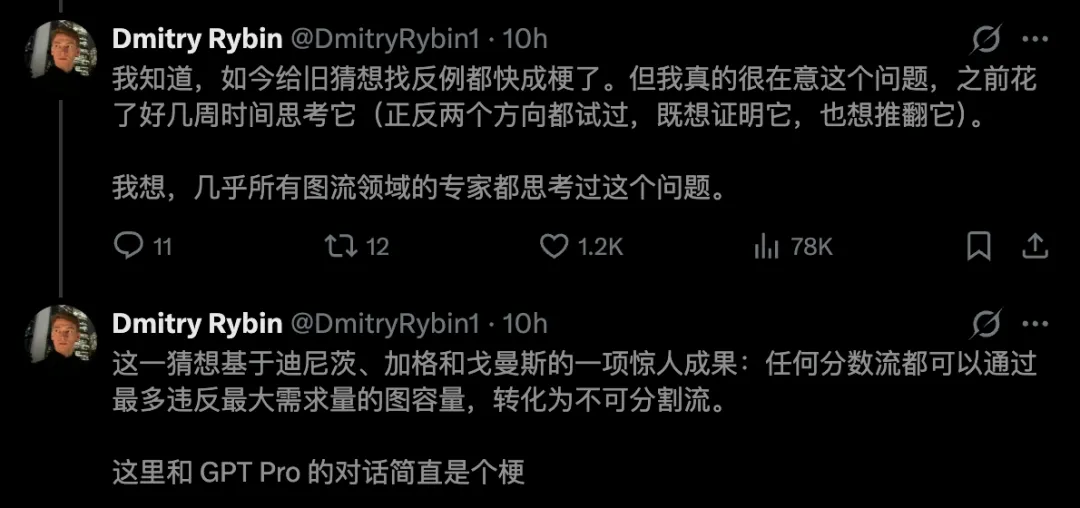
In the same year, Dinitz, Garg and Goemans confirmed a beautiful conclusion:
As long as there is a scaling flow that meets the capacity limit, there must be an inseparable flow that costs as much as the capacity exceeds the "maximum demand".
Goemans later added a very natural conjecture: can the cost of a villa be kept at the same time as it is not too much?
This cost version has never been made by anyone.
In the arXiv papers of 2023, it is open; in the January 26th, it is still open.
Almost everyone who works in the drawing business has thought about it.
The counter-examples given by the model are as follows: three terminals with demands of 15, 10, 15 respectively. Each terminal has a "cheap way" (zero cost) and a "expensive way" (cost 30).
The key is that three cheaper ways are two or two conflicts. If you choose two, there must be an overlap.
So any legitimate route can only take one cheap route at most, and the remaining two terminals must take expensive routes, costing at least 60.
The three cheapest routes can be used at the same time, at a rate of 1/3, 2/5 and 1/3, at a cost of only 58.
People who are familiar with combinatorics optimization will react to this immediately: This is the stability set inequality of a triangle.
The integer solution satisfies z1+z2+z3≤1, while the numerical solution is 1/3+2/5+1/3=16/15, greater than 1.
During the entire conversation, Rybin said only three words.
First sentence: to construct a counter-example, you have to make a breakthrough and find a structured counter-example.
Second sentence: continue to look for clear strategies that come from a deep understanding of the structure of the problem.
Third sentence: Partial results are enough, we give a complete, unconditional counter-example.
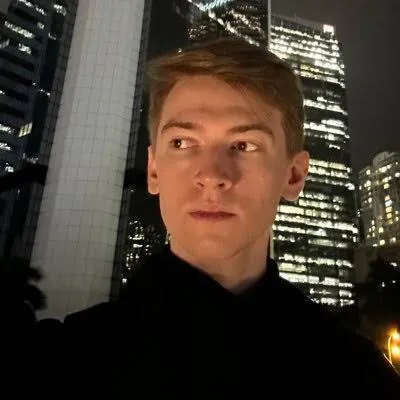
Dmitry Rybin, who overthrew 30 years of graph theory, is currently the co-founder of a $100 million AI startup.
In a personal introduction, Rybin has earned a PhD in machine learning from the Chinese University of Hong Kong (Shenzhen).
Most notably, he also won gold medals in the International Student Mathematics Competition and the National Olympic Games in Mathematics.
It was a paper in May 2025 that really made him famous in the circle.
Rybin found a faster algorithm for calculating a matrix multiplied by its own inversion.
This operation sounds abstract, but it's a matrix of correlations in statistics, the foundation of chip design and wireless communication, and something that's often calculated when training large models.
In October, he sent another message: to calculate the accuracy of causal attention less than 10 percent.
He has a repository on his GitHub called "Algorithmic Discovery and Optimization Experiments with OpenEvolve".
An Olympic gold medallist who didn't pursue a model during his doctoral studies got caught up in "how to get a robot to find a new algorithm".
Chinese alumni of Northeastern UniversityFive days to solve six puzzlesThere's another thing on the same timeline.
Senior Dr. Shouqiao Wang said that he solved six Erdos problems that had previously been labeled as open in five days using the GPT-5.6 Sol Codex.
A total of 13 attempts were made with a 46% success rate, one of which ran for 32 consecutive hours.
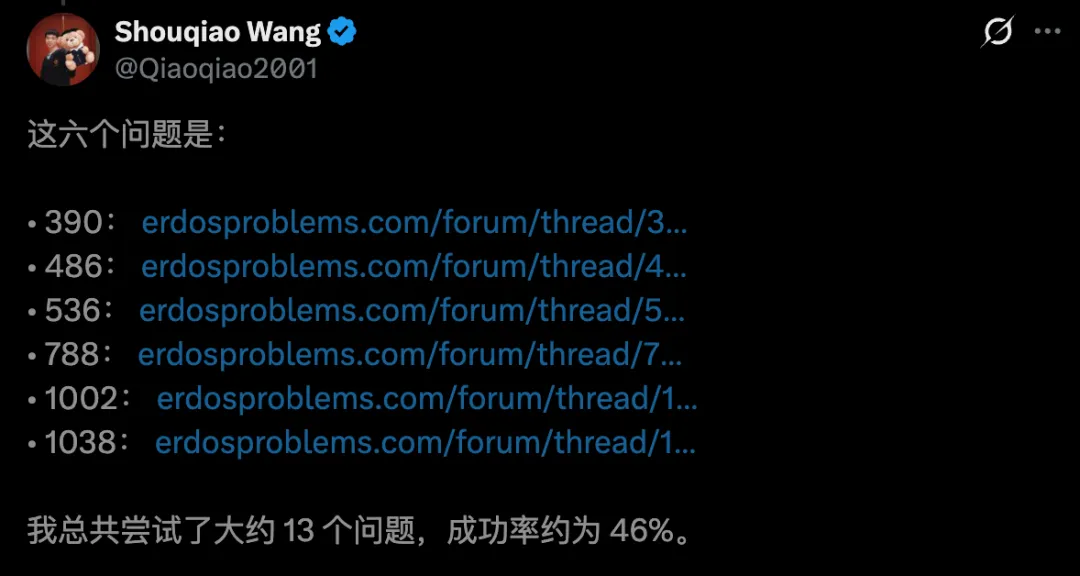
He broke the method into three pieces.
In the selection process, only mathematicians select the topics that are already being discussed, and AI eliminates those that are tied to major speculations, dead dead.
Self-definition of "what to solve": accurately repeat the problem, write a complete proof of what needs to be established, list the weakest inferences, and name the problem-specific craters.
Finally, the Independent Opposition called for the Agency to challenge each candidate's conclusions.
The whole process is a dead cycle: trying → failing → diagnosing → changing directions → writing proof drafts → countering audits → fixing.
The model repeatedly overthrows itself, attacking its own arguments, until it no longer raises substantive questions.
It is worth mentioning that one of the themes, which was studied by Taoist philosophers, is still unresolved.
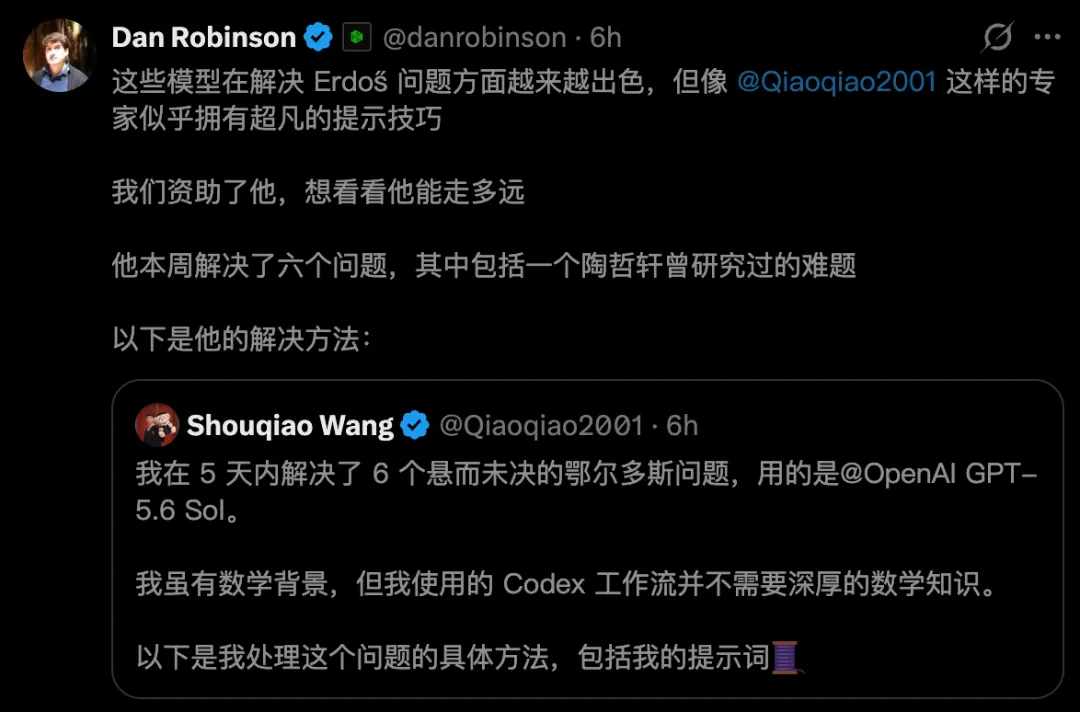
Shouqiao Wang said: "I have a background in mathematics, but this workflow doesn't require very deep mathematical knowledge".
But what he called "some background" in his mouth was slightly exaggerated in gold content.
At the age of 13, when his peers were still in elementary school, he enrolled at the University of Waterloo's Eurovision Mathematics Competition, taking first place in the world.
In 2016 and 2017, he also picked up two Chinese Olympic silver medals in mathematics (CMO) and successfully placed first in the 2017 National High School Mathematics League.
In 2018, with his full talent, he opened the door to the Great Northern Mathematical Hall of "Fight of the Gods".
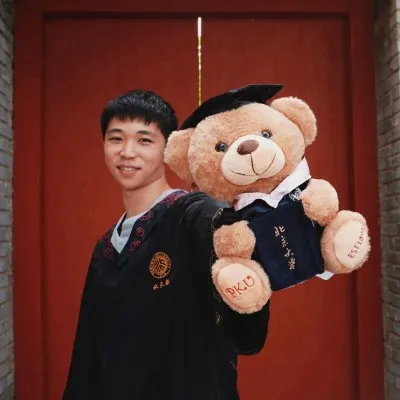
But the most interesting part of the story is that he didn't live in a world of pure numbers according to the script.
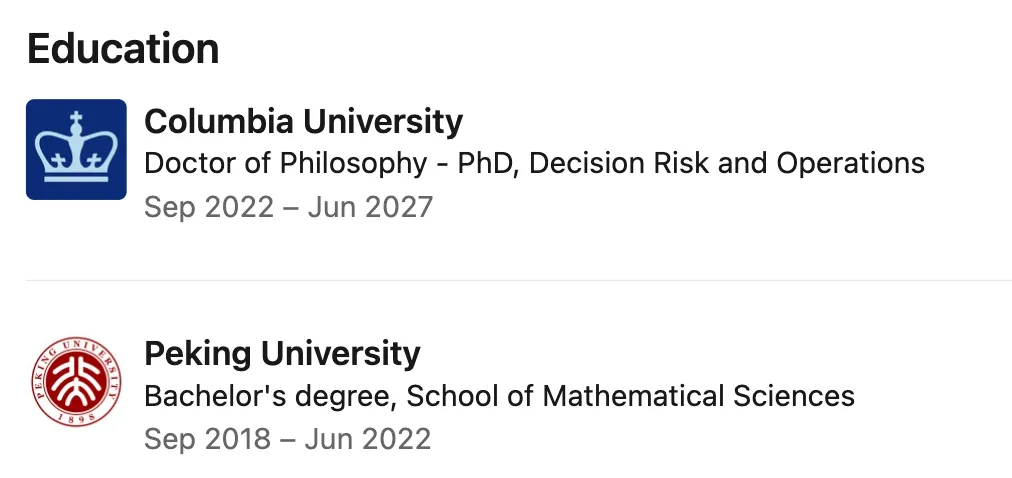
He is currently pursuing a Ph.D. in Decision, Risk and Operations at Columbia Business School.
He dismantled the mystery of mathematical equations and shifted to the frontier of more realistic tensions: research mechanism design and game theory.
 What about the Fields Award for "The Last Man?"
In four-and-a-half hours, he broke thirty years of pending cases; in five days, he broke six puzzles.
The Fields Prize, which will be announced tonight, may truly be the "singer" of pure human intelligence.
But this is not the end, it is the beginning of a "new era" of AI and human coexistence.
From single-armed combat to multi-agent autonomous combat, AI has become a "scientific partner" that can truly push the boundaries of cognition.
How far do you think AI is from taking its own "Fields Prize"?