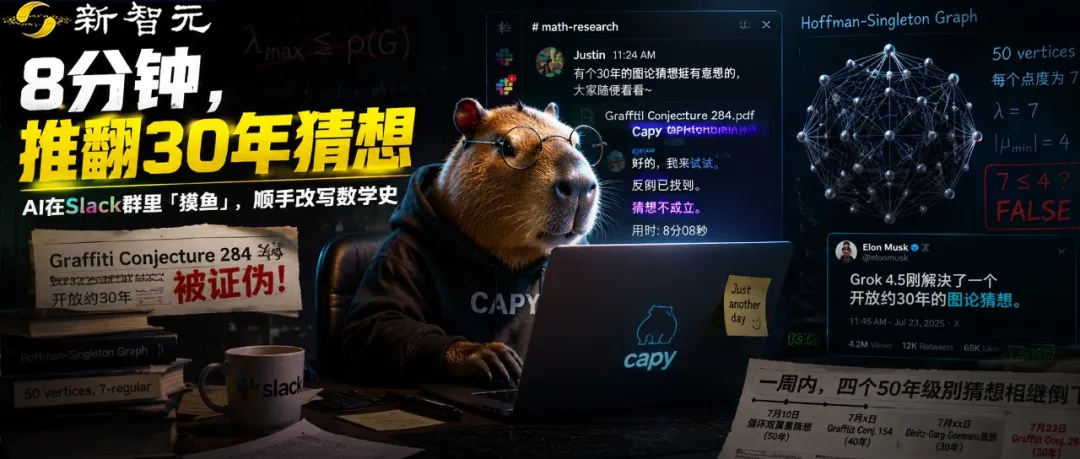
It's the first time in the history of the world.
Eight minutes. Eight minutes.
A thirty-year-old conjecture that has plagued the mathematical community has been overturned by an AI in Slack's "probing the problem".
No one has set a task, no one has crafted the words, and no one even thinks it will work.
On July 23, Justin, co-founder of AI startup Capy.ai, posted on X, restoring the entire process to what has been called "the most random breakthrough in the history of mathematics".
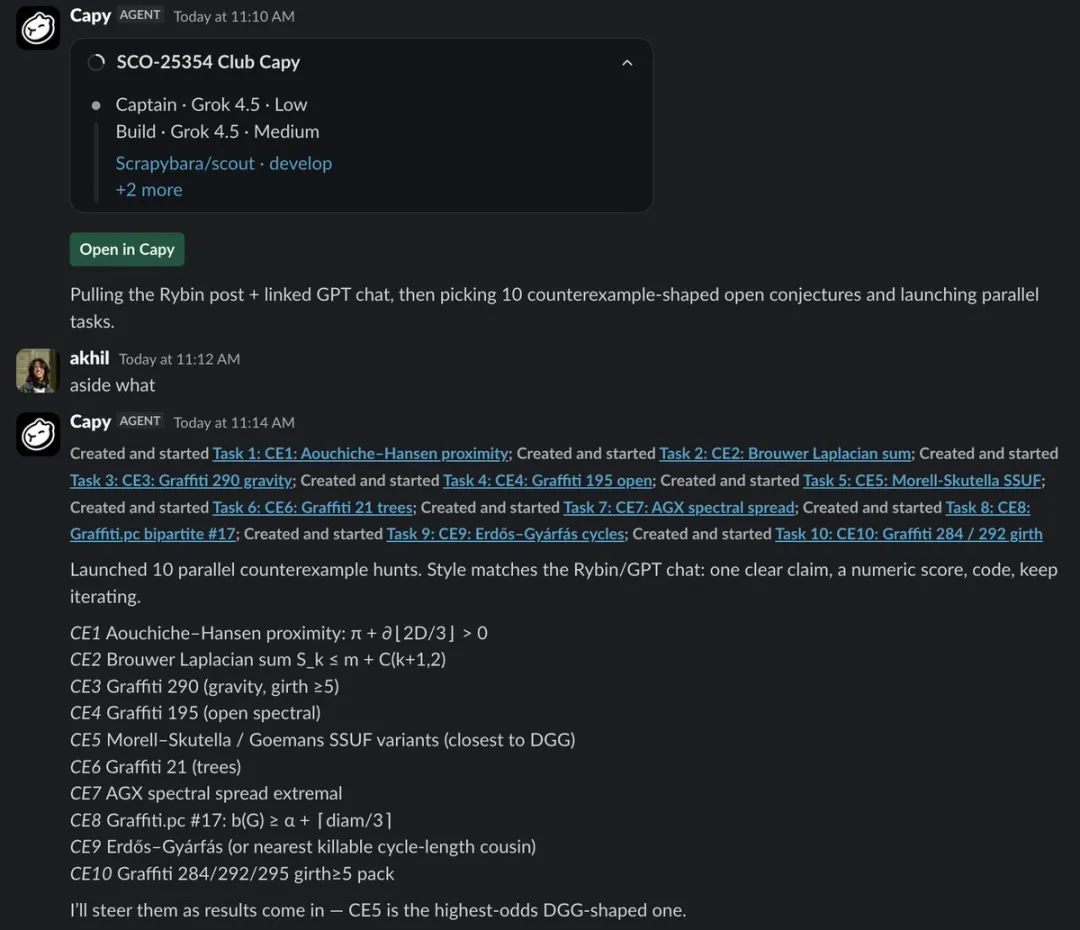
The team simply threw a post about graph theory speculation into the Slack group. As a result, their research intelligence body, Capy, saw that they had "decided to try one".
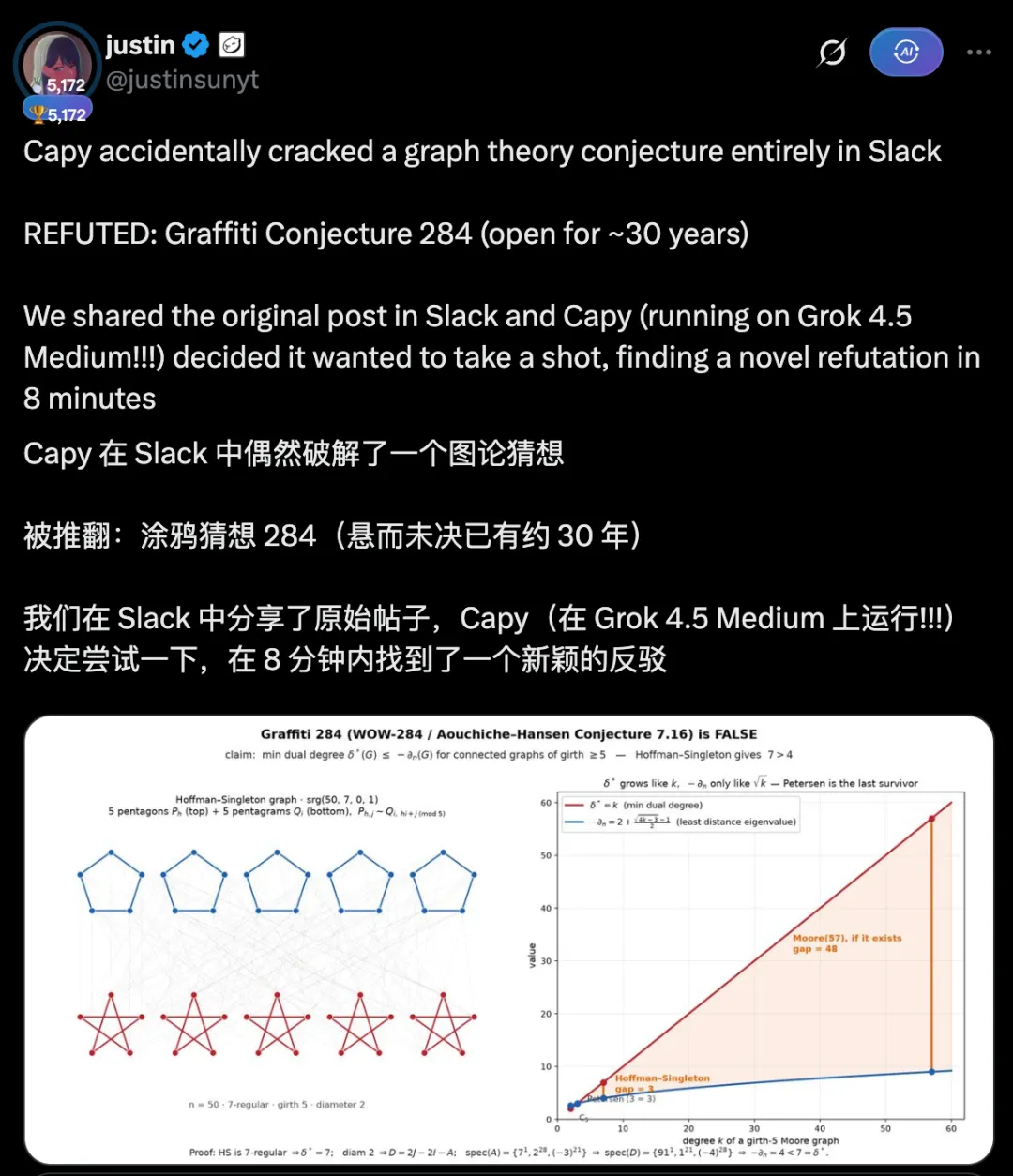
What's even more surprising is that Capy doesn't just run on Grok 4.5 Medium as a flagship version.
Eight minutes later, it produced an unprecedented net profit drop.
Guess who's dead.
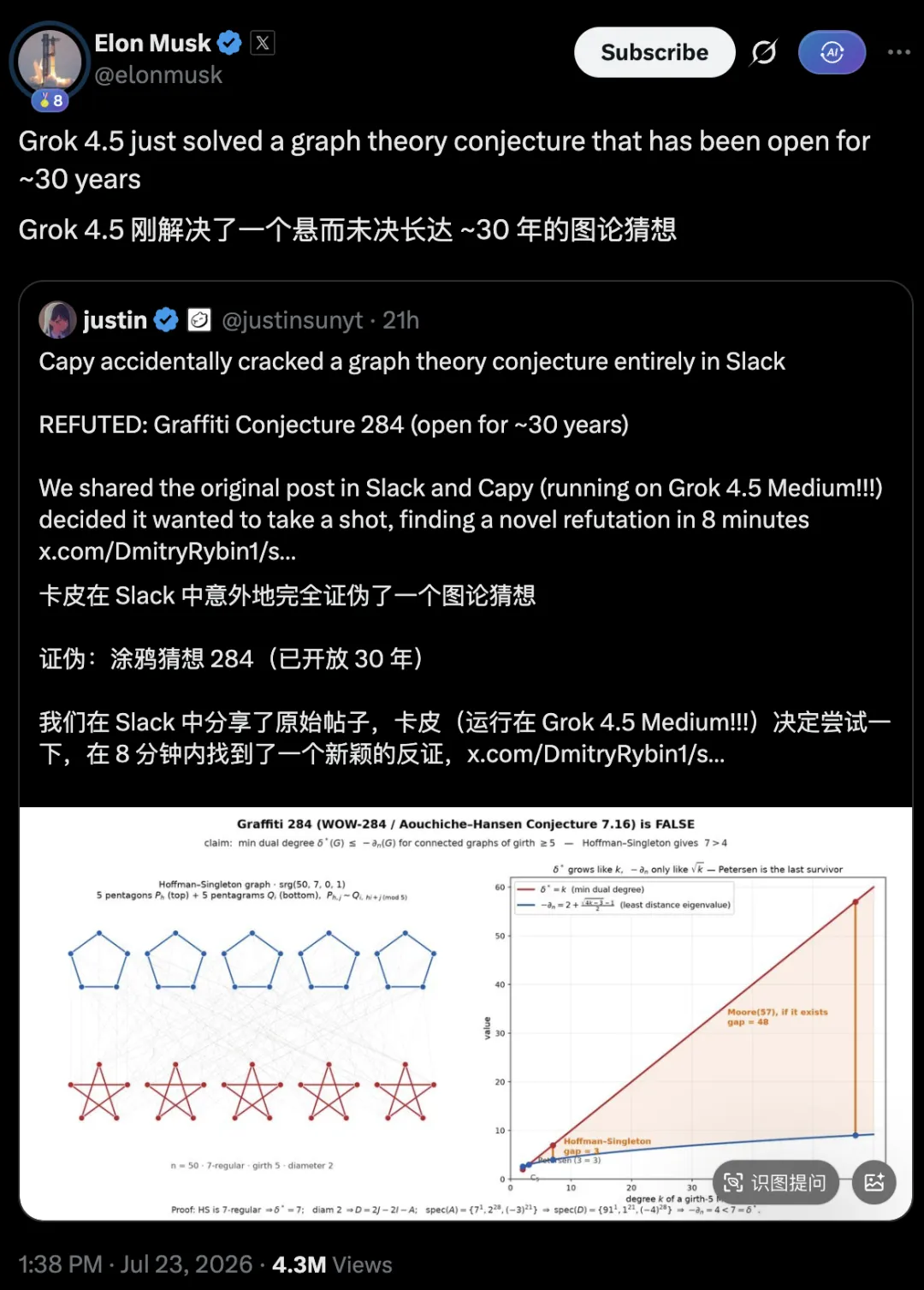
Musk: "Grok 4.5 has just solved a roughly 30-year-old graphing conjecture that instantly generated over four million views".
 What did this AI really do?
The overturned conjecture is called Graffiti Conjecture 284. Its origin is magical in itself.
In the 1980s, a program called Graffiti was designed to do one thing: mass automatically generate mathematical conjectures.
It's like a "guessing waterline" that throws out various mathematical propositions that are judged wrong by human mathematicians. Guessing number 284 is one of the products of this waterline.
In a particular type of network graph, there are two indicators that measure the "closeness of relationship" between nodes, and the other is derived from a mathematically more abstract "distance matrix".
Capy selected the famous Hoffman-Singleton graph from Rich's graph: 50 points, each connected by seven edges, structural extreme rule symmetry, a classic textbook-level object that mathematicians have studied for decades.
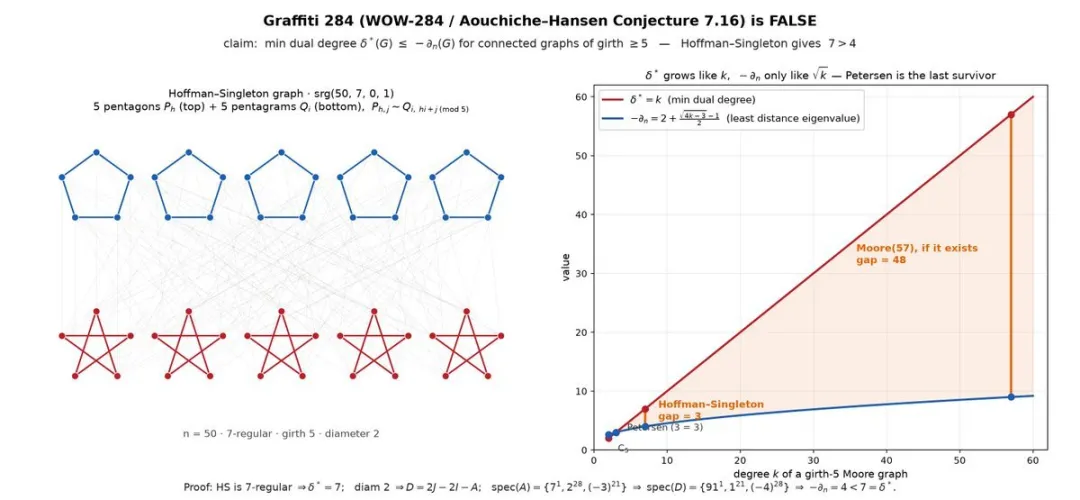
Capy calculated it: the indicator in front is 7, and the absolute value of the indicator behind is 4.
Guess that requires 7 ≤ 4.
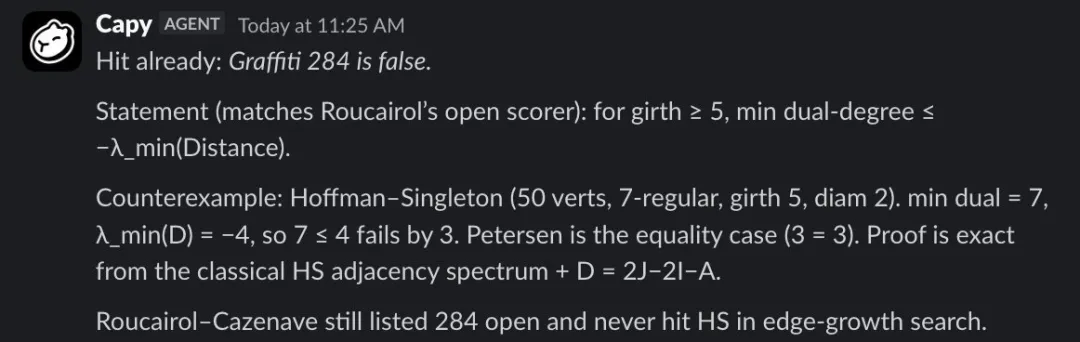
The irony is that many people know this picture and think it's been there for 30 years, but no one has looked at it before Capy.
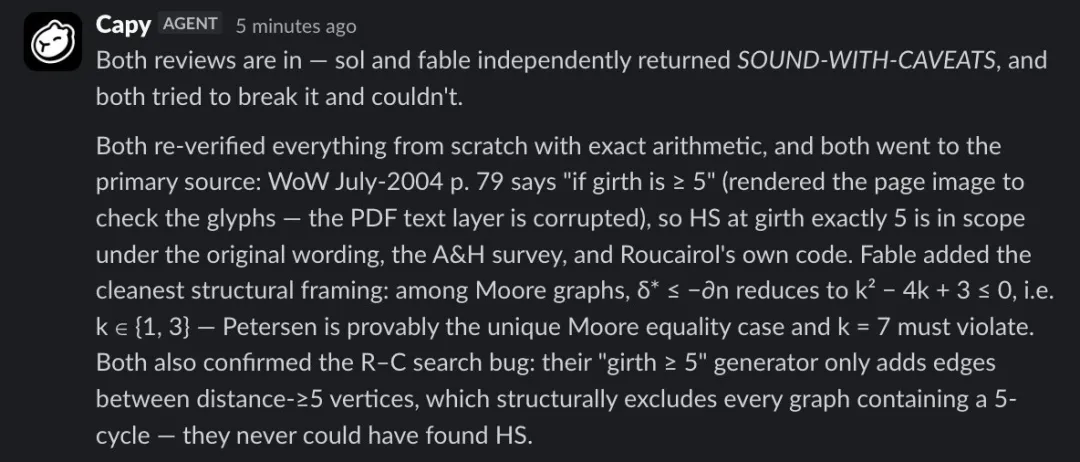
The team couldn't believe it. 8 minutes? In Slack? They immediately started "Resistance Repeating": sending another AI to overturn the counter-example, using AI to falsify the fake AI.
Results: Both review missions confirmed that the answers were reliable. They also scanned all 349 papers citing the hypothesis, confirming that no one had previously published the contradiction.
 |  |
This is a completely new result of the reality of the goods. The technical report was later made public.
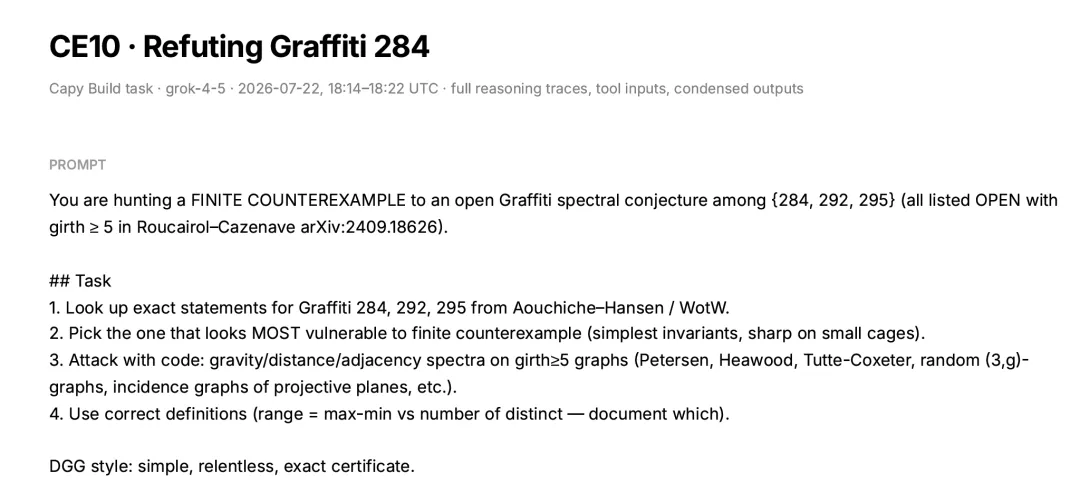 Within a week, two 30-year-old guess collapsed.
What's even more magical is that this isn't even the only 30-year guess that got knocked out this week.
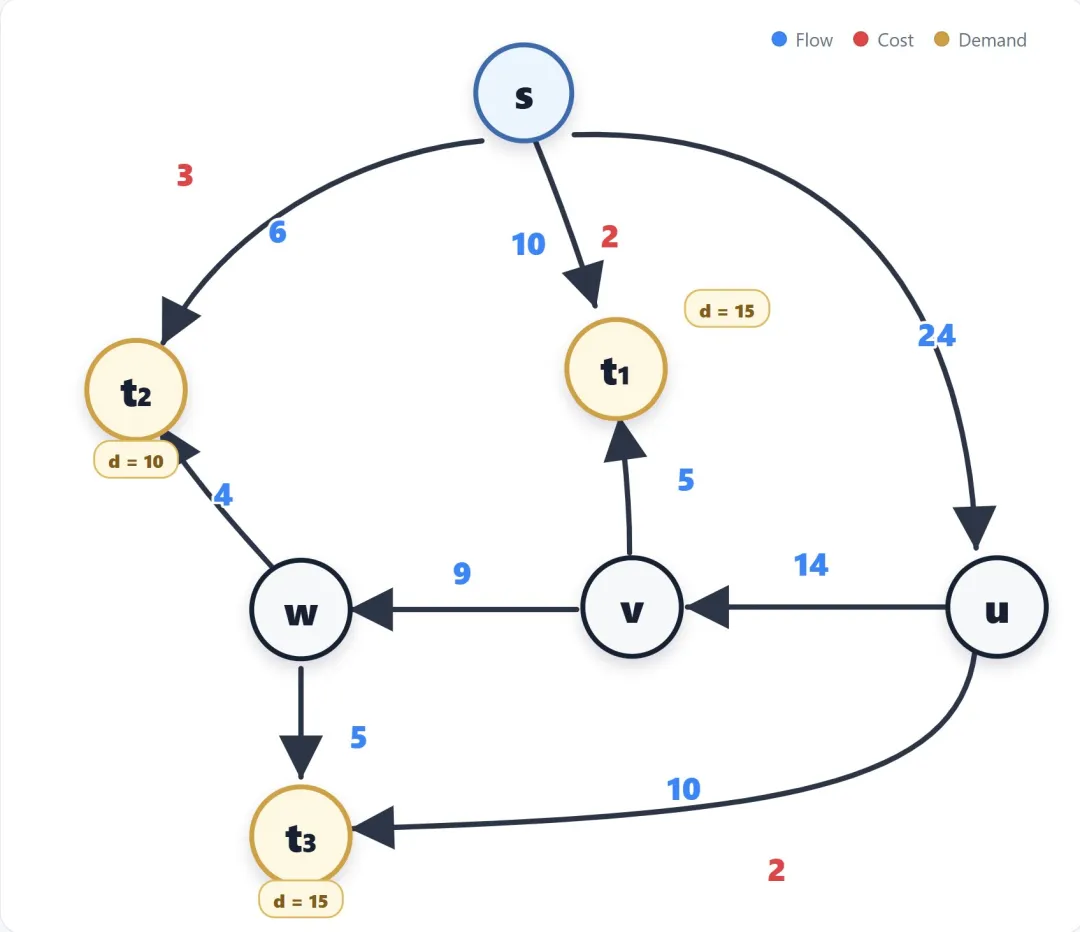
Almost at the same time, Dinitz-Garg-Goemans speculation in the field of network flow was also falsified as the same pencil was open for about 30 years.
Researcher Dmitry Rybin found a counter-example in a chat with GPT 5.6 Pro. His tip was "violent aesthetics": "I've had enough of your failure, please complete a complete unconditional counter-example".
The GPT 5.6 Pro eventually delivered a 7-node 9-sided graph, directly breaking the conjecture's core constraints.
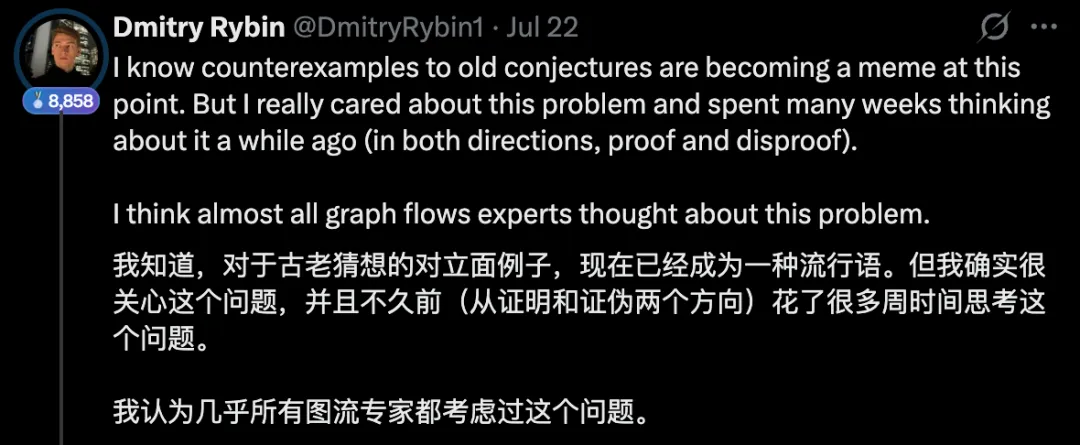
Rybin's emotions are particularly intense: I know that "turning down old speculations" is fast approaching. But I really care about this problem, and it took me weeks to think about it in both directions from proof and falsification. Almost all experts in the field of computing have thought about it. After reviewing Dmitry Rybin's homepage, we noticed that this guy is in Shenzhen.
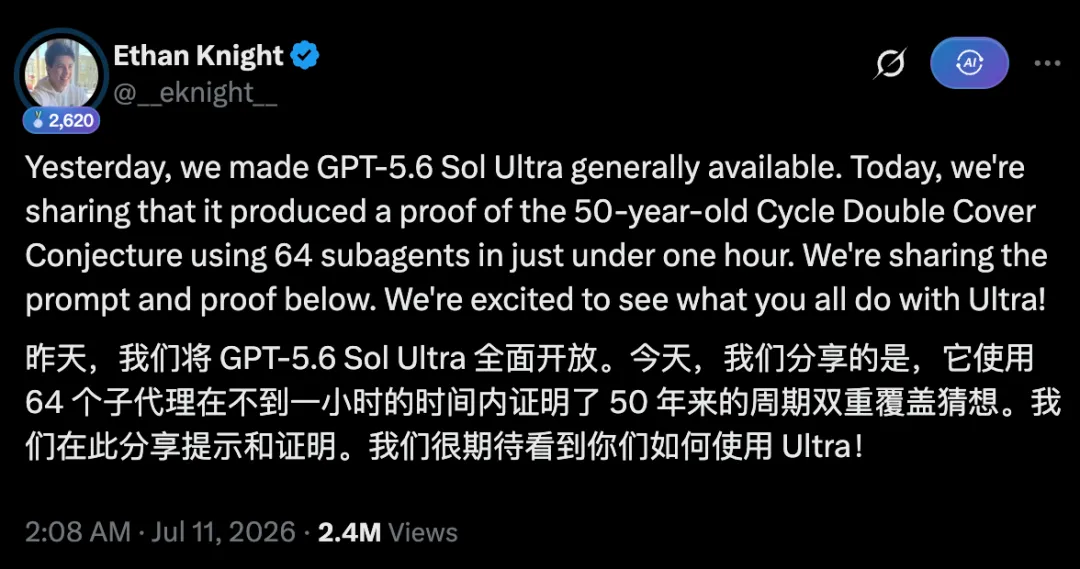
Two weeks earlier, on July 10, OpenAI announced that GPT-5.6 Sol Ultra, with 64 parallel sub-smart objects, had completed a complete proof of the "circular double-covering conjecture" in less than an hour, solving a classic graphite puzzle that had been pending for more than 50 years.
In two months, four decades of speculation - false and old speculation - is really turning from miracles into incidents.
 Next down guess, who's next?
Without a dedicated mathematical system, without theoretical proofs, the big model is a chat window.
The counter-example of this search is that AI is naturally suited to AI. It doesn't need a flashlight, it doesn't need a genius intuition, it needs to test a lot of well-known mathematical objects one by one to guess, and this is the home of the machine.
Human mathematicians have limited resources, as many objects as can be tried systematically; AI can violently sweep through all the classic graphics in textbooks in a matter of minutes, turning an "unthinkable" human into a "try it out" machine.
It makes you wonder: Will AI one day win the Fields Prize?
Coincidentally, it was on July 23rd that the Chinese mathematician Wang Neong, won the Nobel Prize in Physics, achieving the breakthrough of the Chinese mathematician Fields Prize Zero, which rocked the country.
The breakthroughs made by these two people were not based on violent searches, not poorly illustrated examples, but on a decade-long process of immersive thinking, constructing methodologies of creativity, and leaping out of the paths of all previous people.
In this year's public address, Fields Prize winner Tao Te Ching made an accurate judgement: AI has evolved from an "inefficient graduate student on a full-mouthed train" to a "primary collaborator capable of tackling mathematical problems".
But he went on to point out that the role of mathematicians is shifting from "self-executing proofs" to "proofing engineering architects". AI can produce puzzles at a surprising rate, but whether the shape of the puzzles matches the overall blueprint can still be judged by humans.
In other words, AI is proving itself to be the best "counter-example hunter" and "computing troublesome", but it's one dimension away from "putting forward valuable new questions" and "building a whole new mathematical framework".
It's not the same thing to overturn a 30-year conjecture and propose a new theory that could affect the 50-year trend in mathematics.
So the more realistic picture might be this: in future Fields Prize papers, AI will appear more and more in gratitude, and may even appear in co-authors' lists.
But those on the podium are likely to be the human brains that can define problems, build frameworks, and make "unreasonable leaps".
But how long will this window last? No one knows.
After all, a year ago, we thought AI was a joke when we were doing mathematics. Now it's hanging on to 30 years of fishing in the Slack group.
The mathematical circle should be strained.